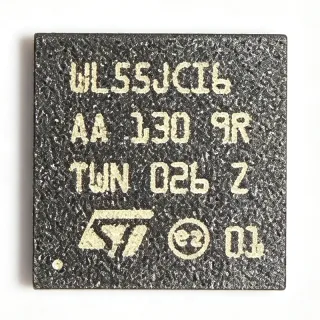
ADL5385ACPZ-R7 - 50MHz-2.2GHz Quadrature Modulator | Analog Devices
Référence : ADL5385ACPZ-R7 ✓ Actif| Qté | Prix unitaire | Total |
|---|---|---|
| 1 | $12.5 | $12,50 |
| 10 | $11.25 | $112,50 |
| 100 | $10 | $1 000,00 |
| 500 | $9 | $4 500,00 |
| 1 000 | $8 | $8 000,00 |
ADL5385ACPZ-R7 Présentation
A quadrature modulator is a key building block in modern wireless transmitters. It takes two baseband signals (I and Q) and modulates them onto a carrier signal, producing a modulated RF output. This architecture is fundamental to digital communication standards such as WCDMA, LTE, and WiMAX, where complex modulation schemes require precise I/Q balance. The ADL5385 simplifies the design of such transmitters by integrating the modulator function into a single IC, reducing component count and board space.
Key features of the ADL5385 include a wide operating frequency range from 30 MHz to 2200 MHz, excellent phase accuracy and amplitude balance, and a differential baseband interface. The device operates from a single 5V supply and provides a high output IP3, making it suitable for demanding linearity requirements. The LFCSP package with exposed pad ensures efficient thermal dissipation, while the tape and reel packaging (R7 suffix) is optimized for high-volume production.
Technically, the ADL5385 uses a double-balanced mixer topology with integrated quadrature phase splitting. This architecture provides high carrier feedthrough suppression and excellent sideband suppression, which are critical for spectral purity. The device also features a wide baseband bandwidth, allowing it to support both narrowband and wideband modulation schemes. Its performance is specified over the full -40°C to +85°C temperature range, ensuring reliable operation in diverse environments.
Typical applications include cellular base stations, point-to-point radios, satellite communications, and test and measurement equipment. In these systems, the ADL5385 is used to upconvert baseband I/Q signals to RF frequencies, enabling efficient and accurate signal transmission. Its high linearity and low noise make it ideal for high-performance communication links.
When designing with the ADL5385, it is important to provide proper decoupling on the supply pins and to match the differential baseband inputs to the driving source impedance. The exposed pad should be soldered to a ground plane for optimal thermal and electrical performance. Additionally, the LO input should be driven with a clean, well-leveled signal to achieve the best carrier feedthrough performance.
Alternatives de remplacement direct pour ADL5385ACPZ-R7 — même boîtier, compatible broche à broche. Les références à boîtier différent nécessitant une retouche du PCB sont exclues.
Variantes de cette série
Modèles de la même série directement compatibles avec ADL5385ACPZ-R7 (même facteur de forme et même empreinte) — différant par Package.
Outil de comparaison rapide — sélectionnez des références alternatives pour une comparaison côte à côte :
ADL5385ACPZ-WP
✅ Remplacement direct📋 Alternative de référence (hors catalogue)
ADL5370ACPZ-R7
✅ Remplacement direct ⚠️ Spécifications non vérifiées📋 Alternative de référence (hors catalogue)
ADL5371ACPZ-R7
✅ Remplacement direct ⚠️ Spécifications non vérifiées📋 Alternative de référence (hors catalogue)
ADL5372ACPZ-R7
✅ Remplacement direct ⚠️ Spécifications non vérifiées📋 Alternative de référence (hors catalogue)
ADL5375ACPZ-R7
✅ Remplacement direct ⚠️ Spécifications non vérifiées📋 Alternative de référence (hors catalogue)
ADL5385ACPZ-R7 Spécifications
| Fonction | Quadrature Modulator |
| Frequency Range | 30 MHz to 2200 MHz |
| Tension d'alimentation | 5 V |
| Boîtier | 24-Lead LFCSP (WFQFN) with Exposed Pad |
| Type de montage | Surface Mount |
| Plage de température de fonctionnement | -40°C to +85°C |
| Baseband Interface | Differential |
| Phase Accuracy | Excellent (per datasheet) |
| Amplitude Balance | Excellent (per datasheet) |
| Statut RoHS | Compliant |
| REACH Status | Compliant |
| Conflict Minerals | DRC Conflict Free |
Configuration des broches de ADL5385ACPZ-R7
| Broche 1 | GND — Ground |
| Broche 2 | IBBP — Baseband I positive input |
| Broche 3 | IBBN — Baseband I negative input |
| Broche 4 | VCC — Supply voltage (5V) |
| Broche 5 | QBBP — Baseband Q positive input |
| Broche 6 | QBBN — Baseband Q negative input |
| Broche 7 | GND — Ground |
| Broche 8 | LOP — LO positive input |
| Broche 9 | LON — LO negative input |
| Broche 10 | GND — Ground |
| Broche 11 | RFOUT — RF output |
| Broche 12 | GND — Ground |
| Broche 13 | GND — Ground |
| Broche 14 | GND — Ground |
| Broche 15 | GND — Ground |
| Broche 16 | GND — Ground |
| Broche 17 | GND — Ground |
| Broche 18 | GND — Ground |
| Broche 19 | GND — Ground |
| Broche 20 | GND — Ground |
| Broche 21 | GND — Ground |
| Broche 22 | GND — Ground |
| Broche 23 | GND — Ground |
| Broche 24 | GND — Ground |
Applications typiques
ADL5385ACPZ-R7 convient pour 6 applications: Cellular Base Stations, Point-to-Point Radios, Satellite Communications, Test and Measurement Equipment, Wireless Infrastructure, Broadband Communication Systems.
Cellular Base Stations
The ADL5385ACPZ-R7 is ideal for cellular base stations, where it upconverts baseband I/Q signals to RF frequencies. Its wide frequency range (30 MHz to 2200 MHz) supports WCDMA, LTE, and other standards. The high linearity and excellent phase accuracy ensure minimal signal distortion, critical for maintaining spectral purity in multi-carrier environments. The device's differential baseband interface simplifies connection to DACs, and its 5V supply integrates easily into existing power architectures.
Recommandé
Point-to-Point Radios
In point-to-point microwave links, the ADL5385ACPZ-R7 provides direct RF modulation, eliminating the need for an IF stage. Its 30 MHz to 2200 MHz range covers common microwave bands, while the excellent amplitude balance and phase accuracy ensure reliable QAM modulation. The device's low power consumption and compact LFCSP package are ideal for space-constrained outdoor units. Proper LO drive and decoupling are essential for achieving the specified carrier feedthrough suppression.
Recommandé
Satellite Communications
The ADL5385ACPZ-R7 is well-suited for satellite communication systems, where it modulates baseband signals onto L-band or S-band carriers. Its wide frequency range and high linearity support complex modulation schemes used in satellite links. The device's differential baseband inputs interface directly with satellite modem DACs, and its 5V supply simplifies power design. The exposed pad ensures efficient thermal dissipation, crucial for continuous operation in outdoor satellite equipment.
Recommandé
Test and Measurement Equipment
In test and measurement, the ADL5385ACPZ-R7 is used in signal generators and vector modulators to produce modulated RF signals. Its wide frequency range and excellent phase accuracy enable precise signal generation for testing communication devices. The device's high output IP3 ensures low distortion, essential for accurate measurements. The LFCSP package and tape and reel packaging facilitate automated assembly in high-volume test equipment.
Recommandé
Wireless Infrastructure
The ADL5385ACPZ-R7 is a key component in wireless infrastructure, including repeaters and distributed antenna systems. It modulates baseband signals onto RF carriers for transmission over fiber or coaxial links. Its wide frequency range and high linearity ensure signal integrity across various frequency bands. The device's differential baseband interface and 5V supply make it easy to integrate into existing designs. Proper PCB layout with decoupling capacitors is recommended for optimal performance.
Recommandé
Broadband Communication Systems
The ADL5385ACPZ-R7 supports broadband communication systems such as WiMAX and LTE, where wide bandwidth and high linearity are required. Its 30 MHz to 2200 MHz range covers multiple frequency bands, and its excellent phase accuracy and amplitude balance enable high-order QAM modulation. The device's differential baseband inputs allow direct connection to high-speed DACs, simplifying the transmit chain. The 5V supply and compact package make it suitable for compact, power-efficient designs.
Recommandé
Récapitulatif des produits recommandés
Données de référence d'ingénierie pour ADL5385ACPZ-R7 — comparaison, recommandations de conception et informations de conformité.
Guide de sélection
Comparaison avec les alternatives
| Paramètre | Ce produit | ADL5385ACPZ-WP | ADL5370ACPZ-R7 | ADL5371ACPZ-R7 | ADL5372ACPZ-R7 | ADL5375ACPZ-R7 |
|---|---|---|---|---|---|---|
| Package | 24-Lead LFCSP (WFQFN) | 24-Lead LFCSP (WFQFN) | 24-Lead LFCSP (WFQFN) | 24-Lead LFCSP (WFQFN) | 24-Lead LFCSP (WFQFN) | 24-Lead LFCSP (WFQFN) |
| Brand | Analog Devices | Analog Devices | Analog Devices | Analog Devices | Analog Devices | Analog Devices |
| Frequency Range | 30 MHz to 2200 MHz | 30 MHz to 2200 MHz | 30 MHz to 2200 MHz | 30 MHz to 2200 MHz | 30 MHz to 2200 MHz | 30 MHz to 2200 MHz |
| Supply Voltage | 5V | 5V | 5V | 5V | 5V | 5V |
| Baseband Interface | Differential | Differential | Differential | Differential | Differential | Differential |
| Operating Temperature Range | -40°C to +85°C | -40°C to +85°C | -40°C to +85°C | -40°C to +85°C | -40°C to +85°C | -40°C to +85°C |
| RoHS Compliance | Compliant | Compliant | Compliant | Compliant | Compliant | Compliant |
Principaux différenciateurs
- Wide frequency range from 30 MHz to 2200 MHz (vs ADL5370ACPZ-R7)
- Excellent phase accuracy and amplitude balance (vs ADL5371ACPZ-R7)
- Single 5V supply operation (vs ADL5372ACPZ-R7)
Notes de conception
The ADL5385ACPZ-R7 operates from a single 5V supply. It is critical to provide adequate decoupling on the VCC pin, using a 100nF capacitor placed as close to the pin as possible, along with a 10uF bulk capacitor. This ensures stable operation and minimizes supply noise that could affect modulation accuracy.
The exposed pad on the LFCSP package must be soldered to a ground plane for optimal thermal and electrical performance. Use multiple vias under the pad to enhance heat dissipation. Ensure the ground plane is continuous beneath the device to minimize parasitic inductance.
Match the differential baseband input traces to the driving source impedance, typically 50 ohms. Keep the LO input traces short and well-shielded to prevent coupling into the baseband or RF paths. Use a clean, well-leveled LO signal to achieve the best carrier feedthrough suppression.
Informations de conformité
EU RoHS Compliant, REACH Compliant, DRC Conflict Free per Abacus Technologies.