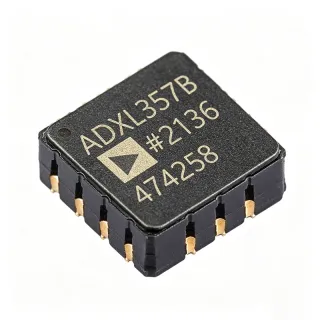
ADXL357BEZ-RL - 3-Axis Digital Accelerometer | Analog Devices
Référence : ADXL357BEZ-RL ✓ Actif| Qté | Prix unitaire | Total |
|---|---|---|
| 1 | $18.5 | $18,50 |
| 10 | $16.75 | $167,50 |
| 100 | $14.2 | $1 420,00 |
| 500 | $12.8 | $6 400,00 |
| 1 000 | $11.5 | $11 500,00 |
ADXL357BEZ-RL Présentation
An accelerometer is a sensor that measures proper acceleration, which is the rate of change of velocity per unit time. The ADXL357 is a MEMS capacitive accelerometer that converts mechanical displacement into an electrical signal, which is then digitized by an onboard ADC. It belongs to the category of inertial sensors, which are essential for motion detection, vibration monitoring, and tilt sensing. The ADXL357 family includes the analog output ADXL356 and the digital output ADXL357, with the ADXL357B variant supporting additional interface options.
Key features of the ADXL357BEZ-RL include ultra-low noise density (typically 80 µg/√Hz), low 0 g offset drift over temperature, and low power consumption (typically 150 µA at 3.3V). The selectable measurement ranges allow the user to optimize resolution and dynamic range for specific applications. The device also includes an integrated temperature sensor and a 32-level FIFO buffer to reduce host processor loading.
The ADXL357 uses a MEMS capacitive sensing element with a precision analog front-end and a 20-bit digital output. The device features a programmable high-pass filter and low-pass filter, enabling flexible signal conditioning. The SPI and I2C interfaces allow easy integration with microcontrollers and digital signal processors. The 14-lead CLCC package provides a compact footprint with excellent thermal and mechanical stability.
Typical applications include structural health monitoring, condition monitoring of rotating machinery, inertial measurement units (IMUs), platform stabilization, and seismic sensing. The low noise and low drift characteristics make it suitable for precision tilt and vibration measurements. The wide bandwidth supports both static and dynamic acceleration measurements.
When designing with the ADXL357BEZ-RL, ensure proper decoupling of the power supply and careful PCB layout to minimize noise coupling. The device requires an external pull-up resistor on the I2C lines if used in I2C mode. The FIFO can be configured to reduce interrupt overhead in high-sample-rate applications.
Alternatives de remplacement direct pour ADXL357BEZ-RL — même boîtier, compatible broche à broche. Les références à boîtier différent nécessitant une retouche du PCB sont exclues.
Variantes de cette série
Modèles de la même série directement compatibles avec ADXL357BEZ-RL (même facteur de forme et même empreinte) — différant par 0 g Offset Drift, Bandwidth, Interface, Measurement Range, Noise Density.
Outil de comparaison rapide — sélectionnez des références alternatives pour une comparaison côte à côte :
ADXL357BEZ
✅ Remplacement direct✓ En stock
$87.5 / unité
Voir la fiche technique →ADXL357BEZ-RL7
✅ Remplacement direct✓ En stock
$72 / unité
Voir la fiche technique →ADXL357BCCZ
✅ Remplacement direct ⚠️ Spécifications non vérifiées📋 Alternative de référence (hors catalogue)
ADXL354BEZ
✅ Remplacement direct📋 Alternative de référence (hors catalogue)
ADXL362BCCZ
✅ Remplacement direct📋 Alternative de référence (hors catalogue)
ADXL357BEZ-RL Valeurs maximales et caractéristiques électriques
| Axis | X, Y, Z |
| Plage de mesure | ±10g, ±20g, ±40g (selectable) |
| Bandwidth | 1Hz ~ 1kHz |
| Interface | SPI, I2C |
| Boîtier | 14-CLCC (6x6 mm) |
| Tension d'alimentation | 2.25V to 3.6V |
| Current Consumption | 150 µA (typical) |
| Densité de bruit | 80 µg/√Hz (typical) |
| 0 g Offset Drift | 0.75 mg/°C (max) |
| Sensitivity | 2560 LSB/g (at ±10g) |
| Température de fonctionnement | -40°C to +125°C |
| Type de montage | Surface Mount |
| Statut RoHS | Compliant |
| FIFO | 32-level |
| Temperature Sensor | Integrated |
Configuration des broches de ADXL357BEZ-RL
| Broche 1 | VDD — Power supply input (2.25V to 3.6V) |
| Broche 2 | GND — Ground |
| Broche 3 | SCLK/SCL — SPI clock or I2C clock |
| Broche 4 | SDI/SDA — SPI data input or I2C data |
| Broche 5 | SDO/ADR0 — SPI data output or I2C address bit 0 |
| Broche 6 | CS — Chip select (active low) |
| Broche 7 | INT1 — Interrupt output 1 |
| Broche 8 | INT2 — Interrupt output 2 |
| Broche 9 | NC — No connect |
| Broche 10 | NC — No connect |
| Broche 11 | NC — No connect |
| Broche 12 | NC — No connect |
| Broche 13 | NC — No connect |
| Broche 14 | NC — No connect |
Applications typiques
ADXL357BEZ-RL convient pour 6 applications: Structural Health Monitoring, Condition Monitoring of Rotating Machinery, Inertial Measurement Units (IMUs), Platform Stabilization, Seismic Sensing, Tilt Sensing and Leveling.
Structural Health Monitoring
The ADXL357BEZ-RL's low noise density of 80 µg/√Hz and wide bandwidth up to 1kHz make it ideal for detecting micro-vibrations in bridges, buildings, and other structures. Its low 0 g offset drift ensures accurate long-term measurements, while the selectable ranges allow adaptation to different vibration levels. The digital SPI/I2C interface simplifies integration with data acquisition systems, and the 32-level FIFO reduces host processor load during continuous monitoring.
Recommandé
Condition Monitoring of Rotating Machinery
In industrial machinery, the ADXL357BEZ-RL can detect bearing faults and imbalance by measuring vibration signatures. Its 1kHz bandwidth captures high-frequency components, and the low noise floor allows early fault detection. The device's wide temperature range (-40°C to +125°C) suits harsh environments. The SPI interface enables high-speed data streaming to an external processor for real-time analysis, and the integrated temperature sensor aids in thermal compensation.
Recommandé
Inertial Measurement Units (IMUs)
The ADXL357BEZ-RL is a key component in IMUs for drones, robotics, and autonomous vehicles. Its low noise and low drift provide accurate acceleration data for navigation and stabilization. The selectable ranges (up to ±40g) accommodate high-dynamic maneuvers. The digital output simplifies fusion with gyroscopes and magnetometers. The small 6x6mm CLCC package enables compact IMU designs, and the low power consumption extends battery life in portable systems.
Recommandé
Platform Stabilization
For camera gimbals and antenna stabilization, the ADXL357BEZ-RL provides precise tilt and vibration feedback. Its low noise density ensures smooth stabilization, and the wide bandwidth allows fast response to disturbances. The SPI interface enables high-speed control loops, while the FIFO reduces interrupt overhead. The device's low power consumption is beneficial for battery-operated gimbals, and the wide temperature range supports outdoor use.
Recommandé
Seismic Sensing
The ADXL357BEZ-RL's ultra-low noise (80 µg/√Hz) and low drift make it suitable for seismic monitoring applications. It can detect ground motion with high resolution, aiding in earthquake early warning systems. The wide bandwidth captures both low-frequency and high-frequency seismic waves. The digital output allows direct connection to data loggers, and the low power consumption enables remote deployment with battery power. The device's robust package withstands harsh environmental conditions.
Recommandé
Tilt Sensing and Leveling
The ADXL357BEZ-RL can measure static acceleration due to gravity, enabling precise tilt sensing for leveling applications. Its low 0 g offset drift (0.75 mg/°C max) ensures accurate angle measurements over temperature. The selectable ranges allow optimization for different tilt sensitivities. The I2C interface simplifies connection to microcontrollers, and the integrated temperature sensor can be used for compensation. The device's low power consumption is ideal for battery-powered leveling tools.
Recommandé
Récapitulatif des produits recommandés
Données de référence d'ingénierie pour ADXL357BEZ-RL — comparaison, recommandations de conception et informations de conformité.
Guide de sélection
Comparaison avec les alternatives
| Paramètre | Ce produit | ADXL357BEZ | ADXL357BEZ-RL7 | ADXL354BEZ | ADXL362BCCZ |
|---|---|---|---|---|---|
| Package | 14-CLCC (6x6 mm) | 14-CLCC (6x6 mm) | 14-CLCC (6x6 mm) | 14-CLCC (6x6 mm) | 14-CLCC (6x6 mm) |
| Brand | Analog Devices | Analog Devices | Analog Devices | Analog Devices | Analog Devices |
| Output Type | Digital (SPI/I2C) | Digital (SPI/I2C) | Digital (SPI/I2C) | Analog | Digital (SPI) |
| Measurement Range | ±10g, ±20g, ±40g | ±10g, ±20g, ±40g | ±10g, ±20g, ±40g | ±2g, ±4g, ±8g | ±2g, ±4g, ±8g |
| Noise Density | 80 µg/√Hz | 80 µg/√Hz | 80 µg/√Hz | 20 µg/√Hz | 175 µg/√Hz |
| Supply Voltage | 2.25V to 3.6V | 2.25V to 3.6V | 2.25V to 3.6V | 2.25V to 3.6V | 1.6V to 3.5V |
| Current Consumption | 150 µA | 150 µA | 150 µA | 150 µA | 1.8 µA (measurement mode) |
| Bandwidth | 1Hz to 1kHz | 1Hz to 1kHz | 1Hz to 1kHz | 1Hz to 1kHz | 0.1Hz to 400Hz |
Principaux différenciateurs
- Selectable measurement ranges up to ±40g (vs ADXL354BEZ)
- Digital output with SPI/I2C interface (vs ADXL354BEZ)
- Lower noise density than ADXL362 (vs ADXL362BCCZ)
Notes de conception
The ADXL357BEZ-RL operates from 2.25V to 3.6V. Use a low-noise LDO such as the ADP150 to supply the sensor, and place a 0.1µF and 1µF decoupling capacitor close to the VDD pin. Avoid sharing the supply with high-current digital circuits to prevent noise coupling.
For optimal performance, place the accelerometer on a rigid PCB section away from flexural stress. Use a solid ground plane under the device and route the SPI/I2C lines with controlled impedance if long. Ensure the CLCC package's exposed pad is soldered to the ground plane for thermal and mechanical stability.
Do not exceed the absolute maximum supply voltage of 3.6V. When using I2C, ensure pull-up resistors are connected to the correct voltage level. The FIFO can be configured to reduce interrupt load; set the watermark level appropriately to avoid data loss. Also, calibrate the 0 g offset at the system level for best accuracy.
Informations de conformité
RoHS compliant per Analog Devices product page. Not AEC-Q100 qualified; for automotive, consider ADXL357BCCZ.