ADXL357BEZ-RL7 - Low Noise 3-Axis MEMS Accelerometer | Analog Devices
MPN: ADXL357BEZ-RL7 ✓ Active| Qty | Unit Price | Extended |
|---|---|---|
| 1 | $98.89 | $98.89 |
| 10 | $92.5 | $925.00 |
| 100 | $85 | $8,500.00 |
| 500 | $78 | $39,000.00 |
| 1,000 | $72 | $72,000.00 |
ADXL357BEZ-RL7 Overview
An accelerometer is a sensor that measures proper acceleration, which is the rate of change of velocity of a body in its own instantaneous rest frame. MEMS accelerometers are micro-electromechanical systems that integrate mechanical and electrical components on a single chip. They are widely used in inertial measurement units (IMUs), vibration monitoring, and tilt sensing. The ADXL357 belongs to the family of low-noise, low-drift accelerometers designed for precision applications.
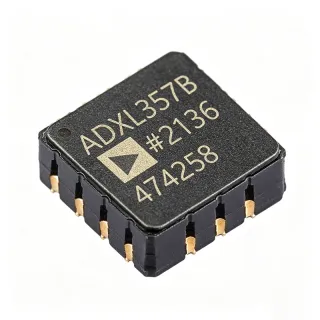
Key features include ultra-low noise density of 80 µg/√Hz, low 0 g offset drift of 0.75 mg/°C, and low power consumption of 200 µA at 3.3 V. The device operates from a single 2.25 V to 3.6 V supply and includes an internal temperature sensor. It supports both SPI and I2C interfaces, with the ADXL357B variant offering limited I2C. The ADXL357BEZ-RL7 is the reel packaging variant (RL7) of the ADXL357BEZ, which is tray packaged.
The ADXL357 uses a capacitive sensing element with a precision analog-to-digital converter (ADC) and digital signal processing. It provides 20-bit resolution and includes a built-in self-test feature. The device is designed for high-performance applications requiring low noise and low drift, such as structural health monitoring, seismic sensing, and platform stabilization.
Typical applications include inertial navigation systems, vibration analysis, earthquake detection, and industrial condition monitoring. The low noise and low drift make it ideal for precision measurement over extended periods. The device is also suitable for tilt sensing in robotics and autonomous vehicles.
When designing with the ADXL357, ensure proper decoupling of the power supply and careful PCB layout to minimize noise. The device requires an external capacitor on the VDD pin and a pull-up resistor on the SPI lines. The operating temperature range is -40°C to +125°C, making it suitable for harsh environments.
Drop-in alternatives for ADXL357BEZ-RL7 — same package, pin-to-pin compatible. Different-package parts requiring PCB rework are excluded.
Variants in this series
Same-series models that are drop-in compatible with ADXL357BEZ-RL7 (same form factor and footprint) — differing in Measurement Range, Supply Voltage, 0 g Offset Drift, Operating Temperature, Package.
Quick Comparison Tool — Select alternative parts for side-by-side comparison:
ADXL357BEZ
✅ Drop-In✓ In Stock
$87.5 / Unit
View Datasheet →ADXL357BCPZ-RL7
✅ Drop-In ⚠️ Specs Unverified📋 Reference alternative (not in catalog)
ADXL357BCCZ-RL7
✅ Drop-In ⚠️ Specs Unverified📋 Reference alternative (not in catalog)
ADXL356BEZ
✅ Drop-In📋 Reference alternative (not in catalog)
ADXL356CEZ
✅ Drop-In📋 Reference alternative (not in catalog)
ADXL357BEZ-RL7 Maximum Ratings & Electrical Characteristics
| Axis | X, Y, Z |
| Measurement Range | ±10g, ±20g, ±40g |
| Bandwidth | 1 Hz to 1 kHz |
| Noise Density | 80 µg/√Hz |
| 0 g Offset Drift | 0.75 mg/°C |
| Supply Voltage | 2.25 V to 3.6 V |
| Supply Current | 200 µA at 3.3 V |
| Interface | SPI, I2C (limited) |
| Resolution | 20-bit |
| Package | 14-CLCC (6x6 mm) |
| Operating Temperature | -40°C to +125°C |
| Mounting Type | Surface Mount |
| Packaging | Tape & Reel (RL7) |
| Self-Test | Built-in |
| RoHS Status | Compliant |
ADXL357BEZ-RL7 Pin Configuration
| Pin 1 | VDD — Power supply input (2.25V to 3.6V) |
| Pin 2 | GND — Ground |
| Pin 3 | CS — Chip select (active low) for SPI |
| Pin 4 | SCLK — Serial clock for SPI |
| Pin 5 | SDI — Serial data input for SPI |
| Pin 6 | SDO — Serial data output for SPI |
| Pin 7 | INT1 — Interrupt output 1 |
| Pin 8 | INT2 — Interrupt output 2 |
| Pin 9 | NC — No connect |
| Pin 10 | NC — No connect |
| Pin 11 | NC — No connect |
| Pin 12 | NC — No connect |
| Pin 13 | NC — No connect |
| Pin 14 | NC — No connect |
Typical Applications
ADXL357BEZ-RL7 is suitable for 6 applications: Inertial Navigation Systems, Structural Health Monitoring, Seismic Sensing, Industrial Condition Monitoring, Tilt Sensing in Robotics, Earthquake Detection Networks.
Inertial Navigation Systems
The ADXL357BEZ-RL7's low noise density of 80 µg/√Hz and low offset drift of 0.75 mg/°C make it ideal for inertial navigation systems (INS). In an INS, the accelerometer measures linear acceleration, which is integrated to estimate velocity and position. The low noise ensures accurate velocity tracking, while the low drift minimizes error accumulation over time. The device's 3-axis measurement capability and selectable ranges (up to ±40g) allow it to handle dynamic maneuvers. Its SPI interface enables high-speed data transfer to the navigation processor. The wide temperature range (-40°C to +125°C) ensures reliable operation in aerospace and defense environments. Compared to higher-noise accelerometers, the ADXL357 improves navigation accuracy, especially during GPS-denied operation.
Recommended
Structural Health Monitoring
The ADXL357BEZ-RL7 is well-suited for structural health monitoring (SHM) of bridges, buildings, and other infrastructure. Its low noise density of 80 µg/√Hz allows detection of tiny vibrations and deformations, while the low offset drift ensures long-term stability for continuous monitoring. The device's bandwidth up to 1 kHz captures both low-frequency sway and higher-frequency vibrations. The 20-bit resolution provides fine measurement granularity. The device operates from a 2.25 V to 3.6 V supply, making it compatible with battery-powered wireless sensor nodes. The wide temperature range enables outdoor deployment. In SHM, the ADXL357 can be used to detect structural anomalies, track fatigue, and provide early warning of failure. Its SPI interface allows easy integration with data loggers and wireless transmitters.
Recommended
Seismic Sensing
The ADXL357BEZ-RL7 is designed for seismic sensing applications, including earthquake detection and monitoring. Its ultra-low noise density of 80 µg/√Hz is critical for detecting small ground motions, while the low offset drift ensures accurate long-term measurements. The device's bandwidth from 1 Hz to 1 kHz covers the frequency range of seismic waves. The selectable measurement ranges (up to ±40g) allow it to handle both micro-tremors and strong earthquakes without saturation. The 20-bit resolution provides high dynamic range. The device's low power consumption (200 µA) is advantageous for remote seismic stations powered by batteries or solar panels. The SPI interface enables easy connection to data acquisition systems. The wide temperature range (-40°C to +125°C) ensures reliable operation in various environmental conditions.
Recommended
Industrial Condition Monitoring
The ADXL357BEZ-RL7 is ideal for industrial condition monitoring, where it can detect vibrations in rotating machinery such as motors, pumps, and turbines. Its low noise density of 80 µg/√Hz enables early detection of bearing wear and imbalance, while the bandwidth up to 1 kHz captures relevant vibration frequencies. The device's low offset drift ensures consistent measurements over time, reducing false alarms. The selectable ranges (up to ±40g) accommodate both normal operation and shock events. The 20-bit resolution provides detailed vibration signatures. The device operates from a 2.25 V to 3.6 V supply, making it suitable for industrial sensor nodes. The wide temperature range (-40°C to +125°C) allows deployment in harsh factory environments. The SPI interface facilitates integration with PLCs and data acquisition systems.
Recommended
Tilt Sensing in Robotics
The ADXL357BEZ-RL7 is used for tilt sensing in robotics and autonomous vehicles, where accurate orientation is essential. The device's low noise density of 80 µg/√Hz allows precise measurement of static acceleration due to gravity, enabling tilt angles to be calculated with high accuracy. The low offset drift ensures stable readings over time and temperature. The device's 3-axis measurement capability provides full orientation information. The selectable ranges (up to ±40g) allow it to handle dynamic movements without saturation. The 20-bit resolution provides fine angular resolution. The device operates from a 2.25 V to 3.6 V supply, making it compatible with robot control boards. The SPI interface enables high-speed communication with the robot's microcontroller. The wide temperature range (-40°C to +125°C) ensures reliable operation in various environments.
Recommended
Earthquake Detection Networks
The ADXL357BEZ-RL7 is a key component in earthquake detection networks, where it senses ground motion and triggers alerts. Its low noise density of 80 µg/√Hz is essential for detecting small precursor tremors, while the low offset drift ensures reliable long-term operation. The device's bandwidth from 1 Hz to 1 kHz covers the frequency range of seismic waves. The selectable ranges (up to ±40g) allow it to measure both minor vibrations and strong earthquakes. The 20-bit resolution provides high sensitivity. The device's low power consumption (200 µA) is ideal for battery-powered sensor nodes distributed across a region. The SPI interface enables easy networking with data concentrators. The wide temperature range (-40°C to +125°C) ensures operation in diverse climates. The ADXL357's performance makes it suitable for early warning systems.
Recommended
Recommended Products Summary
Engineering reference data for ADXL357BEZ-RL7 — comparison, design guidance, and compliance information.
Selection Guide
Comparison with Alternatives
| Parameter | This Product | ADXL357BEZ | ADXL357BCPZ-RL7 | ADXL357BCCZ-RL7 | ADXL356BEZ | ADXL356CEZ |
|---|---|---|---|---|---|---|
| Package | 14-CLCC (6x6) | 14-CLCC (6x6) | 14-CLCC (6x6) | 14-CLCC (6x6) | 14-CLCC (6x6) | 14-CLCC (6x6) |
| Brand | Analog Devices | Analog Devices | Analog Devices | Analog Devices | Analog Devices | Analog Devices |
| Output Type | Digital (SPI/I2C) | Digital (SPI/I2C) | Digital (SPI/I2C) | Digital (SPI/I2C) | Analog | Analog |
| Measurement Range | ±10g, ±20g, ±40g | ±10g, ±20g, ±40g | ±10g, ±20g, ±40g | ±10g, ±20g, ±40g | ±10g, ±20g, ±40g | ±10g, ±20g |
| Noise Density | 80 µg/√Hz | 80 µg/√Hz | 80 µg/√Hz | 80 µg/√Hz | 80 µg/√Hz | 80 µg/√Hz |
| Supply Voltage | 2.25V to 3.6V | 2.25V to 3.6V | 2.25V to 3.6V | 2.25V to 3.6V | 2.25V to 3.6V | 2.25V to 3.6V |
| Supply Current | 200 µA | 200 µA | 200 µA | 200 µA | 200 µA | 200 µA |
| Interface | SPI, I2C (limited) | SPI, I2C (limited) | SPI, I2C (limited) | SPI, I2C (limited) | Analog output | Analog output |
Key Differentiators
- Ultra-low noise density of 80 µg/√Hz (vs ADXL356BEZ)
- Low 0 g offset drift of 0.75 mg/°C (vs ADXL356CEZ)
- Digital SPI interface with 20-bit resolution (vs ADXL356BEZ)
Design Notes
Ensure a clean power supply for the ADXL357BEZ-RL7. Use a low-dropout regulator (LDO) to provide 3.3V, and place a 0.1 µF ceramic capacitor close to the VDD pin. Additionally, a 10 µF bulk capacitor is recommended to handle transient currents. Avoid sharing the supply with high-current digital circuits to prevent noise coupling.
For optimal performance, place the ADXL357BEZ-RL7 on a PCB with a solid ground plane. Keep the SPI traces short and avoid routing them near high-frequency signals. Use series resistors (e.g., 22 Ω) on the SPI lines to reduce ringing. Ensure the exposed pad (if any) is properly soldered to the ground plane for thermal and mechanical stability.
A common mistake is neglecting the offset drift specification. The ADXL357BEZ-RL7 has a 0 g offset drift of 0.75 mg/°C, which can cause measurement errors over temperature. To mitigate this, implement a temperature compensation algorithm using the internal temperature sensor. Also, avoid mechanical stress on the package, as it can affect offset.
Compliance Information
RoHS compliance is indicated by Analog Devices. AEC-Q100 qualification is not specified for this part; check specific variants for automotive grade.