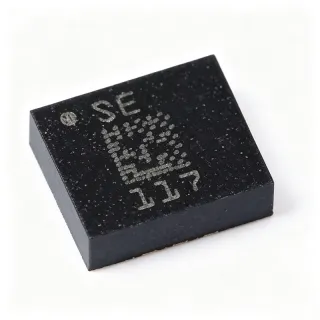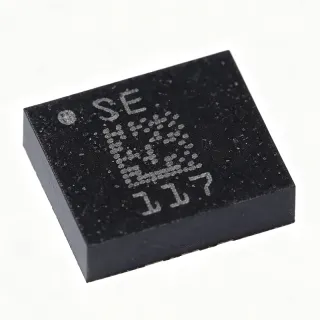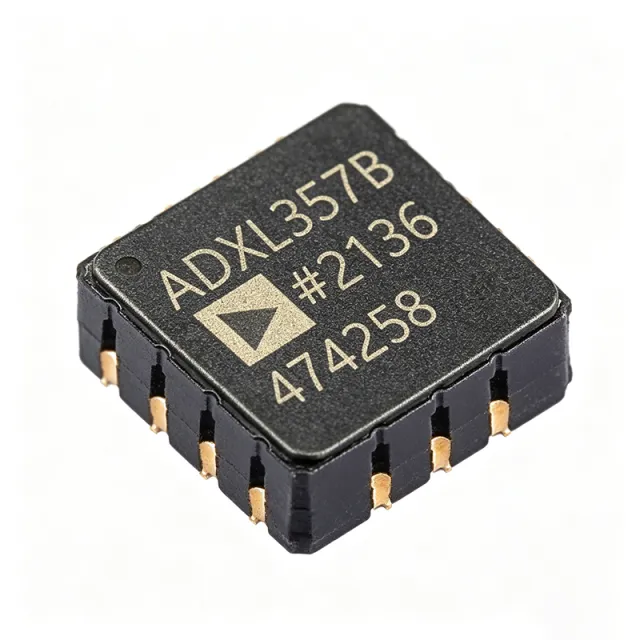
ADXL357BEZ - Low Noise 3-Axis MEMS Accelerometer | Analog Devices
MPN: ADXL357BEZ ✓ Active| Qty | Unit Price | Extended |
|---|---|---|
| 1 | $150 | $150.00 |
| 10 | $108.3333 | $1,083.33 |
| 100 | $95.8333 | $9,583.33 |
| 500 | $91.6667 | $45,833.35 |
| 1,000 | $87.5 | $87,500.00 |
ADXL357BEZ Overview
An accelerometer is a sensor that measures proper acceleration, which is the rate of change of velocity of a body in its own instantaneous rest frame. MEMS (Micro-Electro-Mechanical Systems) accelerometers are micro-machined devices that integrate mechanical sensing elements with electronic circuitry on a single chip. They are widely used in motion sensing, vibration monitoring, and inertial navigation systems. The ADXL357BEZ belongs to the category of digital-output accelerometers, which convert the sensed acceleration into a digital signal for direct interfacing with microcontrollers or digital signal processors.
Key features of the ADXL357BEZ include ultra-low noise density of 80 µg/√Hz, low 0 g offset drift of less than 0.75 mg over temperature, and low power consumption of 200 µA at 3.3 V. The device supports both SPI and I2C digital interfaces, allowing flexible integration into various system architectures. It also includes an integrated temperature sensor and a 32-level FIFO buffer to reduce host processor loading.
The ADXL357BEZ utilizes a capacitive sensing element with a high-resolution sigma-delta ADC, providing excellent linearity and stability. The device is factory-calibrated for sensitivity and offset, minimizing the need for user calibration. Its low noise and low drift characteristics make it suitable for precision applications such as structural health monitoring, platform stabilization, and seismic sensing.
Typical applications include industrial vibration monitoring, inertial measurement units (IMUs), robotics, and aerospace navigation systems. The device's wide measurement range and high bandwidth enable it to capture both low-frequency tilt and high-frequency vibration signals. Its low power consumption makes it ideal for battery-powered wireless sensor nodes.
When designing with the ADXL357BEZ, ensure proper power supply decoupling with a 0.1 µF capacitor close to the VDD pin and a 1 µF capacitor on the VDD I/O pin. The device requires a supply voltage between 2.25 V and 3.6 V, and the digital interface voltage can be set independently via the VDD I/O pin. Careful PCB layout with a solid ground plane is recommended to minimize noise coupling.
Drop-in alternatives for ADXL357BEZ — same package, pin-to-pin compatible. Different-package parts requiring PCB rework are excluded.
Variants in this series
Same-series models that are drop-in compatible with ADXL357BEZ (same form factor and footprint) — differing in 0 g Offset Drift, Bandwidth, Interface, Measurement Range, Noise Density.
Quick Comparison Tool — Select alternative parts for side-by-side comparison:
ADXL357BEZ-RL7
✓ In Stock
$72 / Unit
View Datasheet →ADXL357BCPZ
📋 Reference alternative (not in catalog)
ADXL356BEZ
📋 Reference alternative (not in catalog)
ADXL356B
📋 Reference alternative (not in catalog)
ADXL357B
📋 Reference alternative (not in catalog)
ADXL357BEZ Maximum Ratings & Electrical Characteristics
| Measurement Range | ±10g, ±20g, ±40g (selectable) |
| Interface | SPI, I2C |
| Bandwidth | 1 Hz to 1 kHz |
| Noise Density | 80 µg/√Hz |
| 0 g Offset Drift | < 0.75 mg over temperature |
| Supply Voltage | 2.25 V to 3.6 V |
| Current Consumption | 200 µA at 3.3 V |
| Package | 14-CLCC (6x6 mm) |
| Operating Temperature | -40°C to +125°C |
| FIFO | 32-level |
| Temperature Sensor | Integrated |
| RoHS | Compliant |
| Mounting Type | Surface Mount |
ADXL357BEZ Pin Configuration
| Pin 1 | VDD — Power supply |
| Pin 2 | GND — Ground |
| Pin 3 | SCLK/SCL — SPI clock or I2C clock |
| Pin 4 | SDI/SDA — SPI data in or I2C data |
| Pin 5 | SDO/ADR0 — SPI data out or I2C address bit |
| Pin 6 | CS — Chip select |
| Pin 7 | VDD I/O — Digital interface supply |
| Pin 8 | INT1 — Interrupt 1 |
| Pin 9 | INT2 — Interrupt 2 |
| Pin 10 | NC — No connect |
| Pin 11 | NC — No connect |
| Pin 12 | NC — No connect |
| Pin 13 | NC — No connect |
| Pin 14 | NC — No connect |
Typical Applications
ADXL357BEZ is suitable for 6 applications: Industrial Vibration Monitoring, Inertial Measurement Units (IMUs), Structural Health Monitoring, Robotics and Platform Stabilization, Seismic Sensing, Aerospace Navigation.
Industrial Vibration Monitoring
The ADXL357BEZ's low noise density of 80 µg/√Hz and wide bandwidth up to 1 kHz make it ideal for detecting subtle vibrations in industrial machinery. Its selectable ranges of ±10g, ±20g, and ±40g allow optimization for different vibration levels. The digital SPI/I2C interface simplifies integration with industrial controllers, and the low power consumption enables battery-powered wireless condition monitoring nodes. The device's low 0 g offset drift ensures stable long-term measurements, critical for predictive maintenance systems.
Recommended
Inertial Measurement Units (IMUs)
The ADXL357BEZ provides the acceleration sensing core for IMUs, offering low noise and low drift essential for accurate inertial navigation. Its 3-axis measurement with selectable ranges covers various dynamic environments. The digital output simplifies data fusion with gyroscopes, and the 32-level FIFO reduces host processor load. The device's low power consumption is beneficial for portable and battery-operated IMU systems, such as those in drones and robotics.
Recommended
Structural Health Monitoring
The ADXL357BEZ's low noise and low drift make it suitable for long-term structural health monitoring of bridges, buildings, and dams. Its wide bandwidth captures both static tilt and dynamic vibrations. The device's low power consumption allows deployment in remote, battery-powered sensor nodes. The digital interface enables easy data logging and analysis. The wide temperature range ensures reliable operation in outdoor environments.
Recommended
Robotics and Platform Stabilization
The ADXL357BEZ provides precise acceleration feedback for robotics and platform stabilization systems. Its low noise density enables accurate motion control, while the selectable ranges accommodate different dynamic requirements. The SPI/I2C interface allows direct connection to microcontrollers, and the FIFO buffer reduces real-time processing demands. The device's small 6x6 mm CLCC package is ideal for space-constrained robotic joints and gimbals.
Recommended
Seismic Sensing
The ADXL357BEZ's ultra-low noise density of 80 µg/√Hz makes it suitable for seismic sensing applications, where detecting micro-vibrations is critical. Its low drift ensures stable baseline measurements over time. The device's wide bandwidth allows capture of both low-frequency seismic waves and higher-frequency aftershocks. The digital output simplifies data acquisition, and the low power consumption enables deployment in remote seismic stations.
Recommended
Aerospace Navigation
The ADXL357BEZ is used in aerospace navigation systems, including drones and UAVs, where low noise and low drift are essential for accurate inertial navigation. Its wide temperature range and robust CLCC package ensure reliability in harsh environments. The digital interface allows integration with flight controllers, and the low power consumption is critical for battery-powered aircraft. The selectable ranges accommodate various flight dynamics.
Recommended
Recommended Products Summary
Engineering reference data for ADXL357BEZ — comparison, design guidance, and compliance information.
Selection Guide
Comparison with Alternatives
| Parameter | This Product | ADXL357BEZ-RL7 | ADXL357BCPZ | ADXL356BEZ |
|---|---|---|---|---|
| Package | 14-CLCC (6x6) | 14-CLCC (6x6) | 14-CLCC (6x6) | 14-CLCC (6x6) |
| Brand | Analog Devices | Analog Devices | Analog Devices | Analog Devices |
| Output Type | Digital (SPI/I2C) | Digital (SPI/I2C) | Digital (SPI/I2C) | Analog |
| Measurement Range | ±10g, ±20g, ±40g | ±10g, ±20g, ±40g | ±10g, ±20g, ±40g | ±10g, ±20g, ±40g |
| Noise Density | 80 µg/√Hz | 80 µg/√Hz | 80 µg/√Hz | 80 µg/√Hz |
| Supply Voltage | 2.25 V to 3.6 V | 2.25 V to 3.6 V | 2.25 V to 3.6 V | 2.25 V to 3.6 V |
| Current Consumption | 200 µA | 200 µA | 200 µA | 200 µA |
| FIFO | 32-level | 32-level | 32-level | None |
Key Differentiators
- Ultra-low noise density of 80 µg/√Hz (vs ADXL356BEZ)
- Digital SPI/I2C interface (vs ADXL356BEZ)
- 32-level FIFO buffer (vs ADXL356BEZ)
Design Notes
Ensure a clean power supply for the ADXL357BEZ. Place a 0.1 µF capacitor close to the VDD pin and a 1 µF capacitor on the VDD I/O pin. The supply voltage should be between 2.25 V and 3.6 V, and the VDD I/O pin can be set independently to match the host logic level, reducing power consumption in mixed-voltage systems.
Use a solid ground plane beneath the ADXL357BEZ to minimize noise coupling. Keep the SPI/I2C traces short and shielded if possible. Avoid routing high-speed digital lines near the analog sensing elements. Follow the layout guidelines in the ADXL357 datasheet for optimal performance.
Do not exceed the absolute maximum ratings, especially on the VDD and VDD I/O pins. Ensure the digital interface voltage does not exceed the supply voltage. When using the FIFO, configure the watermark interrupt correctly to avoid data loss. Also, account for the device's power-up time before reading data.
Compliance Information
RoHS compliance inferred from Analog Devices standard compliance. Other compliance data not explicitly provided.