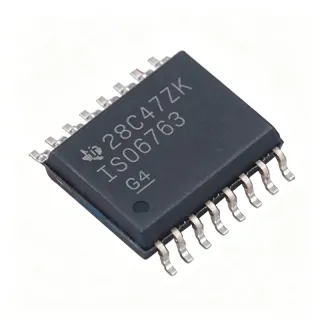
ISO6763FDWR - 6-Ch 5kVrms Digital Isolator 50Mbps | TI
Référence : ISO6763FDWR ✓ Actif| Qté | Prix unitaire | Total |
|---|---|---|
| 1 | $2.31 | $2,31 |
| 10 | $2.08 | $20,80 |
| 100 | $1.89 | $189,00 |
| 500 | $1.72 | $860,00 |
| 1 000 | $1.55 | $1 550,00 |
ISO6763FDWR Présentation
A digital isolator is a semiconductor device that transfers digital signals across an isolation barrier using high-frequency carrier-based or edge-based encoding, replacing optocouplers with faster, more reliable, and more power-efficient capacitive isolation. Digital isolators sit within the signal isolation hierarchy of industrial interface components, alongside isolated transceivers and isolated gate drivers, and are fundamental to galvanic isolation in power management and communication systems.
Key features of the ISO6763FDWR include the 50 Mbps maximum data rate, a high 50 kV/us CMTI that maintains signal integrity in electrically noisy environments such as motor drives, and reinforced isolation rated to 5000 Vrms per UL 1577 with additional VDE, TUV, CSA, and CQC certifications. The device offers high electromagnetic immunity and low emissions at low power consumption, per the TI ISO676x family datasheet.
Architecturally, the ISO676x family uses TI capacitive isolation technology with on-chip transformers formed from SiO2, providing a robust insulation barrier that is resistant to magnetic field interference and field aging, unlike optocoupler LED-based approaches. The F suffix grade of the ISO6763 carries the default default characteristic; the six channels are split symmetrically 3/3, allowing bidirectional signal transfer in a single package without extra components.
Typical applications include isolated RS-485 and RS-232 communication links, isolated SPI buses in industrial programmable logic controllers, CAN isolation in factory automation, and battery management systems where multi-bit status signals must cross a safety barrier.
When designing with this device, ensure both VCC1 and VCC2 supplies are decoupled with 0.1 uF ceramic capacitors placed close to the pins, and verify that the default output states match the system fail-safe requirements.
This page synthesizes distributor pricing, drop-in family alternatives, and practical design notes not found in the manufacturer datasheet.
Alternatives de remplacement direct pour ISO6763FDWR — même boîtier, compatible broche à broche. Les références à boîtier différent nécessitant une retouche du PCB sont exclues.
Variantes de cette série
Modèles de la même série directement compatibles avec ISO6763FDWR (même facteur de forme et même empreinte) — différant par Isolation Rating, Package, Channel Configuration, Common-Mode Transient Immunity (CMTI), Isolation Type.
Outil de comparaison rapide — sélectionnez des références alternatives pour une comparaison côte à côte :
ISO6763FQDWRQ1
✅ Remplacement direct✓ En stock
$1.78 / unité
Voir la fiche technique →ISO6763QDWRQ1
✅ Remplacement direct✓ En stock
$1.05 / unité
Voir la fiche technique →ISO6763DWR
✅ Remplacement direct✓ En stock
$1.85 / unité
Voir la fiche technique →ISO6762DWR
✅ Remplacement direct📋 Alternative de référence (hors catalogue)
ISO6760QDWRQ1
✅ Remplacement direct📋 Alternative de référence (hors catalogue)
ISO6763FDWR Spécifications
| Channel Configuration | 6 channels, 3/3 (three forward, three reverse) |
| Maximum Data Rate | 50 Mbps |
| Isolation Rating | 5000 Vrms (UL 1577) |
| Common-Mode Transient Immunity (CMTI) | 50 kV/us |
| Logic Compatibility | CMOS / LVCMOS, 1.8V logic support |
| Isolation Technology | Capacitive isolation (TI ISO676x family) |
| Certifications | UL 1577, VDE, TUV, CSA, CQC |
| Boîtier | 16-SOIC (DW), 0.295 in / 7.50 mm width |
| Nombre de broches | 16 |
| Plage de température de fonctionnement | -40C to +125C |
| Type de montage | Surface Mount |
| Typical Applications | CAN, RS-232, RS-485, SPI isolation |
| Electromagnetic Immunity | High immunity, low emissions |
| Reinforced Isolation Grade | Yes (reinforced digital isolator) |
Guide de configuration des broches du ISO6763FDWR 16-soic (dw), 0.295 in / 7.50 mm width
Configuration des broches du ISO6763FDWR (boîtier 16-soic (dw), 0.295 in / 7.50 mm width). La numérotation des broches, les fonctions et les schémas de connexion sont définis dans la fiche technique du fabricant. Consultez-la pour l'empreinte exacte et les directives de soudage.

Aucune donnée de brochage détaillée disponible pour ISO6763FDWR.
Consultez la fiche technique pour la configuration complète des broches.
Applications typiques
ISO6763FDWR convient pour 6 applications: Isolated RS-485 / RS-232 Communication, Isolated SPI in Industrial PLCs, CAN Bus Isolation in Factory Automation, Battery Management Systems (BMS), Motor Drive and Inverter Control Isolation, Test and Measurement / Data Acquisition Isolation.
Isolated RS-485 / RS-232 Communication
The ISO6763FDWR isolates the control and data-enable lines of RS-485 and RS-232 transceivers across a reinforced 5000 Vrms barrier. Its 50 Mbps data rate far exceeds RS-485 requirements (up to ~10 Mbps at short runs), so it adds negligible propagation overhead to the link, while its 50 kV/us CMTI keeps outputs stable in the presence of large ground potential shifts between nodes on long industrial cable runs. Typically placed between the MCU UART/direction-control GPIOs and an isolated RS-485 transceiver such as the THVD1550, with 0.1 uF decoupling on both VCC domains. Unlike optocoupler solutions, it delivers faster, more uniform propagation delay across channels and significantly lower power at speed.
Recommandé
Isolated SPI in Industrial PLCs
In programmable logic controllers and industrial I/O modules, the ISO6763FDWR isolates the four-line SPI bus (CS, SCLK, MOSI, MISO) between the low-voltage MCU domain (1.8V logic support enables direct connection to modern processors) and the field-side domain. The 3/3 channel split accommodates the SPI signals plus an interrupt or enable line in each direction within a single SOIC-16 package, eliminating a second isolator. At 50 Mbps, full-speed SPI operation is supported with deterministic delay, and the capacitive isolation barrier provides high electromagnetic immunity against the noisy 24V industrial environment. Compared to slow optocouplers that cap SPI clocks at a few MHz, this part preserves ADC/DAC throughput across the barrier.
Recommandé
CAN Bus Isolation in Factory Automation
The ISO6763FDWR is explicitly listed for CAN isolation (per DigiKey categorization) and isolates the CAN_TX, CAN_RX, and standby/control lines between a CAN controller and an isolated CAN transceiver. CAN networks span large factory floors where ground potential differences of tens of volts are common; the 5000 Vrms reinforced barrier and 50 kV/us CMTI of the ISO6763FDWR protect the controller while maintaining data integrity during ground transients caused by motor switching or lightning-induced surges. The 50 Mbps rate comfortably covers CAN FD arbitration and data phases, and the symmetric 3/3 channel split leaves spare channels for status or error-flag signaling in each direction across the barrier.
Recommandé
Battery Management Systems (BMS)
In battery management systems for energy storage and industrial equipment, the ISO6763FDWR transfers multi-bit status, alarm, and communication signals from the high-voltage cell-monitoring domain to the low-voltage system controller across a reinforced 5000 Vrms barrier. Devices such as the BQ76952 battery monitor operate on the stacked high-voltage side; the ISO6763FDWR's six channels carry UART or SPI traffic between the AFE and the pack controller, with the 1.8V logic support matching modern low-voltage controllers. The capacitive isolation withstands the continuous DC stress typical of battery stacks and meets the reinforced isolation required by safety standards for high-voltage equipment, while drawing low quiescent power to preserve system-level energy budgets.
Recommandé
Motor Drive and Inverter Control Isolation
Motor drives and power inverters generate extreme common-mode transients as IGBT or SiC switches toggle hundreds of volts in nanoseconds; the ISO6763FDWR's 50 kV/us CMTI is specifically specified to survive these slew rates without output glitches. It isolates PWM enable, fault, and status feedback signals between the controller ground and the gate-driver domain, complementing isolated gate drivers in the signal path. The high electromagnetic immunity and low emissions of the ISO676x family keep switching noise from corrupting the control signals, per TI's robust EMC design goal for the family. Reinforced 5000 Vrms isolation supports the functional safety isolation requirements typical between user-accessible control electronics and hazardous voltage domains.
Recommandé
Test and Measurement / Data Acquisition Isolation
In test and measurement equipment and data acquisition systems, the ISO6763FDWR provides a reinforced isolation barrier between the measurement front end and the host interface, protecting users and instruments from hazardous potentials on the device under test. With six bidirectional channels at 50 Mbps, it passes ADC control buses, status flags, and trigger lines without throttling acquisition throughput, and the 1.8V logic support interfaces directly with modern low-voltage FPGA and MCU banks. The low propagation delay skew across channels preserves timing relationships in multi-channel sampled systems. Its SOIC-16 footprint is widely used in modular DAQ cards where board area per isolation function is constrained.
Recommandé
Récapitulatif des produits recommandés
Données de référence d'ingénierie pour ISO6763FDWR — comparaison, recommandations de conception et informations de conformité.
Guide de sélection
Comparaison avec les alternatives
| Paramètre | Ce produit | ISO6763FQDWRQ1 | ISO6763QDWRQ1 | ISO6763DWR | ISO6762DWR | ISO6760QDWRQ1 |
|---|---|---|---|---|---|---|
| Package | 16-SOIC (DW), 7.50 mm | 16-SOIC (DW) - same | 16-SOIC (DW) - same | 16-SOIC (DW) - same | 16-SOIC (DW) - same | 16-SOIC (DW) - same |
| Brand | Texas Instruments | Texas Instruments | Texas Instruments | Texas Instruments | Texas Instruments | Texas Instruments |
| Channel Configuration | 6 ch, 3/3 | 6 ch, 3/3 | 6 ch, 3/3 | 6 ch, 3/3 | 6 ch, different split | 6 ch with interlock |
| Isolation Rating | 5000 Vrms (UL 1577) | 5000 Vrms (UL 1577) | 5000 Vrms (UL 1577) | 5000 Vrms (UL 1577) | 5000 Vrms (UL 1577) | 5000 Vrms (UL 1577) |
| Automotive Qualification | No | Yes (AEC-Q100, Q1) | Yes (AEC-Q100, Q1) | No | No | Yes (AEC-Q100, Q1) |
| Integrated Interlock | No | No | No | No | No | Yes |
| 1.8V Logic Support | Yes | Yes | Yes | Yes | Yes | Yes |
| Operating Temperature | -40C to +125C | -40C to +125C | -40C to +125C | -40C to +125C | -40C to +125C | -40C to +125C |
Principaux différenciateurs
- 3/3 symmetric channel split (vs ISO6762DWR)
- General-purpose grade cost advantage (vs ISO6763FQDWRQ1)
- Simple six-channel function without interlock complexity (vs ISO6760QDWRQ1)
Notes de conception
Decouple each side independently: place a 0.1 uF X7R ceramic capacitor within 2 mm of VCC1/GND1 and VCC2/GND2 respectively. Because the two grounds are galvanically separated, maintain a clear creepage slot or keep-out region under the package spanning the isolation barrier, and do not route any signal traces across the barrier area beneath the ISO6763FDWR. Keep the board-to-board clearance consistent with the reinforced isolation spacing requirements of your end-application standard.
At 50 Mbps, treat the isolator inputs and outputs as transmission-line sources: keep traces short (<50 mm) and add 22-33 ohm series resistors at the driver side if ringing appears on fast edges. The 1.8V logic support means side-1 output swing is low - verify the receiving MCU input threshold meets VIH/VIL with margin, especially across the -40C to +125C range. Unused channels should have their inputs tied to GND or VCC (never floating) to prevent oscillation and excess supply current.
Verify the default output state before swapping within the ISO676x family: family members (ISO6762, ISO6760, ISO6763) differ in channel direction split and power-up default levels, so a substitution can invert fail-safe behavior in RS-485 direction-control or PWM-disable paths. Also, CMTI of 50 kV/us is only guaranteed with both supplies present and within recommended operating range - an unpowered side during inverter transients can allow output disturbances. Estimated: check power-up sequencing if one side is battery-fed and the other always powered.
Informations de conformité
Isolation certifications per TI product page: UL 1577 (5000 Vrms), VDE, TUV, CSA, CQC. The base ISO6763 is not AEC-Q100 qualified; use ISO6763QDWRQ1/ISO6763FQDWRQ1 for automotive. RoHS/REACH status not stated in provided data - verify on TI product quality pages.