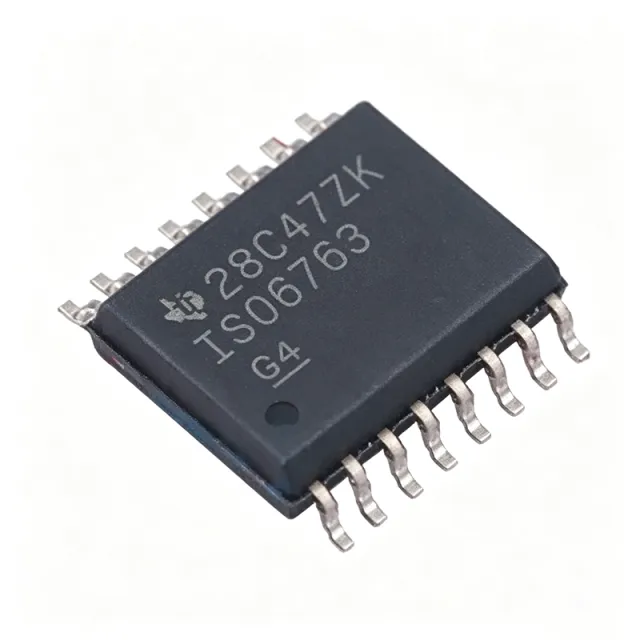
ISO6763DWR - 6-Ch 50Mbps 5000Vrms Digital Isolator | TI
Référence : ISO6763DWR ✓ Actif| Qté | Prix unitaire | Total |
|---|---|---|
| 1 | $2.95 | $2,95 |
| 10 | $2.65 | $26,50 |
| 100 | $2.3 | $230,00 |
| 500 | $2.05 | $1 025,00 |
| 1 000 | $1.85 | $1 850,00 |
ISO6763DWR Présentation
A digital isolator is a semiconductor device that transfers digital signals across an isolation barrier without any galvanic connection, replacing optocouplers in the signal-isolation hierarchy of industrial interface and power-management systems. Reinforced digital isolators use a capacitive or transformer-based barrier certified to withstand thousands of volts, enabling safe communication between controllers and high-voltage circuitry in compliance with reinforced-insulation system requirements.
The ISO6763DWR's key features include a 50 Mbps maximum data rate for high-throughput SPI, RS-485, CAN, and RS-232 links; a robust isolation barrier with up to 5000 VRMS isolation rating, 1500 VRMS working voltage, up to 10 kV surge capability, and high CMTI (50 kV/us minimum per distributor listings, up to 150 kV/us typical per the ISO676x datasheet); and a wide dual-supply range of 1.71 V to 1.89 V on one side and 2.25 V to 5.5 V on the other, allowing direct interfacing with 1.8 V logic.
The device uses TI's proven capacitive isolation construction with an SiO2 dielectric barrier, delivering long barrier lifetime at 1500 VRMS working voltage and robust EMC performance against common-mode transients. The symmetrical 3-forward/3-reverse channel configuration supports bidirectional buses such as full-duplex RS-485 and isolated SPI with independent read-back.
Typical applications include isolated CAN, RS-232, and RS-485 industrial fieldbus nodes, isolated SPI communication in battery management and motor-drive systems, and isolation of PLC I/O modules in factory automation.
Designers should bypass both VCC pins with 0.1 uF and 1 uF ceramic capacitors placed as close to the package as possible, and verify that the logic-side supply domain matches the 1.71 V to 1.89 V narrow range of the low-voltage side.
This page adds distributor pricing tiers, drop-in alternatives, and engineering design notes beyond what the manufacturer datasheet provides.
Alternatives de remplacement direct pour ISO6763DWR — même boîtier, compatible broche à broche. Les références à boîtier différent nécessitant une retouche du PCB sont exclues.
Variantes de cette série
Modèles de la même série directement compatibles avec ISO6763DWR (même facteur de forme et même empreinte) — différant par Isolation Rating.
Outil de comparaison rapide — sélectionnez des références alternatives pour une comparaison côte à côte :
ISO6763FDWR
✓ En stock
$1.55 / unité
Voir la fiche technique →ISO6763QDWRQ1
✓ En stock
$1.05 / unité
Voir la fiche technique →ISO6763FQDWRQ1
✓ En stock
$1.78 / unité
Voir la fiche technique →ISO7763DWR
✓ En stock
Contactez-nous pour le prix
Voir la fiche technique →ISO6763DWR Spécifications
| Number of Channels | 6 (3 forward / 3 reverse) |
| Isolation Type | Reinforced digital isolator |
| Maximum Data Rate | 50 Mbps |
| Isolation Rating | 5000 VRMS |
| Working Voltage | 1500 VRMS |
| Surge Withstand | Up to 10 kV |
| CMTI | 50 kV/us (min); up to 150 kV/us typical (typical per ISO676x datasheet) |
| Supply Voltage Side 1 | 1.71 V to 1.89 V |
| Supply Voltage Side 2 | 2.25 V to 5.5 V |
| Logic Level Support | 1.8 V logic supported |
| Supported Interfaces | CAN, RS-232, RS-485, SPI |
| Température de fonctionnement | -40C to +125C |
| Boîtier | 16-SOIC (DW), 0.295 in / 7.50 mm width |
| Type de montage | Surface Mount |
| Nombre de broches | 16 |
| Barrier Technology | SiO2 capacitive isolation |
Guide de configuration des broches du ISO6763DWR 16-soic (dw), 0.295 in / 7.50 mm width
Configuration des broches du ISO6763DWR (boîtier 16-soic (dw), 0.295 in / 7.50 mm width). La numérotation des broches, les fonctions et les schémas de connexion sont définis dans la fiche technique du fabricant. Consultez-la pour l'empreinte exacte et les directives de soudage.

Aucune donnée de brochage détaillée disponible pour ISO6763DWR.
Consultez la fiche technique pour la configuration complète des broches.
Applications typiques
ISO6763DWR convient pour 6 applications: Isolated RS-485 Fieldbus Nodes, Isolated CAN Bus Interfaces, Isolated SPI Communication, Battery Management Systems, PLC I/O Module Isolation, RS-232 Legacy Equipment Isolation.
Isolated RS-485 Fieldbus Nodes
The ISO6763DWR fits isolated RS-485 links because its 3-forward/3-reverse channel arrangement maps directly onto TX, RX, and transceiver direction-control signals, while its 50 Mbps ceiling comfortably exceeds RS-485's conventional 10 Mbps maximum. The 50 kV/us minimum CMTI prevents data corruption from the large ground-potential differences typical between field nodes and control cabinets, and the 5000 VRMS reinforced barrier satisfies industrial safety isolation requirements. Placed between the MCU and an RS-485 transceiver such as TI's THVD1550, the isolator adds only a few nanoseconds of propagation delay per channel. The wide 2.25 V to 5.5 V supply range on the field side lets designers power the bus-side logic at 3.3 V or 5 V to match the transceiver, without level-shift circuitry.
Recommandé
Isolated CAN Bus Interfaces
For isolated CAN nodes, the ISO6763DWR provides three forward and three reverse channels covering TX, RX, standby, and fault-flag signaling between the CAN controller and an isolated transceiver such as TI's TCAN1051 family. CAN's 1 Mbps maximum data rate uses only a fraction of the isolator's 50 Mbps capability, yielding large timing margin and low propagation-delay-induced bit-time distortion. The up-to-150 kV/us typical CMTI is critical on CAN networks running in motor-drive environments, where inverter switching generates steep common-mode transients on the bus ground. The 1.71 V to 1.89 V supply domain connects directly to 1.8 V microcontroller GPIO without level shifting, and the 16-pin SOIC DW package with reinforced insulation simplifies certification of the complete node.
Recommandé
Isolated SPI Communication
Isolated SPI is where the ISO6763DWR's 50 Mbps rating is fully exploited: SCLK, MOSI, MISO, and chip-select signals cross the barrier with sufficient speed for fast data converters and FPGA configuration links. With a 3/3 channel split, one device isolates a full SPI master-slave link plus an interrupt or status line in both directions, replacing four discrete single-channel isolators. The 1.8 V logic support on the low-voltage side allows direct connection to modern ADCs, DACs, and MCUs that run on narrow 1.8 V supplies, while the 2.25 V to 5.5 V domain serves 3.3 V or 5 V logic. Designers should budget the per-channel propagation delay and channel-to-channel skew to preserve SPI setup and hold timing at the maximum clock rate.
Recommandé
Battery Management Systems
In battery management systems for EVs and energy storage, the ISO6763DWR isolates the SPI or UART communication between the low-voltage controller domain and the high-voltage battery stack monitoring domain. The 5000 VRMS reinforced isolation and 1500 VRMS working voltage provide the safety barrier between pack-level potentials (hundreds of volts) and the vehicle or system controller, while 1.8 V logic support interfaces with low-power MCUs. The -40C to +125C operating range covers automotive under-hood and battery-pack environments. Pairing the isolator with TI's BQ76952 battery monitor on the stack side creates a complete isolated measurement and communication chain; the Q1-qualified ISO6763QDWRQ1 variant should be used for automotive production programs requiring AEC-Q100 components.
Recommandé
PLC I/O Module Isolation
Programmable logic controller I/O cards require galvanic isolation between the field wiring and the backplane logic, and the ISO6763DWR supplies six isolated channels in one compact 16-pin SOIC, reducing board area versus six optocoupler channels and their bias components. The 1500 VRMS working-voltage lifetime rating addresses continuous stress from 230/400 VAC industrial power present on field lines, and the robust EMC performance of the capacitive SiO2 barrier resists the contactor arcing and switching transients common in control cabinets. The 50 Mbps rate is far more than needed for discrete I/O, giving immunity against slow-edge susceptibility and generous timing margin. The 5 V-tolerant 2.25 V to 5.5 V domain matches legacy 5 V PLC logic as well as modern 3.3 V designs.
Recommandé
RS-232 Legacy Equipment Isolation
The ISO6763DWR is explicitly qualified by TI for RS-232 isolation, allowing service and commissioning links to industrial equipment to be galvanically isolated to protect laptops and diagnostic tools from ground faults on plant equipment. The 3/3 channel configuration matches RS-232's TXD, RXD, and handshake signals (RTS/CTS, DTR/DSR) in both directions within a single package, at data rates far beyond the 115.2 kbps standard RS-232 ceiling. The high CMTI protects the link when the host and target are on different grounding systems, and the reinforced 5000 VRMS barrier gives maintenance personnel safety isolation from equipment running at hazardous potentials. The wide supply range supports powering the equipment side from standard 5 V or 3.3 V rails.
Recommandé
Récapitulatif des produits recommandés
Données de référence d'ingénierie pour ISO6763DWR — comparaison, recommandations de conception et informations de conformité.
Guide de sélection
Comparaison avec les alternatives
| Paramètre | Ce produit | ISO7763DWR | ISO6763FDWR | ISO6763QDWRQ1 | ISO6763FQDWRQ1 |
|---|---|---|---|---|---|
| Package | 16-SOIC (DW), 7.50 mm | 16-SOIC (DW) - same | 16-SOIC (DW) - same | 16-SOIC (DW) - same | 16-SOIC (DW) - same |
| Brand | Texas Instruments | Texas Instruments | Texas Instruments | Texas Instruments | Texas Instruments |
| Channels | 6 (3/3) | 6 (3/3) | 6 (3/3) | 6 (3/3) | 6 (3/3) |
| Max Data Rate | 50 Mbps | 50 Mbps | 50 Mbps | 50 Mbps | 50 Mbps |
| Isolation Rating | 5000 VRMS | 5000 VRMS | 5000 VRMS | 5000 VRMS | 5000 VRMS |
| Supply Range | 1.71-1.89 V and 2.25-5.5 V | 1.71-1.89 V and 2.25-5.5 V | 1.71-1.89 V and 2.25-5.5 V | 1.71-1.89 V and 2.25-5.5 V | 1.71-1.89 V and 2.25-5.5 V |
| Default Output Option | Standard | Standard | F (fast default-output) | Standard | F (fast default-output) |
| Automotive Grade (AEC-Q100) | No | No | No | Yes (Q1) | Yes (Q1) |
Principaux différenciateurs
- Narrow 1.8 V supply domain on logic side (vs ISO7763DWR)
- Robust EMC and CMTI (vs ISO6763FDWR)
- Commercial vs automotive qualification split (vs ISO6763QDWRQ1)
Notes de conception
Decouple both supply domains independently: place a 0.1 uF ceramic capacitor within 2 mm of each VCC pin plus a 1 uF bulk capacitor per side. Do not share a single decoupling network across the isolation barrier, and keep the VCC1 and VCC2 copper pours physically separated to preserve creepage and clearance across the board's isolated region, mirroring the internal barrier of the SOIC-16 DW package.
At 50 Mbps, route barrier-crossing signals as short, direct traces and maintain controlled impedance where practical. Budget propagation delay and channel-to-channel skew from the datasheet's timing tables when computing SPI setup/hold margins; at the maximum 50 Mbps clock, skew between SCLK and data channels consumes a meaningful fraction of the unit interval, so match trace lengths between isolator and converter pins.
Side 1 of the ISO6763DWR requires a narrow 1.71 V to 1.89 V supply - do not connect it to a standard 3.3 V or 5 V rail, or the device will be damaged. Verify which signal channels are inputs on each side for the 3/3 configuration before routing, and confirm default-output behavior (standard vs F variant) is acceptable for your fail-safe state, especially on power-loss of one side.
Informations de conformité
RoHS/lead-free status per standard TI active-part status; explicit REACH and halogen-free statements not present in retrieved data. ISO6763DWR itself is not AEC-Q100 qualified - use ISO6763QDWRQ1 for automotive.







