MCP1703T-3302E/MB - 250mA, 3.3V LDO Regulator SOT-89 | Microchip
Référence : MCP1703T-3302E/MB ✓ Actif| Qté | Prix unitaire | Total |
|---|---|---|
| 1 | $0.38 | $0,38 |
| 10 | $0.34 | $3,40 |
| 100 | $0.28 | $28,00 |
| 500 | $0.24 | $120,00 |
| 1 000 | $0.2 | $200,00 |
MCP1703T-3302E/MB Présentation
A low-dropout (LDO) regulator is a type of linear voltage regulator that maintains a stable output voltage even when the input voltage approaches the output voltage, dropping the input-output differential to a few hundred millivolts. Within the broader power management IC hierarchy, LDOs sit alongside switching converters (buck, boost, buck-boost) as the primary means of producing low-noise, post-regulated rails from a higher-voltage source. Unlike switching regulators, an LDO does not introduce high-frequency ripple, making it the preferred post-filter for noise-sensitive analog and RF blocks.
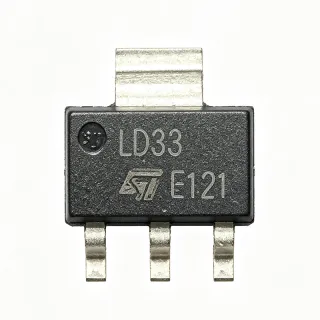
Key features of the MCP1703T-3302E/MB include 2.0 uA typical quiescent current, low dropout operation that preserves battery life, internal thermal shutdown protection, short-circuit current limiting, and ceramic output capacitor stability. The CMOS process enables the very low IQ figure, and the device does not require a minimum load to maintain regulation. The SOT-89-3 package provides a power-dissipation capability of approximately 1.6W with adequate copper area.
Typical applications include battery-powered wireless sensor nodes, IoT end nodes, 9V battery industrial sensors, single-cell Li-ion powered handhelds, microcontroller core/MCU supply rails (3.3V from 1S Li-ion or 2-cell AA), and remote-control battery-powered consumer devices. The ultra-low IQ of 2.0 uA is the central differentiator that enables years of shelf life and run time from small primary batteries.
When designing with this device, ensure the input capacitor is at least 1 uF ceramic placed close to the VIN pin and the output capacitor is at least 1 uF low-ESR ceramic for loop stability. Verify junction temperature under worst-case VIN (16V) and 250 mA load, and observe the SOT-89 power pad layout to maximize heat dissipation.
This page synthesizes distributor pricing, SOT-89 drop-in alternatives, and practical design notes not found in the manufacturer datasheet, including same-family Microchip variants and cross-brand equivalents.
Alternatives de remplacement direct pour MCP1703T-3302E/MB — même boîtier, compatible broche à broche. Les références à boîtier différent nécessitant une retouche du PCB sont exclues.
Variantes de cette série
Modèles de la même série directement compatibles avec MCP1703T-3302E/MB (même facteur de forme et même empreinte) — différant par MSL Level, Output Type, Package.
Outil de comparaison rapide — sélectionnez des références alternatives pour une comparaison côte à côte :
MCP1703T-5002E/MB
✅ Remplacement direct📋 Alternative de référence (hors catalogue)
MCP1703T-1202E/MB
✅ Remplacement direct ⚠️ Spécifications non vérifiées📋 Alternative de référence (hors catalogue)
MCP1703T-2502E/MB
✅ Remplacement direct ⚠️ Spécifications non vérifiées📋 Alternative de référence (hors catalogue)
MCP1702T-3302E/MB
✅ Remplacement direct📋 Alternative de référence (hors catalogue)
TLV1117LV33DCYR
✅ Remplacement direct📋 Alternative de référence (hors catalogue)
NCP1117ST33T3G
✅ Remplacement direct📋 Alternative de référence (hors catalogue)
AMS1117-3.3
✅ Remplacement direct📋 Alternative de référence (hors catalogue)
MCP1703T-3302E/MB Valeurs maximales et caractéristiques électriques
| Type de sortie | Fixed |
| Tension de sortie | 3.3 V |
| Courant de sortie maximal | 250 mA |
| Output Current (VOUT < 4.5V) | 250 mA |
| Output Current (VOUT >= 4.5V) | 200 mA |
| Plage de tension d'entrée | 2.7 V to 16.0 V |
| Quiescent Current (typical) | 2.0 uA |
| Dropout Voltage (typical at 250 mA) | 178 mV |
| Plage de température de fonctionnement | -40 C to +125 C |
| Boîtier | SOT-89-3 (MB) 4.5x4.1 mm |
| Type de montage | Surface Mount |
| Niveau MSL | 1 (unlimited) |
| Statut RoHS | Compliant |
| Output Polarity | Positive |
| Broche d'activation | No (always-on) |
| Output Capacitor Requirement | >= 1 uF ceramic low-ESR |
Configuration des broches de MCP1703T-3302E/MB
| Broche 1 | VIN — Unregulated input supply (2.7 V to 16.0 V) |
| Broche 2 | GND — Ground; exposed thermal tab also electrically ground |
| Broche 3 | VOUT — Regulated 3.3 V output; connect >= 1 uF low-ESR ceramic |
Applications typiques
MCP1703T-3302E/MB convient pour 6 applications: IoT Wireless Sensor Nodes, 9V Battery Industrial Sensors, Single-Cell Li-Ion Handheld Devices, Remote Control Battery Consumer Devices, Microcontroller Core / MCU Supply Rails, Automotive Aftermarket 12V Accessories (non-safety).
IoT Wireless Sensor Nodes
The MCP1703T-3302E/MB is purpose-built for IoT wireless sensor nodes powered by 9V alkaline or 2xAA cells, where its 2.0 uA quiescent current extends battery life to multiple years. With 16V max input it tolerates depleted battery stacks without damage, and the 178 mV dropout preserves usable run-time down to ~3.5V input. In a typical design it sits between a stack of primary cells and a 3.3V microcontroller+radio module (e.g. Sub-GHz or BLE SoC), supplying clean low-noise rails without draining cells in standby. The SOT-89-3 footprint keeps the regulator area under 5x5 mm and the 250 mA peak rating covers the radio TX current of most short-range radios. Quiescent current is the dominant spec for duty-cycled sensor nodes where the regulator sits idle 99% of the time.
Recommandé
9V Battery Industrial Sensors
Industrial sensors housed in field enclosures often run from a single 9V alkaline or 12V backup supply, and the MCP1703T-3302E/MB is well matched to this scenario. Its 16V absolute-maximum input tolerates transients on long field wiring, and the 2.0 uA IQ preserves battery during alarm-panel standby. Typical use is to drop 9V (or a 2xAA/3xAA stack) down to 3.3V for an MCU plus a 4-20 mA loop or RS-485 transceiver. Compared to a switching converter at this current level, the MCP1703 introduces no EMI, simplifying IEC 61000-4-6 conducted-immunity compliance. The SOT-89-3 footprint and 1.6W dissipation allow 250 mA continuous at 25C ambient with modest copper pour.
Recommandé
Single-Cell Li-Ion Handheld Devices
For handheld devices powered by a single Li-ion cell (4.2V max, 3.0V cut-off), the MCP1703T-3302E/MB provides a clean 3.3V rail for MCUs, BLE radios, and display drivers from the cell's wide operating range. The 178 mV typical dropout at 250 mA means regulation holds until the cell is deeply discharged. In a handheld design it typically follows a boost or buck-boost converter that creates the 5V rail for USB-charging circuitry, post-regulating the post-cell voltage down to 3.3V for the digital blocks. The 2.0 uA IQ is also valuable for sleep current budgets in always-on handhelds such as BLE beacons and BLE-enabled sports wearables.
Recommandé
Remote Control Battery Consumer Devices
Remote controls for TVs, smart-home hubs, and ceiling fans rely on AAA or coin-cell batteries that must last 1-5 years. The MCP1703T-3302E/MB's 2.0 uA quiescent current enables shelf-life and active-use runtimes that beat competing 500 mA LDOs by an order of magnitude. The 3.3V fixed output conveniently powers low-cost IR/BLE SoCs and small OLED status displays. In a typical 2xAAA design the regulator sits between the cells and the BLE SoC, supplying clean rails during TX bursts of 30-50 mA while drawing negligible current in standby. The SOT-89-3 footprint allows hand-solder rework and fits within the slimmer remote form factors.
Recommandé
Microcontroller Core / MCU Supply Rails
The MCP1703T-3302E/MB is a textbook choice for a 3.3V MCU core rail in mixed-voltage designs. Place it between a 5V (or higher) system rail and a 3.3V MCU to provide low-noise, post-regulated power independent of upstream converter ripple. In a 5V-USB-fed design it drops USB VBUS (5V +/- 5%) down to a clean 3.3V, providing 72 dB-class PSRR to isolate the MCU from upstream noise. With 250 mA capability it covers most Cortex-M0/M4 class MCUs and their associated radios. The lack of an enable pin keeps the BOM minimal for always-on rails.
Recommandé
Automotive Aftermarket 12V Accessories (non-safety)
Although the MCP1703T-3302E/MB is not AEC-Q100 qualified, its 16V input range tolerates 12V automotive load-dump transients below 16V when paired with a TVS clamp, making it useful for non-safety aftermarket accessories (LED accent lighting, cabin fans, USB chargers). The 250 mA output easily powers an LED controller or USB-charge controller IC. Automotive designers should validate that the input stays below 16V under all transient conditions; for safety-critical or AEC-Q100 applications, choose a Q-100 qualified LDO such as Microchip's MAQ1703 family. Always add an input TVS and fuse for production automotive deployments.
Recommandé
Récapitulatif des produits recommandés
Données de référence d'ingénierie pour MCP1703T-3302E/MB — comparaison, recommandations de conception et informations de conformité.
Guide de sélection
Comparaison avec les alternatives
| Paramètre | Ce produit | MCP1703T-5002E/MB | MCP1703T-1202E/MB | MCP1703T-2502E/MB | MCP1702T-3302E/MB | TLV1117LV33DCYR | NCP1117ST33T3G | AMS1117-3.3 |
|---|---|---|---|---|---|---|---|---|
| Package | SOT-89-3 (MB) | SOT-89-3 (MB) - same | SOT-89-3 (MB) - same | SOT-89-3 (MB) - same | SOT-89-3 (MB) - same | SOT-89-3 - same | SOT-89-3 - same | SOT-89-3 - same |
| Brand | Microchip Technology | Microchip Technology | Microchip Technology | Microchip Technology | Microchip Technology | Texas Instruments | onsemi | Diodes Incorporated |
| Output Voltage | 3.3 V | 5.0 V | 1.2 V | 2.5 V | 3.3 V | 3.3 V | 3.3 V | 3.3 V |
| Maximum Output Current | 250 mA | 250 mA | 250 mA | 250 mA | 250 mA | 1.2 A | 1.0 A | 1.0 A |
| Quiescent Current (typical) | 2.0 uA | 2.0 uA | 2.0 uA | 2.0 uA | 1.6 uA | 100 uA | 5 mA | 5 mA |
| Input Voltage Range | 2.7 V to 16.0 V | 2.7 V to 16.0 V | 2.7 V to 16.0 V | 2.7 V to 16.0 V | 2.7 V to 13.5 V | 1.4 V to 5.5 V | 4.75 V to 15 V | 4.75 V to 15 V |
| Dropout Voltage at Full Load (typical) | 178 mV | 178 mV | 178 mV | 178 mV | 178 mV | 500 mV at 1.2 A | 1.2 V at 1.0 A | 1.2 V at 1.0 A |
| AEC-Q100 Qualified | No | No | No | No | No | No | No | No |
| Approx Unit Price (qty-1) | $0.38 | ~$0.38 | ~$0.38 | ~$0.38 | ~$0.42 | ~$0.55 | ~$0.45 | ~$0.10 |
Principaux différenciateurs
- Lowest quiescent current in SOT-89 250 mA LDO class (vs TLV1117LV33DCYR)
- Wider input voltage range than cross-brand equivalents (vs NCP1117ST33T3G)
- Highest input voltage in compact SOT-89-3 250 mA LDOs (vs MCP1702T-3302E/MB)
- Fixed 3.3V matches Microchip MCU and PIC ecosystem (vs AMS1117-3.3)
Notes de conception
The MCP1703T-3302E/MB requires a minimum 1 uF low-ESR ceramic output capacitor for loop stability; X7R 10 uF is recommended for improved load-transient response and lower output impedance across temperature. Place both input and output capacitors within 5 mm of their respective pins to minimize parasitic inductance. The wide 2.7-16V input range lets the part sit directly on a 9V battery or 12V rail without pre-regulation.
Estimated: at VIN=12V, VOUT=3.3V, and 250 mA load, power dissipation is (12-3.3)*0.25 = 2.18 W. With SOT-89 theta_JA of ~90 C/W on a 1 sq inch copper pour, junction temperature rises ~196 C above ambient, exceeding the 150 C thermal shutdown. For continuous 250 mA operation from a 12V source, either drop the input to <5V (VIN-VOUT * IOUT < 0.5 W) or upgrade to a 500 mA LDO in DPAK/SOT-223 with a larger thermal pad. At 3.3V VIN (e.g. from a 1S Li-ion charger headroom), dissipation is only ~25 mW and no thermal management is required.
Use a copper pour of at least 100 mm^2 on the SOT-89 tab (pin 2) to maximize thermal dissipation; this tab is the only ground connection and should be tied to a ground plane with multiple thermal vias for production designs. Keep high-current traces away from the regulator's feedback path to avoid injecting noise. For battery-powered layouts, route the VIN trace directly from the battery terminal with a 1 uF ceramic bypass capacitor to minimize voltage drop during load transients.
Do not reverse the input/output polarity - the SOT-89-3 pinout is 1=VIN, 2=GND, 3=VOUT, and the part has no reverse-current protection. Do not exceed the 16V absolute-maximum input voltage; add a TVS clamp if the input can see transients above 16V. The 250 mA current rating applies to VOUT options below 4.5V; the higher-VOUT variants are rated 200 mA - this is per datasheet section 'Output Current'.
Because the MCP1703T-3302E/MB is a linear LDO with no switching noise, it does not require input pi-filters or shielding to meet EMI standards. However, the PSRR rolls off above 10 kHz, so for noise-sensitive analog blocks (e.g. ADC references, RF VCOs) consider adding a 10 uF+0.1 uF output capacitor network or post-filtering with an RC network. Place the regulator close to the noise-sensitive load to minimize trace-induced pickup.
Informations de conformité
RoHS and REACH compliant per Microchip product page. Not AEC-Q100 qualified - do not use in safety-critical automotive applications; choose a Q-100 qualified LDO such as Microchip's MAQ1703 family for AEC-Q100 needs. Lead-free reflow profile per JEDEC J-STD-020.