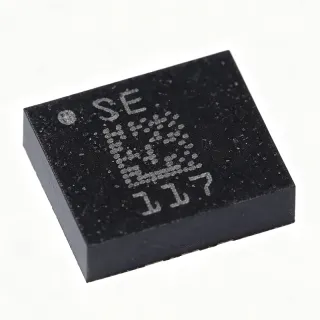
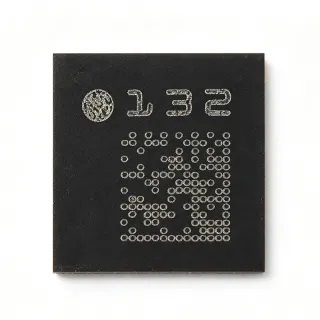
MMA1260EGR2 - ±1.5g Z-Axis Micromachined Accelerometer | NXP
Référence : MMA1260EGR2 ✗ Fin de vie| Qté | Prix unitaire | Total |
|---|---|---|
| 1 | $8.95 | $8,95 |
| 10 | $8.1 | $81,00 |
| 100 | $6.85 | $685,00 |
| 500 | $5.95 | $2 975,00 |
| 1 000 | $5.2 | $5 200,00 |
MMA1260EGR2 Présentation
What is a low-G micromachined accelerometer? A low-G accelerometer is a micro-electromechanical (MEMS) sensor that measures acceleration in the sub-5g range, typically used for tilt, motion, vibration, and orientation detection. The MMA1260EGR2 is built around a silicon capacitive sensing cell whose deflection under acceleration unbalances a differential capacitor pair; on-chip signal conditioning, a 2-pole low-pass filter, and temperature compensation convert this imbalance into a ratiometric analog voltage. In the broader sensor hierarchy, it sits as: MEMS accelerometer -> inertial sensor -> motion sensor -> semiconductor.
Key features include a 5.0 V single-supply operation, ratiometric output centred at 2.5 V, self-test capability that simulates a defined acceleration by applying an electrostatic force to the proof mass, and zero-g offset/full-scale span that are factory-set to remove the need for external trim components. The integrated 2-pole low-pass filter has a -3 dB cutoff near 50 Hz, suppressing out-of-band noise and high-frequency mechanical disturbances.
The MMA1260EGR2 uses a surface-micromachined polysilicon sense element and a bipolar CMOS interface IC, all packaged in a 16-pin SOIC with the proof-mass sensing direction perpendicular to the PCB top surface (Z-axis). The Z-axis orientation simplifies single-axis tilt and drop/impact applications where lateral sensing is undesirable, while the ratiometric output makes the reading immune to fluctuations in supply voltage.
Typical applications include appliance vibration monitoring, HDD free-fall detection, automotive alarm and tilt sensing, game-controller motion input, and portable-electronics drop detection. Its low current consumption and 5 V supply make it compatible with both 5 V MCU ADC front-ends and 3.3 V systems through a simple resistor divider.
When designing with this device, place a 0.1 µF decoupling capacitor close to VDD, route the analogue output away from switching nodes, and use the self-test pin only after the supply has stabilised for at least 50 ms. As of 2026-10-15, the part is distributed through major channels with broadly stable lead times.
This page synthesises distributor pricing, drop-in same-package alternatives, and practical design notes that go beyond the manufacturer datasheet, including a pinout reference and an application-oriented comparison table.
Alternatives de remplacement direct pour MMA1260EGR2 — même boîtier, compatible broche à broche. Les références à boîtier différent nécessitant une retouche du PCB sont exclues.
Variantes de cette série
Modèles de la même série directement compatibles avec MMA1260EGR2 (même facteur de forme et même empreinte) — différant par Bandwidth, Output Type, Package, Supply Voltage.
Outil de comparaison rapide — sélectionnez des références alternatives pour une comparaison côte à côte :
MMA1270EGR2
✅ Remplacement direct📋 Alternative de référence (hors catalogue)
MMA1260EG
✅ Remplacement direct📋 Alternative de référence (hors catalogue)
MMA1250EGR2
✅ Remplacement direct✓ En stock
$2.85 / unité
Voir la fiche technique →MMA2260EGR2
✅ Remplacement direct📋 Alternative de référence (hors catalogue)
MMA6260QR2
✅ Remplacement direct✓ En stock
$4.65 / unité
Voir la fiche technique →MMA1260EGR2 Valeurs maximales et caractéristiques électriques
| Type de capteur | Accelerometer |
| Sensing Axis | Z |
| Acceleration Range | ±1.55 g |
| Sensitivity | 1140 mV/g to 1260 mV/g |
| Bandwidth | 50 Hz (2-pole low-pass filter) |
| Tension d'alimentation | 5.0 V (nominal) |
| Type de sortie | Analog voltage (ratiometric) |
| Output at 0 g | 2.5 V (nominal, ratiometric) |
| Self-Test | Yes (electrostatic force activation) |
| Boîtier | 16-pin SOIC (SOG) |
| Type de montage | Surface Mount |
| Statut RoHS | Compliant (per distributor listings) |
Configuration des broches de MMA1260EGR2
| Broche 1 | OUT — Analog output voltage |
| Broche 2 | ST — Self-test input (active high) |
| Broche 3 | NC — Not connected (per datasheet) |
| Broche 4 | GND — Ground |
| Broche 5 | GND — Ground |
| Broche 6 | GND — Ground |
| Broche 7 | GND — Ground |
| Broche 8 | VDD — Supply voltage (5 V nominal) |
| Broche 9 | NC — Not connected (per datasheet) |
| Broche 10 | NC — Not connected (per datasheet) |
| Broche 11 | NC — Not connected (per datasheet) |
| Broche 12 | NC — Not connected (per datasheet) |
| Broche 13 | NC — Not connected (per datasheet) |
| Broche 14 | NC — Not connected (per datasheet) |
| Broche 15 | NC — Not connected (per datasheet) |
| Broche 16 | NC — Not connected (per datasheet) |
Applications typiques
MMA1260EGR2 convient pour 6 applications: Appliance Vibration Monitoring, HDD Free-Fall Detection, Automotive Alarm and Tilt Sensor, Game-Controller Motion Input, Portable Drop Detection, Industrial Vibration Switch.
Appliance Vibration Monitoring
The MMA1260EGR2's ±1.55g Z-axis range and 50 Hz internal low-pass filter match the dominant vibration band of white-goods compressors and washing-machine drums, where tilt and unbalance detection is critical. Its 1140-1260 mV/g sensitivity gives roughly 1.4-2.0 V full-scale swing at 5 V supply, easily readable from a 10-bit MCU ADC after offset removal. Unlike digital MEMS parts, the analog ratiometric output avoids I2C/SPI bus traffic on resource-constrained motor-control MCUs. The on-chip self-test pin allows end-of-line functional verification without a shaker table.
Recommandé
HDD Free-Fall Detection
Hard-disk drop protection requires a Z-axis accelerometer that can detect the brief g-onset before impact. The MMA1260EGR2's ±1.55g range covers typical drop-onset thresholds (1.0-1.2g) with margin, and its 50 Hz bandwidth rejects high-frequency chassis vibration that could cause false triggers. The analog output drives directly into the HDD controller's comparator without an MCU, saving BOM and firmware in legacy 5 V disk subsystems. Self-test via the ST pin verifies sensor integrity during power-on self-test, a requirement for enterprise HDD diagnostics.
Recommandé
Automotive Alarm and Tilt Sensor
Vehicle alarm systems use tilt sensors to detect jacking or towing (often <0.5g sustained). The MMA1260EGR2's Z-axis orientation naturally aligns with vehicle vertical-axis changes, and its 1140-1260 mV/g sensitivity resolves sub-1g signals clearly. Although this part is NRNDer (Not Recommended for New Designs) and not AEC-Q100 qualified, it remains in widespread use in legacy aftermarket alarm modules that already have an MCU ADC front-end. For new automotive designs, prefer AEC-Q100-qualified digital successors like FXLS8471Q.
Recommandé
Game-Controller Motion Input
Early-generation game controllers and TV remotes used single-axis analog accelerometers to translate wrist gestures into on-screen actions. The MMA1260EGR2's 16-pin SOIC footprint, 5 V operation, and analog output pair well with legacy 8-bit game MCUs that lack I2C. Its 50 Hz filter matches typical hand-gesture bandwidth (1-30 Hz) while suppressing mechanical noise from button presses. Self-test via the electrostatic ST pin enables end-of-line calibration in a high-volume consumer product.
Recommandé
Portable Drop Detection
Portable electronics such as laptops and PDAs historically integrated the MMA1260EGR2 for hard-disk protection during accidental drops. The sensor detects the brief free-fall g-onset (less than 1g) and signals the HDD to park the heads within the few-millisecond latency budget. Its Z-axis orientation aligns with the typical vertical drop axis, and its analog output can drive a hardware interrupt directly without an MCU round-trip. The integrated 2-pole low-pass filter eliminates the need for an external RC on the signal path.
Recommandé
Industrial Vibration Switch
Industrial equipment monitors vibration on rotating machinery via standalone vibration switches that trip above a programmable threshold. The MMA1260EGR2 provides an analog output proportional to Z-axis acceleration, and its 1140-1260 mV/g sensitivity scales to a clean trip-point setting when fed into a comparator window. The integrated 50 Hz filter targets the rotating-element vibration band of pumps and fans (typically 10-40 Hz), making it suitable for VFD cabinet and HVAC monitor applications.
Recommandé
Récapitulatif des produits recommandés
Données de référence d'ingénierie pour MMA1260EGR2 — comparaison, recommandations de conception et informations de conformité.
Guide de sélection
Comparaison avec les alternatives
| Paramètre | Ce produit | MMA1270EGR2 | MMA1250EGR2 | MMA2260EGR2 |
|---|---|---|---|---|
| Package | 16-pin SOIC | 16-pin SOIC - same | 16-pin SOIC - same | 16-pin SOIC - same |
| Brand | NXP Semiconductors | NXP Semiconductors | NXP Semiconductors | NXP Semiconductors |
| Acceleration Range | ±1.55 g | ±2.5 g | ±1.0 g | ±1.5 g |
| Sensing Axis | Z | Z | Z | X |
| Supply Voltage | 5.0 V | 5.0 V | 5.0 V | 5.0 V |
| Output Type | Analog (ratiometric) | Analog (ratiometric) | Analog (ratiometric) | Analog (ratiometric) |
| Bandwidth | 50 Hz | 50 Hz | 50 Hz | 50 Hz |
| Self-Test | Yes | Yes | Yes | Yes |
Principaux différenciateurs
- Highest absolute g-range in this alternatives set (vs MMA1250EGR2)
- True Z-axis sensing (vs MMA2260EGR2)
- Single-axis simplicity vs dual-axis alternative (vs MMA6260QR2)
Notes de conception
Decouple VDD (pin 8) with a 0.1 µF ceramic capacitor placed within 5 mm of the pin, plus an optional 1 µF bulk cap if the 5 V rail is shared with switching regulators. The analog output is ratiometric, so any ripple on VDD directly scales the reading; use a linear regulator or LDO stage (for example, a member of the MAX15x family with low dropout) if the system 5 V is noisy.
Do not assert the self-test (ST, pin 2) pin before VDD has fully stabilised for at least 50 ms; early self-test may produce an incorrect offset. Self-test should only be triggered momentarily during power-on diagnostics, never held continuously. Leaving ST floating during normal operation can couple noise into the sense element, degrading offset and noise floor.
Orient the SOIC-16 footprint so that the package mechanical Z-axis (perpendicular to the PCB top surface) matches the desired sensing direction; the SOIC body has a Z-axis indicator stripe on top. Provide a solid ground pour directly under the device connecting to pins 4-7 to minimise thermal and supply-shift errors. Avoid running high-current traces or switching nodes directly above or below the sense cell area.
Route the analog OUT (pin 1) trace as a short, guarded track with a ground guard on either side. Place a low-pass RC (for example, 10 kΩ + 100 nF) if the receiving ADC is more than 25 mm from the sensor, to limit pickup of in-band noise above the integrated 50 Hz filter cutoff.
Informations de conformité
RoHS status confirmed through major distributor product listings (DigiKey, Mouser). AEC-Q100 qualification is not present on this part; for automotive designs choose an AEC-Q100-qualified successor. Reach, halogen-free, and conflict-minerals declarations were not present in the verified web data and are flagged as 'unknown' rather than assumed.