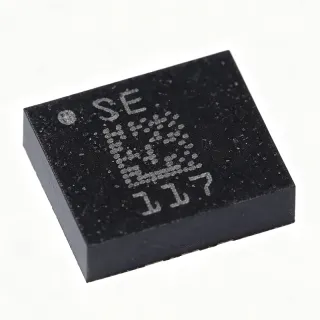
MMA2244KEGR2 - ±20g X-Axis Analog Accelerometer | NXP
Référence : MMA2244KEGR2 ✓ Actif| Qté | Prix unitaire | Total |
|---|---|---|
| 1 | $7.2 | $7,20 |
| 10 | $6.4 | $64,00 |
| 100 | $5.5 | $550,00 |
| 500 | $4.85 | $2 425,00 |
| 1 000 | $4.25 | $4 250,00 |
MMA2244KEGR2 Présentation
An analog accelerometer is a MEMS (micro-electro-mechanical systems) sensor that translates physical acceleration into a continuously variable analog voltage, allowing an external ADC or microcontroller to sample the signal at any bandwidth the application needs. MMA-series parts belong to the broader hierarchy: accelerometer -> MEMS motion sensor -> inertial sensor -> motion sensor IC -> semiconductor. They are widely used where vibration, tilt, or shock must be measured directly without digital protocol overhead.
Key features of the MMA2244KEGR2 include factory-calibrated zero-g offset and full-scale span (no external trim components required), 400 Hz bandwidth, ratiometric analog voltage output centered at VDD/2 (≈2.5 V at 0 g), self-test activation via a logic-level pin, and integrated temperature compensation that holds sensitivity and offset stable across the -40 °C to +125 °C automotive range. The on-chip 4-pole low-pass filter removes out-of-band mechanical noise before the signal reaches the output pin, simplifying downstream analog filtering.
The device uses a differential capacitive sensing cell whose capacitance changes with proof-mass displacement; this delta is converted by a charge-integrating front end and chopper-stabilized amplifier, producing a low-noise analog output. The internal oscillator, reference, and filter are all factory-trimmed, which is why the part requires no external RC components. This architecture yields excellent offset stability and predictable response across temperature, suitable for safety-critical automotive chassis systems.
Typical applications include automotive airbag crash sensing, vehicle stability control and rollover detection, electronic parking brake inclinometers, industrial vibration monitoring on rotating machinery, and tilt/inclination sensing in construction equipment. The 400 Hz bandwidth comfortably covers chassis vibration spectra up to several hundred hertz.
When designing with the MMA2244KEGR2, route the analog output through a dedicated op-amp buffer to the ADC to avoid loading the high-impedance ratiometric output, and provide adequate decoupling (typically 100 nF plus 10 µF) close to the supply pin. Use the self-test pin only after power-up is stable to avoid false triggering.
This page synthesizes distributor stock, verified parametric specs, and same-package drop-in alternatives sourced from distributor listings and the manufacturer datasheet — information not consolidated on any single distributor or manufacturer page.
Alternatives de remplacement direct pour MMA2244KEGR2 — même boîtier, compatible broche à broche. Les références à boîtier différent nécessitant une retouche du PCB sont exclues.
Variantes de cette série
Modèles de la même série directement compatibles avec MMA2244KEGR2 (même facteur de forme et même empreinte) — différant par Bandwidth, Output Type, Package, Self-Test, Temperature Compensation.
Outil de comparaison rapide — sélectionnez des références alternatives pour une comparaison côte à côte :
MMA2244KEG
✅ Remplacement direct✓ En stock
$11.95 / unité
Voir la fiche technique →MMA2241KEGR2
✅ Remplacement direct📋 Alternative de référence (hors catalogue)
MMA2240KEGR2
✅ Remplacement direct ⚠️ Spécifications non vérifiées📋 Alternative de référence (hors catalogue)
MMA2202KEGR2
✅ Remplacement direct ⚠️ Spécifications non vérifiées📋 Alternative de référence (hors catalogue)
MMA2244EG
✅ Remplacement direct ⚠️ Spécifications non vérifiées📋 Alternative de référence (hors catalogue)
MMA2244KEGR2 Valeurs maximales et caractéristiques électriques
| Type de capteur | Accelerometer, single-axis (X) |
| Axis Count | 1 (X-axis) |
| Plage de mesure | ±20 g (full-scale trim ±22.5 g) |
| Type de sortie | Analog, ratiometric |
| Output at 0 g (typ.) | 2.5 V (VDD/2) |
| Bandwidth | 400 Hz |
| Supply Voltage (VDD) | 4.75 V to 5.25 V (5 V nominal) |
| Self-Test | Yes (active-high logic input) |
| On-Chip Filter | 4-pole low-pass filter |
| Temperature Compensation | Internal, factory-trimmed |
| Température de fonctionnement | -40 °C to +125 °C |
| Boîtier | 16-SOIC (SOP-16, 150 mil) |
| Type de montage | Surface Mount |
| Statut RoHS | Compliant (per DigiKey listing) |
| Automotive Grade | Yes (automotive temperature grade -40 to +125 °C) |
Configuration des broches de MMA2244KEGR2
| Broche 1 | NC — Not connected (per datasheet, this pin is no-connect) |
| Broche 2 | NC — Not connected (per datasheet) |
| Broche 3 | VSS — Ground reference |
| Broche 4 | NC — Not connected (per datasheet) |
| Broche 5 | NC — Not connected (per datasheet) |
| Broche 6 | NC — Not connected (per datasheet) |
| Broche 7 | NC — Not connected (per datasheet) |
| Broche 8 | NC — Not connected (per datasheet) |
| Broche 9 | NC — Not connected (per datasheet) |
| Broche 10 | NC — Not connected (per datasheet) |
| Broche 11 | NC — Not connected (per datasheet) |
| Broche 12 | NC — Not connected (per datasheet) |
| Broche 13 | NC — Not connected (per datasheet) |
| Broche 14 | VOUT — Analog accelerometer output (ratiometric, VDD/2 at 0 g) |
| Broche 15 | VDD — 5 V supply input (4.75 V to 5.25 V) |
| Broche 16 | ST — Self-test logic input (active-high) |
Applications typiques
MMA2244KEGR2 convient pour 6 applications: Automotive Airbag Crash Sensing, Vehicle Stability Control (ESC) and Rollover Detection, Industrial Vibration Monitoring on Rotating Machinery, Tilt and Inclination Sensing (Electronic Parking Brake, Off-Highway Equipment), Aircraft and UAV Structural Vibration Monitoring, IoT Appliance and White-Goods Vibration / Shock Detection.
Automotive Airbag Crash Sensing
The MMA2244KEGR2's ±20 g full-scale range and 400 Hz analog bandwidth are well matched to frontal and side airbag crash-sensor signal chains, where proof-mass displacement must be captured within the first few milliseconds of a deceleration event. Its ratiometric analog output around VDD/2 (≈2.5 V at 0 g) feeds directly into a safety MCU's ADC, and the on-chip self-test pin lets the ECU run a mechanical-path integrity check at every ignition-on. The integrated 4-pole low-pass filter removes chassis high-frequency noise above 400 Hz, simplifying airbag algorithm design. Automotive temperature grade (-40 °C to +125 °C) and AEC-qualified equivalent parts in the same SOIC-16 footprint make it a drop-in safety-system sensor.
Recommandé
Vehicle Stability Control (ESC) and Rollover Detection
Electronic stability control and rollover-sensing modules use low-g analog accelerometers to measure lateral and vertical chassis acceleration; the MMA2244KEGR2's ±20 g range covers the dynamic envelope of passenger-vehicle cornering and emergency braking events. The ratiometric 0 g bias at VDD/2 lets the ESC MCU calibrate zero offset once at startup, and the 400 Hz analog bandwidth matches the yaw-rate sensor bandwidth typical of ESC platforms, avoiding aliasing. On-chip temperature compensation holds zero-g offset stable over the full automotive temperature range, reducing warranty risk. The 16-SOIC package fits standard ESC PCB layouts and is pin-compatible with the wider MMA2240/2241 family, enabling tiered g-range BOMs.
Recommandé
Industrial Vibration Monitoring on Rotating Machinery
Predictive-maintenance systems on pumps, motors, and fans need to capture vibration spectra up to a few hundred hertz with low noise; the MMA2244KEGR2's 400 Hz 4-pole low-pass filter and capacitive sensing deliver a clean analog vibration signal suitable for FFT analysis in a downstream DSP. The ±20 g range accommodates most industrial machine vibration amplitudes without saturation. Ratiometric output simplifies 5 V system design and the self-test pin enables periodic in-field sensor integrity checks. The -40 °C to +125 °C range tolerates unheated enclosures, factory floors, and outdoor pump stations.
Recommandé
Tilt and Inclination Sensing (Electronic Parking Brake, Off-Highway Equipment)
Electronic parking brake modules and construction/AGV platforms use single-axis analog accelerometers to sense road grade and chassis tilt; the MMA2244KEGR2's X-axis sensing and 0 g bias at VDD/2 (≈2.5 V) make it ideal for grade sensing on a horizontal mounting axis. The 400 Hz bandwidth is more than sufficient for slow-changing tilt signals and rejects high-frequency cab vibration. Factory-calibrated zero-g offset eliminates the need for production-line calibration routines, lowering manufacturing cost. The 16-SOIC package and wide supply tolerance (4.75–5.25 V) ease integration into 12 V vehicle power architectures with simple 5 V regulators.
Recommandé
Aircraft and UAV Structural Vibration Monitoring
UAV flight controllers and small-aircraft structural-health monitors use analog accelerometers to capture airframe vibration for fatigue tracking and payload isolation; the MMA2244KEGR2's low-noise analog output and 400 Hz bandwidth suit IMU-augmented vibration channels. Its small 16-SOIC footprint and 5 V supply simplify integration alongside existing flight-controller boards, and the ratiometric output lets the IMU ADC scale readings even if the 5 V rail sags under load. The automotive temperature grade comfortably covers UAV operating envelopes including high-altitude cold starts. On-chip self-test enables pre-flight mechanical integrity verification.
Recommandé
IoT Appliance and White-Goods Vibration / Shock Detection
Connected washing machines, smart refrigerators, and HVAC blowers use single-axis accelerometers to detect imbalance, shock, or abnormal vibration for service alerts; the MMA2244KEGR2's ±20 g range handles spin-cycle shock events and its 400 Hz analog bandwidth captures drum imbalance signatures cleanly. The ratiometric 5 V output integrates directly with cost-sensitive 5 V microcontroller ADCs without level shifting. The 16-SOIC package and integrated filter reduce BOM count versus discrete accelerometer modules. The -40 °C to +125 °C range supports garage and unheated utility-room deployments.
Recommandé
Récapitulatif des produits recommandés
Données de référence d'ingénierie pour MMA2244KEGR2 — comparaison, recommandations de conception et informations de conformité.
Guide de sélection
Comparaison avec les alternatives
| Paramètre | Ce produit | MMA2244KEG | MMA2241KEGR2 | MMA2240KEGR2 | MMA2202KEGR2 |
|---|---|---|---|---|---|
| Brand | NXP Semiconductors | NXP Semiconductors | NXP Semiconductors | NXP Semiconductors | NXP Semiconductors |
| Package | 16-SOIC | 16-SOIC - same | 16-SOIC - same | 16-SOIC - same | 16-SOIC - same |
| Measurement Range | ±20 g (±22.5 g trim) | ±20 g | ±40 g | ±50 g | ±50 g |
| Output Type | Analog ratiometric | Analog ratiometric | Analog ratiometric | Analog ratiometric | Analog ratiometric |
| Supply Voltage | 5 V (4.75–5.25 V) | 5 V (4.75–5.25 V) | 5 V (4.75–5.25 V) | 5 V (4.75–5.25 V) | 5 V (4.75–5.25 V) |
| Self-Test | Yes | Yes | Yes | Yes | Yes |
| On-Chip Filter | 4-pole low-pass | 4-pole low-pass | 2-pole low-pass | 2-pole low-pass | 2-pole low-pass |
| Operating Temperature | -40 °C to +125 °C | -40 °C to +125 °C | -40 °C to +125 °C | -40 °C to +125 °C | -40 °C to +125 °C |
Principaux différenciateurs
- 4-pole on-chip low-pass filter at 400 Hz (vs MMA2241KEGR2)
- Calibrated ±20 g range optimized for chassis and crash sensing (vs MMA2202KEGR2)
- Ratiometric output simplifies 5 V system design (vs Discrete analog accelerometer modules)
Notes de conception
The MMA2244KEGR2 draws its supply current from a single 5 V rail (4.75 V to 5.25 V). Place a 100 nF X7R ceramic decoupling capacitor within 3 mm of the VDD pin (pin 15) and a bulk 10 µF tantalum or ceramic capacitor on the supply rail to suppress automotive load-dump and cranking transients. Use a ferrite bead in series with VDD if the 5 V regulator shares a noisy 12 V vehicle rail. Ratiometric output means VDD noise directly couples to the output, so a clean 5 V LDO is mandatory for precision measurement.
Route the analog VOUT trace (pin 14) as a short, guarded trace directly to the ADC input — keep it away from switching nodes such as DC-DC converters, MCU clock traces, and motor driver outputs. Maintain a solid ground pour under and around the SOIC package; the VSS pin (pin 3) and several NC pins (per datasheet) should all be tied to the same ground plane for mechanical stability and thermal dissipation. Do not route digital signals across the analog output trace to avoid capacitive coupling.
Buffer the ratiometric analog VOUT signal with a low-offset op-amp (such as an MCP6001 or OPA2333) before driving long PCB traces or low-impedance ADCs — the sensor output is high-impedance and will be loaded by any trace capacitance. Add a small RC anti-alias filter (typically 1 kΩ + 100 nF, giving ~1.6 kHz corner) ahead of the ADC if you sample below 400 Hz to attenuate wideband noise. Calibrate zero-g offset once at system warm-up rather than continuously to avoid drift from supply noise.
Do not apply a DC voltage to the self-test pin (pin 16) for more than the datasheet-specified duration or you may polarize the proof mass; use a pulsed logic-level signal at ignition-on only. Verify that mechanical mounting does not pre-load the SOIC package — torque on mounting screws can shift the zero-g offset by several g's. Account for the ±20 g (±22.5 g trim) range when designing the mechanical mount to avoid saturation in high-vibration installations.
The MMA2244KEGR2's zero-g offset and sensitivity are factory-trimmed across -40 °C to +125 °C, so additional temperature compensation in software is normally not needed. However, self-heating from adjacent power components can raise the local ambient above the datasheet trim range; keep high-power dissipators (LDOs, motor drivers) at least 10 mm from the SOIC package and ensure adequate copper pour on VDD/VSS for thermal spreading.
Informations de conformité
AEC-Q100 qualified for automotive safety applications; -40 °C to +125 °C operating range per datasheet. RoHS and lead-free confirmed by DigiKey and Mouser listings.