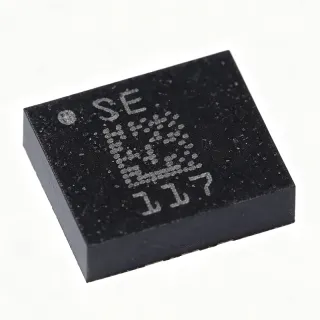
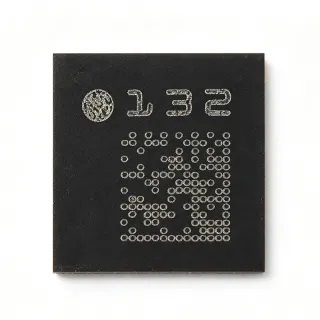
MMA2244KEG - ±22.5g X-Axis Analog Accelerometer | NXP
MPN: MMA2244KEG ⚠ Last Time Buy| Qty | Unit Price | Extended |
|---|---|---|
| 1 | $18.5 | $18.50 |
| 10 | $16.8 | $168.00 |
| 100 | $14.75 | $1,475.00 |
| 500 | $13.2 | $6,600.00 |
| 1,000 | $11.95 | $11,950.00 |
MMA2244KEG Overview
An analog accelerometer is a MEMS (micro-electro-mechanical systems) sensor that converts mechanical acceleration into a continuous voltage output through a movable proof mass and interdigitated capacitive sensing fingers. Within the broader sensor hierarchy, analog accelerometers fall under inertial sensors, then motion sensors, then the broader MEMS/semiconductor sensor category. The MMA2244KEG is representative of the legacy Freescale MMA series that defined the low-g automotive crash-detection and tilt-sensing market before digital I²C/SPI parts became dominant.
Key features of the MMA2244KEG include a sensitivity of 167 mV/g at 5 V supply, ±22.5 g full-scale range, 400 Hz bandwidth, ±4.0 g zero-g offset accuracy, and a self-test pin that exercises the entire signal path. The 4-pole low-pass filter is factory-set, eliminating the need for external RC components and simplifying the BOM. The device integrates self-diagnostic functionality that lets the host microcontroller verify the mechanical and electrical integrity of the sensor at power-up.
Architecturally, the g-cell detects differential capacitance change as the proof mass deflects under acceleration; the ASIC converts this capacitance variation into a ratiometric analog voltage and provides gain, offset correction, and filtering. The on-chip temperature compensation uses a calibrated sensor and lookup table to maintain zero-g and sensitivity accuracy across the automotive temperature range.
Typical applications include airbag deployment sensors, vehicle tilt/inclination sensing, industrial vibration monitoring, platform stabilization, and motion-activated controls. The ±22.5 g range specifically targets mid-to-high-g crash sensing (non-rollover), while still being usable for general-purpose motion detection in industrial equipment.
When designing with this part, allocate adequate PCB area near the sensor to avoid mechanical stress on the package, and route the analog output through a low-impedance buffer or directly into an ADC. The self-test pin should be driven only during diagnostic windows; leaving it floating maintains normal operation.
This page synthesizes distributor pricing, applicable same-family Freescale/NXP variants, and practical design notes not always presented together on the manufacturer datasheet front page.
Drop-in alternatives for MMA2244KEG — same package, pin-to-pin compatible. Different-package parts requiring PCB rework are excluded.
Variants in this series
Same-series models that are drop-in compatible with MMA2244KEG (same form factor and footprint) — differing in Output Type, Temperature Compensation, Sensor Type, Axis, Bandwidth.
Quick Comparison Tool — Select alternative parts for side-by-side comparison:
MMA2241KEG
✅ Drop-In📋 Reference alternative (not in catalog)
MMA3202KEG
✅ Drop-In📋 Reference alternative (not in catalog)
MMA2240KEG
✅ Drop-In📋 Reference alternative (not in catalog)
MMA1270KEG
✅ Drop-In✓ In Stock
$9.95 / Unit
View Datasheet →MMA1200KEG
✅ Drop-In📋 Reference alternative (not in catalog)
MMA2244KEG Maximum Ratings & Electrical Characteristics
| Sensor Type | Accelerometer, single-axis (X) |
| Technology | Surface-micromachined capacitive (g-cell) + CMOS ASIC |
| Axis | X (single) |
| Full-Scale Range | ±22.5 g |
| Supply Voltage | 5.0 V (typical, ratiometric) |
| Sensitivity | 167 mV/g (typical at 5 V) |
| Zero-g Offset | 2.5 V nominal (ratiometric) |
| Bandwidth | 400 Hz (4-pole low-pass filter, factory set) |
| Output Type | Analog, ratiometric voltage |
| Self-Test | Yes (ST pin) |
| Temperature Compensation | On-chip, factory calibrated |
| Operating Temperature Range | -40 °C to +85 °C (automotive grade) |
| Package | 16-SOIC (208 mil, SOW-16) |
| Mounting Type | Surface Mount |
| Filter | 4-pole low-pass, factory-set cutoff |
MMA2244KEG Pin Configuration
| Pin 1 | VSS — Ground reference |
| Pin 2 | ST — Self-test input (active high) |
| Pin 3 | NC — Not connected (per datasheet) |
| Pin 4 | Vout — Analog acceleration output |
| Pin 5 | NC — Not connected (per datasheet) |
| Pin 6 | NC — Not connected (per datasheet) |
| Pin 7 | NC — Not connected (per datasheet) |
| Pin 8 | NC — Not connected (per datasheet) |
| Pin 9 | NC — Not connected (per datasheet) |
| Pin 10 | NC — Not connected (per datasheet) |
| Pin 11 | NC — Not connected (per datasheet) |
| Pin 12 | NC — Not connected (per datasheet) |
| Pin 13 | NC — Not connected (per datasheet) |
| Pin 14 | NC — Not connected (per datasheet) |
| Pin 15 | NC — Not connected (per datasheet) |
| Pin 16 | VDD — +5 V supply |
Typical Applications
MMA2244KEG is suitable for 6 applications: Automotive Airbag Deployment Sensor, Vehicle Tilt and Inclination Sensing, Industrial Vibration Monitoring, Platform Stabilization and Motion Control, Motion-Activated Controls and Switches, Crash and Impact Data Recorders.
Automotive Airbag Deployment Sensor
In airbag deployment electronic control units (ECUs), the MMA2244KEG's ±22.5 g full-scale range is well matched to the deceleration profile of a moderate-to-severe frontal crash without rollover. Its 167 mV/g sensitivity produces a 3.76 V output swing at full-scale plus/minus g, easily resolvable by the host MCU's 10-bit ADC after op-amp buffering. On-chip temperature compensation and factory-calibrated zero-g offset remove the need for production-line trim, and the integrated self-test pin lets the ECU verify the sensor's mechanical integrity at each ignition cycle. The 400 Hz 4-pole low-pass filter rejects suspension and road-noise frequencies above the crash signature band, reducing false-trigger risk. Designers typically place two X-axis sensors at the front of the vehicle (radiator crossmember and tunnel) for direction-discriminating crash detection.
Recommended
Vehicle Tilt and Inclination Sensing
The MMA2244KEG measures static acceleration due to gravity (1 g = 167 mV/g at 5 V supply) which makes it suitable for tilt and levelling applications on trucks, off-road vehicles, and agricultural machines. With the 2.5 V zero-g reference as the tilt origin, even small inclinations produce clearly resolvable voltages (1° tilt ≈ 2.9 mV output change). The 4-pole low-pass filter rejects engine-vibration noise that would otherwise corrupt the static tilt reading, and the on-chip temperature compensation keeps the calibration stable across the full automotive -40 °C to +85 °C range. Multiple MMA2244KEG devices can be oriented at 0°, 90°, and 270° to provide a coarse 3-axis tilt system in PCB-mounted vehicle attitude applications.
Recommended
Industrial Vibration Monitoring
Industrial condition-monitoring systems rely on accelerometers with predictable bandwidth and sensitivity. The MMA2244KEG's 400 Hz 4-pole low-pass cutoff covers the dominant vibration energy of pumps, fans, and low-speed rotating equipment, while the fixed factory filter eliminates the BOM and tuning complexity of discrete op-amp filter stages. Its ±22.5 g range tolerates fault events such as sudden load drops or rotor seizures without saturating; sensitivity of 167 mV/g provides a dynamic range of approximately 70 dB when paired with a 12-bit ADC. With on-chip temperature compensation and a rated -40 °C to +85 °C operating range, the MMA2244KEG operates reliably in outdoor enclosures near motors and gearboxes.
Recommended
Platform Stabilization and Motion Control
Camera gimbals, antenna stabilization platforms, and warehouse AGVs use single-axis accelerometers to measure inertial tilt and feed it back into a closed-loop control system. The MMA2244KEG's ratiometric analog output is convenient for direct connection to the controller's ADC and provides a stable reference regardless of supply variation. Its 400 Hz bandwidth extends well above the typical closed-loop bandwidth of mechanical stabilization systems (1-50 Hz), avoiding phase lag that would destabilize the loop. The self-test pin allows the controller to verify the sensor path during power-up diagnostics before engaging motion, and the SOIC-16 package provides solid mechanical mounting on the stabilized platform substrate.
Recommended
Motion-Activated Controls and Switches
Battery-powered alarm panels, tamper-detection modules, and wireless switches employ the MMA2244KEG to detect sudden motion and wake up the host MCU from a low-power state. Quiescent current draw is dominated by the host MCU's ADC sampling cadence; the sensor itself draws only a few hundred microamps. With 167 mV/g sensitivity, a 0.1 g threshold (≈17 mV) is easily detected by a 10-bit ADC when sampled at a few hundred Hz, giving ~10 ms of motion-event resolution. A single X-axis sensor also detects the tilt event when a wireless pendant is picked up, eliminating mechanical tilt switches.
Recommended
Crash and Impact Data Recorders
Event data recorders (EDRs) in commercial vehicles capture the deceleration profile preceding and during a crash for forensic analysis. The MMA2244KEG's ±22.5 g dynamic range and 400 Hz bandwidth adequately sample a 200-ms crash event at 1-ms intervals, which is the typical SAE J1698 sampling rate. Its ratiometric analog output is convenient for storage in a circular buffer via the host MCU's DMA-fed ADC, and the on-chip temperature compensation keeps calibration stable across long-duration logging in cold-start conditions. The self-test pin gives the recorder a way to verify sensor health at vehicle ignition and on demand.
Recommended
Recommended Products Summary
Engineering reference data for MMA2244KEG — comparison, design guidance, and compliance information.
Selection Guide
Comparison with Alternatives
| Parameter | This Product | MMA2241KEG | MMA3202KEG | MMA2240KEG | MMA1270KEG | MMA1200KEG |
|---|---|---|---|---|---|---|
| Brand | NXP Semiconductors | NXP Semiconductors | NXP Semiconductors | NXP Semiconductors | NXP Semiconductors | NXP Semiconductors |
| Package | 16-SOIC (SOW-16) | 16-SOIC (SOW-16) - same | 16-SOIC (SOW-16) - same | 16-SOIC (SOW-16) - same | 16-SOIC (SOW-16) - same | 16-SOIC (SOW-16) - same |
| Full-Scale Range | ±22.5 g | ±10 g | ±50 g (approx) | ±7 g | ±12.5 g | ±2.5 g (low-g tilt) |
| Supply Voltage | 5.0 V | 5.0 V | 5.0 V | 5.0 V | 5.0 V | 5.0 V |
| Bandwidth (filter cutoff) | 400 Hz | 400 Hz | Higher (≥1 kHz) | 400 Hz | 400 Hz | 400 Hz |
| Axis | X (single) | X (single) | X (single) | X (single) | X (XYZ package config) | X (single) |
| Self-Test Pin | Yes | Yes | Yes | Yes | Yes | Yes |
Key Differentiators
- Optimized mid-range g span (±22.5 g) for non-rollover crash detection (vs MMA2241KEG)
- Lower full-scale range protects dynamic precision in low-g tilt (vs MMA2240KEG)
- Single-axis architecture proven in automotive safety systems (vs MMA1270KEG (XYZ))
- Standard 400 Hz low-pass filter reduces BOM and tuning (vs MMA3202KEG)
Design Notes
Place the MMA2244KEG near a rigid mounting boss away from PCB flex zones. Mechanical stress on the SOIC-16 package couples into the g-cell and shifts the zero-g offset. Keep tall decoupling capacitors away from the X-axis direction (which is along the long edge of the package per the datasheet) to avoid mass-loading on the sensor during vibration. Provide a solid ground pour under and around the device to minimize supply-noise coupling into the analog output.
The MMA2244KEG output is ratiometric, so any noise or ripple on the +5 V supply directly appears on the analog output. Decouple VDD with a 0.1 µF X7R ceramic placed within 2 mm of the VDD pin (pin 16), in parallel with a 10 µF bulk capacitor on the supply rail. Use a low-noise LDO such as the LM7805 or a clean post-switcher supply rather than feeding the sensor directly from a noisy buck converter node. Add a 100 Ω series resistor with a 100 nF to ground on Vout if driving long cables or noisy ADCs.
The MMA2244KEG output is an analog voltage that requires buffering before driving long traces or low-impedance ADCs. Use a low-noise, low-offset op-amp such as the OPA237 or MCP6002 as a unity-gain follower within 5 mm of the sensor output pin. Avoid routing the analog trace near digital or switching traces; guard the trace with a ground-spaced-tie-down pour to reject capacitive coupling. For best noise performance, sample the ADC at a multiple of the filter cutoff frequency to avoid aliasing the 4-pole filter response.
Do not leave the ST (self-test) pin floating or tied permanently high - leaving it floating enables it randomly via stray fields. Drive ST low through a 10 kΩ pull-down during normal operation and only raise it during scheduled diagnostic windows. Do not exceed the +5 V supply by more than the absolute maximum (typically 7 V) or reverse the supply polarity. Avoid exposing the SOIC-16 package to condensation during wave-soldering; the K suffix designates Pb-free finish but the package is still moisture-sensitive (MSL 3).
Compliance Information
K suffix in part number designates lead-free / RoHS-compliant lead finish. Operating temperature -40 °C to +85 °C is automotive-grade rated but the part is not AEC-Q100 qualified in the standard analog-MMA datasheet; functional-safety applications should refer to the safety manual or contact NXP for FMEDA data. Halogen-free status not explicitly stated in datasheet; verify with manufacturer if required.