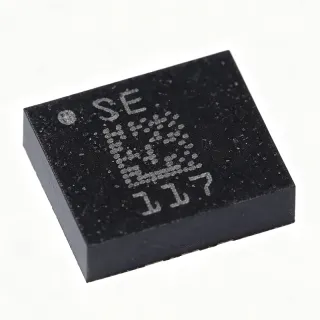
MMA6233QR2 - ±10g Dual-Axis Micromachined Accelerometer | NXP
Référence : MMA6233QR2 ✗ Fin de vie| Qté | Prix unitaire | Total |
|---|---|---|
| 1 | $7.95 | $7,95 |
| 10 | $7.16 | $71,60 |
| 100 | $6.36 | $636,00 |
| 500 | $5.57 | $2 785,00 |
| 1 000 | $4.77 | $4 770,00 |
MMA6233QR2 Présentation
An accelerometer is a micro-electromechanical systems (MEMS) sensor that measures the change in velocity (acceleration) along one or more axes, converting mechanical motion into an electrical signal. The MMA6233QR2 belongs to the MEMS accelerometer family, which sits within the broader hierarchy of motion sensors, then sensors, and finally the semiconductor product category. MEMS capacitive accelerometers detect motion by sensing the displacement of a proof mass between capacitive plates - a differential capacitance change that is demodulated and amplified to produce an analog voltage proportional to acceleration.
Key features include factory-trimmed zero-g offset and full-scale span (no external calibration required), integrated 1-pole low-pass filtering for noise bandwidth control, on-board temperature compensation for stable output across -20C to +85C, and g-select input pins that allow the user to switch between ±10g and ±6g full-scale range dynamically. The device operates from a single 3.0V to 5.25V supply, drawing a low 2.5 mA typical supply current. The integrated g-select logic and self-test capability reduce external component count and simplify firmware calibration routines.
Architecturally, the MMA6233QR2 uses a polysilicon capacitive sense element suspended over a silicon substrate; deflection of the proof mass modulates two nominally equal capacitors, and an on-chip ASIC performs charge integration, gain, and filtering. The analog output stage provides a ratiometric output centered at VDD/2 with sensitivity scaled to the supply voltage, simplifying ADC interface design. This architecture yields a robust sensor suitable for cost-sensitive consumer and industrial applications where digital interfaces are not required.
Typical applications include tilt and inclination sensing, free-fall detection in hard-disk drives, vibration monitoring in industrial equipment, motion-activated user interfaces, and anti-theft alarm systems. The wide ±10g range and small 6x6 mm QFN-EP footprint make it a flexible choice for portable battery-powered designs. Compared to digital-output MEMS accelerometers (SPI/I2C), the analog ratiometric output of the MMA6233QR2 enables direct connection to an MCU ADC, minimizing firmware overhead.
When designing with the MMA6233QR2, place 100 nF decoupling capacitors close to VDD and place a low-ESR bulk capacitor on the supply rail to reduce noise on the analog output. Use an op-amp buffer if the ADC input impedance is below 100 kohm to prevent measurement gain error. The exposed pad must be soldered to the PCB ground plane for thermal dissipation and electrical reference integrity.
Alternatives de remplacement direct pour MMA6233QR2 — même boîtier, compatible broche à broche. Les références à boîtier différent nécessitant une retouche du PCB sont exclues.
Variantes de cette série
Modèles de la même série directement compatibles avec MMA6233QR2 (même facteur de forme et même empreinte) — différant par Bandwidth, Operating Temperature, Package, RoHS Status, Self-Test.
Outil de comparaison rapide — sélectionnez des références alternatives pour une comparaison côte à côte :
MMA6260QR2
✅ Remplacement direct✓ En stock
$4.65 / unité
Voir la fiche technique →MMA6240QR2
✅ Remplacement direct📋 Alternative de référence (hors catalogue)
MMA6250QR2
✅ Remplacement direct📋 Alternative de référence (hors catalogue)
MMA6200QR2
✅ Remplacement direct📋 Alternative de référence (hors catalogue)
MMA6233QR2 Valeurs maximales et caractéristiques électriques
| Type de capteur | Accelerometer, Dual-Axis (X, Y) |
| Full-Scale Range | ±10g (±6g via g-select) |
| Type de sortie | Analog, ratiometric |
| Output Voltage at 0g | VDD/2 |
| Bandwidth | 900 Hz (maximum) |
| Supply Voltage (VDD) | 3.0 V to 5.25 V |
| Température de fonctionnement | -20C to +85C |
| Self-Test | Yes (active-high logic input) |
| g-Select Input | Yes (±10g or ±6g selection) |
| Boîtier | 16-pin QFN-EP (6x6 mm) |
| Type de montage | Surface Mount |
| Filter Type | 1-pole low-pass (factory-set cut-off) |
| Statut RoHS | Compliant |
| Lead-Free Status | Contains Lead (NXP datasheet note) |
Configuration des broches de MMA6233QR2
| Broche 1 | NC — Not connected (per datasheet) |
| Broche 2 | YOUT — Y-axis analog output (ratiometric, VDD/2 at 0g) |
| Broche 3 | GND — Ground reference |
| Broche 4 | XOUT — X-axis analog output (ratiometric, VDD/2 at 0g) |
| Broche 5 | NC — Not connected (per datasheet) |
| Broche 6 | GND — Ground reference |
| Broche 7 | ST — Self-test input (active-high logic) |
| Broche 8 | VDD — Power supply (3.0 V to 5.25 V) |
| Broche 9 | g-SEL — g-select input (selects full-scale range) |
| Broche 10 | NC — Not connected (per datasheet) |
| Broche 11 | NC — Not connected (per datasheet) |
| Broche 12 | NC — Not connected (per datasheet) |
| Broche 13 | NC — Not connected (per datasheet) |
| Broche 14 | NC — Not connected (per datasheet) |
| Broche 15 | NC — Not connected (per datasheet) |
| Broche 16 | NC — Not connected (per datasheet) |
| Broche EP | EPAD — Exposed thermal pad - solder to PCB ground plane |
Applications typiques
MMA6233QR2 convient pour 6 applications: Tilt and Inclination Sensing, Free-Fall Detection in Hard-Disk Drives, Industrial Vibration Monitoring, Motion-Activated User Interfaces, Anti-Theft and Security Alarms, Portable Battery-Powered Motion Devices.
Tilt and Inclination Sensing
The MMA6233QR2 dual-axis analog output enables direct tilt and inclination measurement with the g-force along X and Y axes mapped to a VDD/2-centered analog voltage. The sensor's ±10g range and 120 mV/g sensitivity at 3.3 V VDD let an MCU ADC resolve sub-degree tilt angles after atan2 math, while the integrated 1-pole low-pass filter removes high-frequency vibration that would otherwise corrupt the static tilt reading. Compared to digital-output accelerometers that require I2C driver code, the MMA6233QR2 outputs a ratiometric voltage that connects directly to an ADC channel. Recommended companion parts: NXP MMA6260QR2 (lower g-range), NXP MMA8451Q (digital upgrade), and a low-offset op-amp such as TLV9062IDR for ADC buffering in low-impedance ADC designs.
Recommandé
Free-Fall Detection in Hard-Disk Drives
The MMA6233QR2's ±10g range and 900 Hz bandwidth make it suitable for free-fall detection in 2.5-inch and 3.5-inch hard-disk drives, where the sensor must detect sudden loss of gravity to park the read/write heads before impact. Its 2.5 mA typical supply current is acceptable for HDD power budgets, and the analog output lets the HDD controller ASIC sample acceleration directly without adding a digital sensor bus. Compared to discrete shock-detection circuits, the integrated MEMS + ASIC in the MMA6233QR2 reduces PCB area and BOM count. Recommended companion parts: an HDD controller ASIC with ADC input, a low-ESR bulk capacitor for supply rail, and an N-channel MOSFET for the head-parking actuator driver.
Recommandé
Industrial Vibration Monitoring
The MMA6233QR2's 900 Hz bandwidth and ±10g full-scale range cover the dominant vibration frequencies in most rotating machinery (motors, pumps, fans below 100 Hz fundamental with harmonics up to 800 Hz). Its capacitive MEMS architecture provides good noise performance, and the analog output drives a 4-20 mA loop transmitter or an isolation amplifier with no firmware overhead. The integrated temperature compensation maintains sensitivity stability across the -20C to +85C industrial range. Compared to piezoelectric accelerometers, the MMA6233QR2 operates from a single low-voltage supply and does not require a charge amplifier. Recommended companion parts: an isolation amplifier such as AMC1200BDWVR, a 16-bit ADC like ADS131A04IPW, and an RS-485 transceiver for plant-floor communication.
Recommandé
Motion-Activated User Interfaces
The MMA6233QR2 dual-axis sensing supports tap, double-tap, and shake gesture recognition in handheld consumer products such as remote controls and toys. Its ±10g range captures sharp hand gestures without saturating, and the analog output can be polled at low sample rates by an 8-bit MCU ADC, eliminating the cost of a higher-resolution I2C sensor. The integrated self-test pin allows in-line production verification of the MEMS element after PCB assembly. Compared to digital-output sensors, the MMA6233QR2 simplifies the BOM and firmware for cost-driven products. Recommended companion parts: a low-cost MCU such as NXP LPC1102, a 100 nF decoupling capacitor array, and a low-dropout regulator such as LP2985-33DBVR.
Recommandé
Anti-Theft and Security Alarms
The MMA6233QR2 detects tilt, vibration, and shock events in anti-theft alarm modules mounted on motorcycles, bicycles, doors, and windows. Its ±10g range captures forced-entry shock while the 1-pole low-pass filter ignores ambient vibration noise from wind and traffic. The low 2.5 mA supply current extends battery life in wireless alarm transmitters, and the analog output drives a comparator circuit that wakes the radio MCU only on a threshold-crossing event. Compared to discrete piezo shock sensors, the MMA6233QR2 provides direction-of-shock information (X vs Y axis) and self-test capability. Recommended companion parts: a sub-GHz radio such as CC1101RTKR, a comparator such as TLV3201AIDBVR, and a lithium coin-cell battery.
Recommandé
Portable Battery-Powered Motion Devices
The MMA6233QR2's 2.5 mA typical supply current and 3.0 V to 5.25 V supply range make it compatible with single-cell lithium-ion (3.7 V nominal) and two-AA battery packs (3.0 V) in portable motion devices such as fitness wearables, pedometers, and GPS loggers. Its small 6x6 mm QFN-EP footprint consumes minimal PCB area in space-constrained designs, and the exposed pad provides thermal dissipation for the ASIC die. Compared to digital-output sensors, the analog output lets a low-power MCU enter deep sleep between ADC samples, extending battery life. Recommended parts: a low-power MCU like STM32L031K6T6, a boost converter for stable 3.3 V rail, and a lithium-ion charge management IC.
Recommandé
Récapitulatif des produits recommandés
Données de référence d'ingénierie pour MMA6233QR2 — comparaison, recommandations de conception et informations de conformité.
Guide de sélection
Comparaison avec les alternatives
| Paramètre | Ce produit | MMA6260QR2 | MMA6240QR2 | MMA6250QR2 | MMA6200QR2 |
|---|---|---|---|---|---|
| Package | 16-QFN-EP (6x6) | 16-QFN-EP (6x6) - same | 16-QFN-EP (6x6) - same | 16-QFN-EP (6x6) - same | 16-QFN-EP (6x6) - same |
| Brand | NXP Semiconductors | NXP Semiconductors | NXP Semiconductors | NXP Semiconductors | NXP Semiconductors |
| Full-Scale Range | ±10g (±6g via g-select) | ±1.5g / ±6g (g-select) | ±4g / ±6g (g-select) | ±5g / ±6g (g-select) | ±10g |
| Number of Axes | 2 (X, Y) | 2 (X, Y) | 2 (X, Y) | 2 (X, Y) | 2 (X, Y) |
| Output Type | Analog, ratiometric | Analog, ratiometric | Analog, ratiometric | Analog, ratiometric | Analog, ratiometric |
| Self-Test | Yes | Yes | Yes | Yes | Yes |
| Supply Voltage | 3.0 V to 5.25 V | 3.0 V to 5.25 V | 3.0 V to 5.25 V | 3.0 V to 5.25 V | 3.0 V to 5.25 V |
| Lifecycle Status | Obsolete | Obsolete | Obsolete | Obsolete | Obsolete |
Principaux différenciateurs
- Pin-compatible with all MMA6200-series family members (vs MMA6260QR2 / MMA6240QR2 / MMA6250QR2)
- ±10g range covers both tilt and shock applications (vs MMA6260QR2 (±1.5g / ±6g))
- Factory-trimmed zero-g offset and full-scale span (vs Generic raw MEMS sense element)
Notes de conception
Place a 100 nF ceramic decoupling capacitor as close as possible to the VDD pin (pin 8) and a low-ESR 1-10 uF bulk capacitor on the supply rail to suppress analog output noise. The MMA6233QR2 draws approximately 2.5 mA typical; ensure the upstream LDO can supply this plus any downstream ADC and op-amp current with at least 30% headroom. Use a star-ground topology with the exposed pad (EPAD) tied directly to the PCB ground plane to minimize ground bounce on the analog signal.
The exposed thermal pad (EPAD, pin 0) MUST be soldered to the PCB ground plane for both thermal dissipation and a stable electrical reference. The NXP datasheet specifies that insufficient EPAD soldering degrades zero-g offset stability and increases temperature drift. Keep the analog output traces (XOUT, YOUT) short and routed away from switching power traces or digital clock lines. Add a ground guard trace around the analog output lines to reduce capacitive coupling from adjacent noisy signals.
Buffer the analog XOUT and YOUT signals with a low-offset op-amp (input impedance > 100 Mohm, input bias current < 1 nA) before driving any ADC with input impedance below 100 kohm. Without buffering, the ADC's finite input impedance forms a voltage divider with the MMA6233QR2's 32 kohm output impedance, introducing gain error of up to 24% at 10 kohm ADC input impedance. A candidate buffer is the TLV9062IDR or OPA2333AIDR, both offering rail-to-rail output and sub-100 uV offset.
Do not exceed the absolute maximum mechanical shock rating (typically 2000g for unpowered survival and 50g powered operation) - the MEMS sense element can be permanently damaged by sharp hammer blows during board assembly or rework. Activate the self-test (ST) pin only after VDD has stabilized; toggling ST during power ramp can produce spurious X/Y outputs that the host MCU may misinterpret as motion. The g-select (g-SEL) pin must be tied to GND or VDD - never left floating, which can cause intermittent range switching.
Informations de conformité
RoHS compliant per NXP product page. Lead-free status: Contains Lead (per chipdig.com datasheet notes); this is a legacy part originally released before the lead-free transition. AEC-Q100 not applicable (consumer/industrial part). REACH, halogen-free, and conflict-mineral status not explicitly stated in the verified data.