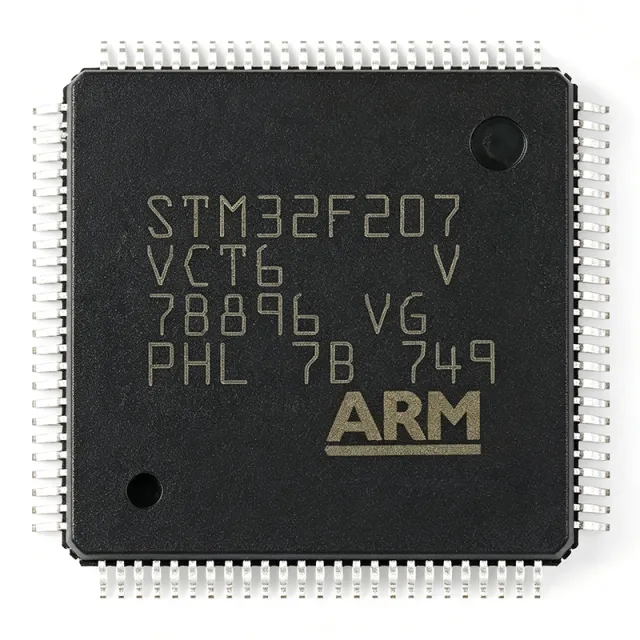
STM32F207VCT6 - 32-bit ARM Cortex-M3 MCU, 256KB Flash | STMicroelectronics
Référence : STM32F207VCT6 ✓ Actif| Qté | Prix unitaire | Total |
|---|---|---|
| 1 | $12.5455 | $12,55 |
| 10 | $9.0606 | $90,61 |
| 100 | $8.0152 | $801,52 |
| 500 | $7.6667 | $3 833,35 |
| 1 000 | $7.3182 | $7 318,20 |
STM32F207VCT6 Présentation
A microcontroller (MCU) is a compact integrated circuit designed to govern a specific operation in an embedded system. It contains a processor core, memory, and programmable input/output peripherals. The STM32F207VCT6 belongs to the STM32F2 series, which is part of the broader STM32 family of 32-bit Flash microcontrollers. This family is widely used in industrial control, consumer electronics, and IoT devices due to its balance of performance, power efficiency, and peripheral integration.
Key features include a rich set of peripherals: 3x SPI, 3x I2C, 4x USART, 2x UART, 2x CAN, 1x USB 2.0 OTG FS, 1x USB 2.0 OTG HS, 1x Ethernet MAC, 1x SDIO, 1x FSMC, 2x 12-bit DAC, 3x 12-bit ADC (up to 24 channels), and multiple timers including advanced-control timers. The device also includes a cryptographic/hash processor for AES, DES, and SHA-1/MD5, and a true random number generator (RNG).
The STM32F207VCT6 is built on a 90nm process technology, offering a good balance of speed and power consumption. It supports a wide operating temperature range of -40°C to +85°C, making it suitable for industrial environments. The Cortex-M3 core includes a Nested Vectored Interrupt Controller (NVIC) for efficient interrupt handling, and a Memory Protection Unit (MPU) for enhanced system reliability.
Typical applications include industrial automation, motor control, medical devices, smart meters, and IoT gateways. The Ethernet MAC and USB OTG HS interfaces enable connectivity in networked systems, while the advanced timers and ADC/DAC support precise analog control loops.
When designing with this device, ensure proper decoupling of the power supply pins and a stable clock source. The internal RC oscillator can be used for basic operation, but an external crystal is recommended for applications requiring precise timing. The device supports in-circuit programming and debugging via SWD and JTAG interfaces.
Alternatives de remplacement direct pour STM32F207VCT6 — même boîtier, compatible broche à broche. Les références à boîtier différent nécessitant une retouche du PCB sont exclues.
Variantes de cette série
Modèles de la même série directement compatibles avec STM32F207VCT6 (même facteur de forme et même empreinte) — différant par ADC, Package, Timers, SRAM, Communication Interfaces.
Outil de comparaison rapide — sélectionnez des références alternatives pour une comparaison côte à côte :
STM32F207VGT6
✓ En stock
$6.8182 / unité
Voir la fiche technique →STM32F407VGT6
✓ En stock
$7.55 / unité
Voir la fiche technique →STM32F205VCT6
📋 Alternative de référence (hors catalogue)
STM32F207VET6
📋 Alternative de référence (hors catalogue)
STM32F207ZCT6
📋 Alternative de référence (hors catalogue)
STM32F207VCT6 Valeurs maximales et caractéristiques électriques
| Core | ARM Cortex-M3 |
| Max Clock Speed | 120 MHz |
| Flash Memory | 256 KB |
| SRAM | 128 KB |
| Tension d'alimentation | 1.8 V to 3.6 V |
| Boîtier | LQFP-100 (14x14 mm) |
| Température de fonctionnement | -40C to +85C |
| GPIO Pins | 82 |
| ADC | 3x 12-bit, up to 24 channels |
| DAC | 2x 12-bit |
| Timers | 12 (including advanced-control) |
| Communication Interfaces | 3x SPI, 3x I2C, 4x USART, 2x UART, 2x CAN, USB OTG FS/HS, Ethernet MAC, SDIO |
| Cryptographic Acceleration | AES, DES, SHA-1, MD5 |
| Random Number Generator | Yes (RNG) |
| Statut RoHS | Compliant |
Configuration des broches de STM32F207VCT6
| Broche 1 | VBAT — Backup battery supply |
| Broche 2 | PC13 — GPIO / RTC output |
| Broche 3 | PC14 — GPIO / OSC32_IN |
| Broche 4 | PC15 — GPIO / OSC32_OUT |
| Broche 5 | PF0 — GPIO / OSC_IN |
| Broche 6 | PF1 — GPIO / OSC_OUT |
| Broche 7 | NRST — Reset (active low) |
| Broche 8 | PC0 — GPIO / ADC_IN10 |
| Broche 9 | PC1 — GPIO / ADC_IN11 |
| Broche 10 | PC2 — GPIO / ADC_IN12 |
| Broche 11 | PC3 — GPIO / ADC_IN13 |
| Broche 12 | VSSA — Analog ground |
| Broche 13 | VDDA — Analog power supply |
| Broche 14 | PA0 — GPIO / ADC_IN0 / WKUP |
| Broche 15 | PA1 — GPIO / ADC_IN1 |
| Broche 16 | PA2 — GPIO / ADC_IN2 / USART2_TX |
| Broche 17 | PA3 — GPIO / ADC_IN3 / USART2_RX |
| Broche 18 | VSS — Ground |
| Broche 19 | VDD — Power supply |
| Broche 20 | PA4 — GPIO / DAC_OUT1 |
| Broche 21 | PA5 — GPIO / DAC_OUT2 |
| Broche 22 | PA6 — GPIO / ADC_IN6 |
| Broche 23 | PA7 — GPIO / ADC_IN7 |
| Broche 24 | PC4 — GPIO / ADC_IN14 |
| Broche 25 | PC5 — GPIO / ADC_IN15 |
| Broche 26 | PB0 — GPIO / ADC_IN8 |
| Broche 27 | PB1 — GPIO / ADC_IN9 |
| Broche 28 | PB2 — GPIO / BOOT1 |
| Broche 29 | PB10 — GPIO / I2C2_SCL |
| Broche 30 | PB11 — GPIO / I2C2_SDA |
| Broche 31 | VSS — Ground |
| Broche 32 | VDD — Power supply |
| Broche 33 | PB12 — GPIO / SPI2_NSS |
| Broche 34 | PB13 — GPIO / SPI2_SCK |
| Broche 35 | PB14 — GPIO / SPI2_MISO |
| Broche 36 | PB15 — GPIO / SPI2_MOSI |
| Broche 37 | PD8 — GPIO / FSMC_D13 |
| Broche 38 | PD9 — GPIO / FSMC_D14 |
| Broche 39 | PD10 — GPIO / FSMC_D15 |
| Broche 40 | PD11 — GPIO / FSMC_A16 |
| Broche 41 | PD12 — GPIO / FSMC_A17 |
| Broche 42 | PD13 — GPIO / FSMC_A18 |
| Broche 43 | PD14 — GPIO / FSMC_D0 |
| Broche 44 | PD15 — GPIO / FSMC_D1 |
| Broche 45 | PE0 — GPIO / FSMC_NBL0 |
| Broche 46 | PE1 — GPIO / FSMC_NBL1 |
| Broche 47 | PE2 — GPIO / FSMC_A23 |
| Broche 48 | PE3 — GPIO / FSMC_A19 |
| Broche 49 | PE4 — GPIO / FSMC_A20 |
| Broche 50 | PE5 — GPIO / FSMC_A21 |
| Broche 51 | PE6 — GPIO / FSMC_A22 |
| Broche 52 | VSS — Ground |
| Broche 53 | VDD — Power supply |
| Broche 54 | PE7 — GPIO / FSMC_D4 |
| Broche 55 | PE8 — GPIO / FSMC_D5 |
| Broche 56 | PE9 — GPIO / FSMC_D6 |
| Broche 57 | PE10 — GPIO / FSMC_D7 |
| Broche 58 | PE11 — GPIO / FSMC_D8 |
| Broche 59 | PE12 — GPIO / FSMC_D9 |
| Broche 60 | PE13 — GPIO / FSMC_D10 |
| Broche 61 | PE14 — GPIO / FSMC_D11 |
| Broche 62 | PE15 — GPIO / FSMC_D12 |
| Broche 63 | PB3 — GPIO / JTDO |
| Broche 64 | PB4 — GPIO / NJTRST |
| Broche 65 | PB5 — GPIO / I2C1_SMBA |
| Broche 66 | PB6 — GPIO / I2C1_SCL |
| Broche 67 | PB7 — GPIO / I2C1_SDA |
| Broche 68 | BOOT0 — Boot mode selection |
| Broche 69 | PB8 — GPIO / CAN1_RX |
| Broche 70 | PB9 — GPIO / CAN1_TX |
| Broche 71 | VSS — Ground |
| Broche 72 | VDD — Power supply |
| Broche 73 | PE0 — GPIO / TIM4_ETR |
| Broche 74 | PE1 — GPIO / TIM4_CH1 |
| Broche 75 | PE2 — GPIO / TIM4_CH2 |
| Broche 76 | PE3 — GPIO / TIM4_CH3 |
| Broche 77 | PE4 — GPIO / TIM4_CH4 |
| Broche 78 | PE5 — GPIO / TIM9_CH1 |
| Broche 79 | PE6 — GPIO / TIM9_CH2 |
| Broche 80 | PC6 — GPIO / TIM3_CH1 |
| Broche 81 | PC7 — GPIO / TIM3_CH2 |
| Broche 82 | PC8 — GPIO / TIM3_CH3 |
| Broche 83 | PC9 — GPIO / TIM3_CH4 |
| Broche 84 | PA8 — GPIO / MCO1 |
| Broche 85 | PA9 — GPIO / USART1_TX |
| Broche 86 | PA10 — GPIO / USART1_RX |
| Broche 87 | PA11 — GPIO / USB_DM |
| Broche 88 | PA12 — GPIO / USB_DP |
| Broche 89 | PA13 — GPIO / SWDIO |
| Broche 90 | PA14 — GPIO / SWCLK |
| Broche 91 | PA15 — GPIO / JTDI |
| Broche 92 | PC10 — GPIO / USART3_TX |
| Broche 93 | PC11 — GPIO / USART3_RX |
| Broche 94 | PC12 — GPIO / USART3_CK |
| Broche 95 | PD0 — GPIO / FSMC_D2 |
| Broche 96 | PD1 — GPIO / FSMC_D3 |
| Broche 97 | PD2 — GPIO / SDIO_CMD |
| Broche 98 | PD3 — GPIO / FSMC_CLK |
| Broche 99 | PD4 — GPIO / FSMC_NOE |
| Broche 100 | PD5 — GPIO / FSMC_NWE |
Applications typiques
STM32F207VCT6 convient pour 6 applications: Industrial Automation, IoT Gateway, Motor Control, Medical Devices, Smart Metering, Audio Processing.
Industrial Automation
The STM32F207VCT6 is ideal for industrial automation due to its robust communication interfaces (Ethernet, CAN, USART) and advanced timers for precise motor control. It can handle complex control algorithms and real-time data processing, making it suitable for PLCs, robotic controllers, and factory automation systems. The device's wide operating temperature range (-40°C to +85°C) ensures reliability in harsh industrial environments. Its cryptographic acceleration and RNG enhance security for industrial IoT applications.
Recommandé
IoT Gateway
With its Ethernet MAC, USB OTG HS, and multiple communication interfaces, the STM32F207VCT6 is well-suited for IoT gateways that aggregate data from various sensors and devices. It can run embedded Linux or a real-time OS to manage network protocols and data routing. The cryptographic acceleration supports secure communication (TLS/SSL) without burdening the CPU. Its low power consumption and wide supply voltage range make it suitable for always-on gateway devices.
Recommandé
Motor Control
The STM32F207VCT6 excels in motor control applications, particularly field-oriented control (FOC) of brushless DC (BLDC) motors. Its advanced-control timers generate high-resolution PWM signals, while the multiple ADCs sample phase currents and rotor position. The device's 120 MHz core can execute complex control algorithms like sensorless FOC in real time. The DACs can be used for analog reference generation. This makes it ideal for industrial drives, robotics, and electric vehicles.
Recommandé
Medical Devices
The STM32F207VCT6 is suitable for medical devices such as patient monitors, infusion pumps, and diagnostic equipment. Its high processing power enables real-time signal processing for ECG, EEG, and other biosignals. The device's rich analog peripherals (ADC, DAC) interface with sensors and actuators. The cryptographic acceleration ensures secure data handling, and the wide temperature range supports sterilization processes. Its long-term availability and industrial-grade reliability are critical for medical applications.
Recommandé
Smart Metering
The STM32F207VCT6 is used in smart meters for energy monitoring and management. Its multiple ADCs accurately measure voltage and current, while the Ethernet or PLC communication interfaces enable remote data transmission. The cryptographic acceleration secures metering data and prevents tampering. The device's low power consumption and wide supply voltage range support battery-backed operation. Its robust design ensures long-term reliability in outdoor environments.
Recommandé
Audio Processing
The STM32F207VCT6 can handle audio processing tasks such as audio effects, voice recognition, and audio streaming. Its 120 MHz core and DMA controllers enable real-time audio data processing. The I2S interface connects to audio codecs, and the USB OTG HS supports USB audio class. The device's large SRAM (128 KB) buffers audio samples, and the cryptographic acceleration can be used for DRM. This makes it suitable for audio interfaces, smart speakers, and musical instruments.
Recommandé
Récapitulatif des produits recommandés
Données de référence d'ingénierie pour STM32F207VCT6 — comparaison, recommandations de conception et informations de conformité.
Guide de sélection
Comparaison avec les alternatives
| Paramètre | Ce produit | STM32F207VGT6 | STM32F205VCT6 | STM32F407VGT6 | STM32F207VET6 |
|---|---|---|---|---|---|
| Package | LQFP-100 | LQFP-100 | LQFP-100 | LQFP-100 | LQFP-100 |
| Brand | STMicroelectronics | STMicroelectronics | STMicroelectronics | STMicroelectronics | STMicroelectronics |
| Core | ARM Cortex-M3 | ARM Cortex-M3 | ARM Cortex-M3 | ARM Cortex-M4F | ARM Cortex-M3 |
| Max Clock Speed | 120 MHz | 120 MHz | 120 MHz | 168 MHz | 120 MHz |
| Flash Memory | 256 KB | 1 MB | 256 KB | 1 MB | 512 KB |
| SRAM | 128 KB | 128 KB | 128 KB | 192 KB | 128 KB |
| Ethernet MAC | Yes | Yes | No | Yes | Yes |
| Cryptographic Acceleration | Yes | Yes | No | Yes | Yes |
Principaux différenciateurs
- Integrated Ethernet MAC and cryptographic acceleration (vs STM32F205VCT6)
- Higher performance than STM32F1 series (vs STM32F103VCT6)
- Cost-effective alternative to STM32F407 (vs STM32F407VGT6)
Notes de conception
Decouple each VDD pin with a 100nF ceramic capacitor placed as close to the pin as possible. Additionally, use a 4.7uF or larger bulk capacitor on the main power rail. For VDDA, use a dedicated 1uF capacitor and a ferrite bead to isolate analog noise. Ensure VDD and VDDA are connected to the same supply but filtered separately.
For the LQFP-100 package, ensure proper solder paste stencil design to avoid bridging. Use a 0.4mm pitch land pattern. Provide a solid ground plane under the device to reduce EMI and improve thermal performance. For Ethernet and USB, follow impedance-controlled routing (90 ohms differential for USB, 100 ohms for Ethernet).
Do not leave the BOOT0 pin floating; connect it to ground through a 10k resistor for normal boot from Flash. Ensure the NRST pin has a 100nF capacitor to ground for reliable reset. When using the internal RC oscillator, be aware of its accuracy (±1%) and use an external crystal for timing-critical applications like USB or Ethernet.
Informations de conformité
RoHS compliant per STMicroelectronics product page. Not AEC-Q100 qualified; for automotive, consider STM32F207VCT6TR or other automotive-grade variants.