STM32F302CBT6 - 32-Bit ARM Cortex-M4 MCU 72MHz 128KB Flash | STMicroelectronics
Référence : STM32F302CBT6 ✓ Actif| Qté | Prix unitaire | Total |
|---|---|---|
| 1 | $4.85 | $4,85 |
| 10 | $4.36 | $43,60 |
| 100 | $3.88 | $388,00 |
| 500 | $3.49 | $1 745,00 |
| 1 000 | $3.1 | $3 100,00 |
STM32F302CBT6 Présentation
A microcontroller (MCU) is a compact integrated circuit designed to govern a specific operation in an embedded system. It contains a processor core, memory, and programmable input/output peripherals. The STM32F302CBT6 belongs to the STM32F3 series, which is optimized for mixed-signal processing, combining an ARM Cortex-M4 core with advanced analog peripherals such as high-speed ADCs, operational amplifiers, and comparators. This positions it within the broader hierarchy of embedded processors, from general-purpose MCUs to application-specific system-on-chips.
Key features include a 12-bit ADC with 5 MSPS sampling rate, programmable gain amplifiers (PGAs), and analog comparators, enabling precise analog signal conditioning without external components. The device also includes a memory protection unit (MPU) and a CCM (Core Coupled Memory) for real-time performance. The FPU accelerates floating-point calculations, which is critical for control algorithms and digital signal processing tasks.
The STM32F302CBT6 is built on a high-performance ARM Cortex-M4 core with a 72 MHz clock, providing 90 DMIPS of processing power. The inclusion of DSP instructions and an FPU allows efficient execution of complex mathematical operations, making it ideal for motor control, power conversion, and audio processing. The device operates from a 2.0V to 3.6V supply and supports a temperature range of -40°C to +85°C.
Typical applications include motor control for industrial drives, power management in renewable energy systems, and audio processing in consumer electronics. The high-speed ADC and analog peripherals make it particularly well-suited for applications requiring real-time analog signal acquisition and processing, such as digital power supplies and smart sensors.
When designing with this device, ensure proper decoupling of the power supply pins and careful layout of the analog and digital grounds to minimize noise. The flexible clock tree allows the use of an external crystal or internal RC oscillator, providing design flexibility for cost-sensitive applications.
Alternatives de remplacement direct pour STM32F302CBT6 — même boîtier, compatible broche à broche. Les références à boîtier différent nécessitant une retouche du PCB sont exclues.
Variantes de cette série
Modèles de la même série directement compatibles avec STM32F302CBT6 (même facteur de forme et même empreinte) — différant par Flash Memory, SRAM.
Outil de comparaison rapide — sélectionnez des références alternatives pour une comparaison côte à côte :
STM32F302CCT6
✅ Remplacement direct📋 Alternative de référence (hors catalogue)
STM32F302C8T6
✅ Remplacement direct📋 Alternative de référence (hors catalogue)
GD32F303CBT6
✅ Remplacement direct ⚠️ Spécifications non vérifiées📋 Alternative de référence (hors catalogue)
STM32F303CBT6
✅ Remplacement direct✓ En stock
$4.16 / unité
Voir la fiche technique →STM32F302CBT6 Valeurs maximales et caractéristiques électriques
| Core | ARM Cortex-M4 with FPU |
| Fréquence d'horloge maximale | 72 MHz |
| Flash Memory | 128 KB |
| SRAM | 32 KB |
| Largeur du bus de données | 32-bit |
| ADC Resolution | 12-bit |
| ADC Sampling Rate | 5 MSPS |
| Number of I/O Pins | 37 |
| Supply Voltage Range | 2.0 V to 3.6 V |
| Plage de température de fonctionnement | -40°C to +85°C |
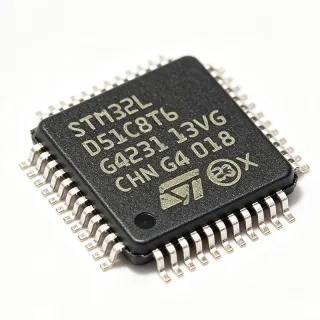
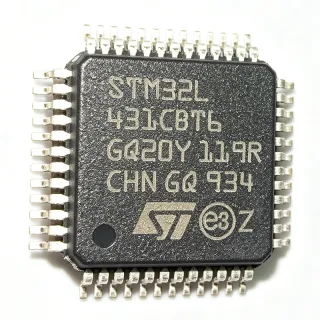
| Boîtier | LQFP-48 (7x7 mm) |
| Type de montage | Surface Mount |
| DSP Instructions | Yes |
| Floating Point Unit | Yes |
| Memory Protection Unit | Yes |
| Core Coupled Memory | Yes |
| Programmable Gain Amplifiers | Yes |
| Analog Comparators | Yes |
| Statut RoHS | Compliant |
Configuration des broches de STM32F302CBT6
| Broche 1 | VBAT — Battery backup supply |
| Broche 2 | PC13 — GPIO / RTC output |
| Broche 3 | PC14 — GPIO / OSC32_IN |
| Broche 4 | PC15 — GPIO / OSC32_OUT |
| Broche 5 | PF0 — GPIO / OSC_IN |
| Broche 6 | PF1 — GPIO / OSC_OUT |
| Broche 7 | NRST — Reset (active low) |
| Broche 8 | VDD — Digital power supply |
| Broche 9 | VSS — Digital ground |
| Broche 10 | PA0 — GPIO / ADC_IN0 |
| Broche 11 | PA1 — GPIO / ADC_IN1 |
| Broche 12 | PA2 — GPIO / USART2_TX |
| Broche 13 | PA3 — GPIO / USART2_RX |
| Broche 14 | PA4 — GPIO / DAC_OUT1 |
| Broche 15 | PA5 — GPIO / DAC_OUT2 |
| Broche 16 | PA6 — GPIO / SPI1_MISO |
| Broche 17 | PA7 — GPIO / SPI1_MOSI |
| Broche 18 | PB0 — GPIO / ADC_IN8 |
| Broche 19 | PB1 — GPIO / ADC_IN9 |
| Broche 20 | PB2 — GPIO / BOOT1 |
| Broche 21 | PB10 — GPIO / I2C2_SCL |
| Broche 22 | PB11 — GPIO / I2C2_SDA |
| Broche 23 | PB12 — GPIO / SPI2_NSS |
| Broche 24 | PB13 — GPIO / SPI2_SCK |
| Broche 25 | PB14 — GPIO / SPI2_MISO |
| Broche 26 | PB15 — GPIO / SPI2_MOSI |
| Broche 27 | PA8 — GPIO / MCO |
| Broche 28 | PA9 — GPIO / USART1_TX |
| Broche 29 | PA10 — GPIO / USART1_RX |
| Broche 30 | PA11 — GPIO / USB_DM |
| Broche 31 | PA12 — GPIO / USB_DP |
| Broche 32 | PA13 — GPIO / SWDIO |
| Broche 33 | PA14 — GPIO / SWCLK |
| Broche 34 | PA15 — GPIO / JTDI |
| Broche 35 | PB3 — GPIO / JTDO |
| Broche 36 | PB4 — GPIO / NJTRST |
| Broche 37 | PB5 — GPIO / I2C1_SMBA |
| Broche 38 | PB6 — GPIO / I2C1_SCL |
| Broche 39 | PB7 — GPIO / I2C1_SDA |
| Broche 40 | BOOT0 — Boot mode selection |
| Broche 41 | PB8 — GPIO / CAN_RX |
| Broche 42 | PB9 — GPIO / CAN_TX |
| Broche 43 | VDD — Digital power supply |
| Broche 44 | VSS — Digital ground |
| Broche 45 | PC14 — GPIO / OSC32_IN |
| Broche 46 | PC15 — GPIO / OSC32_OUT |
| Broche 47 | PC13 — GPIO / RTC output |
| Broche 48 | VBAT — Battery backup supply |
Applications typiques
STM32F302CBT6 convient pour 6 applications: Motor Control, Digital Power Conversion, Audio Processing, Industrial Automation, Medical Devices, Consumer Electronics.
Motor Control
The STM32F302CBT6 is ideal for motor control applications due to its high-speed 12-bit ADC (5 MSPS), comparators, and advanced PWM timers. The Cortex-M4 FPU accelerates field-oriented control (FOC) algorithms, enabling efficient and precise control of brushless DC (BLDC) and permanent magnet synchronous motors (PMSM). In a typical motor control system, the MCU reads phase currents and rotor position via the ADC, processes the FOC algorithm, and generates PWM signals to drive the inverter. The high-speed ADC ensures accurate current sensing, while the comparators provide overcurrent protection. The FPU reduces computation time for complex mathematical operations, allowing higher control loop frequencies and improved dynamic response. Compared to MCUs without an FPU, the STM32F302CBT6 can execute FOC algorithms with lower latency, reducing torque ripple and improving efficiency. Designers should ensure proper isolation between power and control stages and use dedicated PWM timers with dead-time insertion to prevent shoot-through.
Recommandé
Digital Power Conversion
The STM32F302CBT6 is well-suited for digital power conversion applications such as switch-mode power supplies (SMPS) and DC-DC converters. Its high-speed ADC (5 MSPS) enables precise voltage and current sensing, while the comparators and PWM timers facilitate digital control loops. The Cortex-M4 FPU accelerates complex control algorithms like PID and predictive control, improving transient response and efficiency. In a typical digital power supply, the MCU samples the output voltage and current, computes the control signal, and adjusts the PWM duty cycle to maintain regulation. The high-speed ADC ensures minimal delay in the control loop, reducing output voltage ripple. The device's analog peripherals, including PGAs, allow direct interfacing with current sense resistors without external amplifiers. Compared to analog controllers, the STM32F302CBT6 offers flexibility for implementing advanced features like digital compensation and telemetry. Designers should pay attention to the ADC sampling timing and use appropriate filtering to minimize noise in the control loop.
Recommandé
Audio Processing
The STM32F302CBT6 is suitable for audio processing applications due to its Cortex-M4 core with FPU and DSP instructions, which accelerate audio algorithms like filtering, equalization, and noise reduction. The high-speed ADC can sample audio signals at high rates, while the DAC (if available) can output processed audio. In a typical audio application, the MCU reads audio data from a microphone or line input, processes it using DSP algorithms, and outputs the result to a speaker or headphone. The FPU enables efficient implementation of floating-point filters, reducing quantization noise and improving audio quality. The device's low power consumption and small package make it suitable for portable audio devices. Compared to MCUs without an FPU, the STM32F302CBT6 can handle more complex audio processing tasks in real-time. Designers should ensure proper grounding and shielding to minimize noise in the audio signal path.
Recommandé
Industrial Automation
The STM32F302CBT6 is used in industrial automation for applications like PLCs, sensors, and actuators. Its robust design, wide operating temperature range (-40°C to +85°C), and rich peripheral set make it suitable for harsh environments. The high-speed ADC and comparators enable precise analog signal acquisition and threshold detection. The Cortex-M4 core with FPU accelerates control algorithms for robotics and motion control. In a typical industrial sensor, the MCU reads analog signals from sensors, processes them, and communicates via interfaces like UART, SPI, or I2C. The device's multiple timers and PWM outputs can drive actuators and motors. Compared to general-purpose MCUs, the STM32F302CBT6 offers better analog performance and processing power, making it ideal for advanced industrial applications. Designers should consider using external protection components like TVS diodes and optocouplers for isolation in industrial environments.
Recommandé
Medical Devices
The STM32F302CBT6 is used in medical devices such as patient monitors, infusion pumps, and diagnostic equipment. Its high-speed ADC and analog peripherals enable precise measurement of physiological signals like ECG and blood pressure. The Cortex-M4 core with FPU accelerates signal processing algorithms for filtering and analysis. In a typical patient monitor, the MCU samples ECG signals, processes them to detect abnormalities, and displays the results on a screen. The device's low power consumption is critical for battery-powered portable medical devices. Compared to MCUs without an FPU, the STM32F302CBT6 can handle more complex signal processing in real-time, improving diagnostic accuracy. Designers must ensure compliance with medical safety standards like IEC 60601 and use appropriate isolation and protection circuits.
Recommandé
Consumer Electronics
The STM32F302CBT6 is used in consumer electronics like smart home devices, wearables, and gaming peripherals. Its small package, low power consumption, and rich peripheral set make it suitable for space-constrained designs. The high-speed ADC and comparators enable touch sensing and analog signal processing. The Cortex-M4 core with FPU accelerates user interface algorithms and audio processing. In a typical smart home device, the MCU reads sensor data, processes it, and communicates via Bluetooth or Wi-Fi modules. The device's multiple timers and PWM outputs can drive LEDs and buzzers. Compared to general-purpose MCUs, the STM32F302CBT6 offers better performance and analog capabilities, making it ideal for advanced consumer products. Designers should consider using low-power modes to extend battery life in portable devices.
Recommandé
Récapitulatif des produits recommandés
Données de référence d'ingénierie pour STM32F302CBT6 — comparaison, recommandations de conception et informations de conformité.
Guide de sélection
Comparaison avec les alternatives
| Paramètre | Ce produit | STM32F302CCT6 | STM32F302RBT6 | STM32F302C8T6 | GD32F303CBT6 | STM32F303CBT6 |
|---|---|---|---|---|---|---|
| Package | LQFP-48 (7x7 mm) | LQFP-48 (7x7 mm) - same | LQFP-64 (10x10 mm) - different | LQFP-48 (7x7 mm) - same | LQFP-48 (7x7 mm) - same | LQFP-48 (7x7 mm) - same |
| Brand | STMicroelectronics | STMicroelectronics | STMicroelectronics | STMicroelectronics | GigaDevice | STMicroelectronics |
| Core | ARM Cortex-M4 with FPU | ARM Cortex-M4 with FPU | ARM Cortex-M4 with FPU | ARM Cortex-M4 with FPU | ARM Cortex-M4 with FPU | ARM Cortex-M4 with FPU |
| Maximum Clock Frequency | 72 MHz | 72 MHz | 72 MHz | 72 MHz | 72 MHz | 72 MHz |
| Flash Memory | 128 KB | 256 KB | 128 KB | 64 KB | 128 KB | 128 KB |
| SRAM | 32 KB | 32 KB | 32 KB | 16 KB | 32 KB | 32 KB |
| Supply Voltage Range | 2.0V to 3.6V | 2.0V to 3.6V | 2.0V to 3.6V | 2.0V to 3.6V | 2.6V to 3.6V | 2.0V to 3.6V |
Principaux différenciateurs
- High-speed ADC with 5 MSPS sampling rate (vs STM32F103CBT6)
- Integrated programmable gain amplifiers (PGAs) (vs STM32F103CBT6)
- Floating-point unit (FPU) for faster math (vs STM32F103CBT6)
Notes de conception
The STM32F302CBT6 operates from 2.0V to 3.6V. Use a 100nF decoupling capacitor on each VDD pin and a 4.7uF bulk capacitor on the main supply. For the VDDA pin, use a 1uF capacitor and a ferrite bead to isolate analog noise. Ensure the VSSA pin is connected to a clean analog ground.
For the LQFP-48 package, ensure proper solder paste stencil design to avoid bridging. Place the crystal oscillator close to the OSC_IN/OSC_OUT pins with load capacitors as specified in the datasheet. Keep the SWD interface traces short and shielded to prevent noise during debugging.
Do not leave unused pins floating; configure them as outputs or tie them to a defined level. Ensure the BOOT0 pin is properly pulled low for normal operation. When using the ADC, avoid routing digital traces near the analog input pins to minimize noise coupling.
Informations de conformité
RoHS compliant per STMicroelectronics product page. Not AEC-Q100 qualified - this is a standard-grade MCU.