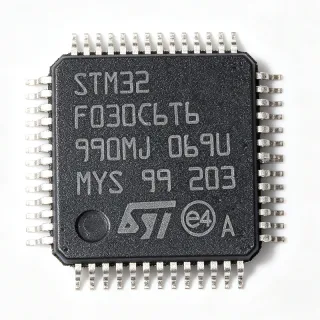
STM32L072CZT6 - 192KB Flash Cortex-M0+ MCU | STMicroelectronics
Référence : STM32L072CZT6 ✓ Actif| Qté | Prix unitaire | Total |
|---|---|---|
| 1 | $6.12 | $6,12 |
| 10 | $5.42 | $54,20 |
| 100 | $4.75 | $475,00 |
| 500 | $4.21 | $2 105,00 |
| 1 000 | $3.78 | $3 780,00 |
STM32L072CZT6 Présentation
An ARM Cortex-M0+ microcontroller (MCU) is a 32-bit RISC processor core from ARM's Cortex-M family optimized for energy efficiency and deterministic interrupt response in deeply embedded systems. The Cortex-M0+ sits at the low-power end of the Cortex-M lineup (Cortex-M0+ -> Cortex-M0 -> Cortex-M3/M4/M33), and STM32L0 microcontrollers sit at the low-power end of the STM32 product hierarchy (STM32L0 -> STM32L1/L4/L5 -> STM32F/G/H families). L0-series MCUs target coin-cell, sensor, metering, and wearable designs where standby current and integrated analog peripherals matter more than raw compute throughput.
Key features of the STM32L072CZT6 include 192 KB Flash with ECC, 20 KB SRAM, a 12-bit ADC with hardware oversampling, two ultra-low-power comparators, a real-time clock, multiple timers, and a USB 2.0 full-speed device interface that operates without an external crystal. The device supports AES-128 hardware encryption for secure connectivity in IoT endpoints. Integrated peripherals include I2C, SPI, USART, USB, and capacitive-touch sensing I/Os.
The architecture combines a Cortex-M0+ core with ST's ultra-low-power design techniques, including multiple voltage domains, low-power RTC, and a wide set of GPIOs tolerant to 5 V. The 48-pin LQFP package balances compact board footprint with easy hand-soldering and breadboard prototyping, and supports the full STM32L072xx peripheral set on the available I/O count.
Typical applications include battery-powered IoT sensors, USB-connected wearables, smart metering endpoints, wireless sensor nodes, medical patch devices, asset trackers, and human-machine interface panels. Designers value the part for USB connectivity in small form factors, deep-sleep currents, and an established STM32 toolchain (STM32CubeIDE, HAL/LL libraries). When designing with this part, plan decoupling around the 1.2 V core regulator pin and verify the low-power mode transitions in your application firmware before committing to battery-life calculations.
Alternatives de remplacement direct pour STM32L072CZT6 — même boîtier, compatible broche à broche. Les références à boîtier différent nécessitant une retouche du PCB sont exclues.
Variantes de cette série
Modèles de la même série directement compatibles avec STM32L072CZT6 (même facteur de forme et même empreinte) — différant par ADC, Communication Interfaces, Core, Timers.
Outil de comparaison rapide — sélectionnez des références alternatives pour une comparaison côte à côte :
STM32L073CZT6
✅ Remplacement direct📋 Alternative de référence (hors catalogue)
STM32L072CZT3
✅ Remplacement direct📋 Alternative de référence (hors catalogue)
STM32L072CZT6D
✅ Remplacement direct📋 Alternative de référence (hors catalogue)
STM32L053CZT6
✅ Remplacement direct📋 Alternative de référence (hors catalogue)
STM32L083CZT6
✅ Remplacement direct📋 Alternative de référence (hors catalogue)
STM32L072CZT6 Valeurs maximales et caractéristiques électriques
| Core | ARM Cortex-M0+ (32-bit) |
| Fréquence d'horloge maximale | 32 MHz |
| Flash Memory | 192 KB |
| SRAM | 20 KB |
| Supply Voltage (VDD) | 1.65 V to 3.6 V |
| Supply Voltage (BOR enabled) | 1.8 V to 3.6 V |
| Température de fonctionnement | -40 C to +85 C (grade 6) |
| Boîtier | 48-pin LQFP (7x7 mm) |
| Type de montage | Surface Mount |
| USB | USB 2.0 full-speed device (crystal-less) |
| ADC | 12-bit, hardware oversampling |
| Comparators | 2 ultra-low-power comparators |
| Timers | Multiple 16-bit and 32-bit timers (see datasheet) |
| Communication Interfaces | I2C, SPI, USART, USB |
| AES Hardware | AES-128 |
| RTC | Yes, with calendar and tamper |
| I/Os | Up to 37 GPIOs (package-dependent) |
| Statut RoHS | Compliant |
Configuration des broches de STM32L072CZT6
| Broche 1 | PB9 — GPIO PB9 / I2C1_SDA |
| Broche 2 | PB10 — GPIO PB10 / I2C2_SDA |
| Broche 3 | PB11 — GPIO PB11 / I2C2_SCL |
| Broche 4 | VDD — Digital supply voltage |
| Broche 5 | PB12 — GPIO PB12 / SPI2_NSS |
| Broche 6 | PB13 — GPIO PB13 / SPI2_SCK |
| Broche 7 | PB14 — GPIO PB14 / SPI2_MISO |
| Broche 8 | PB15 — GPIO PB15 / SPI2_MOSI |
| Broche 9 | PA8 — GPIO PA8 |
| Broche 10 | PA9 — GPIO PA9 / USART1_TX |
| Broche 11 | PA10 — GPIO PA10 / USART1_RX |
| Broche 12 | PA11 — GPIO PA11 / USB_DM |
| Broche 13 | PA12 — GPIO PA12 / USB_DP |
| Broche 14 | PA13 — GPIO PA13 / SWDIO |
| Broche 15 | VSS — Digital ground |
| Broche 16 | VDD — Digital supply voltage |
| Broche 17 | PA14 — GPIO PA14 / SWCLK |
| Broche 18 | PA15 — GPIO PA15 / JTDI |
| Broche 19 | PB3 — GPIO PB3 / JTDO |
| Broche 20 | PB4 — GPIO PB4 / NJTRST |
| Broche 21 | PB5 — GPIO PB5 |
| Broche 22 | PB6 — GPIO PB6 / I2C1_SCL |
| Broche 23 | PB7 — GPIO PB7 / I2C1_SDA |
| Broche 24 | PB8 — GPIO PB8 |
| Broche 25 | VSS — Digital ground |
| Broche 26 | VDD — Digital supply voltage |
| Broche 27 | PC13 — GPIO PC13 / RTC_TAMP |
| Broche 28 | PC14 — GPIO PC14 / OSC32_IN |
| Broche 29 | PC15 — GPIO PC15 / OSC32_OUT |
| Broche 30 | VSS — Digital ground |
| Broche 31 | VDDA — Analog supply voltage |
| Broche 32 | VREF+ — ADC reference voltage |
| Broche 33 | PA0 — GPIO PA0 / ADC_IN0 |
| Broche 34 | PA1 — GPIO PA1 / ADC_IN1 |
| Broche 35 | PA2 — GPIO PA2 / ADC_IN2 / USART2_TX |
| Broche 36 | PA3 — GPIO PA3 / ADC_IN3 / USART2_RX |
| Broche 37 | PA4 — GPIO PA4 / ADC_IN4 |
| Broche 38 | PA5 — GPIO PA5 / ADC_IN5 |
| Broche 39 | PA6 — GPIO PA6 / ADC_IN6 |
| Broche 40 | PA7 — GPIO PA7 / ADC_IN7 |
| Broche 41 | PC0 — GPIO PC0 / ADC_IN10 |
| Broche 42 | PC1 — GPIO PC1 / ADC_IN11 |
| Broche 43 | PC2 — GPIO PC2 / ADC_IN12 |
| Broche 44 | PC3 — GPIO PC3 / ADC_IN13 |
| Broche 45 | VSSA — Analog ground |
| Broche 46 | VREF- — ADC reference ground |
| Broche 47 | VSS — Digital ground |
| Broche 48 | VDD — Digital supply voltage |
Applications typiques
STM32L072CZT6 convient pour 6 applications: Battery-Powered IoT Sensor Nodes, USB-Connected Wearable Devices, Smart Metering Endpoints, Medical Patch and Health Monitoring Devices, Asset Tracking and Cold-Chain Loggers, Human-Machine Interface Panels.
Battery-Powered IoT Sensor Nodes
The STM32L072CZT6 fits battery-powered IoT sensor nodes because of its sub-microamp Standby current (sub-uA) and 192 KB Flash for sensor-stack firmware. Its 32 MHz Cortex-M0+ core is fast enough for periodic sensor sampling while sleeping deeply between events, which directly extends CR2032 coin-cell life. According to the ST datasheet, Stop mode with RTC draws less than 1 uA, enabling multi-year battery deployments for environmental sensors.
Recommandé
USB-Connected Wearable Devices
The STM32L072CZT6 is well matched to USB-connected wearables because of its crystal-less USB 2.0 full-speed device interface and 192 KB Flash for vendor-class USB stacks. Designers save a 48 MHz crystal and reduce BOM cost while maintaining USB compliance, per the ST datasheet. The LQFP-48 package fits on small wearable PCAs with 5 V-tolerant GPIOs for charger integration.
Recommandé
Smart Metering Endpoints
Smart metering applications benefit from the STM32L072CZT6's RTC with calendar, tamper detection, AES-128 hardware encryption, and 12-bit ADC for voltage/current sensing. The part's wide 1.65-3.6 V supply supports battery-backed meter designs, and the LQFP-48 footprint provides enough I/Os for meter interfaces. According to the datasheet, AES-128 hardware runs at low power without CPU overhead, securing AMI traffic.
Recommandé
Medical Patch and Health Monitoring Devices
The STM32L072CZT6 suits medical patch devices thanks to its low-power modes, 12-bit ADC with hardware oversampling, and 192 KB Flash for DSP-style signal processing. According to the ST datasheet, the 12-bit ADC reaches 16-bit effective resolution with oversampling, supporting accurate bio-potential measurements. The LQFP-48 package is small enough for wearable form factors and has 5 V-tolerant GPIOs for sensor interfacing.
Recommandé
Asset Tracking and Cold-Chain Loggers
Cold-chain and asset tracking applications benefit from the STM32L072CZT6's RTC calendar, low-power Stop mode, AES-128 for signed log integrity, and 192 KB Flash for local storage of time-stamped events. The 32 MHz Cortex-M0+ core is sufficient to drive temperature/humidity sampling and USB-based log extraction in field service. Per ST documentation, the part handles -40 C to +85 C industrial environments.
Recommandé
Human-Machine Interface Panels
The STM32L072CZT6 supports HMI panel designs with its capacitive-touch sensing I/Os, 12-bit ADC for analog slider feedback, AES-128 for secure boot, and 192 KB Flash for graphics state machines. The LQFP-48 footprint provides sufficient I/O count for keypad scanning plus LCD segment driving via external drivers. The crystal-less USB interface supports field firmware updates without an external oscillator.
Recommandé
Récapitulatif des produits recommandés
Données de référence d'ingénierie pour STM32L072CZT6 — comparaison, recommandations de conception et informations de conformité.
Guide de sélection
Comparaison avec les alternatives
| Paramètre | Ce produit | STM32L073CZT6 | STM32L072CZT3 | STM32L072CZT6D | STM32L053CZT6 | STM32L083CZT6 |
|---|---|---|---|---|---|---|
| Package | LQFP-48 (7x7 mm) | LQFP-48 (7x7 mm) - same | LQFP-48 (7x7 mm) - same | LQFP-48 (7x7 mm) - same | LQFP-48 (7x7 mm) - same | LQFP-48 (7x7 mm) - same |
| Brand | STMicroelectronics | STMicroelectronics | STMicroelectronics | STMicroelectronics | STMicroelectronics | STMicroelectronics |
| Flash Memory | 192 KB | 192 KB | 192 KB | 192 KB | 192 KB | 192 KB |
| SRAM | 20 KB | 20 KB | 20 KB | 20 KB | 20 KB | 20 KB |
| USB Peripheral | Yes (crystal-less USB 2.0 FS) | Yes | Yes | Yes | No | Yes |
| AES-128 Hardware | Yes | Yes | Yes | Yes | Yes | Yes |
| Wireless Connectivity | None | Sigfox | None | None | None | LoRa |
| Operating Temperature | -40 C to +85 C | -40 C to +85 C | -40 C to +125 C | -40 C to +85 C | -40 C to +85 C | -40 C to +85 C |
| Supply Voltage | 1.65 V to 3.6 V | 1.65 V to 3.6 V | 1.65 V to 3.6 V | 1.65 V to 3.6 V | 1.65 V to 3.6 V | 1.65 V to 3.6 V |
Principaux différenciateurs
- Crystal-less USB 2.0 full-speed peripheral (vs STM32L053CZT6)
- Optional wireless connectivity without PCB rework (vs STM32L073CZT6)
- 192 KB Flash headroom for USB stacks (vs STM32L052C8T6)
Notes de conception
Estimated: at 32 MHz active core current with peripherals disabled the STM32L072CZT6 draws around 1 mA/MHz per ST datasheet figures. Add 100 nF + 10 uF ceramic decoupling near each VDD/VDDA pin and a ferrite bead between digital and analog supplies for clean ADC readings. Use the integrated voltage regulator to drive VDD from a 1.8 V to 3.3 V rail and avoid supplying core voltage externally.
At low duty cycles the STM32L072CZT6 spends nearly all its time in Stop or Standby, so self-heating is negligible. For continuous-active designs at 32 MHz, the LQFP-48 theta_JA around 65 C/W produces only a few degrees of rise even without a copper pour. Still place thermal vias under the exposed pad if your PCB stackup supports it.
Route the USB DP/DM pair (PA11/PA12) as a 90 ohm differential with length matching within 150 mils and keep them away from switching nodes. The crystal-less USB relies on internal trimming, so a clean 3.3 V rail with low ripple is essential. Per ST AN4879, place the USB common-mode choke near the connector side of the route.
Do not exceed 3.6 V on any pin including 5 V-tolerant GPIOs. Make sure BOOT0 is tied low for normal Flash boot and pulled high only for system memory bootloader access. Disable unused peripherals in PWR register settings before entering Stop mode to achieve sub-microamp current per the ST reference manual RM03510.
Informations de conformité
RoHS and REACH compliance per ST product page. Not AEC-Q100 qualified - this is a commercial/consumer part. For automotive applications use the equivalent -A or -Q suffix variant if available.