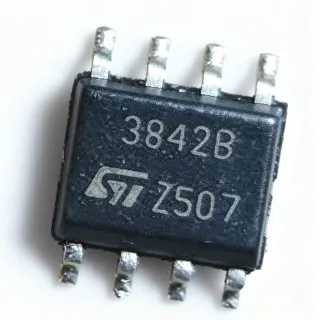
TEA2017AAT/3 - Digital LLC + Multimode PFC Combo Controller | NXP
Référence : TEA2017AAT/3 ✓ Actif| Qté | Prix unitaire | Total |
|---|---|---|
| 1 | $1.83 | $1,83 |
| 10 | $1.68 | $16,80 |
| 100 | $1.52 | $152,00 |
| 500 | $1.4 | $700,00 |
| 1 000 | $1.28 | $1 280,00 |
TEA2017AAT/3 Présentation
An LLC + PFC combo controller is a power management IC that governs the two main power-conversion stages of a modern AC-DC supply: the power factor correction (PFC) front end and the LLC resonant half-bridge stage that provides isolated, regulated DC output. Within the power management IC hierarchy, it belongs to AC-DC controllers with integrated PFC, where combining both control loops in a single IC reduces component count, board area, and design complexity.
Key features include a fully digital architecture built on a high-speed configurable hardware state machine ensuring reliable real-time performance, a PFC configurable for DCM/QR or CCM fixed-frequency operation, and integrated advanced functions such as active X-capacitor discharge and external OTP (over-temperature protection) sensing. The PFC control uses average current mode, delivering low input-current distortion and high power factor across the universal AC input range.
Technical depth: because both control engines share one digital die, inter-stage coordination such as burst-mode operation at light load and PFC/LLC sequencing is handled natively, enabling very high efficiency from light load to full 1000 W output. Paired with the TEA2095T dual-channel LLC resonant synchronous rectifier controller, the TEA2017AAT forms a complete high-performance, cost-effective resonant power supply solution.
Typical applications include server and telecom power supplies, LED street lighting drivers, audio amplifiers, notebook and desktop adapters, and open-frame industrial power supplies in the 90 W to 1000 W range.
Design consideration: according to NXP, the TEA2017AAT/3 is a pin-compatible update of the TEA2017AAT/2, but a few small differences must be considered when replacing /2 with /3; for new designs the /3 version is preferred. Route the PFC current-sense network close to IC pin 4 GND near the PFC sense resistor and bulk capacitor ground.
This page synthesizes distributor pricing, drop-in alternatives verified against NXP application note AN13140, and practical design notes not found in the manufacturer datasheet.
Alternatives de remplacement direct pour TEA2017AAT/3 — même boîtier, compatible broche à broche. Les références à boîtier différent nécessitant une retouche du PCB sont exclues.
Outil de comparaison rapide — sélectionnez des références alternatives pour une comparaison côte à côte :
TEA2017AAT/2Y
✅ Remplacement direct📋 Alternative de référence (hors catalogue)
TEA2016AAT
✅ Remplacement direct📋 Alternative de référence (hors catalogue)
TEA2017AAT/3 Valeurs maximales et caractéristiques électriques
| Fonction | Digital configurable LLC + multimode PFC combo controller |
| Application Power Range | 90 W to 1000 W |
| PFC Operating Modes | DCM/QR, CCM fixed frequency |
| PFC Control Scheme | Average current mode |
| Architecture | Digital, high-speed configurable hardware state machine |
| X-capacitor Discharge | Active (integrated) |
| Over-Temperature Protection | External OTP sensing supported |
| Boîtier | SO16 (low profile, narrow body-width) |
| Type de montage | Surface Mount |
| Supply Topology | AC-DC resonant (LLC half-bridge) |
| Recommended SR Controller Pairing | TEA2095T dual LLC resonant SR controller |
| Programming Tool | TEA2017DK1007 programming kit |
| Statut RoHS | Compliant |
Guide de configuration des broches du TEA2017AAT/3 so16 (low profile, narrow body-width)
Configuration des broches du TEA2017AAT/3 (boîtier so16 (low profile, narrow body-width)). Ce composant de puissance comporte des bornes de grille, de drain et de source. Pour les boîtiers non polarisés, consultez la fiche technique du fabricant pour l'orientation exacte de la broche 1 et les détails de l'empreinte. Les applications courantes incluent la conception d'alimentations, la commande de moteurs et la commutation de charges.

Aucune donnée de brochage détaillée disponible pour TEA2017AAT/3.
Consultez la fiche technique pour la configuration complète des broches.
Applications typiques
TEA2017AAT/3 convient pour 6 applications: Server and Telecom Power Supplies, LED Street and Industrial Lighting Drivers, Audio Amplifier Power Supplies, High-Power AC-DC Adapters, Open-Frame Industrial Power Supplies, Consumer TV and Display Power Boards.
Server and Telecom Power Supplies
The TEA2017AAT/3 fits 90 W to 1000 W server PSUs and telecom rectifiers where 80 PLUS-class efficiency is mandatory. Its CCM fixed-frequency PFC with average current mode control keeps input-current distortion low at full load, while the digital LLC stage maintains high efficiency across the load range. Combined with the TEA2095T secondary-side SR controller, synchronous rectification minimizes output-stage losses at low output voltages. Active X-capacitor discharge supports inrush and safety requirements without extra bleed resistors, and burst-mode coordination between PFC and LLC preserves light-load efficiency for redundant server systems operating at partial capacity.
Recommandé
LED Street and Industrial Lighting Drivers
High-power LED luminaires in the 90 W to 300 W range benefit from the TEA2017AAT/3's single-IC PFC + LLC integration, which reduces component count on space-constrained driver boards and improves reliability by cutting solder-joint count. The DCM/QR PFC mode optimizes efficiency at typical lighting loads, while low-ripple LLC output protects LED strings from visible flicker. External OTP sensing allows direct attachment of an NTC to the luminaire housing for accurate thermal protection, and the digital state-machine architecture delivers deterministic protection timing required for outdoor installations with wide ambient temperature swings.
Recommandé
Audio Amplifier Power Supplies
Class-D audio amplifiers demand compact supplies with excellent transient response and low output noise. The TEA2017AAT/3's resonant LLC topology switches the power stage sinusoidally, producing far less EMI than flyback or forward designs, which simplifies filtering near sensitive audio circuitry. The digital control loop adapts to audio load transients, and light-load burst operation keeps standby power low between tracks. In a 200 W to 500 W powered-speaker supply, pairing with the TEA2095T for secondary synchronous rectification raises efficiency and reduces heatsink size, enabling sealed enclosures without forced airflow.
Recommandé
High-Power AC-DC Adapters
Notebook, monitor, and industrial adapters between 90 W and 250 W use the TEA2017AAT/3 to meet universal-input efficiency regulations with minimal board area. The narrow-body SO16 package suits the low-profile form factor of wall adapters, and integration of PFC and LLC control removes a second controller IC from the BOM. DCM/QR PFC delivers high efficiency at adapter-typical partial loads, while active X-capacitor discharge meets disconnect-plug safety requirements without dissipative resistors. External OTP sensing supports adapter thermal protection at the transformer or enclosure for compliance with safety standards.
Recommandé
Open-Frame Industrial Power Supplies
DIN-rail and open-frame industrial supplies in the 100 W to 1000 W class exploit the TEA2017AAT/3's wide power coverage and robust digital protection set. CCM PFC mode handles continuous full-load operation from three-phase-derived or single-phase universal AC, while the LLC stage provides regulated, tightly specified output rails for PLCs, drives, and instrumentation. The hardware state-machine architecture ensures predictable protection behavior under fault conditions such as short circuit or overload, which industrial certifications demand, and configurable OTP thresholds let one controller design span multiple product temperature ratings.
Recommandé
Consumer TV and Display Power Boards
Large-screen TVs and monitors require compact combined standby and main power stages; the TEA2017AAT/3's integrated PFC + LLC control enables a single-controller main board with high efficiency at both video-playback and standby load points. Burst-mode operation meets regional standby power limits, and the LLC topology's low switching noise prevents interference with sensitive display timing circuitry on the same PCB. The digital configurability allows one hardware platform to be reprogrammed for different panel sizes and power ratings, reducing development cost across a TV product family.
Recommandé
Récapitulatif des produits recommandés
Données de référence d'ingénierie pour TEA2017AAT/3 — comparaison, recommandations de conception et informations de conformité.
Guide de sélection
Comparaison avec les alternatives
| Paramètre | Ce produit | TEA2017AAT/2Y | TEA2016AAT |
|---|---|---|---|
| Package | SO16 | SO16 - same | SO16 - same |
| Brand | NXP Semiconductors | NXP Semiconductors | NXP Semiconductors |
| Controller Type | LLC + multimode PFC combo (digital) | LLC + multimode PFC combo (digital) | PFC + resonant combo (predecessor generation) |
| Pin Compatibility | Reference (SO16) | Pin compatible (per AN13140) | Pin-to-pin compatible (per NXP community) |
Principaux différenciateurs
- Latest silicon revision preferred by NXP for new designs (vs TEA2017AAT/2Y)
- Average current mode PFC control (vs TEA2016AAT)
- Single-IC PFC + LLC integration with active X-cap discharge (vs TEA2016AAT)
Notes de conception
Because the TEA2017 PFC control is average current mode, sense IC pin 4 (GND) near the PFC current-sense resistor, and place the PFC sense resistor near the bulk capacitor ground. This layout guidance comes directly from NXP's official community guidance for TEA2016-to-TEA2017 migration; poor grounding here causes PFC current-loop errors and distorted input current, especially after swapping from the peak-current-mode TEA2016.
When replacing a TEA2017AAT/2 with the TEA2017AAT/3, review NXP application note AN13140 first: the parts are functionally and pin compatible, but AN13140 documents a few small differences that must be considered during migration. Do not assume bit-identical behavior of protection timings or configuration registers. For all new designs NXP explicitly prefers the /3 version.
Use the TEA2017DK1007 programming kit (socket board plus development samples) to configure PFC mode (DCM/QR vs CCM) and protection settings before committing to production. Choosing DCM/QR improves light-load efficiency for adapters, while CCM fixed frequency is preferable for continuous high-load industrial supplies above roughly 300 W where low input-current ripple matters.
Estimated: the controller itself dissipates little power, but the external PFC and LLC MOSFETs dominate thermal design in a 1000 W supply. Place the external OTP sensing NTC at the transformer or hottest MOSFET tab rather than near the SO16 IC, so the TEA2017AAT/3 protection reacts to the true thermal stress point of the power stage.
Informations de conformité
RoHS compliant per NXP product listing; other compliance details not stated in provided data.