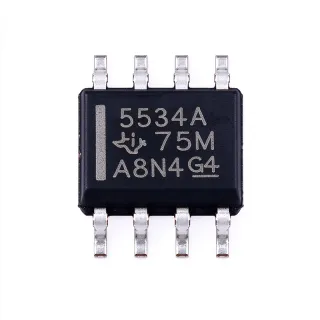
MC33078DG4 - Dual 16 MHz Low-Noise Op Amp | Texas Instruments
MPN: MC33078DG4 ✗ סוף ייצורMC33078DG4 סקירה
An operational amplifier is a voltage-gain building block used to amplify, buffer, filter, and compare small analog signals. The MC33078 belongs to the broader hierarchy of operational amplifiers, analog amplifiers, signal-conditioning ICs, and semiconductor components. Its bipolar input stage and high-frequency PNP transistor design emphasize low noise, high gain bandwidth, and fast slew performance rather than the very-low-quiescent-current operation associated with many CMOS amplifier families.
The two amplifiers provide useful flexibility in analog signal chains. A 16 MHz gain-bandwidth product supports higher closed-loop gain and wider-bandwidth designs than a general-purpose low-speed op amp. The 7 V/µs slew rate is particularly useful for audio, active-filter, line-driver, and instrumentation applications where the output must follow changing input waveforms with low distortion. The 4.5 nV/√Hz input-noise figure helps preserve low-level signals in precision audio and data-acquisition circuits.
The MC33078 family also supports operation from a single supply or from split positive and negative supplies. This makes the device applicable to circuits operating from a single rail, conventional ±15 V laboratory systems, and dual-rail industrial electronics. Its general-purpose classification indicates that it is not dedicated to one market segment; instead, it serves mixed-signal designs requiring better speed and noise performance than ordinary general-purpose amplifiers.
Typical uses include high-quality audio preamplification, active filters, instrumentation amplifiers, low-level sensor conditioning, audio line stages, and general dual-amplifier signal processing. The dual configuration can reduce component count when two independent gain paths are required, provided both channels remain within the same common-mode, supply, and stability limits. Decoupling capacitors should be placed close to the supply pins, while output isolation resistors should be considered where capacitive loading could compromise stability.
The principal design trade-off is speed and noise performance versus supply headroom. The fast 7 V/µs slew rate and 16 MHz gain-bandwidth product make the amplifier well suited to wider-bandwidth signals, but those characteristics do not eliminate the need to check output swing, input common-mode range, noise gain, and stability at the intended operating voltage. The MC33078DG4 is also a legacy TI orderable, so engineers should confirm lifecycle status and availability for new production programs.
This page combines the manufacturer specifications, documented package information, lifecycle observations, cross-reference candidates, and application-oriented design guidance. It also distinguishes confirmed drop-in candidates from alternatives that require engineering review, helping PCB designers evaluate replacement options without confusing an 8-SOIC footprint match with complete electrical equivalence.
חלופות תחליף ישיר עבור MC33078DG4 — אותו מארז, תואם פין-לפין. חלקים במארז שונה הדורשים עיבוד מחדש של ה-PCB אינם נכללים.
MC33078DRE4
✅ Drop-In📋 חלופה להתייחסות (לא בקטלוג)
MC33078DR
✅ Drop-In📋 חלופה להתייחסות (לא בקטלוג)
MC33078DG
✅ Drop-In📋 חלופה להתייחסות (לא בקטלוג)
MC33078DG4 דירוגים מרביים ומאפיינים חשמליים
| Amplifier Type | General Purpose |
| Number of Circuits | 2 circuits |
| Technology | Bipolar |
| Gain-Bandwidth Product | 16 MHz |
| Slew Rate | 7 V/µs |
| Input Voltage Noise Density | 4.5 nV/√Hz |
| Input Offset Voltage | 0.15 mV |
| Total Harmonic Distortion | 0.002% |
| Supply Configuration | Single or dual supply |
| Stated Supply Voltage Range | ±18 V |
| מארז | 8-SOIC (0.154 in, 3.90 mm width) |
| Packaging | Tube |
| סוג הרכבה | Surface mount |
תצורת פינים של MC33078DG4
| פין 1 | OUT A — Amplifier A output |
| פין 2 | IN A- — Amplifier A inverting input |
| פין 3 | IN A+ — Amplifier A non-inverting input |
| פין 4 | V- — Negative supply connection |
| פין 5 | IN B+ — Amplifier B non-inverting input |
| פין 6 | IN B- — Amplifier B inverting input |
| פין 7 | OUT B — Amplifier B output |
| פין 8 | V+ — Positive supply connection |
יישומים טיפוסיים
MC33078DG4 מתאים עבור 6 יישוםs: Low-Noise Audio Preamplifier, Active Audio Filter, Instrumentation Signal Conditioning, Data Acquisition Front End, Precision Voltage Buffer, Communications Signal Interface.
Low-Noise Audio Preamplifier
The MC33078DG4 fits a low-noise audio preamplifier because its documented input-voltage-noise density is 4.5 nV/√Hz and total harmonic distortion is 0.002%. Place one channel in a gain stage ahead of a line-level amplifier or mixer, with the feedback network returned directly to the inverting input. The 7 V/µs slew rate provides additional headroom for higher-frequency audio waveforms, while the bipolar architecture suits low-level source signals that benefit from low input noise. Check the output swing and input common-mode limits against the selected dual-rail voltage, and use stable feedback values for the intended load.
מומלץ
Active Audio Filter
The MC33078DG4 can implement a wide-band active filter because its 16 MHz gain-bandwidth product provides more loop bandwidth than a conventional low-speed general-purpose amplifier. Its 7 V/µs slew rate helps maintain low distortion when the filter passes or shapes fast signal transients, while the 4.5 nV/√Hz noise density limits added input noise in microphone and line-level circuits. Use one amplifier per second-order section and verify phase margin against the exact resistor, capacitor, and load values. Headroom at the output must be checked under the highest expected signal level.
מומלץ
Instrumentation Signal Conditioning
The MC33078DG4 is suitable for instrumentation signal conditioning when low-level sensor information requires more bandwidth and lower input noise than a general-purpose slow amplifier. Its 4.5 nV/√Hz input-noise density reduces the amplifier's contribution to the measurement noise floor, and the 16 MHz gain-bandwidth product supports moderate closed-loop gains and wider-bandwidth sensors. The two channels can form a differential front end or separate measurement and reference paths. Designers should verify input bias current, offset behavior, common-mode range, and output drive before adopting it for high-impedance sources.
מומלץ
Data Acquisition Front End
The MC33078DG4 can condition low-level inputs before an ADC when the signal path requires a 7 V/µs slew rate and 16 MHz gain-bandwidth product. Its low 4.5 nV/√Hz input-noise density is useful when the source impedance is low enough that amplifier noise, rather than source noise, dominates. Configure the stage as a non-inverting or inverting amplifier and place the feedback components close to the amplifier pins to minimize parasitic effects. Confirm settling performance, common-mode range, and ADC input compatibility at the selected sampling rate.
מומלץ
Precision Voltage Buffer
The MC33078DG4 can buffer a low-noise reference or sensor voltage when the driven load is reasonably light and the required bandwidth is below its 16 MHz gain-bandwidth product. The bipolar input stage provides a 4.5 nV/√Hz input-noise density, while the 7 V/µs slew rate allows the output to follow relatively rapid input changes without excessive distortion. Stable unity-gain operation requires attention to output loading and noise gain, so validate the chosen feedback configuration. Confirm that the source, output, and supply voltages remain inside the datasheet's electrical limits.
מומלץ
Communications Signal Interface
The MC33078DG4 can support line-level communications and data-signal interfaces where a dual amplifier, 7 V/µs slew rate, and 16 MHz bandwidth are more useful than minimum-power operation. The two channels can provide independent transmit and receive amplification paths, or one channel can amplify while the other handles filtering or buffering. Its 4.5 nV/√Hz input-noise density is beneficial for small signals, but the complete interface must still satisfy impedance, bandwidth, and common-mode constraints. Keep input routing short and provide local supply bypassing to reduce coupling from fast digital nodes.
מומלץ
סיכום מוצרים מומלצים
נתוני עזר הנדסיים עבור MC33078DG4 — השוואה, הנחיות תכנון ומידע על תאימות.
מדריך בחירה
השוואה עם חלופות
| פרמטר | מוצר זה | MC33078DRE4 | MC33078DR | MC33078DG |
|---|---|---|---|---|
| Brand | Texas Instruments | Texas Instruments | Texas Instruments | onsemi |
| Package | 8-SOIC | 8-SOIC | 8-SOIC | 8-SOIC |
| Number of Amplifiers | 2 circuits | 2 circuits | 2 circuits | 2 circuits |
| Amplifier Type | General Purpose | General Purpose | General Purpose | Low Noise Dual |
מבדילים עיקריים
- Direct same-manufacturer replacement path (לעומתMC33078DRE4)
- High-speed dual-amplifier integration (לעומתMC33078DG)
- Audio-oriented noise and distortion performance (לעומתMC33078DG)
הערות תכנון
Keep the eight-SOIC footprint unchanged when replacing MC33078DG4 with MC33078DRE4 or MC33078DR. Preserve the original pin-1 orientation and verify the pad dimensions and solder-paste pattern against the selected manufacturer's package drawing. A mechanically similar SOIC outline is not enough for a drop-in qualification; compare pin numbering, lead pitch, body width, and exposed thermal features.
Route both amplifier outputs away from input and feedback nodes, and keep the inverting-input traces short because they are sensitive to parasitic capacitance. Connect the power pins to low-impedance planes and place the manufacturer-recommended bypass capacitors close to pins 4 and 8. For audio or instrumentation circuits, separate the analog return path from switching and digital return currents to reduce correlated noise.
Validate closed-loop stability using the actual source impedance, feedback network, load, and output capacitance. The MC33078DG4's 7 V/µs slew rate and 16 MHz gain-bandwidth product support fast signals but can expose insufficient phase margin in aggressive layouts. Add a small isolation resistor between the output and a capacitive load when necessary, then recheck amplitude response and distortion.
Do not treat identical packaging as proof that every replacement is electrically identical. Before substituting MC33078DG4, compare input offset voltage, input bias current, common-mode range, output swing, supply limits, noise density, slew rate, and stability against the design requirements. For the onsemi MC33078DG cross-brand candidate, review the onsemi datasheet directly rather than relying only on the family description.
מידע על תאימות
The available product and distributor records do not explicitly state the required compliance results. Obtain the current declarations and qualification records for the ordered Texas Instruments part before regulated production use.