Texas Instruments

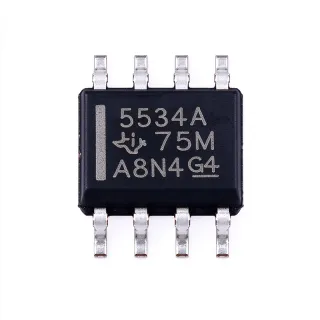
MC33078DG4 - Dual 16 MHz Low-Noise Op Amp | Texas Instruments

MPN: MC33078DG4 ✗ End of Life
4.5 nV/√Hz Vdss 8-SOIC (0.154 in, 3.90 mm width) Package
MOQ: 1 |

MC33078DG4 Overview

The Texas Instruments MC33078DG4 is a bipolar dual operational amplifier designed for quality audio and data-signal processing, with two amplifiers in an 8-pin SOIC package. Key headline specifications include a 16 MHz gain-bandwidth product, 7 V/µs slew rate, and 4.5 nV/√Hz input voltage-noise density. The device supports single- and dual-supply operation, including a stated ±18 V operating range.

An operational amplifier is a voltage-gain building block used to amplify, buffer, filter, and compare small analog signals. The MC33078 belongs to the broader hierarchy of operational amplifiers, analog amplifiers, signal-conditioning ICs, and semiconductor components. Its bipolar input stage and high-frequency PNP transistor design emphasize low noise, high gain bandwidth, and fast slew performance rather than the very-low-quiescent-current operation associated with many CMOS amplifier families.

The two amplifiers provide useful flexibility in analog signal chains. A 16 MHz gain-bandwidth product supports higher closed-loop gain and wider-bandwidth designs than a general-purpose low-speed op amp. The 7 V/µs slew rate is particularly useful for audio, active-filter, line-driver, and instrumentation applications where the output must follow changing input waveforms with low distortion. The 4.5 nV/√Hz input-noise figure helps preserve low-level signals in precision audio and data-acquisition circuits.

The MC33078 family also supports operation from a single supply or from split positive and negative supplies. This makes the device applicable to circuits operating from a single rail, conventional ±15 V laboratory systems, and dual-rail industrial electronics. Its general-purpose classification indicates that it is not dedicated to one market segment; instead, it serves mixed-signal designs requiring better speed and noise performance than ordinary general-purpose amplifiers.

Typical uses include high-quality audio preamplification, active filters, instrumentation amplifiers, low-level sensor conditioning, audio line stages, and general dual-amplifier signal processing. The dual configuration can reduce component count when two independent gain paths are required, provided both channels remain within the same common-mode, supply, and stability limits. Decoupling capacitors should be placed close to the supply pins, while output isolation resistors should be considered where capacitive loading could compromise stability.

The principal design trade-off is speed and noise performance versus supply headroom. The fast 7 V/µs slew rate and 16 MHz gain-bandwidth product make the amplifier well suited to wider-bandwidth signals, but those characteristics do not eliminate the need to check output swing, input common-mode range, noise gain, and stability at the intended operating voltage. The MC33078DG4 is also a legacy TI orderable, so engineers should confirm lifecycle status and availability for new production programs.

This page combines the manufacturer specifications, documented package information, lifecycle observations, cross-reference candidates, and application-oriented design guidance. It also distinguishes confirmed drop-in candidates from alternatives that require engineering review, helping PCB designers evaluate replacement options without confusing an 8-SOIC footprint match with complete electrical equivalence.

Drop-in alternatives for MC33078DG4 — same package, pin-to-pin compatible. Different-package parts requiring PCB rework are excluded.

MC33078DRE4

✅ Drop-In
📦 8-SOIC
Same 8-SOIC footprint and 16 MHz gain-bandwidth product; documented as a complete replacement, with temperature-grade and lifecycle details requiring confirmation.

📋 Reference alternative (not in catalog)

MC33078DR

✅ Drop-In
📦 8-SOIC
Same 8-SOIC footprint and 16 MHz gain-bandwidth product; documented as a complete replacement, with package-ordering and lifecycle details requiring confirmation.

📋 Reference alternative (not in catalog)

MC33078DG

✅ Drop-In
📦 8-SOIC
Same dual 8-SOIC format; electrical equivalence requires checking because the manufacturer and detailed offset, bias-current, and supply-limit values are not provided in the cross-reference listing.

📋 Reference alternative (not in catalog)

MC33078DG4 Maximum Ratings & Electrical Characteristics

Amplifier Type General Purpose
Number of Circuits 2 circuits
Technology Bipolar
Gain-Bandwidth Product 16 MHz
Slew Rate 7 V/µs
Input Voltage Noise Density 4.5 nV/√Hz
Input Offset Voltage 0.15 mV
Total Harmonic Distortion 0.002%
Supply Configuration Single or dual supply
Stated Supply Voltage Range ±18 V
Package 8-SOIC (0.154 in, 3.90 mm width)
Packaging Tube
Mounting Type Surface mount

MC33078DG4 Pin Configuration

SOIC-8 Package Pinout Diagram SOIC-8 8-pin small outline IC, 3.9x4.9mm, P1.27mm, JEDEC MS-012. 1 8 2 7 3 6 4 5 SOIC-8
Pin 1 OUT A — Amplifier A output
Pin 2 IN A- — Amplifier A inverting input
Pin 3 IN A+ — Amplifier A non-inverting input
Pin 4 V- — Negative supply connection
Pin 5 IN B+ — Amplifier B non-inverting input
Pin 6 IN B- — Amplifier B inverting input
Pin 7 OUT B — Amplifier B output
Pin 8 V+ — Positive supply connection

Typical Applications

MC33078DG4 is suitable for 6 applications: Low-Noise Audio Preamplifier, Active Audio Filter, Instrumentation Signal Conditioning, Data Acquisition Front End, Precision Voltage Buffer, Communications Signal Interface.

🎧

Low-Noise Audio Preamplifier

The MC33078DG4 fits a low-noise audio preamplifier because its documented input-voltage-noise density is 4.5 nV/√Hz and total harmonic distortion is 0.002%. Place one channel in a gain stage ahead of a line-level amplifier or mixer, with the feedback network returned directly to the inverting input. The 7 V/µs slew rate provides additional headroom for higher-frequency audio waveforms, while the bipolar architecture suits low-level source signals that benefit from low input noise. Check the output swing and input common-mode limits against the selected dual-rail voltage, and use stable feedback values for the intended load.

🎧

Active Audio Filter

The MC33078DG4 can implement a wide-band active filter because its 16 MHz gain-bandwidth product provides more loop bandwidth than a conventional low-speed general-purpose amplifier. Its 7 V/µs slew rate helps maintain low distortion when the filter passes or shapes fast signal transients, while the 4.5 nV/√Hz noise density limits added input noise in microphone and line-level circuits. Use one amplifier per second-order section and verify phase margin against the exact resistor, capacitor, and load values. Headroom at the output must be checked under the highest expected signal level.

🏭

Instrumentation Signal Conditioning

The MC33078DG4 is suitable for instrumentation signal conditioning when low-level sensor information requires more bandwidth and lower input noise than a general-purpose slow amplifier. Its 4.5 nV/√Hz input-noise density reduces the amplifier's contribution to the measurement noise floor, and the 16 MHz gain-bandwidth product supports moderate closed-loop gains and wider-bandwidth sensors. The two channels can form a differential front end or separate measurement and reference paths. Designers should verify input bias current, offset behavior, common-mode range, and output drive before adopting it for high-impedance sources.

🖥️

Data Acquisition Front End

The MC33078DG4 can condition low-level inputs before an ADC when the signal path requires a 7 V/µs slew rate and 16 MHz gain-bandwidth product. Its low 4.5 nV/√Hz input-noise density is useful when the source impedance is low enough that amplifier noise, rather than source noise, dominates. Configure the stage as a non-inverting or inverting amplifier and place the feedback components close to the amplifier pins to minimize parasitic effects. Confirm settling performance, common-mode range, and ADC input compatibility at the selected sampling rate.

🔧

Precision Voltage Buffer

The MC33078DG4 can buffer a low-noise reference or sensor voltage when the driven load is reasonably light and the required bandwidth is below its 16 MHz gain-bandwidth product. The bipolar input stage provides a 4.5 nV/√Hz input-noise density, while the 7 V/µs slew rate allows the output to follow relatively rapid input changes without excessive distortion. Stable unity-gain operation requires attention to output loading and noise gain, so validate the chosen feedback configuration. Confirm that the source, output, and supply voltages remain inside the datasheet's electrical limits.

🌐

Communications Signal Interface

The MC33078DG4 can support line-level communications and data-signal interfaces where a dual amplifier, 7 V/µs slew rate, and 16 MHz bandwidth are more useful than minimum-power operation. The two channels can provide independent transmit and receive amplification paths, or one channel can amplify while the other handles filtering or buffering. Its 4.5 nV/√Hz input-noise density is beneficial for small signals, but the complete interface must still satisfy impedance, bandwidth, and common-mode constraints. Keep input routing short and provide local supply bypassing to reduce coupling from fast digital nodes.

What is the Texas Instruments MC33078DG4?
The MC33078DG4 is a Texas Instruments bipolar dual operational amplifier packaged in an 8-SOIC. According to the manufacturer product page, it is intended for quality audio and data-signal applications and combines a 16 MHz gain-bandwidth product, 7 V/µs slew rate, and 4.5 nV/√Hz input-noise density. The two independent amplifier channels can implement gain, filtering, buffering, or signal-conditioning functions in one package.
What are the key specifications of MC33078DG4 that engineers should know?
The MC33078DG4 combines two general-purpose bipolar amplifiers in an 8-SOIC package. Its principal documented performance figures are 16 MHz gain-bandwidth product, 7 V/µs slew rate, 4.5 nV/√Hz input-voltage-noise density, 0.15 mV input-offset voltage, and 0.002% total harmonic distortion. The manufacturer describes the device for quality audio and data-signal processing, with support for single- and dual-supply operation.
Where can I download the MC33078DG4 datasheet PDF?
The official MC33078DG4 datasheet is available from Texas Instruments at https://www.ti.com/lit/ds/symlink/mc33078.pdf. The manufacturer product page is also available at https://www.ti.com/product/MC33078. Use the manufacturer pin-description table and electrical-characteristics tables when assigning PCB signals, selecting gain, and confirming operating limits for the exact supply conditions.
Where can I find the MC33078DG4 pinout and package dimensions?
The MC33078DG4 uses an 8-SOIC package, and its complete numbered pin assignment is shown in the manufacturer datasheet at https://www.ti.com/lit/ds/symlink/mc33078.pdf. Pin 1 is marked on the package, while pins 1 through 8 follow the package's counter-clockwise numbering. Confirm signal names and exposed-pad requirements directly from the datasheet before modifying an existing PCB.
Is MC33078DG4 suitable for audio preamplifier applications?
The MC33078DG4 is suitable for audio preamplifier and low-level signal-conditioning stages because its manufacturer-reported 4.5 nV/√Hz input-noise density and 0.002% total harmonic distortion target low-noise, low-distortion amplification. Its 7 V/µs slew rate also provides headroom for higher-frequency audio waveforms. Supply headroom and output swing must still be checked against the selected operating voltage.
Can MC33078DG4 operate from a single supply?
Yes, the MC33078 family supports both single-supply and dual-supply operation, as stated on the Texas Instruments product page. The manufacturer also identifies a ±18 V operating range for dual-rail use. In single-supply designs, the input common-mode range and output swing are critical because the amplifier cannot reproduce signals below its lower output limit; consult the datasheet for exact limits.
What is the best drop-in replacement for MC33078DG4?
MC33078DRE4 is the closest documented same-manufacturer replacement candidate because it uses the same 8-SOIC footprint and is identified as a complete replacement in the cross-reference material. Confirm input offset, bias current, supply range, noise, stability, and lifecycle requirements against the MC33078 datasheet before production use. Request current availability through the Request a Quote form on this page.
Can MC33078DR replace MC33078DG4 on an existing PCB?
MC33078DR is documented as a complete 8-SOIC replacement candidate for MC33078DG4, with consistent terminals and package characteristics. The footprint can therefore match the original design, but engineers should still verify electrical parameters for the actual gain, load, and supply configuration. Use the Request a Quote form on this page for current availability and lot-level sourcing information.
What can replace MC33078DG4?
MC33078DRE4 and MC33078DR are documented replacement candidates in the same 8-SOIC family, while the onsemi MC33078DG is a cross-brand candidate requiring a full electrical review. A footprint match alone does not guarantee equivalent DC offset, input bias current, common-mode range, or output-drive behavior. Validate the replacement against the manufacturer datasheet and the completed analog stage.
Is the onsemi MC33078DG equivalent to the Texas Instruments MC33078DG4?
The onsemi MC33078DG is a dual, low-noise bipolar operational amplifier offered in an 8-SOIC package, making it a plausible cross-brand replacement candidate. It is not automatically identical to MC33078DG4 because input offset, input bias current, supply limits, noise, slew behavior, and output drive must be compared. Verify those parameters and the exact pin mapping before substitution.
MC33078DG4 vs MC33078DRE4 - which is better for an existing 8-SOIC design?
MC33078DRE4 is the more direct choice for an existing MC33078DG4 design because the cross-reference information identifies consistent package and terminals and describes it as a complete replacement. It remains necessary to verify operating-temperature grade, production status, and lot availability because package equivalence alone does not establish complete lifecycle equivalence. Request current availability using the Request a Quote form.
When should I choose MC33078DG4 over a general-purpose dual op amp?
Choose MC33078DG4 when the design benefits from its documented 16 MHz gain-bandwidth product, 7 V/µs slew rate, and 4.5 nV/√Hz input-noise density. Those characteristics favor audio, active filtering, and low-level signal-conditioning stages over slower general-purpose dual amplifiers. Choose a current-production part for new volume designs after checking lifecycle requirements and any manufacturer migration guidance.
Is MC33078DG4 still active?
The MC33078DG4 is treated as an obsolete legacy orderable for this product record, and the distributor product listing indicates that it is discontinued and no longer carried by DigiKey. Texas Instruments continues to publish family documentation and related part details. For a new design, confirm whether a current TI family member or an approved cross-brand equivalent is preferable.
Where can I buy MC33078DG4 and check its lead time?
Use the Request a Quote form on this page to request MC33078DG4 availability, lot information, and the current lead time. Because this is a legacy TI orderable, stock and manufacturing status may vary by package and lot. Do not rely on an old catalog record for a production commitment; request confirmation for the quantity, date code, and shipment destination.
What is the price of MC33078DG4?
The current price and available quantity for MC33078DG4 are generated from current structured product data and should be checked through the Request a Quote form on this page. Because the device is a legacy orderable, quotation may depend on lot size, packaging, date code, and current inventory. Use the quote form for a binding commercial response rather than relying on historical catalog pricing.
Is MC33078DG4 currently in stock?
Current stock should be confirmed through the Request a Quote form on this page because inventory for a legacy MC33078DG4 orderable can change independently of its technical specifications. The product is listed as obsolete for lifecycle purposes, so availability should not be treated as a long-term production guarantee. Specify required quantity and acceptable date codes when requesting a quote.
How should decoupling and layout be handled for MC33078DG4?
Place input and output compensation components close to their associated pins and route the power pins through short, low-inductance traces. Place a suitable bypass capacitor near each supply pin and keep sensitive input nodes away from high-impedance bias and feedback routing. The manufacturer datasheet provides the authoritative application guidance; stable noise gain and output loading are especially important in high-frequency designs.
Is MC33078DG4 RoHS compliant and qualified for automotive use?
The MC33078DG4 is a Texas Instruments industrial-era 8-SOIC amplifier, but its exact RoHS, REACH, and AEC-Q100 status must be confirmed from the current manufacturer product record or declaration for the ordered part. Automotive qualification should not be inferred from the operating range or package type. Obtain the applicable compliance documents from Texas Instruments before using the device in a regulated production design.

Engineering reference data for MC33078DG4 — comparison, design guidance, and compliance information.

Selection Guide

Choose MC33078DG4 for legacy audio, active-filter, instrumentation, and signal-conditioning designs that benefit from its documented 4.5 nV/√Hz noise density, 16 MHz gain-bandwidth product, and 7 V/µs slew rate in a dual 8-SOIC package. Choose MC33078DRE4 or MC33078DR when an existing board must be serviced or converted without a footprint change; both are documented same-family replacement candidates, but temperature grade, lifecycle status, and exact electrical conditions still require review. Consider the onsemi MC33078DG when cross-brand sourcing is acceptable, but verify its offset voltage, bias current, common-mode range, output swing, and stability against the original design. For new production programs, favor a current lifecycle part unless preserving an existing design makes MC33078-family continuity essential.

Comparison with Alternatives

Parameter This Product MC33078DRE4 MC33078DR MC33078DG
Brand Texas Instruments Texas Instruments Texas Instruments onsemi
Package 8-SOIC 8-SOIC 8-SOIC 8-SOIC
Number of Amplifiers 2 circuits 2 circuits 2 circuits 2 circuits
Amplifier Type General Purpose General Purpose General Purpose Low Noise Dual

Key Differentiators

  • Direct same-manufacturer replacement path (vs MC33078DRE4)
  • High-speed dual-amplifier integration (vs MC33078DG)
  • Audio-oriented noise and distortion performance (vs MC33078DG)

Design Notes

Keep the eight-SOIC footprint unchanged when replacing MC33078DG4 with MC33078DRE4 or MC33078DR. Preserve the original pin-1 orientation and verify the pad dimensions and solder-paste pattern against the selected manufacturer's package drawing. A mechanically similar SOIC outline is not enough for a drop-in qualification; compare pin numbering, lead pitch, body width, and exposed thermal features.

Route both amplifier outputs away from input and feedback nodes, and keep the inverting-input traces short because they are sensitive to parasitic capacitance. Connect the power pins to low-impedance planes and place the manufacturer-recommended bypass capacitors close to pins 4 and 8. For audio or instrumentation circuits, separate the analog return path from switching and digital return currents to reduce correlated noise.

Validate closed-loop stability using the actual source impedance, feedback network, load, and output capacitance. The MC33078DG4's 7 V/µs slew rate and 16 MHz gain-bandwidth product support fast signals but can expose insufficient phase margin in aggressive layouts. Add a small isolation resistor between the output and a capacitive load when necessary, then recheck amplitude response and distortion.

Do not treat identical packaging as proof that every replacement is electrically identical. Before substituting MC33078DG4, compare input offset voltage, input bias current, common-mode range, output swing, supply limits, noise density, slew rate, and stability against the design requirements. For the onsemi MC33078DG cross-brand candidate, review the onsemi datasheet directly rather than relying only on the family description.

Compliance Information

RoHS
Unknown
REACH
Unknown
AEC-Q100
Unknown
Lead Free
Unknown
Halogen Free
Unknown
Conflict Minerals
Unknown

The available product and distributor records do not explicitly state the required compliance results. Obtain the current declarations and qualification records for the ordered Texas Instruments part before regulated production use.

Related Searches

MC33078DG4 datasheet MC33078DG4 pinout MC33078DG4 datasheet pdf MC33078DG4 8-SOIC pinout MC33078DG4 equivalent MC33078DG4 replacement MC33078DG4 cross reference MC33078DG4 vs MC33078DRE4 MC33078DG4 price MC33078DG4 stock Texas Instruments MC33078DG4 MC33078DG4 application circuit MC33078DG4 16MHz op amp

Related Components & Terms

Texas Instruments MC33078DG4 MC33078DRE4 MC33078DR onsemi MC33078DG MC33078 bipolar operational amplifier dual operational amplifier analog amplifier signal-conditioning IC semiconductor 8-SOIC SOIC package family surface-mount package gain-bandwidth product slew rate input voltage noise density input offset voltage total harmonic distortion single-supply operation dual-supply operation audio preamplifier active filter instrumentation amplifier
Quick Quote RFQ
Fill in complete details — our sales team will respond within 24 hours
Part Number Manufacturer Package QTY Target Price Extended
✓
Quote submitted!

We will respond to your email within 24 hours

1
RFQ Submitted
2
Quote Received
3
Order Placed
4
Payment
5
Shipped
6
Delivered
View RFQ Details