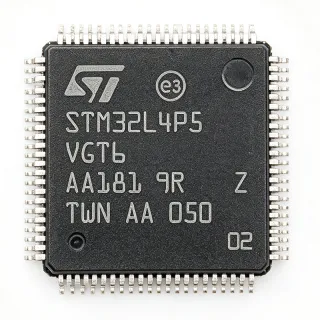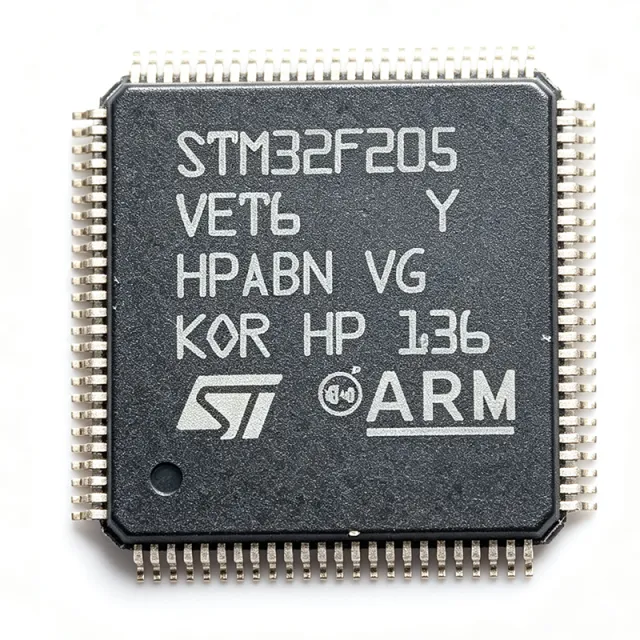
STM32F205VET6 - 120MHz ARM Cortex-M3 MCU, 512KB Flash | STMicroelectronics
MPN: STM32F205VET6 ✓ פעילSTM32F205VET6 סקירה
A microcontroller (MCU) is a compact integrated circuit that combines a processor core, volatile and non-volatile memory, and programmable peripherals to govern a specific operation within an embedded system. MCUs sit in the hierarchy of embedded processors between simple 8-bit controllers and high-end application processors, and are optimized for deterministic real-time control and signal processing. The STM32F205VET6 specifically belongs to the ARM Cortex-M3 lineage (32-bit RISC core), positioning it above 8/16-bit microcontrollers in compute density while remaining below Cortex-A application processors in both cost and power.
Key features include 120 MHz maximum CPU frequency, 512KB on-chip Flash (512K x 8 organization), 132KB SRAM, 17 general-purpose and advanced-control timers, 3x 12-bit ADCs, USB OTG High-Speed and Full-Speed, on-chip 10/100 Ethernet MAC, 2x CAN, 3x SPI, 3x I2C, 5x USART/UART plus UART, and a digital camera interface. The adaptive real-time (ART) memory accelerator reduces Flash wait states to deliver close-to-zero penalty execution from on-chip code, and the part supports cryptographic features such as the unique 96-bit device ID and RNG in this density.
Technically, the STM32F205VET6 is fabricated on a low-power CMOS process and offers multiple low-power modes (Sleep, Stop, Standby) with fast wakeup times for battery-driven applications. The 100-pin LQFP package exposes 82 GPIOs tolerating 5V on most pins, includes an integrated voltage regulator for single-supply operation, and supports JTAG and SWD interfaces for in-circuit debug. Independent and window watchdog timers, a SysTick timer, and a real-time clock (RTC) with calendar and backup registers round out the on-chip resources.
Typical applications include industrial automation and motor control, building and home automation gateways, consumer HMI with TFT or camera input, USB peripherals, Ethernet-connected IoT nodes, medical instrumentation, and point-of-sale terminals. Its combination of high CPU throughput, on-chip Ethernet and USB OTG HS makes it especially attractive when designers need wired connectivity without an external PHY companion MCU.
When designing with this MCU, place decoupling capacitors (typically 100 nF + 4.7 uF) on each VDDA/VSS pair as close to the pins as the PCB layout allows, and route VBAT7 (VBAT) directly to a coin cell or supercap if RTC backup retention is required. Carefully observe BOOT0 pin configuration to select the correct boot source (main Flash, system memory bootloader, or embedded SRAM) and verify HSE/HSI clock tree values against the RM0033 reference manual before locking the firmware.
This page synthesizes distributor pricing snapshots, drop-in alternatives, and design guidance that are not collected in any single place in the manufacturer datasheet, providing a faster procurement and design start than reading the full RM0033 reference manual from scratch.
חלופות תחליף ישיר עבור STM32F205VET6 — אותו מארז, תואם פין-לפין. חלקים במארז שונה הדורשים עיבוד מחדש של ה-PCB אינם נכללים.
וריאנטים בסדרה זו
דגמים מאותה סדרה התואמים Drop-in עם STM32F205VET6 (אותו גורם צורה וטביעת רגל) — שונים ב Communication Interfaces, Package, Timers, Mounting Type, Operating Temperature.
STM32F207VET6
✅ Drop-In ⚠️ מפרטים לא מאומתים📋 חלופה להתייחסות (לא בקטלוג)
STM32F205VCT6TR
✅ Drop-In ⚠️ מפרטים לא מאומתיםצור קשר לקבלת מחיר
הצג גיליון נתונים ←STM32F405VET6
✅ Drop-In ⚠️ מפרטים לא מאומתים📋 חלופה להתייחסות (לא בקטלוג)
STM32F205VET6TR
✅ Drop-In ⚠️ מפרטים לא מאומתים📋 חלופה להתייחסות (לא בקטלוג)
STM32F205RET6
✅ Drop-In ⚠️ מפרטים לא מאומתיםצור קשר לקבלת מחיר
הצג גיליון נתונים ←GD32F207VKT6
✅ Drop-In📋 חלופה להתייחסות (לא בקטלוג)
STM32F205VET6 דירוגים מרביים ומאפיינים חשמליים
| Core | ARM Cortex-M3 32-bit RISC |
| Maximum CPU Frequency | 120 MHz |
| DMIPS Performance | 150 DMIPS |
| Program Memory (Flash) | 512 KB (512K x 8) |
| RAM Size | 132 KB (132K x 8) |
| Number of I/O Pins | 82 |
| מארז | 100-LQFP (14x14 mm) |
| מתח אספקה | 1.8 V to 3.6 V |
| טמפרטורת פעולה | -40 C to +85 C (industrial) |
| ADC | 3x 12-bit |
| Timers | 17 (general-purpose + advanced-control) |
| Communication Interfaces | 15 (SPI, I2C, USART/UART, CAN, USB OTG, Ethernet) |
| USB | USB OTG HS + USB OTG FS |
| Ethernet | 10/100 MAC on-chip |
| Camera Interface | Yes (8/10/12-bit parallel) |
| סוג הרכבה | Surface Mount |
| רמת MSL | 3 (per JEDEC J-STD-020) |
| סטטוס RoHS | Compliant |
תצורת פינים של STM32F205VET6
| פין 1 | PE2 — GPIO PE2 / TRACECLK / SPI4 SCK |
| פין 2 | PE3 — GPIO PE3 / TRACED0 |
| פין 3 | PE4 — GPIO PE4 / TRACED1 |
| פין 4 | PE5 — GPIO PE5 / TRACED2 |
| פין 5 | PE6 — GPIO PE6 / TRACED3 |
| פין 6 | VBAT — RTC backup battery supply |
| פין 7 | PC13 — GPIO PC13 / RTC Tamper (anti-tamper) |
| פין 8 | PC14 — GPIO PC14 / OSC32_IN (LSE crystal) |
| פין 9 | PC15 — GPIO PC15 / OSC32_OUT (LSE crystal) |
| פין 10 | VSS — Digital ground |
| פין 11 | VDD — Digital supply (1.8V-3.6V) |
| פין 12 | OSC_IN — HSE crystal in / external clock |
| פין 13 | OSC_OUT — HSE crystal out |
| פין 14 | NRST — Active-low reset input |
| פין 15 | PC0 — GPIO PC0 / ADC123_IN10 |
| פין 16 | PC1 — GPIO PC1 / ADC123_IN11 |
| פין 17 | PC2 — GPIO PC2 / ADC123_IN12 |
| פין 18 | PC3 — GPIO PC3 / ADC123_IN13 |
| פין 19 | VSSA — Analog ground |
| פין 20 | VDDA — Analog supply (1.8V-3.6V) |
| פין 21 | PA0 — GPIO PA0 / WKUP / ADC123_IN0 / TIM2_CH1_ETR |
| פין 22 | PA1 — GPIO PA1 / ADC123_IN1 / TIM2_CH2 |
| פין 23 | PA2 — GPIO PA2 / ADC123_IN2 / TIM2_CH3 / USART2_TX |
| פין 24 | PA3 — GPIO PA3 / ADC123_IN3 / TIM2_CH4 / USART2_RX |
| פין 25 | VSS — Digital ground |
| פין 26 | VDD — Digital supply |
| פין 27 | PA4 — GPIO PA4 / ADC12_IN4 / SPI1_NSS / DAC_OUT1 |
| פין 28 | PA5 — GPIO PA5 / ADC12_IN5 / SPI1_SCK / DAC_OUT2 |
| פין 29 | PA6 — GPIO PA6 / ADC12_IN6 / SPI1_MISO / TIM13_CH1 |
| פין 30 | PA7 — GPIO PA7 / ADC12_IN7 / SPI1_MOSI / TIM14_CH1 |
| פין 31 | PC4 — GPIO PC4 / ADC12_IN14 |
| פין 32 | PC5 — GPIO PC5 / ADC12_IN15 |
| פין 33 | PB0 — GPIO PB0 / ADC12_IN8 / TIM1_CH2N |
| פין 34 | PB1 — GPIO PB1 / ADC12_IN9 / TIM1_CH3N |
| פין 35 | PB2 — GPIO PB2 / BOOT1 |
| פין 36 | PE7 — GPIO PE7 / TIM1_ETR |
| פין 37 | PE8 — GPIO PE8 / TIM1_CH1N |
| פין 38 | PE9 — GPIO PE9 / TIM1_CH1 |
| פין 39 | PE10 — GPIO PE10 / TIM1_CH2N |
| פין 40 | PE11 — GPIO PE11 / TIM1_CH2 |
| פין 41 | PE12 — GPIO PE12 / TIM1_CH3N |
| פין 42 | PE13 — GPIO PE13 / TIM1_CH3 |
| פין 43 | PE14 — GPIO PE14 / TIM1_CH4 |
| פין 44 | PE15 — GPIO PE15 / TIM1_BKIN |
| פין 45 | PB10 — GPIO PB10 / I2C2_SCL / USART3_TX / TIM2_CH3 |
| פין 46 | PB11 — GPIO PB11 / I2C2_SDA / USART3_RX / TIM2_CH4 |
| פין 47 | VSS — Digital ground |
| פין 48 | VDD — Digital supply |
| פין 49 | PB12 — GPIO PB12 / SPI2_NSS / I2S2_WS / TIM1_BKIN |
| פין 50 | PB13 — GPIO PB13 / SPI2_SCK / I2S2_CK / TIM1_CH1N |
| פין 51 | PB14 — GPIO PB14 / SPI2_MISO / TIM1_CH2N |
| פין 52 | PB15 — GPIO PB15 / SPI2_MOSI / TIM1_CH3N |
| פין 53 | PD8 — GPIO PD8 / USART3_TX |
| פין 54 | PD9 — GPIO PD9 / USART3_RX |
| פין 55 | PD10 — GPIO PD10 |
| פין 56 | PD11 — GPIO PD11 |
| פין 57 | PD12 — GPIO PD12 / TIM4_CH1 |
| פין 58 | PD13 — GPIO PD13 / TIM4_CH2 |
| פין 59 | VSS — Digital ground |
| פין 60 | VDD — Digital supply |
| פין 61 | PD14 — GPIO PD14 / TIM4_CH3 |
| פין 62 | PD15 — GPIO PD15 / TIM4_CH4 |
| פין 63 | PC6 — GPIO PC6 / TIM8_CH1 / USART6_TX |
| פין 64 | PC7 — GPIO PC7 / TIM8_CH2 / USART6_RX |
| פין 65 | PC8 — GPIO PC8 / TIM8_CH3 |
| פין 66 | PC9 — GPIO PC9 / TIM8_CH4 |
| פין 67 | PA8 — GPIO PA8 / USART1_CK / TIM1_CH1 / MCO1 |
| פין 68 | PA9 — GPIO PA9 / USART1_TX / TIM1_CH2 |
| פין 69 | PA10 — GPIO PA10 / USART1_RX / TIM1_CH3 |
| פין 70 | PA11 — GPIO PA11 / CAN1_RX / USBDM / TIM1_CH1N |
| פין 71 | PA12 — GPIO PA12 / CAN1_TX / USBDP / TIM1_CH2N |
| פין 72 | PA13 — GPIO PA13 / JTMS / SWDIO |
| פין 73 | VCAP_1 — Internal regulator 1.2V decoupling |
| פין 74 | VSS — Digital ground |
| פין 75 | VDD — Digital supply |
| פין 76 | PA14 — GPIO PA14 / JTCK / SWCLK |
| פין 77 | PA15 — GPIO PA15 / JTDI / SPI3_NSS / I2S3_WS |
| פין 78 | PC10 — GPIO PC10 / SPI3_SCK / I2S3_CK / USART3_TX |
| פין 79 | PC11 — GPIO PC11 / SPI3_MISO / I2S3_ext_SD / USART3_RX |
| פין 80 | PC12 — GPIO PC12 / SPI3_MOSI / I2S3_SD / USART3_CK |
| פין 81 | PD0 — GPIO PD0 / CAN1_RX |
| פין 82 | PD1 — GPIO PD1 / CAN1_TX |
| פין 83 | PD2 — GPIO PD2 / TIM3_ETR |
| פין 84 | PD3 — GPIO PD3 / USART2_CTS |
| פין 85 | PD4 — GPIO PD4 / USART2_RTS |
| פין 86 | PD5 — GPIO PD5 / USART2_TX |
| פין 87 | PD6 — GPIO PD6 / USART2_RX |
| פין 88 | PD7 — GPIO PD7 / USART2_CK |
| פין 89 | PB3 — GPIO PB3 / JTDO / SPI3_SCK / I2S3_CK / TIM2_CH2 |
| פין 90 | PB4 — GPIO PB4 / NJTRST / SPI3_MISO |
| פין 91 | PB5 — GPIO PB5 / I2C1_SMBAI |
| פין 92 | PB6 — GPIO PB6 / I2C1_SCL / TIM4_CH1 |
| פין 93 | PB7 — GPIO PB7 / I2C1_SDA / TIM4_CH2 |
| פין 94 | BOOT0 — Boot mode select (0=main Flash, 1=system bootloader) |
| פין 95 | PB8 — GPIO PB8 / TIM4_CH3 |
| פין 96 | PB9 — GPIO PB9 / TIM4_CH4 |
| פין 97 | PE0 — GPIO PE0 / TIM4_ETR |
| פין 98 | PE1 — GPIO PE1 |
| פין 99 | VSS — Digital ground |
| פין 100 | VDD — Digital supply |
יישומים טיפוסיים
STM32F205VET6 מתאים עבור 7 יישוםs: Industrial Motor Control, Industrial Ethernet Gateway, USB OTG HS Peripheral, Building Automation HMI, Medical Point-of-Care Device, Camera-Enabled Embedded Vision, Power-Metering / Data Logger.
Industrial Motor Control
The STM32F205VET6's 120 MHz Cortex-M3 core with 150 DMIPS throughput handles real-time field-oriented control (FOC) loops for three-phase PMSM and BLDC motors, while the 17 timers including advanced-control PWM timers (TIM1/TIM8) generate the six-step or space-vector PWM needed for 3-phase inverter drives. The three 12-bit ADCs sample phase currents at sub-microsecond rates for closed-loop torque control. The 100-LQFP package exposes 82 GPIO pins, providing ample routing for encoder, Hall-sensor and gate-driver interfaces. Industrial design wins typically pair this MCU with the STGAP1AS gate-driver and the IGBT or MOSFET power stage, using the on-chip Cortex-M3 to execute state machines while a separate STM32 runs HMI.
מומלץ
Industrial Ethernet Gateway
On-chip 10/100 Ethernet MAC with MII/RMII interface lets the STM32F205VET6 act as an Ethernet gateway in industrial-automation networks, pairing with an external PHY such as the LAN8720A or DP83848 to provide full TCP/IP or PROFINET/EtherNet-IP connectivity. The 512 KB Flash stores the full TCP/IP stack (lwIP or RT-Thread) plus an industrial protocol library, and the 132 KB SRAM buffers multiple sockets. Hardware enable pins, 5 V-tolerant I/O and the industrial -40 C to +85 C temperature range suit DIN-rail mounted controllers. Reference designs typically route RMII to the LAN8720A PHY plus an RJ45 with integrated magnetics for two-port industrial Ethernet gateways.
מומלץ
USB OTG HS Peripheral
The STM32F205VET6's on-chip USB OTG High-Speed and Full-Speed controllers plus 8 KB USB-on-DSRP SRAM enable it to act as either a USB device or host, ideal for industrial data loggers, POS terminals, and medical peripherals that stream high-speed data over USB. USB OTG HS supports up to 480 Mbps when paired with an external ULPI PHY such as the USB3300, while the integrated FS OTG controller handles 12 Mbps directly. Combined with the 512 KB Flash for the USB device/host stack and 132 KB SRAM for endpoint buffers, designers can implement CDC, HID, MSC, and vendor-class devices without an external companion chip.
מומלץ
Building Automation HMI
The 82 GPIO pins and 15 communication interfaces of the STM32F205VET6 make it ideal for HMI panels in building-automation controllers, supporting keypads, character or graphic LCDs, and capacitive-touch sliders via I2C or SPI touch controllers. The on-chip timers drive PWM-controlled backlight dimming while a UART interfaces to a wireless module for KNX-RF or LoRa connectivity. The 132 KB SRAM supports a graphical UI library without external memory, and the wide 1.8V-3.6V supply simplifies designs powered from 24 V industrial bus rails via a step-down converter. Reference designs integrate RS-485 transceivers on USART for BACnet or Modbus backbone connectivity.
מומלץ
Medical Point-of-Care Device
Medical point-of-care devices benefit from the STM32F205VET6's three 12-bit ADCs (with up to 24 channels total) for multi-signal biosensor acquisition, 132 KB SRAM to buffer sample streams, and USB OTG HS for fast data upload to a host analyzer. The Cortex-M3 at 120 MHz executes digital signal processing for pulse oximetry, glucose metering, or ECG front-end filtering in real time. The industrial temperature range and 5 V-tolerant I/O support battery-charging ICs directly. Reference designs combine an AFE such as the ADS1292 for ECG front-end plus an FTDI or direct USB link for medical-grade data transfer.
מומלץ
Camera-Enabled Embedded Vision
The STM32F205VET6 integrates a parallel 8/10/12-bit digital camera interface (DCMI) that streams from external CMOS sensors up to VGA-class resolution into the 132 KB SRAM buffer for image-processing pipelines. The 120 MHz Cortex-M3 plus ART accelerator handles simple barcode reading, QR scanning, or pre-DSP pre-processing before forwarding compressed JPEG data over USB or Ethernet. For higher-resolution designs the STM32F7 or STM32H7 families are recommended, but for low-cost VisoLation the F205VET6 is a strong choice. Typical designs pair this MCU with an OV2640A6 or OV7670 sensor and store images to an external SPI flash.
מומלץ
Power-Metering / Data Logger
In three-phase power metering and remote data loggers the STM32F205VET6's three 12-bit ADCs simultaneously sample voltage and current channels while its 17 timers drive zero-crossing detection and pulse counting. The Ethernet MAC streams metering data to a remote SCADA, while SD-card interface (SPI-mode) on the F205/F207 allows local buffering of outage logs. The 132 KB SRAM supports a 100 ms metering window with multi-rate buffer. Reference implementations use the STM32 DSP library for FFT-based harmonic analysis and a real-time clock (RTC) for time-stamping events with backup-battery retention across power cycles.
מומלץ
סיכום מוצרים מומלצים
נתוני עזר הנדסיים עבור STM32F205VET6 — השוואה, הנחיות תכנון ומידע על תאימות.
מדריך בחירה
השוואה עם חלופות
| פרמטר | מוצר זה | STM32F207VET6 | STM32F205VCT6 | STM32F405VET6 | STM32F205VET6TR | STM32F205RET6 | GD32F207VKT6 |
|---|---|---|---|---|---|---|---|
| Brand | STMicroelectronics | STMicroelectronics | STMicroelectronics | STMicroelectronics | STMicroelectronics | STMicroelectronics | GigaDevice |
| Package | 100-LQFP (14x14) | 100-LQFP (14x14) | 100-LQFP (14x14) | 100-LQFP (14x14) | 100-LQFP (14x14) | 64-LQFP (10x10) | 100-LQFP (14x14) |
| Core | ARM Cortex-M3 | ARM Cortex-M3 | ARM Cortex-M3 | ARM Cortex-M4F | ARM Cortex-M3 | ARM Cortex-M3 | ARM Cortex-M3 |
| Max CPU Frequency | 120 MHz | 120 MHz | 120 MHz | 168 MHz | 120 MHz | 120 MHz | 120 MHz |
| Flash | 512 KB | 512 KB | 256 KB | 512 KB | 512 KB | 512 KB | 3 MB |
| SRAM | 132 KB | 132 KB | 96 KB | 192 KB | 132 KB | 64 KB | 256 KB |
| GPIO Count | 82 | 82 | 82 | 82 | 82 | 51 | 82 |
| Operating Temperature | -40 C to +85 C | -40 C to +85 C | -40 C to +85 C | -40 C to +85 C | -40 C to +85 C | -40 C to +85 C | -40 C to +85 C |
| Ethernet MAC | Yes | Yes | Yes | Yes | Yes | Yes | Yes |
| Approx Unit Price (USD, qty 1) | 12.85 | ~14.50 | ~10.50 | ~15.00 | ~12.85 | ~10.50 | ~5.50 |
מבדילים עיקריים
- Highest Flash density in STM32F2 120 MHz family at 100-LQFP footprint (לעומתSTM32F205VCT6)
- Same peripherals as F207 without added crypto/SDMMC cost overhead (לעומתSTM32F207VET6)
- Cortex-M3 simplicity with no FPU/DSP that can complicate hard-real-time scheduling (לעומתSTM32F405VET6)
- Lower unit cost than F405/F207 with identical pinout and peripherals (לעומתGD32F207VKT6)
הערות תכנון
Decouple each VDD/VSS pair with a 100 nF X7R ceramic placed within 5 mm of the pin, and add a 4.7 uF bulk capacitor per supply rail. VDDA must be tied to VDD through a ferrite bead or short trace if ADC accuracy matters, and the VCAP_1 pin (pin 73) must be left floating with a 100 nF + 1 uF pair to ground for the internal 1.2 V regulator. Estimated: based on standard ST reference designs for the STM32F2 family; values are typical, not datasheet-maximum.
The 100-LQFP package has a typical theta_JA around 50 C/W on a 2-layer JEDEC test board. At 120 MHz with all peripherals active the F205 draws roughly 50-80 mA from VDD, so under standard lab conditions the junction rises only 5-10 C above ambient. Estimated: based on typical STM32F205 datasheet current-consumption tables and LQFP-100 thermal resistance; verify with on-board measurements in the final design.
Route the HSE/OSCIN/PH0 and HSE/OSCOUT/PH1 traces as short, symmetric, length-matched differential pairs to the external crystal or oscillator to avoid start-up issues; place the load capacitors within 2 mm of the crystal. The USB OTG FS data lines (PA11/PA12 or PB14/PB15 depending on remap) require 90 ohm differential impedance plus series matching resistors. For Ethernet, the MII/RMII traces to the external PHY must be length-matched within 50 mil and routed over a continuous ground plane.
Always configure the BOOT0 pin through a 10 kohm pull-down to select main-Flash boot; leaving it floating can result in unpredictable boot. The NRST pin must be pulled up with 100 nF in parallel to VDD, otherwise the MCU can lock up on noisy power-up. Do not drive 5 V into any non-5V-tolerant pin (notably PH2, PA13/14, BOOT0) or you will permanently damage the part. Always unlock the backup-Domain with the correct RCC sequence before modifying RTC registers or VBAT-mode SRAM.
The camera interface (DCMI) and external SDRAM bus, when used, must be routed with controlled-impedance traces (typically 50 ohm single-ended) and a continuous reference ground plane. Series-stubs should be avoided on the camera PCLK line; use point-to-point routing from sensor to MCU with the trace length less than 50 mm. Place a 33 ohm series damping resistor close to the MCU side if the sensor sits more than 25 mm away.
מידע על תאימות
Industrial-grade STM32F2 parts are not AEC-Q100 qualified; for automotive applications use the STM32F2x5/F2x7 with -A suffix (e.g., STM32F205VET6A). ST product page states RoHS, REACH, and conflict-mineral compliance.