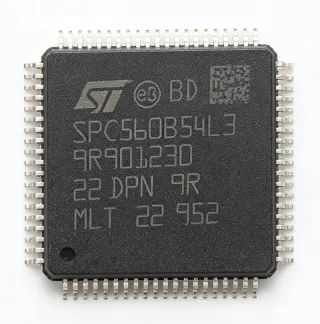
STM32F405VGT6TR - 168MHz ARM Cortex-M4F MCU | STMicroelectronics (Tape & Reel)
MPN: STM32F405VGT6TR ✓ AktifSTM32F405VGT6TR Ringkasan
What is a microcontroller? A microcontroller (MCU) is a compact integrated circuit designed to govern a specific operation in an embedded system. It contains a processor core, memory (flash and SRAM), and programmable input/output peripherals on a single chip. Microcontrollers are the brain of countless electronic devices, from automotive engine control units to consumer electronics. The STM32F405VGT6TR belongs to the STM32F4 series, which is part of the broader STM32 family of 32-bit ARM Cortex-M based MCUs. This family is widely used in industrial, consumer, and IoT applications due to its performance, low power consumption, and extensive ecosystem.
Key features of the STM32F405VGT6TR include a 168 MHz ARM Cortex-M4F core with FPU, 1 MB flash, 192 KB SRAM, and a comprehensive set of peripherals: three 12-bit ADCs (up to 24 channels), two DACs, 12 general-purpose timers, and multiple communication interfaces (USART, SPI, I2C, CAN, USB OTG, Ethernet). The device also features a memory protection unit (MPU), a true random number generator (RNG), and a cryptographic acceleration cell for AES, DES, and 3DES. These features make it a versatile choice for complex embedded applications.
The STM32F405VGT6TR is manufactured using a 90nm process technology, which balances performance and power efficiency. The core operates at 1.8V to 3.6V, with a wide temperature range of -40°C to +85°C (or +105°C for the VGT6 variant). The device supports various low-power modes, including Sleep, Stop, and Standby, enabling battery-powered applications. The rich peripheral set and high clock speed allow for real-time control and signal processing, making it ideal for applications such as motor control, power conversion, and audio processing.
Typical applications include industrial motor control, medical monitoring devices, consumer electronics, and IoT gateways. The STM32F405VGT6TR is also popular in drone flight controllers and robotics, where its processing power and peripheral integration are essential. The device is supported by ST's comprehensive development ecosystem, including the STM32CubeMX configuration tool, HAL libraries, and a wide range of development boards.
When designing with the STM32F405VGT6TR, ensure proper decoupling of the power supply pins with 100nF capacitors placed close to each VDD pin, and a 4.7uF bulk capacitor. The VDDA pin should be filtered with a ferrite bead and a 1uF capacitor to reduce analog noise. The BOOT0 pin must be configured correctly for the desired boot mode, and the NRST pin should have a 100nF capacitor to ground for reliable reset. Pay attention to the maximum junction temperature (125°C) and ensure adequate thermal management for high-current applications.
Alternatif penggantian untuk STM32F405VGT6TR — paket yang sama, pin-pada-pin kompatibel. Bagian paket yang berbeda memerlukan kerja ulang PCB diabaikan.
Variasi di dalam seri ini
Model-series yang sama yang kompatibel dengan penggantian STM32F405VGT6TR (sama faktor bentuk dan footprint) — berbeda di dalam Package, Flash Memory, Core, Performance, Operating Temperature.
STM32F407VGT6
✅ Drop-In✗ Habis Stok
$7.55 / Satuan
Lihat Datasheet →STM32F405VGT7
✅ Drop-In ⚠️ Spesifikasi Tidak DisahkanKontak untuk harga
Lihat Datasheet →STM32F415VGT6
✅ Drop-In ⚠️ Spesifikasi Tidak DisahkanKontak untuk harga
Lihat Datasheet →STM32F405VGT6TR Rating Maksimal & Karakteristik Listrik
| Core | ARM Cortex-M4F with FPU |
| Frekuensi Bawah Maximum | 168 MHz |
| Flash Memory | 1 MB |
| SRAM | 192 KB |
| Tegangan Pemuat | 1.8 V to 3.6 V |
| Suhu Kerja | -40°C to +85°C |
| Paket | LQFP-100 |
| Number of I/Os | 82 |
| ADC Resolution | 12-bit |
| Number of ADC Channels | 24 |
| DAC Resolution | 12-bit |
| Number of Timers | 12 |
| Communication Interfaces | USART, SPI, I2C, CAN, USB OTG, Ethernet |
| DMA Channels | 16 |
| Status RoHS | Compliant |
Konfigurasi Pin STM32F405VGT6TR
| Pin produk 1 | VBAT — Battery backup supply |
| Pin produk 2 | PC13 — GPIO / RTC output |
| Pin produk 3 | PC14 — GPIO / OSC32_IN |
| Pin produk 4 | PC15 — GPIO / OSC32_OUT |
| Pin produk 5 | PF0 — GPIO / OSC_IN |
| Pin produk 6 | PF1 — GPIO / OSC_OUT |
| Pin produk 7 | NRST — Reset (active low) |
| Pin produk 8 | VSSA — Analog ground |
| Pin produk 9 | VDDA — Analog power supply |
| Pin produk 10 | PA0 — GPIO / ADC_IN0 |
| Pin produk 11 | PA1 — GPIO / ADC_IN1 |
| Pin produk 12 | PA2 — GPIO / USART2_TX |
| Pin produk 13 | PA3 — GPIO / USART2_RX |
| Pin produk 14 | PA4 — GPIO / DAC_OUT1 |
| Pin produk 15 | PA5 — GPIO / DAC_OUT2 |
| Pin produk 16 | PA6 — GPIO / SPI1_MISO |
| Pin produk 17 | PA7 — GPIO / SPI1_MOSI |
| Pin produk 18 | PA8 — GPIO / TIM1_CH1 |
| Pin produk 19 | PA9 — GPIO / USART1_TX |
| Pin produk 20 | PA10 — GPIO / USART1_RX |
| Pin produk 21 | PA11 — GPIO / USB_DM |
| Pin produk 22 | PA12 — GPIO / USB_DP |
| Pin produk 23 | PA13 — GPIO / SWDIO |
| Pin produk 24 | PA14 — GPIO / SWCLK |
| Pin produk 25 | PA15 — GPIO / JTDI |
| Pin produk 26 | PC10 — GPIO / USART3_TX |
| Pin produk 27 | PC11 — GPIO / USART3_RX |
| Pin produk 28 | PC12 — GPIO / SDIO_D0 |
| Pin produk 29 | PD2 — GPIO / SDIO_CMD |
| Pin produk 30 | VSS — Ground |
| Pin produk 31 | VDD — Power supply |
| Pin produk 32 | PB0 — GPIO / ADC_IN8 |
| Pin produk 33 | PB1 — GPIO / ADC_IN9 |
| Pin produk 34 | PB2 — GPIO / BOOT1 |
| Pin produk 35 | PB10 — GPIO / I2C2_SCL |
| Pin produk 36 | PB11 — GPIO / I2C2_SDA |
| Pin produk 37 | PB12 — GPIO / SPI2_NSS |
| Pin produk 38 | PB13 — GPIO / SPI2_SCK |
| Pin produk 39 | PB14 — GPIO / SPI2_MISO |
| Pin produk 40 | PB15 — GPIO / SPI2_MOSI |
| Pin produk 41 | PD8 — GPIO / USART3_TX |
| Pin produk 42 | PD9 — GPIO / USART3_RX |
| Pin produk 43 | PD10 — GPIO / USART3_CK |
| Pin produk 44 | PD11 — GPIO / USART3_CTS |
| Pin produk 45 | PD12 — GPIO / USART3_RTS |
| Pin produk 46 | PD13 — GPIO / TIM4_CH2 |
| Pin produk 47 | PD14 — GPIO / TIM4_CH3 |
| Pin produk 48 | PD15 — GPIO / TIM4_CH4 |
| Pin produk 49 | PC6 — GPIO / TIM3_CH1 |
| Pin produk 50 | PC7 — GPIO / TIM3_CH2 |
| Pin produk 51 | PC8 — GPIO / TIM3_CH3 |
| Pin produk 52 | PC9 — GPIO / TIM3_CH4 |
| Pin produk 53 | PA8 — GPIO / TIM1_CH1 |
| Pin produk 54 | PA9 — GPIO / USART1_TX |
| Pin produk 55 | PA10 — GPIO / USART1_RX |
| Pin produk 56 | PA11 — GPIO / USB_DM |
| Pin produk 57 | PA12 — GPIO / USB_DP |
| Pin produk 58 | PA13 — GPIO / SWDIO |
| Pin produk 59 | PA14 — GPIO / SWCLK |
| Pin produk 60 | PA15 — GPIO / JTDI |
| Pin produk 61 | PC10 — GPIO / USART3_TX |
| Pin produk 62 | PC11 — GPIO / USART3_RX |
| Pin produk 63 | PC12 — GPIO / SDIO_D0 |
| Pin produk 64 | PD2 — GPIO / SDIO_CMD |
| Pin produk 65 | VSS — Ground |
| Pin produk 66 | VDD — Power supply |
| Pin produk 67 | PB0 — GPIO / ADC_IN8 |
| Pin produk 68 | PB1 — GPIO / ADC_IN9 |
| Pin produk 69 | PB2 — GPIO / BOOT1 |
| Pin produk 70 | PB10 — GPIO / I2C2_SCL |
| Pin produk 71 | PB11 — GPIO / I2C2_SDA |
| Pin produk 72 | PB12 — GPIO / SPI2_NSS |
| Pin produk 73 | PB13 — GPIO / SPI2_SCK |
| Pin produk 74 | PB14 — GPIO / SPI2_MISO |
| Pin produk 75 | PB15 — GPIO / SPI2_MOSI |
| Pin produk 76 | PD8 — GPIO / USART3_TX |
| Pin produk 77 | PD9 — GPIO / USART3_RX |
| Pin produk 78 | PD10 — GPIO / USART3_CK |
| Pin produk 79 | PD11 — GPIO / USART3_CTS |
| Pin produk 80 | PD12 — GPIO / USART3_RTS |
| Pin produk 81 | PD13 — GPIO / TIM4_CH2 |
| Pin produk 82 | PD14 — GPIO / TIM4_CH3 |
| Pin produk 83 | PD15 — GPIO / TIM4_CH4 |
| Pin produk 84 | PC6 — GPIO / TIM3_CH1 |
| Pin produk 85 | PC7 — GPIO / TIM3_CH2 |
| Pin produk 86 | PC8 — GPIO / TIM3_CH3 |
| Pin produk 87 | PC9 — GPIO / TIM3_CH4 |
| Pin produk 88 | PA8 — GPIO / TIM1_CH1 |
| Pin produk 89 | PA9 — GPIO / USART1_TX |
| Pin produk 90 | PA10 — GPIO / USART1_RX |
| Pin produk 91 | PA11 — GPIO / USB_DM |
| Pin produk 92 | PA12 — GPIO / USB_DP |
| Pin produk 93 | PA13 — GPIO / SWDIO |
| Pin produk 94 | PA14 — GPIO / SWCLK |
| Pin produk 95 | PA15 — GPIO / JTDI |
| Pin produk 96 | PC10 — GPIO / USART3_TX |
| Pin produk 97 | PC11 — GPIO / USART3_RX |
| Pin produk 98 | PC12 — GPIO / SDIO_D0 |
| Pin produk 99 | PD2 — GPIO / SDIO_CMD |
| Pin produk 100 | VSS — Ground |
Aplikasi Umum
STM32F405VGT6TR cocok untuk 6 aplikasis: Industrial Motor Control, Medical Monitoring Devices, Consumer Electronics, IoT Gateways, Drone Flight Controllers, Audio Processing.
Industrial Motor Control
The STM32F405VGT6TR is ideal for industrial motor control applications due to its advanced timers (TIM1 and TIM8) that generate PWM signals with dead-time insertion, and its 12-bit ADCs that sample motor currents and voltages. The 168 MHz Cortex-M4F core with FPU enables complex control algorithms like Field-Oriented Control (FOC) to run efficiently. In a typical motor control system, the MCU reads encoder or Hall sensor feedback, computes the control loop, and outputs PWM signals to the gate driver. The high clock speed and FPU ensure low latency and high precision, improving motor efficiency and dynamic response. Additionally, the device's multiple communication interfaces (CAN, USART, SPI) allow integration with industrial networks and HMI systems. The wide operating temperature range (-40°C to +85°C) makes it suitable for harsh industrial environments. Designers should ensure proper isolation between the power stage and the MCU, and use the ADC's injected channels for synchronized sampling of motor currents.
Direkomendasikan
Medical Monitoring Devices
The STM32F405VGT6TR is well-suited for medical monitoring devices such as patient monitors, infusion pumps, and portable diagnostic equipment. Its high processing power (168 MHz Cortex-M4F) enables real-time signal processing of biosignals like ECG, EEG, and SpO2. The device's multiple ADCs can sample multiple analog channels simultaneously, and its DMA controllers offload data transfer, reducing CPU load. The low-power modes (Sleep, Stop, Standby) are critical for battery-powered portable devices, extending operational life. The device's rich peripheral set includes USART, SPI, and I2C for interfacing with sensors and wireless modules. In a typical patient monitor, the MCU acquires signals from sensors, processes them using DSP algorithms, and displays results on an LCD. The FPU accelerates filtering and feature extraction algorithms. Designers must ensure electrical safety and isolation, and comply with medical standards such as IEC 60601. The device's wide temperature range and reliability make it a trusted choice for medical applications.
Direkomendasikan
Consumer Electronics
The STM32F405VGT6TR is used in consumer electronics such as smart home hubs, audio systems, and wearable devices. Its high performance and rich peripherals enable features like voice recognition, audio processing, and touch sensing. The device's USB OTG interface allows direct connection to smartphones and PCs, enabling data transfer and firmware updates. The Ethernet interface supports IoT connectivity, making it ideal for smart home gateways. In a smart home hub, the MCU manages multiple communication protocols (Zigbee, Z-Wave, Wi-Fi) via external modules, processes sensor data, and controls actuators. The FPU accelerates audio codecs and DSP algorithms, improving sound quality. The device's low-power modes are essential for battery-powered wearables, extending battery life. Designers should optimize power consumption by using the device's sleep modes and peripherals efficiently. The STM32F405VGT6TR's extensive ecosystem, including STM32CubeMX and HAL libraries, accelerates development.
Direkomendasikan
IoT Gateways
The STM32F405VGT6TR is an excellent choice for IoT gateways that aggregate data from multiple sensors and devices, process it, and transmit it to the cloud. Its Ethernet and USB OTG interfaces provide high-speed connectivity, while its multiple USART, SPI, and I2C interfaces allow connection to various sensors and wireless modules (e.g., LoRa, Zigbee, BLE). The 168 MHz Cortex-M4F core with FPU can handle protocol stacks (e.g., MQTT, CoAP) and data encryption (AES) efficiently. The device's large flash (1 MB) and SRAM (192 KB) support complex applications and buffering. In a typical IoT gateway, the MCU collects data from sensors, performs edge processing (e.g., filtering, aggregation), and sends it to the cloud via Ethernet or Wi-Fi. The low-power modes are useful for battery-powered gateways, though most gateways are mains-powered. Designers should ensure robust power supply and consider using the device's cryptographic acceleration for secure communication.
Direkomendasikan
Drone Flight Controllers
The STM32F405VGT6TR is widely used in drone flight controllers due to its high processing power, rich peripherals, and small form factor. The 168 MHz Cortex-M4F core with FPU enables real-time sensor fusion (e.g., IMU data) and complex control algorithms like PID and Kalman filtering. The device's multiple timers can generate PWM signals for ESCs (Electronic Speed Controllers), and its ADCs can read battery voltage and current. The UART and I2C interfaces connect to GPS modules, telemetry radios, and external sensors. In a typical flight controller, the MCU reads data from the IMU (accelerometer, gyroscope), fuses it using a complementary or Kalman filter, and computes control outputs to stabilize the drone. The FPU accelerates the mathematical operations, reducing latency. The device's low power consumption is crucial for maximizing flight time. Designers should use the device's DMA to offload sensor data transfer and ensure proper power supply filtering to avoid noise from the motors.
Direkomendasikan
Audio Processing
The STM32F405VGT6TR is suitable for audio processing applications such as audio interfaces, effects processors, and voice-controlled devices. Its 168 MHz Cortex-M4F core with FPU can handle real-time audio DSP algorithms like filtering, equalization, and effects. The device's I2S interface supports high-quality audio codecs, and its DMA controllers enable efficient audio data transfer without CPU intervention. The multiple ADCs and DACs can be used for analog audio input/output. In a typical audio effects processor, the MCU reads audio samples from an ADC or I2S, processes them (e.g., reverb, delay), and outputs the result via DAC or I2S. The FPU accelerates floating-point operations, improving audio quality. The device's large SRAM (192 KB) can buffer audio data, reducing latency. Designers should pay attention to clock jitter and use a dedicated audio PLL to ensure low distortion. The STM32F405VGT6TR's rich ecosystem includes audio libraries and examples, speeding up development.
Direkomendasikan
Ringkasan Produk Direkomendasikan
Data referensi engineering untuk STM32F405VGT6TR — pembandingan, panduan desain, dan informasi konformitas.
Panduan Pemilihan
Pembandingan dengan Alternatif
| Parameter Umum | Produk Ini | STM32F407VGT6 | STM32F405VGT7 | STM32F405VGT6TRTR | STM32F415VGT6 |
|---|---|---|---|---|---|
| Package | LQFP-100 | LQFP-100 | LQFP-100 | LQFP-100 | LQFP-100 |
| Brand | STMicroelectronics | STMicroelectronics | STMicroelectronics | STMicroelectronics | STMicroelectronics |
| Core | ARM Cortex-M4F | ARM Cortex-M4F | ARM Cortex-M4F | ARM Cortex-M4F | ARM Cortex-M4F |
| Max Clock Frequency | 168 MHz | 168 MHz | 168 MHz | 168 MHz | 168 MHz |
| Flash Memory | 1 MB | 1 MB | 1 MB | 1 MB | 1 MB |
| SRAM | 192 KB | 192 KB | 192 KB | 192 KB | 192 KB |
| Additional Features | None | DCMI, RNG | Extended temp range | Tape & reel packaging | Crypto/hash processor |
| Operating Temperature | -40°C to +85°C | -40°C to +85°C | -40°C to +105°C | -40°C to +85°C | -40°C to +85°C |
Diferensiator Kunci
- Higher clock frequency (168 MHz) compared to many competitors (vsNXP LPC1768 (100 MHz))
- Integrated FPU for floating-point math (vsSTM32F103VGT6 (Cortex-M3, no FPU))
- Larger SRAM (192 KB) for data buffering (vsSTM32F407VGT6 (192 KB SRAM))
Catatan Desain
Decouple each VDD pin with a 100nF ceramic capacitor placed as close as possible to the pin, and add a 4.7uF bulk capacitor per supply group. The VDDA pin should be filtered with a ferrite bead and a 1uF capacitor to reduce analog noise. Ensure the power supply can handle the peak current of the MCU, especially when driving external peripherals.
Use a solid ground plane and place the MCU with proper clearance for the LQFP-100 package. Route high-speed signals (e.g., SPI, USB) with controlled impedance and keep traces short. For the crystal oscillator, place it close to the OSC_IN/OSC_OUT pins and add load capacitors as specified in the datasheet. Avoid routing high-current traces near the analog pins.
Ensure the BOOT0 pin is configured correctly for the desired boot mode (e.g., pull-down for main flash). The NRST pin should have a 100nF capacitor to ground for reliable reset. Do not exceed the absolute maximum ratings for supply voltage (3.6V) and I/O pins. When using the ADC, ensure the sampling time is sufficient for the source impedance to avoid inaccurate readings.
Informasi Konformitas
RoHS compliant per STMicroelectronics product page. Not AEC-Q100 qualified; for automotive, consider STM32F405VGT7 or other automotive-grade variants.