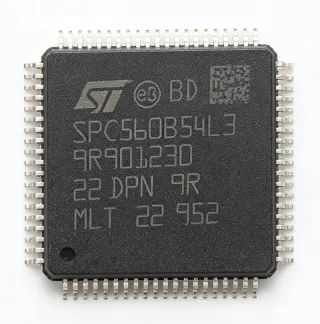
STM32F405VGT6TR - 168MHz ARM Cortex-M4F MCU | STMicroelectronics (Tape & Reel)
MPN: STM32F405VGT6TR ✓ 啟用中STM32F405VGT6TR 概覽
What is a microcontroller? A microcontroller (MCU) is a compact integrated circuit designed to govern a specific operation in an embedded system. It contains a processor core, memory (flash and SRAM), and programmable input/output peripherals on a single chip. Microcontrollers are the brain of countless electronic devices, from automotive engine control units to consumer electronics. The STM32F405VGT6TR belongs to the STM32F4 series, which is part of the broader STM32 family of 32-bit ARM Cortex-M based MCUs. This family is widely used in industrial, consumer, and IoT applications due to its performance, low power consumption, and extensive ecosystem.
Key features of the STM32F405VGT6TR include a 168 MHz ARM Cortex-M4F core with FPU, 1 MB flash, 192 KB SRAM, and a comprehensive set of peripherals: three 12-bit ADCs (up to 24 channels), two DACs, 12 general-purpose timers, and multiple communication interfaces (USART, SPI, I2C, CAN, USB OTG, Ethernet). The device also features a memory protection unit (MPU), a true random number generator (RNG), and a cryptographic acceleration cell for AES, DES, and 3DES. These features make it a versatile choice for complex embedded applications.
The STM32F405VGT6TR is manufactured using a 90nm process technology, which balances performance and power efficiency. The core operates at 1.8V to 3.6V, with a wide temperature range of -40°C to +85°C (or +105°C for the VGT6 variant). The device supports various low-power modes, including Sleep, Stop, and Standby, enabling battery-powered applications. The rich peripheral set and high clock speed allow for real-time control and signal processing, making it ideal for applications such as motor control, power conversion, and audio processing.
Typical applications include industrial motor control, medical monitoring devices, consumer electronics, and IoT gateways. The STM32F405VGT6TR is also popular in drone flight controllers and robotics, where its processing power and peripheral integration are essential. The device is supported by ST's comprehensive development ecosystem, including the STM32CubeMX configuration tool, HAL libraries, and a wide range of development boards.
When designing with the STM32F405VGT6TR, ensure proper decoupling of the power supply pins with 100nF capacitors placed close to each VDD pin, and a 4.7uF bulk capacitor. The VDDA pin should be filtered with a ferrite bead and a 1uF capacitor to reduce analog noise. The BOOT0 pin must be configured correctly for the desired boot mode, and the NRST pin should have a 100nF capacitor to ground for reliable reset. Pay attention to the maximum junction temperature (125°C) and ensure adequate thermal management for high-current applications.
直接替換替代品,適用於 STM32F405VGT6TR — 相同封裝,腳位對腳位相容。需重新設計 PCB 的不同封裝零件不列入。
此系列的變體
與下列產品可直接替換的同系列型號: STM32F405VGT6TR (相同外形與佔位) — 差異在於 Package, Flash Memory, Core, Performance, Operating Temperature.
STM32F407VGT6
✅ 直接替換聯絡詢價
查看資料表 →STM32F405VGT7
✅ 直接替換 ⚠️ 規格未經驗證聯絡詢價
查看資料表 →STM32F415VGT6
✅ 直接替換 ⚠️ 規格未經驗證聯絡詢價
查看資料表 →STM32F405VGT6TR 最大額定值與電氣特性
| Core | ARM Cortex-M4F with FPU |
| 最大時脈頻率 | 168 MHz |
| Flash Memory | 1 MB |
| SRAM | 192 KB |
| 供應電壓 | 1.8 V to 3.6 V |
| 工作溫度 | -40°C to +85°C |
| 封裝 | LQFP-100 |
| Number of I/Os | 82 |
| ADC Resolution | 12-bit |
| Number of ADC Channels | 24 |
| DAC Resolution | 12-bit |
| Number of Timers | 12 |
| Communication Interfaces | USART, SPI, I2C, CAN, USB OTG, Ethernet |
| DMA Channels | 16 |
| RoHS 狀態 | Compliant |
STM32F405VGT6TR 腳位配置
| 腳位 1 | VBAT — Battery backup supply |
| 腳位 2 | PC13 — GPIO / RTC output |
| 腳位 3 | PC14 — GPIO / OSC32_IN |
| 腳位 4 | PC15 — GPIO / OSC32_OUT |
| 腳位 5 | PF0 — GPIO / OSC_IN |
| 腳位 6 | PF1 — GPIO / OSC_OUT |
| 腳位 7 | NRST — Reset (active low) |
| 腳位 8 | VSSA — Analog ground |
| 腳位 9 | VDDA — Analog power supply |
| 腳位 10 | PA0 — GPIO / ADC_IN0 |
| 腳位 11 | PA1 — GPIO / ADC_IN1 |
| 腳位 12 | PA2 — GPIO / USART2_TX |
| 腳位 13 | PA3 — GPIO / USART2_RX |
| 腳位 14 | PA4 — GPIO / DAC_OUT1 |
| 腳位 15 | PA5 — GPIO / DAC_OUT2 |
| 腳位 16 | PA6 — GPIO / SPI1_MISO |
| 腳位 17 | PA7 — GPIO / SPI1_MOSI |
| 腳位 18 | PA8 — GPIO / TIM1_CH1 |
| 腳位 19 | PA9 — GPIO / USART1_TX |
| 腳位 20 | PA10 — GPIO / USART1_RX |
| 腳位 21 | PA11 — GPIO / USB_DM |
| 腳位 22 | PA12 — GPIO / USB_DP |
| 腳位 23 | PA13 — GPIO / SWDIO |
| 腳位 24 | PA14 — GPIO / SWCLK |
| 腳位 25 | PA15 — GPIO / JTDI |
| 腳位 26 | PC10 — GPIO / USART3_TX |
| 腳位 27 | PC11 — GPIO / USART3_RX |
| 腳位 28 | PC12 — GPIO / SDIO_D0 |
| 腳位 29 | PD2 — GPIO / SDIO_CMD |
| 腳位 30 | VSS — Ground |
| 腳位 31 | VDD — Power supply |
| 腳位 32 | PB0 — GPIO / ADC_IN8 |
| 腳位 33 | PB1 — GPIO / ADC_IN9 |
| 腳位 34 | PB2 — GPIO / BOOT1 |
| 腳位 35 | PB10 — GPIO / I2C2_SCL |
| 腳位 36 | PB11 — GPIO / I2C2_SDA |
| 腳位 37 | PB12 — GPIO / SPI2_NSS |
| 腳位 38 | PB13 — GPIO / SPI2_SCK |
| 腳位 39 | PB14 — GPIO / SPI2_MISO |
| 腳位 40 | PB15 — GPIO / SPI2_MOSI |
| 腳位 41 | PD8 — GPIO / USART3_TX |
| 腳位 42 | PD9 — GPIO / USART3_RX |
| 腳位 43 | PD10 — GPIO / USART3_CK |
| 腳位 44 | PD11 — GPIO / USART3_CTS |
| 腳位 45 | PD12 — GPIO / USART3_RTS |
| 腳位 46 | PD13 — GPIO / TIM4_CH2 |
| 腳位 47 | PD14 — GPIO / TIM4_CH3 |
| 腳位 48 | PD15 — GPIO / TIM4_CH4 |
| 腳位 49 | PC6 — GPIO / TIM3_CH1 |
| 腳位 50 | PC7 — GPIO / TIM3_CH2 |
| 腳位 51 | PC8 — GPIO / TIM3_CH3 |
| 腳位 52 | PC9 — GPIO / TIM3_CH4 |
| 腳位 53 | PA8 — GPIO / TIM1_CH1 |
| 腳位 54 | PA9 — GPIO / USART1_TX |
| 腳位 55 | PA10 — GPIO / USART1_RX |
| 腳位 56 | PA11 — GPIO / USB_DM |
| 腳位 57 | PA12 — GPIO / USB_DP |
| 腳位 58 | PA13 — GPIO / SWDIO |
| 腳位 59 | PA14 — GPIO / SWCLK |
| 腳位 60 | PA15 — GPIO / JTDI |
| 腳位 61 | PC10 — GPIO / USART3_TX |
| 腳位 62 | PC11 — GPIO / USART3_RX |
| 腳位 63 | PC12 — GPIO / SDIO_D0 |
| 腳位 64 | PD2 — GPIO / SDIO_CMD |
| 腳位 65 | VSS — Ground |
| 腳位 66 | VDD — Power supply |
| 腳位 67 | PB0 — GPIO / ADC_IN8 |
| 腳位 68 | PB1 — GPIO / ADC_IN9 |
| 腳位 69 | PB2 — GPIO / BOOT1 |
| 腳位 70 | PB10 — GPIO / I2C2_SCL |
| 腳位 71 | PB11 — GPIO / I2C2_SDA |
| 腳位 72 | PB12 — GPIO / SPI2_NSS |
| 腳位 73 | PB13 — GPIO / SPI2_SCK |
| 腳位 74 | PB14 — GPIO / SPI2_MISO |
| 腳位 75 | PB15 — GPIO / SPI2_MOSI |
| 腳位 76 | PD8 — GPIO / USART3_TX |
| 腳位 77 | PD9 — GPIO / USART3_RX |
| 腳位 78 | PD10 — GPIO / USART3_CK |
| 腳位 79 | PD11 — GPIO / USART3_CTS |
| 腳位 80 | PD12 — GPIO / USART3_RTS |
| 腳位 81 | PD13 — GPIO / TIM4_CH2 |
| 腳位 82 | PD14 — GPIO / TIM4_CH3 |
| 腳位 83 | PD15 — GPIO / TIM4_CH4 |
| 腳位 84 | PC6 — GPIO / TIM3_CH1 |
| 腳位 85 | PC7 — GPIO / TIM3_CH2 |
| 腳位 86 | PC8 — GPIO / TIM3_CH3 |
| 腳位 87 | PC9 — GPIO / TIM3_CH4 |
| 腳位 88 | PA8 — GPIO / TIM1_CH1 |
| 腳位 89 | PA9 — GPIO / USART1_TX |
| 腳位 90 | PA10 — GPIO / USART1_RX |
| 腳位 91 | PA11 — GPIO / USB_DM |
| 腳位 92 | PA12 — GPIO / USB_DP |
| 腳位 93 | PA13 — GPIO / SWDIO |
| 腳位 94 | PA14 — GPIO / SWCLK |
| 腳位 95 | PA15 — GPIO / JTDI |
| 腳位 96 | PC10 — GPIO / USART3_TX |
| 腳位 97 | PC11 — GPIO / USART3_RX |
| 腳位 98 | PC12 — GPIO / SDIO_D0 |
| 腳位 99 | PD2 — GPIO / SDIO_CMD |
| 腳位 100 | VSS — Ground |
典型應用
STM32F405VGT6TR 適用於 6 應用s: Industrial Motor Control, Medical Monitoring Devices, Consumer Electronics, IoT Gateways, Drone Flight Controllers, Audio Processing.
Industrial Motor Control
The STM32F405VGT6TR is ideal for industrial motor control applications due to its advanced timers (TIM1 and TIM8) that generate PWM signals with dead-time insertion, and its 12-bit ADCs that sample motor currents and voltages. The 168 MHz Cortex-M4F core with FPU enables complex control algorithms like Field-Oriented Control (FOC) to run efficiently. In a typical motor control system, the MCU reads encoder or Hall sensor feedback, computes the control loop, and outputs PWM signals to the gate driver. The high clock speed and FPU ensure low latency and high precision, improving motor efficiency and dynamic response. Additionally, the device's multiple communication interfaces (CAN, USART, SPI) allow integration with industrial networks and HMI systems. The wide operating temperature range (-40°C to +85°C) makes it suitable for harsh industrial environments. Designers should ensure proper isolation between the power stage and the MCU, and use the ADC's injected channels for synchronized sampling of motor currents.
推薦
Medical Monitoring Devices
The STM32F405VGT6TR is well-suited for medical monitoring devices such as patient monitors, infusion pumps, and portable diagnostic equipment. Its high processing power (168 MHz Cortex-M4F) enables real-time signal processing of biosignals like ECG, EEG, and SpO2. The device's multiple ADCs can sample multiple analog channels simultaneously, and its DMA controllers offload data transfer, reducing CPU load. The low-power modes (Sleep, Stop, Standby) are critical for battery-powered portable devices, extending operational life. The device's rich peripheral set includes USART, SPI, and I2C for interfacing with sensors and wireless modules. In a typical patient monitor, the MCU acquires signals from sensors, processes them using DSP algorithms, and displays results on an LCD. The FPU accelerates filtering and feature extraction algorithms. Designers must ensure electrical safety and isolation, and comply with medical standards such as IEC 60601. The device's wide temperature range and reliability make it a trusted choice for medical applications.
推薦
Consumer Electronics
The STM32F405VGT6TR is used in consumer electronics such as smart home hubs, audio systems, and wearable devices. Its high performance and rich peripherals enable features like voice recognition, audio processing, and touch sensing. The device's USB OTG interface allows direct connection to smartphones and PCs, enabling data transfer and firmware updates. The Ethernet interface supports IoT connectivity, making it ideal for smart home gateways. In a smart home hub, the MCU manages multiple communication protocols (Zigbee, Z-Wave, Wi-Fi) via external modules, processes sensor data, and controls actuators. The FPU accelerates audio codecs and DSP algorithms, improving sound quality. The device's low-power modes are essential for battery-powered wearables, extending battery life. Designers should optimize power consumption by using the device's sleep modes and peripherals efficiently. The STM32F405VGT6TR's extensive ecosystem, including STM32CubeMX and HAL libraries, accelerates development.
推薦
IoT Gateways
The STM32F405VGT6TR is an excellent choice for IoT gateways that aggregate data from multiple sensors and devices, process it, and transmit it to the cloud. Its Ethernet and USB OTG interfaces provide high-speed connectivity, while its multiple USART, SPI, and I2C interfaces allow connection to various sensors and wireless modules (e.g., LoRa, Zigbee, BLE). The 168 MHz Cortex-M4F core with FPU can handle protocol stacks (e.g., MQTT, CoAP) and data encryption (AES) efficiently. The device's large flash (1 MB) and SRAM (192 KB) support complex applications and buffering. In a typical IoT gateway, the MCU collects data from sensors, performs edge processing (e.g., filtering, aggregation), and sends it to the cloud via Ethernet or Wi-Fi. The low-power modes are useful for battery-powered gateways, though most gateways are mains-powered. Designers should ensure robust power supply and consider using the device's cryptographic acceleration for secure communication.
推薦
Drone Flight Controllers
The STM32F405VGT6TR is widely used in drone flight controllers due to its high processing power, rich peripherals, and small form factor. The 168 MHz Cortex-M4F core with FPU enables real-time sensor fusion (e.g., IMU data) and complex control algorithms like PID and Kalman filtering. The device's multiple timers can generate PWM signals for ESCs (Electronic Speed Controllers), and its ADCs can read battery voltage and current. The UART and I2C interfaces connect to GPS modules, telemetry radios, and external sensors. In a typical flight controller, the MCU reads data from the IMU (accelerometer, gyroscope), fuses it using a complementary or Kalman filter, and computes control outputs to stabilize the drone. The FPU accelerates the mathematical operations, reducing latency. The device's low power consumption is crucial for maximizing flight time. Designers should use the device's DMA to offload sensor data transfer and ensure proper power supply filtering to avoid noise from the motors.
推薦
Audio Processing
The STM32F405VGT6TR is suitable for audio processing applications such as audio interfaces, effects processors, and voice-controlled devices. Its 168 MHz Cortex-M4F core with FPU can handle real-time audio DSP algorithms like filtering, equalization, and effects. The device's I2S interface supports high-quality audio codecs, and its DMA controllers enable efficient audio data transfer without CPU intervention. The multiple ADCs and DACs can be used for analog audio input/output. In a typical audio effects processor, the MCU reads audio samples from an ADC or I2S, processes them (e.g., reverb, delay), and outputs the result via DAC or I2S. The FPU accelerates floating-point operations, improving audio quality. The device's large SRAM (192 KB) can buffer audio data, reducing latency. Designers should pay attention to clock jitter and use a dedicated audio PLL to ensure low distortion. The STM32F405VGT6TR's rich ecosystem includes audio libraries and examples, speeding up development.
推薦
推薦產品摘要
工程參考資料,適用於 STM32F405VGT6TR — 比較、設計指引及合規資訊。
選型指南
與替代品比較
| 參數 | 本產品 | STM32F407VGT6 | STM32F405VGT7 | STM32F405VGT6TRTR | STM32F415VGT6 |
|---|---|---|---|---|---|
| Package | LQFP-100 | LQFP-100 | LQFP-100 | LQFP-100 | LQFP-100 |
| Brand | STMicroelectronics | STMicroelectronics | STMicroelectronics | STMicroelectronics | STMicroelectronics |
| Core | ARM Cortex-M4F | ARM Cortex-M4F | ARM Cortex-M4F | ARM Cortex-M4F | ARM Cortex-M4F |
| Max Clock Frequency | 168 MHz | 168 MHz | 168 MHz | 168 MHz | 168 MHz |
| Flash Memory | 1 MB | 1 MB | 1 MB | 1 MB | 1 MB |
| SRAM | 192 KB | 192 KB | 192 KB | 192 KB | 192 KB |
| Additional Features | None | DCMI, RNG | Extended temp range | Tape & reel packaging | Crypto/hash processor |
| Operating Temperature | -40°C to +85°C | -40°C to +85°C | -40°C to +105°C | -40°C to +85°C | -40°C to +85°C |
主要差異化特點
- Higher clock frequency (168 MHz) compared to many competitors (對比NXP LPC1768 (100 MHz))
- Integrated FPU for floating-point math (對比STM32F103VGT6 (Cortex-M3, no FPU))
- Larger SRAM (192 KB) for data buffering (對比STM32F407VGT6 (192 KB SRAM))
設計說明
Decouple each VDD pin with a 100nF ceramic capacitor placed as close as possible to the pin, and add a 4.7uF bulk capacitor per supply group. The VDDA pin should be filtered with a ferrite bead and a 1uF capacitor to reduce analog noise. Ensure the power supply can handle the peak current of the MCU, especially when driving external peripherals.
Use a solid ground plane and place the MCU with proper clearance for the LQFP-100 package. Route high-speed signals (e.g., SPI, USB) with controlled impedance and keep traces short. For the crystal oscillator, place it close to the OSC_IN/OSC_OUT pins and add load capacitors as specified in the datasheet. Avoid routing high-current traces near the analog pins.
Ensure the BOOT0 pin is configured correctly for the desired boot mode (e.g., pull-down for main flash). The NRST pin should have a 100nF capacitor to ground for reliable reset. Do not exceed the absolute maximum ratings for supply voltage (3.6V) and I/O pins. When using the ADC, ensure the sampling time is sufficient for the source impedance to avoid inaccurate readings.
合規資訊
RoHS compliant per STMicroelectronics product page. Not AEC-Q100 qualified; for automotive, consider STM32F405VGT7 or other automotive-grade variants.