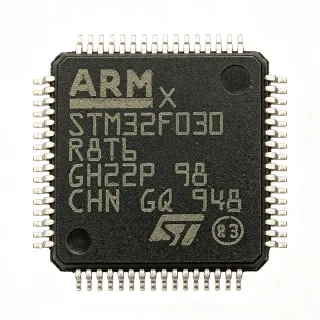
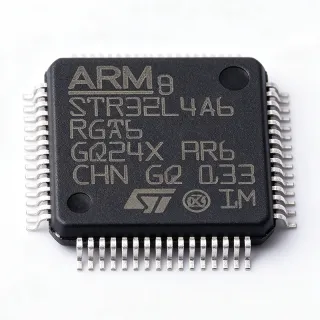
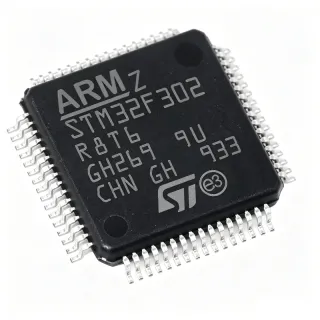
STM32L452RET6TR - 80MHz 512KB Flash MCU | STMicroelectronics
MPN: STM32L452RET6TR ✓ AktifSTM32L452RET6TR Ringkasan
An ultra-low-power microcontroller (MCU) is a single-chip computer that integrates a processor core, non-volatile program memory (Flash), volatile data memory (SRAM), and a broad set of peripherals such as ADCs, DACs, timers, and serial interfaces. The STM32L452RET6TR sits in the STM32L4 family, which is part of the broader STM32 32-bit MCU portfolio, itself a member of the Arm Cortex-M ecosystem. Ultra-low-power MCUs are designed for battery-powered and energy-harvesting systems where every microamp matters, while still providing enough compute throughput for real-time control and signal processing.
Key features include FlexPowerControl with a 1.71 V to 3.6 V supply range, 145 nA in VBAT mode for RTC and 32x32-bit backup registers, 22 nA in Shutdown mode with 5 wakeup pins, and a 12-bit ADC with hardware oversampling. The device also integrates a USB Device controller, DFSDM (digital filter for sigma-delta modulators), and multiple low-power timers, enabling always-on sensing with minimal energy cost.
The STM32L452RET6TR is built on ST's ultra-low-leakage 90 nm process and uses a proprietary adaptive real-time memory accelerator to achieve 100 DMIPS at 80 MHz without wait states. Its analog peripherals include two 12-bit ADCs, one 12-bit DAC, and two ultra-low-power comparators, allowing direct interfacing with sensors and eliminating external signal-conditioning components in many designs.
Typical applications include portable medical monitors, industrial IoT sensor nodes, smart metering, wearable fitness trackers, and battery-operated asset trackers. The combination of 512 KB Flash, 160 KB SRAM, and a rich analog front end makes it suitable for edge processing tasks such as filtering, FFT, and motor control.
When designing with this device, pay close attention to the VDD/VBAT power architecture and the decoupling network. The 64-pin LQFP package provides 52 user I/O pins, so plan pin allocation carefully to avoid conflicts between the USB, ADC, and timer functions.
This page synthesizes distributor pricing, drop-in alternatives, and practical design notes not found in the manufacturer datasheet, giving engineers a single reference for selection, second-sourcing, and layout decisions.
Alternatif penggantian untuk STM32L452RET6TR — paket yang sama, pin-pada-pin kompatibel. Bagian paket yang berbeda memerlukan kerja ulang PCB diabaikan.
Variasi di dalam seri ini
Model-series yang sama yang kompatibel dengan penggantian STM32L452RET6TR (sama faktor bentuk dan footprint) — berbeda di dalam ADC, Core, Performance, Flash Memory, Package.
STM32L452RET6P
✅ Drop-InKontak untuk harga
Lihat Datasheet →STM32L462RET6TR
✅ Drop-In📋 Alternatif referensi (tidak dalam katalog)
STM32L452RCT6
✅ Drop-In📋 Alternatif referensi (tidak dalam katalog)
STM32L452RET3
✅ Drop-In📋 Alternatif referensi (tidak dalam katalog)
STM32L452RET6
✅ Drop-InKontak untuk harga
Lihat Datasheet →STM32L452RET6TR Rating Maksimal & Karakteristik Listrik
| Core | Arm Cortex-M4 with FPU, 32-bit RISC |
| Maximum Frequency | 80 MHz |
| Performance | 100 DMIPS |
| Flash Memory | 512 KB |
| SRAM | 160 KB |
| Supply Voltage Range | 1.71 V to 3.6 V |
| Suhu Kerja | -40 C to +85 C / +125 C |
| Run Mode Current | 84 uA/MHz |
| VBAT Mode Current | 145 nA (RTC + 32x32-bit backup registers) |
| Shutdown Mode Current | 22 nA (5 wakeup pins) |
| ADC | 2x 12-bit ADC with hardware oversampling |
| DAC | 1x 12-bit DAC |
| USB | USB 2.0 Full-Speed Device |
| Paket | LQFP-64 (10x10 mm) |
| Jumlah Pin | 64 pins (52 user I/O) |
| Tipe Mounting | Surface Mount |
| Level MSL | 3 (168 hours) |
| Status RoHS | Compliant |
Konfigurasi Pin STM32L452RET6TR
| Pin produk 1 | VBAT — Backup battery supply for RTC and backup registers |
| Pin produk 2 | PC13 — GPIO / RTC tamper / wakeup |
| Pin produk 3 | PC14-OSC32_IN — GPIO / 32.768 kHz crystal input |
| Pin produk 4 | PC15-OSC32_OUT — GPIO / 32.768 kHz crystal output |
| Pin produk 5 | PH0-OSC_IN — GPIO / HSE crystal input |
| Pin produk 6 | PH1-OSC_OUT — GPIO / HSE crystal output |
| Pin produk 7 | NRST — Reset input (active low) |
| Pin produk 8 | PC0 — GPIO / ADC input |
| Pin produk 9 | PC1 — GPIO / ADC input |
| Pin produk 10 | PC2 — GPIO / ADC input |
| Pin produk 11 | PC3 — GPIO / ADC input |
| Pin produk 12 | VSSA — Analog ground |
| Pin produk 13 | VDDA — Analog supply |
| Pin produk 14 | PA0 — GPIO / ADC / TIM2_CH1 |
| Pin produk 15 | PA1 — GPIO / ADC / TIM2_CH2 |
| Pin produk 16 | PA2 — GPIO / ADC / USART2_TX |
| Pin produk 17 | PA3 — GPIO / ADC / USART2_RX |
| Pin produk 18 | VSS — Digital ground |
| Pin produk 19 | VDD — Digital supply |
| Pin produk 20 | PA4 — GPIO / ADC / DAC_OUT1 |
| Pin produk 21 | PA5 — GPIO / ADC / SPI1_SCK |
| Pin produk 22 | PA6 — GPIO / ADC / SPI1_MISO |
| Pin produk 23 | PA7 — GPIO / ADC / SPI1_MOSI |
| Pin produk 24 | PC4 — GPIO / ADC input |
| Pin produk 25 | PC5 — GPIO / ADC input |
| Pin produk 26 | PB0 — GPIO / ADC / TIM3_CH3 |
| Pin produk 27 | PB1 — GPIO / ADC / TIM3_CH4 |
| Pin produk 28 | PB2 — GPIO / RTC_OUT |
| Pin produk 29 | PB10 — GPIO / I2C2_SCL / USART3_TX |
| Pin produk 30 | PB11 — GPIO / I2C2_SDA / USART3_RX |
| Pin produk 31 | VSS — Digital ground |
| Pin produk 32 | VDD — Digital supply |
| Pin produk 33 | PB12 — GPIO / SPI2_NSS |
| Pin produk 34 | PB13 — GPIO / SPI2_SCK |
| Pin produk 35 | PB14 — GPIO / SPI2_MISO |
| Pin produk 36 | PB15 — GPIO / SPI2_MOSI |
| Pin produk 37 | PC6 — GPIO / TIM8_CH1 |
| Pin produk 38 | PC7 — GPIO / TIM8_CH2 |
| Pin produk 39 | PC8 — GPIO / TIM8_CH3 |
| Pin produk 40 | PC9 — GPIO / TIM8_CH4 |
| Pin produk 41 | PA8 — GPIO / TIM1_CH1 / MCO |
| Pin produk 42 | PA9 — GPIO / USART1_TX / USB_VBUS |
| Pin produk 43 | PA10 — GPIO / USART1_RX / USB_ID |
| Pin produk 44 | PA11 — GPIO / USB_DM / CAN_RX |
| Pin produk 45 | PA12 — GPIO / USB_DP / CAN_TX |
| Pin produk 46 | PA13 — GPIO / SWDIO |
| Pin produk 47 | VSS — Digital ground |
| Pin produk 48 | VDD — Digital supply |
| Pin produk 49 | PA14 — GPIO / SWCLK |
| Pin produk 50 | PA15 — GPIO / JTDI / TIM2_CH1 |
| Pin produk 51 | PC10 — GPIO / USART3_TX / SPI3_SCK |
| Pin produk 52 | PC11 — GPIO / USART3_RX / SPI3_MISO |
| Pin produk 53 | PC12 — GPIO / USART3_CK / SPI3_MOSI |
| Pin produk 54 | PD2 — GPIO / USART3_RX / SDMMC_CMD |
| Pin produk 55 | PB3 — GPIO / JTDO / SPI1_SCK |
| Pin produk 56 | PB4 — GPIO / NJTRST / SPI1_MISO |
| Pin produk 57 | PB5 — GPIO / SPI1_MOSI |
| Pin produk 58 | PB6 — GPIO / I2C1_SCL / USART1_TX |
| Pin produk 59 | PB7 — GPIO / I2C1_SDA / USART1_RX |
| Pin produk 60 | BOOT0 — Boot mode selection |
| Pin produk 61 | PB8 — GPIO / I2C1_SCL / CAN_RX |
| Pin produk 62 | PB9 — GPIO / I2C1_SDA / CAN_TX |
| Pin produk 63 | VSS — Digital ground |
| Pin produk 64 | VDD — Digital supply |
Aplikasi Umum
STM32L452RET6TR cocok untuk 6 aplikasis: Portable Medical Monitors, Industrial IoT Sensor Nodes, Smart Metering, Wearable Fitness Trackers, Battery-Operated Asset Trackers, Motor Control and Robotics.
Portable Medical Monitors
The STM32L452RET6TR fits portable medical monitors because its 84 uA/MHz run current and 22 nA Shutdown mode extend battery life in wearable ECG, SpO2, and glucose monitors. Its two 12-bit ADCs with hardware oversampling capture low-amplitude biosignals without external amplifiers, while the 160 KB SRAM buffers continuous waveform data for on-device filtering. Placed as the main controller between the analog front end and a Bluetooth radio, the MCU runs at 80 MHz to execute real-time QRS detection and then drops to Stop 2 mode between samples. The trade-off is that the 1.71 V minimum supply requires a low-dropout regulator rather than a simple coin cell, but the integrated DAC and comparators reduce total component count.
Direkomendasikan
Industrial IoT Sensor Nodes
The STM32L452RET6TR is well suited to industrial IoT sensor nodes because its 512 KB Flash stores protocol stacks such as Modbus, CANopen, and LoRaWAN alongside application code, while 160 KB SRAM handles buffering and edge analytics. The DFSDM peripheral interfaces directly with sigma-delta sensors and digital microphones, and the 12-bit ADC with oversampling achieves effective resolution beyond 14 bits for slow-moving process variables. In a typical node, the MCU wakes from Stop 2 mode every 100 ms, samples a 4-20 mA loop through an external shunt, runs a moving-average filter, and transmits over RS-485. The trade-off is that the 64-pin LQFP limits I/O expansion, so high-channel-count nodes may need external multiplexers.
Direkomendasikan
Smart Metering
The STM32L452RET6TR suits smart electricity and water meters because its 145 nA VBAT mode keeps the real-time clock and 32x32-bit backup registers alive for years on a backup cell, while the main rail can be fully removed. The 512 KB Flash accommodates metrology algorithms, tariff tables, and communication stacks, and the 12-bit ADC samples current and voltage channels for energy calculation. In a typical meter, the MCU runs metrology at 80 MHz during active measurement and enters Shutdown mode between communication windows, waking via one of five wakeup pins when the radio or optical port signals activity. The trade-off is that accurate metrology still requires external sigma-delta ADCs for class 0.5S accuracy.
Direkomendasikan
Wearable Fitness Trackers
The STM32L452RET6TR is a strong fit for wearable fitness trackers because its 84 uA/MHz active current and 22 nA Shutdown mode allow multi-day operation from a 100 mAh battery. The integrated 12-bit ADC samples heart-rate and SpO2 sensor outputs, while the DFSDM handles digital MEMS microphone and accelerometer data streams. In a typical tracker, the MCU runs a step-counting and heart-rate algorithm at 80 MHz for a few milliseconds per second and sleeps in Stop 2 mode the rest of the time, waking on accelerometer interrupts. The trade-off is that the 64-pin LQFP is larger than a WLCSP, so the tracker PCB must accommodate a 10x10 mm footprint.
Direkomendasikan
Battery-Operated Asset Trackers
The STM32L452RET6TR fits battery-operated asset trackers because its 22 nA Shutdown mode and 145 nA VBAT mode enable multi-year deployment on a single lithium cell. The 512 KB Flash stores GNSS aiding data, geofence tables, and LoRaWAN or NB-IoT stacks, while the USB 2.0 Full-Speed Device interface allows firmware updates and data offload during maintenance. In a typical tracker, the MCU wakes from Shutdown mode on a motion interrupt, acquires a GNSS fix, transmits position over the radio, and returns to Shutdown mode. The trade-off is that GNSS and radio modules dominate the power budget, so the MCU's low leakage mainly extends shelf life between active periods.
Direkomendasikan
Motor Control and Robotics
The STM32L452RET6TR supports motor control and robotics applications because its 80 MHz Cortex-M4 with FPU executes field-oriented control loops in under 10 us, and the 12-bit ADCs sample phase currents with hardware oversampling for noise rejection. The advanced-control timers generate complementary PWM with dead-time insertion, and the 160 KB SRAM buffers trajectory planning data. In a typical robotic joint, the MCU runs a current loop at 20 kHz, a velocity loop at 1 kHz, and a position loop at 100 Hz, communicating with a host over CAN or USB. The trade-off is that the LQFP-64 package limits the number of PWM channels, so multi-axis systems may need one MCU per axis.
Direkomendasikan
Ringkasan Produk Direkomendasikan
Data referensi engineering untuk STM32L452RET6TR — pembandingan, panduan desain, dan informasi konformitas.
Panduan Pemilihan
Pembandingan dengan Alternatif
| Parameter Umum | Produk Ini | STM32L452RET6P | STM32L462RET6TR | STM32L452RCT6 | STM32L452RET3 |
|---|---|---|---|---|---|
| Package | LQFP-64 (10x10 mm) | LQFP-64 (10x10 mm) - same | LQFP-64 (10x10 mm) - same | LQFP-64 (10x10 mm) - same | LQFP-64 (10x10 mm) - same |
| Brand | STMicroelectronics | STMicroelectronics | STMicroelectronics | STMicroelectronics | STMicroelectronics |
| Flash Memory | 512 KB | 512 KB | 512 KB | 256 KB | 256 KB |
| SRAM | 160 KB | 160 KB | 160 KB | 160 KB | 160 KB |
| Core Frequency | 80 MHz | 80 MHz | 80 MHz | 80 MHz | 80 MHz |
| Hardware Crypto | No | No | Yes (AES/HASH/TRNG) | No | No |
| Packaging | Tape & Reel | Tray | Tape & Reel | Tray | Tray |
| Supply Voltage | 1.71 V to 3.6 V | 1.71 V to 3.6 V | 1.71 V to 3.6 V | 1.71 V to 3.6 V | 1.71 V to 3.6 V |
| USB Device | USB 2.0 Full-Speed | USB 2.0 Full-Speed | USB 2.0 Full-Speed | USB 2.0 Full-Speed | USB 2.0 Full-Speed |
Diferensiator Kunci
- Tape & Reel packaging for high-volume SMT (vsSTM32L452RET6P)
- 512 KB Flash vs 256 KB on cost-reduced variants (vsSTM32L452RCT6)
- Lower cost than crypto-enabled sibling (vsSTM32L462RET6TR)
Catatan Desain
Decouple every VDD pin with a 100 nF ceramic capacitor placed within 5 mm of the pin, plus one 4.7 uF bulk capacitor per supply domain. The STM32L452RET6TR has four VDD pins (19, 32, 48, 64) and separate VDDA (pin 13) and VBAT (pin 1) rails. Connect VDDA through a ferrite bead or 10 ohm resistor from VDD and decouple with 100 nF plus 1 uF. If VBAT is unused, tie it to VDD; if a backup cell is used, add a Schottky diode to prevent reverse charging.
Route the 32.768 kHz crystal (PC14/PC15) and the HSE crystal (PH0/PH1) with short, symmetric traces and guard them with ground. Keep the crystal ground returns separate from digital ground and connect them at a single point under the MCU. For the 64-pin LQFP, use a solid ground plane under the device and place stitching vias around the perimeter to minimize loop inductance. Avoid routing high-speed USB (PA11/PA12) traces under the crystal or analog pins.
Do not leave BOOT0 (pin 60) floating; tie it to ground through a 10 kohm resistor for normal Flash boot. The NRST pin (pin 7) has an internal pull-up but adding an external 100 nF capacitor improves noise immunity. When using the internal ADC, ensure VDDA is stable and within 1.71 V to 3.6 V; ADC accuracy degrades if VDDA differs from VREF+. Finally, verify that the debugger does not hold PA13/PA14 (SWDIO/SWCLK) low during low-power modes, as this prevents Stop 2 entry.
Informasi Konformitas
RoHS compliant per STMicroelectronics product page. Not AEC-Q100 qualified; automotive-grade variants are available in the STM32L4A6 series.