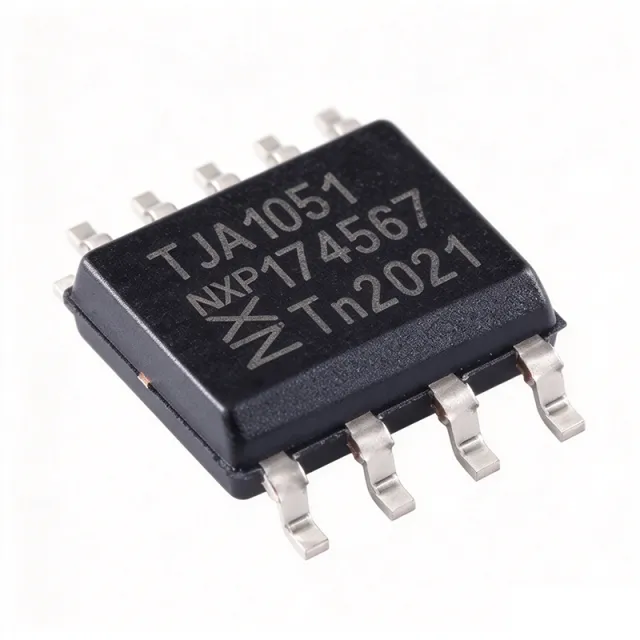
TJA1051T/3/1: What Is It and Why Should Engineers Care?
The NXP TJA1051T/3/1 is a third-generation high-speed CAN transceiver that interfaces a CAN protocol controller to the physical two-wire twisted-pair CAN bus. It supports data rates up to 1 Mbit/s for classical CAN and CAN FD networks, operates from a single 4.5 V to 5.5 V supply, and adds a VIO pin (3 V to 5 V) that lets it talk directly to 3.3 V microcontroller I/O without level shifters. It comes in an 8-pin SO-8 surface-mount package, is AEC-Q100 qualified for -40C to +125C operation, and is pin-compatible with the previous-generation TJA1050. As of 2026-10-13, XAIPART stocks 60,000 units with MOQ of 1, priced from $0.7031 for single units down to $0.4102 at 1,000 pieces.
Three features separate this part from commodity CAN transceivers. First, the /3 suffix means pin 5 is VIO, an I/O-level reference supply that accepts 3 V to 5 V, so a 3.3 V MCU connects to TXD, RXD, and S without external translation. Second, the transceiver presents ideal passive behavior to the bus when unpowered, so an off node does not load or distort the network. Third, the S pin provides silent mode: driving it HIGH disables the transmitter while the receiver stays active, which is exactly what diagnostics tools and listen-only gateway nodes need. The /1 suffix signals dual fab-site sourcing, a supply-chain advantage for high-volume builds. Check current stock and tiered pricing on the TJA1051T/3/1 product page.
What Are the Verified Specifications of the TJA1051T/3/1?
The following table lists the key verified specifications from the XAIPART product database, anchored to the official NXP TJA1051 datasheet.
| Parameter | TJA1051T/3/1 Value |
|---|---|
| Function | High-speed CAN transceiver |
| Data rate | Up to 1 Mbit/s |
| Protocol support | Classical CAN, CAN FD |
| Supply voltage (VCC) | 4.5 V to 5.5 V |
| I/O level voltage (VIO) | 3 V to 5 V |
| Duplex | Half duplex, 1 driver / 1 receiver |
| Silent mode | Yes (S pin) |
| Bus passive when unpowered | Yes (ideal passive behavior) |
| Operating temperature | -40C to +125C |
| Package | SO-8 (8-pin SOIC) |
| Mounting | Surface mount |
| Qualification | AEC-Q100 qualified |
| EMC / ESD | Improved vs TJA1050 generation |
| Backward compatibility | Pin-compatible with TJA1050 |
| Sourcing | Dual fab-site (/1 suffix) |
| RoHS | Compliant |
Takeaway: if your node runs a 3.3 V MCU on a 5 V CAN bus and needs automotive-grade reliability in SO-8, the TJA1051T/3/1 covers all three requirements from one verified part number.
How Do You Design In the TJA1051T/3/1? A Practical Guide
Design-in is straightforward once you handle the three areas that trip up most layouts: pin 5, supply sequencing, and bus termination.
Pinout and connections. The SO-8 pinout is: pin 1 TXD (transmit data input from the CAN controller), pin 2 GND, pin 3 VCC (4.5 V to 5.5 V), pin 4 RXD (receive data output to the controller), pin 5 VIO (I/O level adapter supply, 3 V to 5 V on /3 variants), pin 6 CANL, pin 7 CANH, and pin 8 S (silent mode input; HIGH disables the transmitter). Connect VIO to your microcontroller's I/O supply rail, typically 3.3 V. Connect the S pin to ground for normal transceiver operation; drive it HIGH when you need a listen-only node. If your S pin is not actively driven, tie it low rather than leaving it floating.
Bus termination. Terminate the bus with 120 ohms at both physical ends of the twisted pair. Do not terminate every node; stubs between mid-bus nodes should stay short. Place the 120-ohm resistors and the CANH/CANL traces so that the transceiver pins sit close to the connector, keeping the stub length from transceiver to bus as short as your layout allows.
Power architecture. The part needs one 4.5 V to 5.5 V rail on VCC. The separate VIO input, 3 V to 5 V, decouples the logic-level domain from the bus-driver domain. This means a 3.3 V MCU and a 5 V CAN supply coexist without any translation parts, which removes level-shifter cost and quiescent drain, a meaningful benefit in battery-powered nodes.
Unpowered-node behavior. Because the transceiver presents ideal passive behavior when VCC is off, you can power down a node without corrupting other traffic on the bus. This directly benefits duty-cycled telematics units and industrial networks where technicians de-energize drives or sensors during maintenance.
Replacing a TJA1050. The TJA1051 is pin-compatible with the TJA1050 in the same SO-8 footprint, so existing layouts accept the new part. One caution dominates the swap: on /3 variants, pin 5 is a VIO input, whereas on the TJA1050 pin 5 is a Vref output. If your old board routed Vref to the MCU, cut that connection and tie pin 5 to the MCU supply instead. You also inherit improved EMC and ESD performance over the TJA1050 generation with no layout change, per the NXP TJA1051 datasheet.
CAN FD considerations. The TJA1051 supports CAN FD signaling at the physical layer with 1 Mbit/s arbitration. Per the NXP datasheet FAQ guidance, for full CAN FD data rates above 1 Mbit/s, consider the NXP TJA1044 or TJA1057 families instead.
Takeaway: budget your design around three decisions, VIO tie to the MCU rail, exactly two 120-ohm terminations at the bus ends, and the pin 5 handling when replacing a TJA1050.
What Are the Typical Applications for the TJA1051T/3/1?
The verified application data maps this transceiver to six scenarios, each exploiting a different combination of its specifications.
Body control modules. A 5 V CAN node must talk to a 3.3 V MCU; the VIO pin (3 V to 5 V) removes level shifters, and AEC-Q100 qualification with -40C to +125C operation meets automotive reliability requirements. Improved EMC and ESD ruggedness over the TJA1050 handles load-dump and switching-noise environments. With 120-ohm end termination, it drives up to 1 Mbit/s while ideal passive behavior keeps unpowered nodes from loading the network.
Gateway and central modules. Gateways route traffic between multiple CAN buses, so robustness and supply-chain stability matter. Dual fab-site sourcing (/1 suffix) de-risks high-volume gateway production, and silent mode (S pin) enables listen-only diagnostics on each bus segment. Improved ESD performance protects central nodes where every bus fault converges.
Engine control units. The -40C to +125C range, AEC-Q100 qualification, and improved EMC/ESD versus the TJA1050 generation suit under-hood conditions. The differential receiver maintains reliable 1 Mbit/s communication despite common-mode noise from ignition and injector switching, and the VIO pin interfaces directly with 3.3 V ECU microcontrollers.
Industrial automation networks. CANopen and DeviceNet-style networks benefit from the wide temperature range and robust ESD behavior on factory floors. Silent mode enables listen-only monitoring nodes, and ideal passive bus behavior lets technicians power down individual drives or sensors without breaking communication. The 4.5 V to 5.5 V supply aligns with standard industrial 5 V logic rails.
Battery-powered and low-power nodes. For telematics units, battery sensors, and parked-vehicle monitoring, low standby consumption and ideal passive bus behavior minimize drain: when VCC is off, the transceiver does not load the bus, and the S pin can mute the transmitter while RXD keeps listening. The /3 VIO pin allows direct 3.3 V battery-management MCU interfacing.
CAN diagnostics and test equipment. Handheld analyzers and OBD tools use silent mode to stay a passive listener during bus capture, guaranteeing the measurement does not alter arbitration or error frames. The 1 Mbit/s rate covers classical CAN and OBD-II speeds up to 500 kbit/s with margin. Adafruit's CAN Pal dev board (product 5708) ships with the TJA1051T/3 for exactly this role, with switchable 120-ohm termination.
Takeaway: match your scenario to the spec that solves it, VIO for low-voltage MCUs, silent mode for diagnostics, /1 sourcing for volume builds, and passive bus behavior for duty-cycled nodes.
How Do the TJA1051T/3/1 and Its Alternatives Compare?
Drop-in alternatives verified in the XAIPART database are all NXP family variants plus one cross-brand option. The table below lists them with the distinguishing attributes from the database.
| Alternative | Relationship to TJA1051T/3/1 | Key difference |
|---|---|---|
| TJA1051T/3/1J | Same die, US ordering code variant | Identical function and packing; ordering-code difference only |
| TJA1051T/3,118 | Same die, single-fab-site variant | Tape-and-reel ordering code; single fab site instead of dual |
| TJA1050T | Previous generation, pin-compatible SO-8 | Pin 5 is Vref output instead of VIO input; lower EMC/ESD performance |
| TLE9251V | Cross-brand, Infineon high-speed CAN transceiver | Pin-compatible SO-8, different manufacturer sourcing option |
The FAQ data adds two more cross-brand references worth knowing when qualifying second sources: the TI TCAN1051-Q1, designed as a pin-to-pin replacement for the TJA1051 family in the same SO-8 package with similar 1 Mbit/s performance, and the TCAN1051A variant, which places an EN pin on pin 5, adding standby control not present on the NXP /3 version. Note the direct consequence: a TCAN1051A is not a blind drop-in for a /3 board, because pin 5 carries a different function. Verify pin 5 on every variant before substitution.
For the TJA1050 upgrade path, remember that the comparison table only lists attributes present in the database; the TJA1050T carries no VIO input, so boards that need 3.3 V logic interfacing should move forward to the TJA1051T/3 family, not backward.
Takeaway: within-NXP variants (/1J and /3,118) swap freely; cross-brand alternates require a pin 5 check, and the old TJA1050T is a downgrade unless your board already expects Vref on pin 5.
What Does Pricing, Stock, and Availability Look Like?
XAIPART lists 60,000 units in stock with MOQ of 1, priced as of 2026-10-13 in the following tiers:
| Quantity | Unit Price (USD) |
|---|---|
| 1+ | $0.7031 |
| 10+ | $0.5078 |
| 100+ | $0.4492 |
| 500+ | $0.4297 |
| 1000+ | $0.4102 |
That is a 41.7% unit-price reduction from 1 piece to 1,000 pieces, which makes consolidating pilot and production buys onto one purchase order worthwhile. For broader market context, distributor data as of 2026-08-30 showed the TJA1051T/3/1J stocked at DigiKey and Mouser with same-day small-quantity shipping, with Octopart tracking roughly 9 to 11 distributors. However, the Cosolvic 2026 cross-reference report noted 22-week authorized lead times for TJA1051T/3 during shortage periods, so check live stock before committing production schedules. The lifecycle status in the XAIPART database is active, and the part is RoHS compliant. For supply-chain trend context across components, see the XAIPART lead-time and sourcing outlook and browse the full component catalog.
Takeaway: buy at the 1,000-piece tier when possible, keep the /1 dual-fab suffix in your BOM for sourcing flexibility, and re-check lead times each quarter given the documented 22-week historical worst case.
What Market Position Does the TJA1051 Family Hold?
The TJA1051 sits in NXP's third-generation high-speed CAN transceiver line, positioned directly against the ubiquitous TJA1050 it replaces. Its verified position rests on three pillars: AEC-Q100 qualification for automotive designs, improved EMC and ESD performance versus the TJA1050 generation, and pin compatibility that lets existing TJA1050 layouts adopt it without re-spinning the PCB. The dual fab-site /1 suffix exists specifically to improve supply continuity, which NXP designed into the ordering code rather than leaving to chance.
The family spans variants for different needs: TJA1051T (5 V-only I/O, pin 5 NC), TJA1051T/3 (VIO on pin 5), TJA1051T/E, and the TJA1051TK/3, all documented in the same NXP datasheet. XAIPART's database marks the TJA1051T/3/1 lifecycle as active with 60,000 units available, indicating no allocation constraints at the time of writing. Broader interface-IC market-share and forecast data is not part of the verified dataset, so treat any market-size claims you see elsewhere with skepticism unless sourced.
Takeaway: the part's market position is 'the safe successor', pin-compatible with the installed base, actively supplied, and dual-sourced by design.
What Should Buyers and Engineers Watch Next?
Four developments anchored to the verified data deserve a line item in your sourcing plan.
CAN FD data-phase growth. The TJA1051 supports CAN FD at the physical layer with 1 Mbit/s arbitration. As networks migrate to faster CAN FD data phases above 1 Mbit/s, the NXP datasheet guidance points to the TJA1044 and TJA1057 families. If your roadmap includes data-phase speeds above 1 Mbit/s, qualify those now rather than mid-program.
Second-source qualification. The TI TCAN1051-Q1 and Infineon TLE9251V give you two cross-brand, pin-compatible SO-8 options. Qualify at least one and document the pin 5 difference (VIO versus EN on TCAN1051A) in your Alt BOM so a shortage substitution never corrupts a build.
Lead-time volatility. The documented 22-week authorized lead-time episode for TJA1051T/3 during shortage periods argues for buffer stock on gateway and BCM programs where the transceiver is a single point of network failure. The /1 suffix dual-fab sourcing is your structural hedge; keep it.
3.3 V logic migration. The VIO input accepting 3 V to 5 V is the specification that ages well. As MCU I/O rails keep dropping, VIO-equipped transceivers avoid level-shifter BOM lines entirely. For new 5 V-bus nodes, default to /3 variants over the 5 V-only TJA1051T unless pin 5 must stay NC.
Takeaway: qualify a CAN FD-capable successor and one cross-brand second source now, and treat the /1 suffix plus VIO as the two specs that protect this design long-term.
How Do You Buy the TJA1051T/3/1 on XAIPART?
Order directly from the TJA1051T/3/1 product page: 60,000 units in stock, MOQ 1, tiered pricing from $0.7031 down to $0.4102 at 1,000 pieces as of 2026-10-13. Download the official datasheet PDF from NXP at nxp.com/docs/en/data-sheet/TJA1051.pdf for full timing parameters and application information. For component-selection deep dives on other parts, browse the XAIPART Blog and the component catalog.
Final takeaway: the TJA1051T/3/1 earns its socket by combining 1 Mbit/s classical CAN and CAN FD support, 4.5 V to 5.5 V VCC with 3 V to 5 V VIO, -40C to +125C AEC-Q100 operation, silent mode, ideal unpowered bus behavior, TJA1050 pin compatibility, and dual-fab sourcing, all in a $0.41-to-$0.70 SO-8 package that is in stock today.
コメント
最初のコメントを投稿しましょう。
🔐 コメントするには ログイン してください。
アカウントをお持ちでないですか? 新規登録