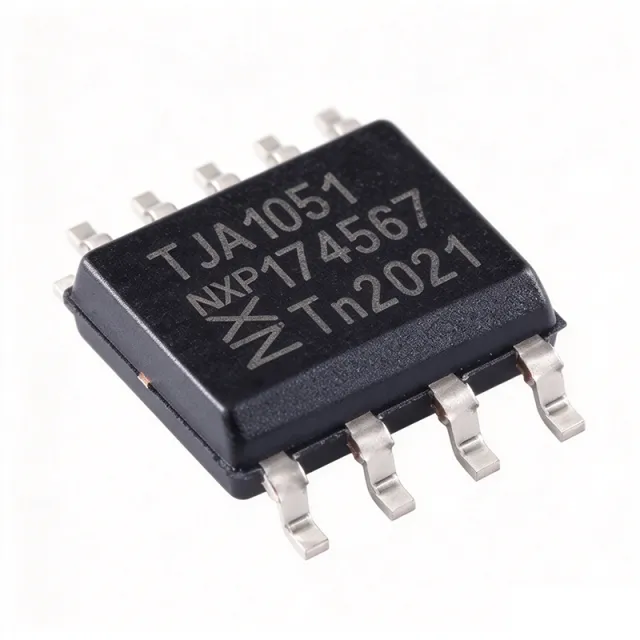
TJA1051T/3/1 - 1Mbit/s High-Speed CAN Transceiver | NXP
MPN: TJA1051T/3/1 ✓ Active| Qty | Unit Price | Extended |
|---|---|---|
| 1 | $0.7031 | $0.70 |
| 10 | $0.5078 | $5.08 |
| 100 | $0.4492 | $44.92 |
| 500 | $0.4297 | $214.85 |
| 1,000 | $0.4102 | $410.20 |
TJA1051T/3/1 Overview
A CAN transceiver is a physical-layer device that converts TXD/RXD logic signals from a CAN controller into differential signals on the twisted-pair bus and back. Within the interface IC hierarchy it sits between the protocol controller and the bus, providing drive capability, bus protection, and noise immunity for reliable communication in harsh automotive and industrial environments.
Key features include a VIO pin (the /3 suffix) enabling direct interfacing to 3V-to-5V microcontroller I/O rails, ideal passive behavior to the bus when unpowered (the off node does not load the network), and a silent-mode S pin that disables the transmitter while the receiver stays active. The /1 suffix indicates dual fab-site sourcing for supply-chain flexibility.
The TJA1051 improves ElectroMagnetic Compatibility (EMC) and ElectroStatic Discharge (ESD) performance versus the earlier TJA1050 generation, and is AEC-Q100 qualified for automotive reliability. It is pin-compatible with the TJA1050, enabling drop-in replacement in existing layouts - note pin 5 changes from Vref output on TJA1050 to VIO input on /3 variants.
Typical applications include body control modules, gateway modules, engine control units, and industrial automation networks. Low power consumption and robust ESD ruggedness suit battery-powered and harsh-environment nodes.
Design tip: terminate the bus with 120 ohms at both ends and connect VIO to the microcontroller supply to match TXD/RXD/S logic levels; in 5V-only systems the non-/3 TJA1051T with pin 5 NC is also safe.
Drop-in alternatives for TJA1051T/3/1 — same package, pin-to-pin compatible. Different-package parts requiring PCB rework are excluded.
Variants in this series
Same-series models that are drop-in compatible with TJA1051T/3/1 (same form factor and footprint) — differing in Package, Protocol, Operating Temperature, Data Rate, Function.
Quick Comparison Tool — Select alternative parts for side-by-side comparison:
TCAN1051-Q1
✓ In Stock
$1.05 / Unit
View Datasheet →SN65HVD230QDRQ1
✓ In Stock
$1.11 / Unit
View Datasheet →TJA1051T/3/1J
📋 Reference alternative (not in catalog)
TJA1051T/3,118
📋 Reference alternative (not in catalog)
TJA1050T
📋 Reference alternative (not in catalog)
TLE9251V
📋 Reference alternative (not in catalog)
TJA1051T/3/1 Specifications
| Function | High-speed CAN transceiver |
| Data Rate | Up to 1 Mbit/s |
| Supply Voltage (VCC) | 4.5 V to 5.5 V |
| I/O Level Voltage (VIO) | 3 V to 5 V |
| Protocol Support | Classical CAN, CAN FD |
| Duplex | Half duplex, 1 driver / 1 receiver |
| Package | SO-8 (8-pin SOIC) |
| Mounting Type | Surface Mount |
| Operating Temperature | -40C to +125C |
| Silent Mode | Yes (S pin) |
| Bus Passive When Unpowered | Yes (ideal passive behavior) |
| AEC-Q100 | Qualified |
| ESD Performance | Improved vs TJA1050 generation |
| Backward Compatibility | Pin-compatible with TJA1050 |
| Sourcing | Dual fab-site (/1 suffix) |
| RoHS Status | Compliant |
TJA1051T/3/1 Pin Configuration
| Pin 1 | TXD — Transmit data input from CAN controller |
| Pin 2 | GND — Ground |
| Pin 3 | VCC — Supply voltage, 4.5V to 5.5V |
| Pin 4 | RXD — Receive data output to CAN controller |
| Pin 5 | VIO — I/O level adapter supply, 3V to 5V (/3 variants) |
| Pin 6 | CANL — CAN low bus line |
| Pin 7 | CANH — CAN high bus line |
| Pin 8 | S — Silent mode input; HIGH disables transmitter |
Typical Applications
TJA1051T/3/1 is suitable for 6 applications: Body Control Modules, Gateway and Central Modules, Engine Control Units, Industrial Automation Networks, Battery-Powered and Low-Power Nodes, CAN Diagnostics and Test Equipment.
Body Control Modules
The TJA1051T/3/1 fits body control modules where a 5V CAN node must talk to 3.3V MCUs: the VIO pin (3V-5V) removes level shifters, and AEC-Q100 qualification with -40C to +125C operation meets automotive reliability requirements. Improved EMC and ESD ruggedness over the TJA1050 handles the harsh load-dump and switching-noise environment of vehicle electrical systems. Placed between the MCU CAN controller and the twisted-pair bus with 120-ohm end termination, it drives up to 1 Mbit/s while its ideal passive behavior keeps unpowered nodes from loading the network.
Recommended
Gateway and Central Modules
Automotive gateways route traffic between multiple CAN buses, making transceiver robustness and supply-chain stability critical. The TJA1051T/3/1 offers dual fab-site sourcing (/1 suffix) to de-risk high-volume gateway production, plus silent mode (S pin) allowing listen-only diagnostics on each bus segment. Its 1 Mbit/s rate supports classical CAN backbone segments, and the VIO pin simplifies interfacing to low-voltage SoC or MCU I/O banks. Improved ESD performance protects central nodes where every bus fault converges, reducing warranty risk in high-node-count networks.
Recommended
Engine Control Units
Engine control units demand transceivers that survive extreme temperatures and electromagnetic interference. The TJA1051T/3/1 operates from -40C to +125C, is AEC-Q100 qualified, and provides improved EMC and ESD performance versus the earlier TJA1050 generation per NXP datasheet TJA1051. Its differential receiver maintains reliable 1 Mbit/s communication on the powertrain CAN bus even with common-mode noise from ignition and injector switching. The VIO pin interfaces directly with 3.3V ECU microcontrollers, and the part tolerates bus faults such as short-to-battery conditions typical of under-hood wiring harnesses.
Recommended
Industrial Automation Networks
Industrial CANopen and DeviceNet-style networks benefit from the TJA1051T/3/1's wide -40C to +125C range and robust ESD specification, which tolerate factory-floor static and cable-induced transients. The silent mode pin enables listen-only monitoring nodes for network diagnostics without disturbing bus arbitration. Because unpowered nodes present an ideal passive load to the bus, maintenance technicians can power down individual drives or sensors without breaking network communication - a key availability advantage. Its 4.5V-5.5V supply aligns with standard industrial 5V logic rails, and SO-8 fits dense I/O boards.
Recommended
Battery-Powered and Low-Power Nodes
For telematics units, battery sensors, and parked-vehicle monitoring, the TJA1051T/3/1's low standby consumption and ideal passive bus behavior minimize drain: when VCC is off the transceiver does not load the bus, and the S pin can mute the transmitter while RXD keeps listening. The /3 VIO pin allows direct 3.3V battery-management MCU interfacing without extra level-shifter quiescent cost. According to NXP datasheet TJA1051, these characteristics suit any duty-cycled CAN node where every microamp of average current shortens battery life, while SO-8 keeps the BOM footprint small.
Recommended
CAN Diagnostics and Test Equipment
Handheld CAN analyzers and OBD diagnostic tools use the TJA1051T/3/1 because silent mode (S pin) lets the tool remain a passive listener during bus capture, guaranteeing the measurement does not alter arbitration or error frames. The VIO pin adapts RXD logic levels to 1.8V-5V-capable USB interface chips or 3.3V microcontrollers. Adafruit's CAN Pal dev board (product 5708) ships with the TJA1051T/3 for exactly this role, with switchable 120-ohm termination. The 1 Mbit/s rate covers classical CAN and OBD-II speeds up to 500 kbit/s with margin.
Recommended
Recommended Products Summary
Engineering reference data for TJA1051T/3/1 — comparison, design guidance, and compliance information.
Selection Guide
Comparison with Alternatives
| Parameter | This Product | TJA1051T/3/1J | TJA1050T | TCAN1051-Q1 | TLE9251V |
|---|---|---|---|---|---|
| Package | SO-8 | SO-8 - same | SO-8 - same | SO-8 - same | SO-8 - same |
| Brand | NXP Semiconductors | NXP Semiconductors | NXP Semiconductors | Texas Instruments | Infineon |
| Data Rate | Up to 1 Mbit/s | Up to 1 Mbit/s | Up to 1 Mbit/s | Up to 1 Mbit/s (CAN FD capable) | Up to 1 Mbit/s |
| Automotive Grade (AEC-Q100) | Qualified | Qualified | Qualified | Qualified (-Q1) | Qualified |
| Bus Passive When Unpowered | Yes | Yes | No | Yes | Yes |
| Generation / EMC-ESD | 3rd generation, improved EMC/ESD | 3rd generation, same | 2nd generation, lower EMC/ESD | Comparable modern generation | Comparable modern generation |
Key Differentiators
- VIO pin for 3V-5V MCU interfacing (vs TJA1050T)
- Ideal passive bus behavior when unpowered (vs TJA1050T)
- Improved EMC and ESD vs previous generation (vs TJA1050T)
- Dual fab-site sourcing (vs TJA1051T/3 (single site))
Design Notes
Connect VIO (pin 5) to the microcontroller I/O supply so TXD, RXD, and S logic thresholds match the MCU bank. In a 5V-only system, the non-/3 TJA1051T with pin 5 NC is safe and saves the VIO rail. Do not leave VIO floating on /3 variants - undefined logic thresholds can cause spurious TXD sampling. Keep CANH/CANL as a matched pair routed together away from switching nodes.
Terminate the bus with 120 ohms at both physical ends only; stubs should be short. When replacing a TJA1050, remember pin 5 changes function from Vref output to VIO input on /3 variants - a legacy layout driving or sensing Vref must be reworked before fitting the /3 part. The S pin must be driven LOW for normal transceive operation; a floating S pin may put the device in silent (receive-only) mode.
Place a 100 nF ceramic decoupling capacitor within 5 mm of VCC (pin 3) to GND, plus a bulk 1-10 uF per node. Improved EMC of the TJA1051 reduces common-mode emissions, but PCB-level symmetry of CANH/CANL traces remains essential to minimize radiation at 1 Mbit/s slopes. Reference NXP application note AN10442 for CAN network layout guidance and split-termination techniques.
Compliance Information
AEC-Q100 qualified per NXP product data. RoHS compliant per NXP product page ordering codes (e.g. ,118 / ,1J suffixes indicate lead-free/RoHS packaging). REACH and halogen-free status not stated in provided data.


