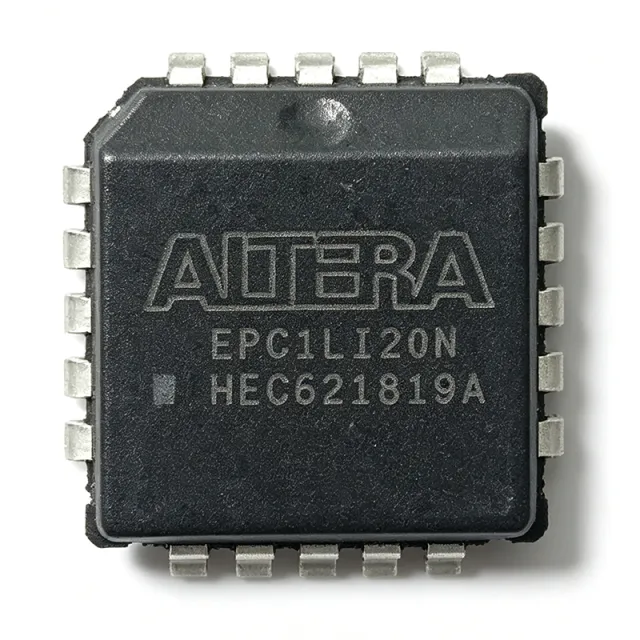
EPC1C20F324I7
EPC1C20F324I7 - Cyclone FPGA, 20K LE, 324-FBGA | Altera
The Altera (now Intel) EPC1C20F324I7 is a Cyclone-family Field Programmable Gate Array (FPGA) housed in a 324-ball Fine-pitch Ball Grid Array (FBGA) package, optimized for high-volume, low-cost digital logic designs. Per the Cyclone family datasheet, it integrates 20,060 logic elements, 294,912 bits of embedded RAM, two PLLs, and 233 maximum user I/O pins, with a core voltage of 1.5V and a maximum internal operating frequency of 320.1 MHz. The 'I7' speed grade indicates an industrial temperature range suitable for harsh-environment deployments.
A Field Programmable Gate Array (FPGA) is a type of programmable logic device (PLD) that allows designers to configure digital logic blocks, interconnect, and I/O after manufacture. FPGAs sit hierarchically within the broader taxonomy: programmable logic -> PLD -> FPGA -> SRAM-based FPGA. The Cyclone family specifically targets cost-sensitive, high-volume applications by balancing logic density, memory, and DSP resources while keeping per-unit cost low relative to high-end FPGAs.
Key features of the EP1C20F324I7 include 20,060 logic elements arranged in logic array blocks (LABs), 294,912 bits (approximately 36 Kbytes) of M4K embedded memory blocks ideal for FIFO and buffer implementations, and dedicated 18x18 hardware multipliers for DSP functions. The device supports multiple I/O standards including LVTTL, LVCMOS, PCI, SSTL, and LVDS through its 324-ball FBGA, enabling flexible interfacing with external memories, processors, and high-speed peripherals.
Architecturally, the Cyclone EP1C20 uses a 0.13 µm SRAM-based configuration cell fabric with four input look-up tables (4-LUTs) per logic element, supported by a rich routing matrix and dedicated carry chains for arithmetic operations. Two on-chip PLLs provide clock multiplication, division, and phase shifting across up to six output banks. Configuration is loaded via passive serial (PS), active serial (AS), or JTAG modes through an EPCS configuration device, with built-in support for design security and remote update.
Typical applications include digital signal processing front-ends, video bridging and image processing, industrial control and factory automation, telecommunications line cards, and prototyping of ASIC designs. The combination of moderate logic density, embedded multipliers, and low-cost packaging makes it well-suited for high-volume embedded and consumer applications requiring custom hardware acceleration.
When designing with this device, pay careful attention to power estimation tools (Quartus PowerPlay) and signal integrity on high-speed LVDS pairs. The 1.5V core supply must be sequenced correctly with the 3.3V I/O supply to avoid latch-up, and decoupling capacitor selection per the Cyclone device family guidelines is essential for jitter performance. Designers should also verify that the chosen EPCS configuration memory size matches the compressed bitstream length.
This page synthesizes distributor pricing, drop-in alternatives, and practical design notes not found in the manufacturer datasheet, offering unique engineering value for sourcing and BOM consolidation decisions.
見積もり
お問い合わせ