EPM3128ATI144-10AA
EPM3128ATI144-10AA - 128-Macrocell MAX 3000A CPLD, 10ns, 144-TQFP | Intel
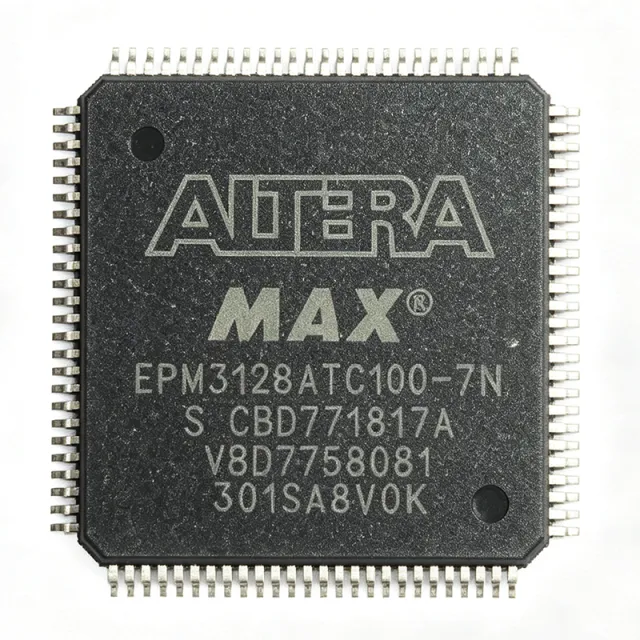
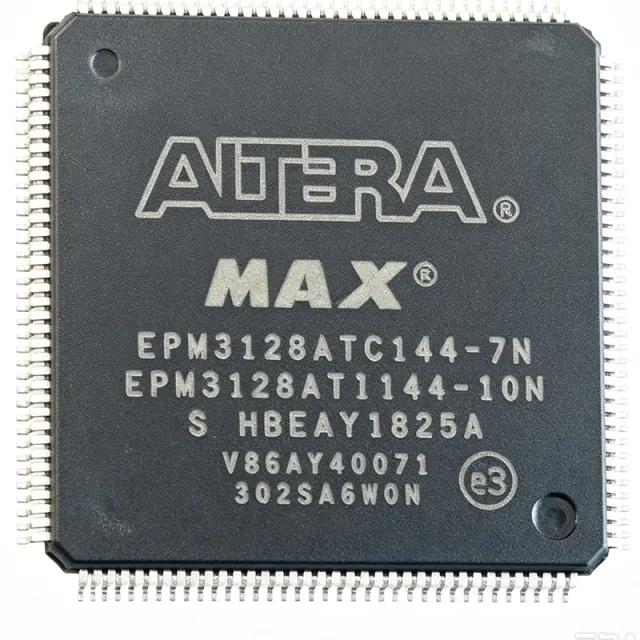
The Intel (formerly Altera) EPM3128ATI144-10AA is a 128-macrocell, 2,500-gate CMOS EEPROM-based Complex Programmable Logic Device (CPLD) from the MAX 3000A family, supplied in a 144-pin TQFP package with a 10 ns pin-to-pin propagation delay (tPD). The part supports in-system programmability (ISP) via a 3.3 V JTAG interface, operates from 3.0 V to 3.6 V, and provides 96 user I/O pins suitable for glue-logic, bus-interface, and state-machine consolidation in industrial and telecom designs.
What is a CPLD? A Complex Programmable Logic Device is a non-volatile programmable logic IC that combines multiple PAL-like macrocell arrays on a single die, providing deterministic timing, predictable pin-to-pin delays, and instant-on behavior that FPGAs cannot match. Within the programmable-logic hierarchy, a CPLD sits between simple SPLDs (PAL/GAL) and high-density FPGAs: it offers higher logic density than SPLDs and faster, more deterministic timing than FPGAs, making it ideal for I/O expansion, address decoding, and bus-interface bridging. The MAX 3000A family is Intel's classic 3.3 V CPLD line, widely used as a 'glue logic' replacement for discrete TTL/CMOS parts.
Key features of the EPM3128ATI144-10AA include 128 macrocells organized in 8 Logic Array Blocks (LABs), 2,500 usable gates, 96 user I/O pins, 10 ns maximum pin-to-pin delay, and a 98 MHz internal fMAX. The device supports IEEE 1149.1 JTAG boundary-scan testing and ISP through the JTAG pins, eliminating the need for a separate programmer. MultiVolt I/O allows interfacing with 1.5 V, 1.8 V, 2.5 V, and 3.3 V devices without external level shifters.
Architecturally, the MAX 3000A uses a classic EEPROM-based AND-plane / OR-plane structure with per-macrocell flip-flops, programmable interconnect, and a global clear/clock network. Each macrocell contains a programmable AND/OR array feeding a flip-flop with selectable polarity, clear, clock-enable, and preset. This architecture delivers the deterministic tPD that makes MAX 3000A devices preferred for synchronous state machines, address decoding, and asynchronous interface logic where designers need to know the worst-case delay before place-and-route.
Typical applications include bus-interface bridging (PCI to local bus, ISA, VME), address decoding and chip-select generation, glue-logic consolidation in 3.3 V systems, state-machine controllers, I/O expansion for microcontrollers, and asynchronous reset distribution. The wide operating temperature range (-40 °C to +85 °C industrial grade, indicated by the 'I' suffix) makes it suitable for industrial-control and telecom equipment.
Design considerations: ensure the 3.3 V supply is well-decoupled with 0.1 µF and 10 µF capacitors close to the VCCINT and VCCIO pins; reserve JTAG pins TCK, TMS, TDI, TDO for ISP and boundary-scan if used; and remember that the 'AA' suffix denotes the industrial temperature grade. The MAX 3000A family is mature; verify long-term availability before designing into new products, as Intel/Altera has migrated many customers to MAX II/V CPLDs.
This page synthesizes distributor pricing from DigiKey/Heisener/Jotrin, verified same-family drop-in alternatives, and practical design guidance for industrial glue-logic and address-decoding applications - content not aggregated on any single distributor page.
見積もり
お問い合わせ