製品 (17663)

TMS320F28332PTPS - 100MHz C2000 Delfino MCU 128KB Flash | TI
TMS320F28332PTPS

TMS320F28332PTPS - 100MHz C2000 Delfino MCU 128KB Flash | TI

The Texas Instruments TMS320F28332PTPS is a 32-bit C2000 Delfino real-time microcontroller (DSC) delivering 100 MIPS at 100 MHz with a floating-point unit (FPU), 128 KB (64K x 16) of on-chip flash memory, and an EMIF external memory interface, housed in a 176-pin HLQFP (PTP) package measuring 24x24 mm with exposed thermal pad. A digital signal controller (DSC) combines the high-throughput arithmetic of a digital signal processor with the peripheral integration and interrupt responsiveness of a microcontroller. Within the power-management hierarchy, the C28x Delfino family sits at the high end of TI's real-time control MCU portfolio, optimized for fast closed-loop control algorithms in motor drives, power conversion, and industrial automation systems. Key differentiating features include the 32-bit C28x CPU with single-cycle multiply-accumulate, an FPU that offloads floating-point math and shortens control-loop software overhead, a 12-bit ADC with up to 16 channels for precise analog acquisition, high-resolution ePWM peripherals for power-stage control, and multiple communication interfaces (SCI, SPI, McBSP, CAN, I2C). Technically, the device runs from a 1.8 V core supply (1.71 V to 1.89 V) with 3.3 V I/O, over a -40C to +125C industrial temperature range. The EMIF enables external memory or FPGA expansion, and 52 KB of on-chip SRAM supports fast control variables and data buffers. Typical applications include industrial motor drives, solar inverters and renewable energy converters, digital power supplies (LLC, totem-pole PFC), and traction control systems. The high-speed ADC and ePWM modules enable precise, low-latency control, while the CAN interface supports robust communication in harsh environments. Design consideration: properly decouple the 1.8 V core and 3.3 V I/O rails, and solder the exposed thermal pad to the ground plane per the datasheet layout guidelines to optimize thermal and electrical performance. This page synthesizes distributor pricing, same-family drop-in alternatives, comparison tables, and practical design notes not found in the manufacturer datasheet.

USD $8.60 在庫あり
TMS320F28335 - C2000 32-Bit DSC 150MHz FPU 512KB | TI
TMS320F28335

TMS320F28335 - C2000 32-Bit DSC 150MHz FPU 512KB | TI

The Texas Instruments TMS320F28335 is a C2000 Delfino 32-bit floating-point digital signal controller (DSC) delivering 150 MIPS (150 MHz CPU clock), 512 KB (256K x 16) of on-chip Flash, an external memory interface (EMIF), and a 12-bit ADC, housed in a 176-pin LQFP package (PGF suffix). A digital signal controller combines the computational throughput of a digital signal processor with the peripheral integration and control-oriented architecture of a microcontroller. Within the power management hierarchy, the DSC sits at the top of the C2000 real-time controller family: MCU -> digital signal controller -> embedded processor -> semiconductor device, making it the central control element in digitally controlled power and motion systems. Key features include the 32-bit C28x CPU core with an integrated single-precision FPU, which removes the software overhead of fixed-point arithmetic for control-law computations; 150 MIPS sustained real-time performance; 512 KB Flash with 34K x 16 bytes of SARAM for code and data; 18 PWM channels including high-resolution ePWM for power conversion; and a rich analog and communications suite with 12-bit ADC, eCAN, McBSP, SPI, SCI, and I2C interfaces. Architecturally, the TMS320F28335 uses a modified Harvard bus structure with separate program and data buses, a unified memory map enabled by the FPU generation, a 32 x 32-bit multiplier, atomic read-modify-write instructions, and fast interrupt latency suited to field-oriented motor control loops running in the tens of microseconds. Three 32-bit CPU timers and a PIE interrupt matrix support deterministic real-time execution. Typical applications include industrial motor drives (FOC for PMSM and induction motors), digital power supplies and solar inverters, and automotive/transportation control systems where high-resolution PWM and fast ADC feedback loops are mandatory. A key design consideration: at 150 MHz, the core voltage supply differs from the I/O supply, so dual-rail power sequencing and proper decoupling per the TI TMS320x2833x Technical Reference Manual are essential for reliable operation. This page synthesizes verified distributor data, drop-in same-family alternatives, and practical design guidance beyond what the manufacturer datasheet page alone provides.

見積もり 在庫あり
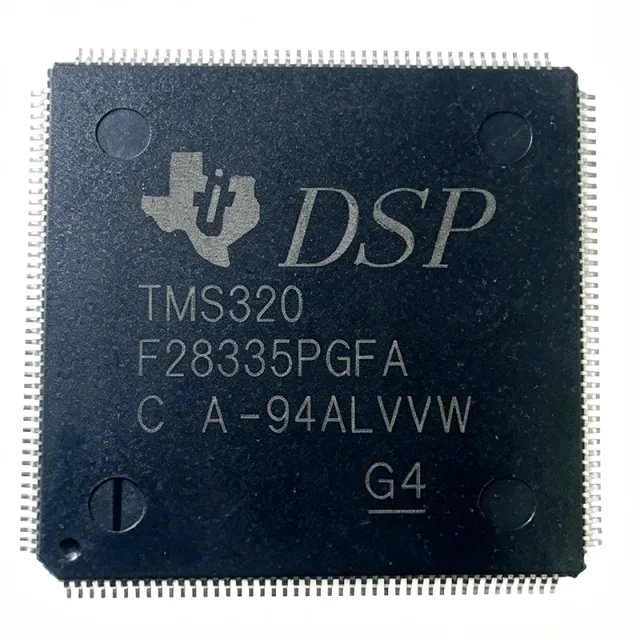
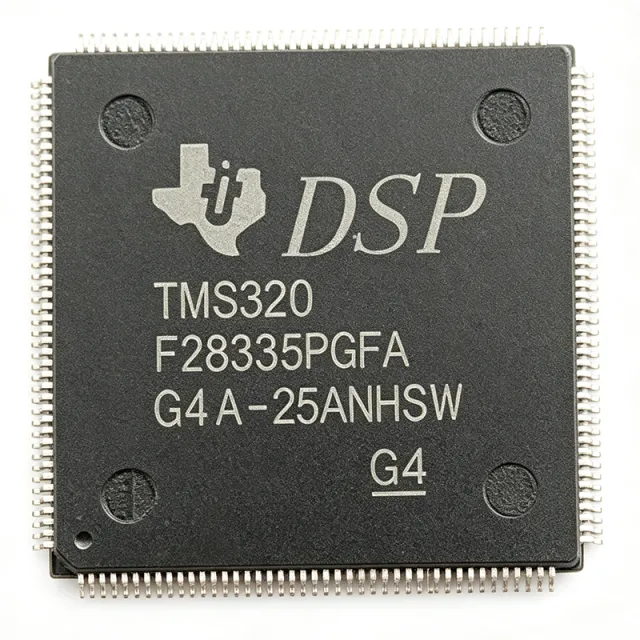
TMS320F28335PGFA - 150MHz 32-bit C2000 DSC MCU | Texas Instruments
TMS320F28335PGFA

TMS320F28335PGFA - 150MHz 32-bit C2000 DSC MCU | Texas Instruments

The Texas Instruments TMS320F28335PGFA is a 32-bit floating-point digital signal controller (DSC) from the C2000 Delfino family, delivering 150 MHz (150 MIPS) performance with 512 KB (256K x 16) on-chip flash memory and 68 KB SRAM, housed in a 176-pin LQFP (24x24 mm, PGF) surface-mount package. A digital signal controller combines the real-time control capability of a microcontroller (MCU) with the mathematical throughput of a digital signal processor (DSP). Within the embedded control hierarchy, the C2000 Delfino DSC sits at the top of real-time controllers, above generic MCUs, for closed-loop control loops running at tens of kilohertz. The C28x core uses a Harvard architecture with a hardware multiplier and a single-precision floating-point unit (FPU) that accelerates field-oriented control (FOC) and other complex control algorithms. Key features include a 12-bit ADC with up to 16 channels, 18 PWM outputs including high-resolution PWM (HRPWM), and communication peripherals covering CAN, SPI, SCI (UART), and I2C. An external memory interface (EMIF) expands memory beyond on-chip resources, a differentiator versus smaller C2000 parts such as the TMS320F28027. The device is fabricated on TI 180 nm CMOS process technology. It runs from a 1.9 V core supply and 3.3 V I/O supply, with typical power consumption near 300 mW at full speed, and operates from -40C to +85C, qualifying it for industrial environments. The FPU executes single-cycle floating-point operations, critical for high-speed control loops without fixed-point IQmath conversion. Typical applications include servo motor drives, solar inverters, digital power supplies, and industrial automation where fast ADC sampling and precise PWM edges are essential. Design consideration: decouple the 1.9 V core and 3.3 V I/O rails separately, budget for LQFP thermal dissipation, and use the JTAG port with Code Composer Studio for real-time emulation and debugging. This page synthesizes distributor pricing, verified drop-in alternatives, and practical design notes not found in the manufacturer datasheet alone.

USD $14.20 在庫あり
TMS320F28335PTPQ - 150MHz C2000 DSC MCU, 512KB Flash | TI
TMS320F28335PTPQ

TMS320F28335PTPQ - 150MHz C2000 DSC MCU, 512KB Flash | TI

The Texas Instruments TMS320F28335PTPQ is an automotive-qualified C2000 Delfino 32-bit digital signal controller (DSC) running at 150 MHz with a hardware floating-point unit, 512KB (256K x 16) of flash memory, and a 176-pin HLQFP (PTP) package rated from -40C to +125C. A digital signal controller combines the computational throughput of a digital signal processor with the peripheral integration of a microcontroller. In the embedded control hierarchy, the C2000 Delfino family sits at TI's high-performance real-time control tier, positioned above general-purpose MCUs and alongside dedicated DSPs. These devices are engineered specifically for closed-loop control systems where fast math and precise analog feedback are critical. Key features include 150 MIPS C28x CPU performance with a hardware FPU for executing complex control laws, 512KB of flash with 68KB of SRAM, and an external memory interface (EMIF) for memory expansion. A 12-bit, 16-channel ADC provides high-resolution conversion for motor current and voltage sensing, while up to 18 PWM outputs deliver precise power-stage switching timing. Architecturally, the C28x core uses a modified Harvard bus structure enabling simultaneous instruction and data fetches. Six-channel DMA offloads the CPU for data movement, and the ADC and PWM modules are synchronized for deterministic control-loop execution. A code security module, watchdog timer, and real-time interrupt support robust operation in safety-critical powertrain systems. Typical applications include automotive traction inverters, electric power steering, industrial servo drives, solar inverters, and digital power supplies. AEC-Q100 Grade 1 qualification makes the device suitable for under-hood environments where reliability is paramount. Designers should budget for dual-rail power (1.9V core, 3.3V I/O) with careful decoupling, provide a clean analog supply and reference for full 12-bit ADC accuracy, and configure flash wait states correctly at 150 MHz for optimal performance. This page synthesizes manufacturer datasheet data, distributor pricing, drop-in replacement information, and practical design notes in a single resource not available in the raw datasheet.

USD $35.20 在庫あり
TMS320F28335QPGFAQ1 - 150MHz C2000 Delfino MCU Q1 | Texas Instruments
TMS320F28335QPGFAQ1

TMS320F28335QPGFAQ1 - 150MHz C2000 Delfino MCU Q1 | Texas Instruments

The Texas Instruments TMS320F28335QPGFAQ1 is an automotive-grade (AEC-Q100 qualified) C2000 Delfino 32-bit real-time microcontroller delivering 150 MIPS with an integrated single-precision FPU, 512 KB (256K x 16) of on-chip flash, EMIF external memory interface, and a 12-bit ADC, housed in a 176-pin LQFP (24x24 mm) package. A digital signal controller (DSC) is a hybrid of a microcontroller (MCU) and a digital signal processor (DSP): it combines flash memory, communication peripherals, and control peripherals with DSP-class math capability. In the hierarchy of embedded processors, the TMS320F28335QPGFAQ1 sits within TI's C2000 real-time control MCU family, which is optimized for processing, sensing, and actuation to improve closed-loop performance in real-time control systems. Key features include the 32-bit C28x core running at 150 MHz with 32x32-bit MAC operations, a single-precision floating-point unit (FPU) for fast control-law computation, 18 PWM outputs for power conversion and motor control, and an external memory interface (EMIF) for expansion. The 12-bit, 16-channel ADC provides fast, precise sensing for current and voltage feedback loops. Automotive qualification makes the device suited to harsh environments with extended temperature support. The architecture integrates control peripherals with the C28x core so that sensing-to-actuation latency is minimized, a critical factor in digital power and motor drives where loop bandwidth determines system performance. Flash-based programmability allows field updates without external memory. Typical applications include industrial motor drives, solar inverters and digital power, electric vehicles and transportation systems, and sensing and signal processing. Design tip: manage flash wait-states at 150 MHz operation and follow TI's power-supply sequencing guidance for the dual-rail 1.9V core and 3.3V I/O domains. Pricing below is as of 2026-08-29.

USD $14.40 在庫あり
TMS320F28343-Q1 - C2000 Delfino MCU | Texas Instruments
TMS320F28343-Q1

TMS320F28343-Q1 - C2000 Delfino MCU | Texas Instruments

The TMS320F28343-Q1 is an automotive-grade real-time microcontroller from Texas Instruments, part of the C2000 Delfino family. The C2000 line is optimized for processing, sensing, and actuation to improve closed-loop performance in real-time control applications such as industrial motor drives, solar inverters and digital power, electrical vehicles and transportation, motor control, and sensing and signal processing. The device is built around the C28x DSP core, which provides 32-bit processing and a floating-point unit for high-precision control algorithms. The C2000 real-time microcontrollers are designed for the most demanding real-time control tasks, offering a rich set of peripherals including PWM modules, ADCs, and communication interfaces. As of our verification date, the full specifications for the TMS320F28343-Q1 were not available in our verified web data. Engineers should consult the official TI datasheet for complete parameters, including clock speed, flash memory, package, and pinout. The TMS320F28343-Q1 is a member of the Delfino family, which is positioned as a premium performance MCU line within C2000. It is intended for applications that require high precision, fast loop rates, and robust operation in harsh environments. The device is supplied in a package that is yet to be confirmed, but typical Delfino parts use 176-pin LQFP or BGA options. For design, it is important to consider the thermal requirements and power supply decoupling. The wide operating temperature range of the Q1 variant enables use in automotive powertrain and chassis control. While specific electrical characteristics are unknown, the architecture ensures that software developed for other Delfino devices, such as the TMS320F28335, can be ported with minor changes. This makes it a flexible option for projects migrating from older C2000 controllers. However, before production, designers must obtain the exact datasheet and verify the pinout, memory sizes, and peripheral set to ensure compatibility with the target application.

見積もり 在庫あり
TMS320F28346-Q1 - 300MHz C2000 Delfino MCU | Texas Instruments
TMS320F28346-Q1

TMS320F28346-Q1 - 300MHz C2000 Delfino MCU | Texas Instruments

The TMS320F28346-Q1 is a C2000 Delfino 32-bit microcontroller from Texas Instruments designed for high-performance real-time control applications. Featuring a C28x core running at 300 MHz, it delivers 300 MIPS of processing power with an integrated floating-point unit (FPU) to accelerate complex mathematical operations. The device includes 516 KB of RAM for data and program storage and an external memory interface (EMIF) that allows expansion with external SRAM or flash. It is available in a 256-ball BGA (17x17 mm) package, suitable for surface-mount assembly. A microcontroller (MCU) is a compact integrated circuit designed to execute a specific application. It typically contains a processor core, memory, and programmable input/output peripherals. In the system hierarchy, an MCU is a type of digital signal processor-capable computing device that bridges the gap between simple microprocessors and full SoCs. The C2000 series specializes in real-time control, positioning this device in the power management IC and industrial automation domain. Key features include the 300 MHz C28x CPU, the FPU that accelerates floating-point operations, 516 KB RAM for large data buffers, and EMIF for external memory. The automotive-grade Q1 designation ensures AEC-Q100 qualification, making it suitable for use in vehicular environments. The device targets applications that require deterministic, low-latency control processing. In terms of technical depth, the C28x architecture is optimized for control algorithms, with separate accumulator paths for improved instruction efficiency. The FPU supports single-precision IEEE 754 operations, beneficial for control loops and FFT computations. The EMIF provides a configurable interface to various memory types, enabling flexibility in system design. Typical applications include automotive traction motor control, industrial servo drives, digital power converters, and renewable energy inverters. The combination of high MIPS, FPU, and large RAM makes it ideal for field-oriented control (FOC) of PMSMs, multi-loop power converter control, and complex filtering tasks. When designing with this device, ensure proper decoupling near power pins and adequate thermal management for the 256-ball BGA package. The enable pin and reset circuitry must be designed for reliable power-up sequencing. [DATA_NEEDED: specific reference design]

見積もり 在庫あり
TMS320F28374SPTPS - 200MHz C2000 MCU | Texas Instruments
TMS320F28374SPTPS

TMS320F28374SPTPS - 200MHz C2000 MCU | Texas Instruments

The TMS320F28374SPTPS is a high-performance 32-bit microcontroller from Texas Instruments' C2000 Delfino family, designed for advanced closed-loop control applications. It features a C28x CPU core running at 200 MHz, delivering 400 MIPS, and includes a Control Law Accelerator (CLA), floating-point unit (FPU), and trigonometric math unit (TMU). The device integrates 512 KB of flash memory (256K x 16) and is packaged in a 176-pin HLQFP (PTP) package with exposed pad. A microcontroller (MCU) is a compact integrated circuit designed to govern a specific operation in an embedded system. It contains a processor core, memory, and programmable input/output peripherals. The C2000 family is a series of MCUs optimized for real-time control, combining the processing power of a digital signal processor with the peripherals of a microcontroller. This makes them ideal for applications requiring precise, high-speed calculations and control loops. Key features include a 12-bit ADC, multiple communication interfaces (SCI, SPI, I2C, CAN), and enhanced PWM modules. The device supports functional safety (FuSa) applications, making it suitable for automotive and industrial systems. The 176-pin HLQFP package provides ample I/O for complex control systems. The TMS320F28374S architecture includes a dual-core option (TMS320F28374D) and a single-core variant, with the 'S' denoting single-core. The CLA is a parallel processing unit that can execute control algorithms independently, offloading the main CPU. The FPU and TMU accelerate mathematical operations, crucial for real-time control algorithms. Typical applications include industrial motor drives, solar inverters, electric vehicle powertrains, and digital power supplies. The device's high-speed ADC and PWM modules enable precise current and voltage sensing and control. When designing with this MCU, ensure proper decoupling of the 1.2V core supply and use the internal voltage regulator. The exposed pad must be soldered to the PCB ground plane for thermal management.

USD $11.60 在庫あり
TMS320F28376S - 400 MIPS C2000 MCU 512KB Flash | Texas Instruments
TMS320F28376S

TMS320F28376S - 400 MIPS C2000 MCU 512KB Flash | Texas Instruments

The Texas Instruments TMS320F28376S is a Delfino C2000 32-bit real-time microcontroller delivering 400 MIPS from a single C28x CPU core at 200 MHz, with 512 KB flash, a Control Law Accelerator (CLA), FPU, TMU, EMIF, and 16-bit ADC, packaged in a 176-pin HLQFP (PTP). A real-time microcontroller is a processor class designed to execute closed-loop control algorithms with deterministic timing. The C2000 Delfino family sits between general-purpose MCUs and high-performance DSPs in the embedded-processor hierarchy, combining a fast core with tightly integrated PWM and ADC peripherals purpose-built for motor control, digital power, and renewable energy systems. Key features include the 200 MHz C28x Harvard-architecture CPU with hardware FPU and Trigonometric Math Unit (TMU), a dedicated CLA that independently executes control loops offloaded from the main CPU, 512 KB of on-chip flash, and a 16-bit ADC with 12-bit mode options for high-precision sensing. External Memory Interface (EMIF) support enables expansion, and connectivity spans CAN, I2C, SPI, SCI, and USB. Architecturally, the C28x core enables simultaneous instruction and data fetches, while the FPU and TMU accelerate floating-point and trigonometric math essential for Field-Oriented Control (FOC) and power-conversion algorithms. A programmable control law accelerator supports custom logic acceleration, reducing CPU interrupt latency in fast control loops. Typical applications include industrial servo drives, solar inverters, digital power supplies, electric vehicle and transportation systems, and power line communications. The 400 MIPS rating and integrated 16-bit ADC support high-bandwidth control loops without external signal-chain components. Design tip: decouple all power pins, follow the datasheet ADC layout guidelines, and solder the exposed thermal pad for proper heat dissipation. Choose the single-CPU TMS320F28376S for cost-optimized designs; the pin-compatible TMS320F28377S adds dual CPUs when more performance headroom is required. This page synthesizes distributor pricing, drop-in alternatives, comparison data, and practical design notes not found in the manufacturer datasheet alone.

USD $13.25 在庫あり
TMS320F28376SQ-Q1 - 200MHz C2000 Delfino AEC-Q100 MCU | TI
TMS320F28376SQ-Q1

TMS320F28376SQ-Q1 - 200MHz C2000 Delfino AEC-Q100 MCU | TI

The Texas Instruments TMS320F28376SQ-Q1 is an automotive-qualified (AEC-Q100) C2000 Delfino 32-bit real-time microcontroller running at 200 MHz, delivering up to 400 MIPS of real-time processing in a 176-pin HTQFP (PTP) surface-mount package. As a member of the TMS320F2837xS family, it integrates a C28x CPU with FPU, TMU, and a Control Law Accelerator (CLA), plus 512 KB of on-chip flash and extensive control peripherals. A real-time microcontroller (MCU) is a single-chip processor optimized for deterministic closed-loop control rather than general-purpose throughput. Within the power-management IC hierarchy, the C2000 Delfino family sits at the high end of TI's real-time MCU portfolio, bridging entry-level C2000 devices (TMS320F2800x) and multicore Delfino parts (TMS320F28379D). The F2837xS family, documented in TI datasheet ZHCSE97K, targets advanced closed-loop control such as industrial motor drives, solar inverters, digital power, electric vehicles, and sensing and signal processing. Key features include the 200 MHz C28x core with a floating-point unit (FPU) and Trigonometric Math Unit (TMU) for fast sin/cos/park-transform math, a Control Law Accelerator (CLA) that offloads control loops from the main CPU, 16-bit ADCs for high-precision current and voltage sensing, and an External Memory Interface (EMIF) for parallel memory expansion. Rich on-chip peripherals include ePWM, eCAP, eQEP, CAN, SPI, and serial communication modules, enabling complete digital-power and traction-control systems on a single chip. Architecturally, the device executes from fast on-chip SRAM and flash with pipelined protection, and TI's DigitalPower SDK and C2000Ware software accelerate development of FOC motor control, LLC/PFC power stages, and onboard-charger firmware. According to the TI TMS320F28377S-Q1 product page, the -Q1 automotive grade variant supports AEC-Q100 workflows for EV, transportation, and functional-safety-oriented designs. Typical applications include traction-inverter and auxiliary motor control in electric vehicles, solar string and central inverter DSP-stage control, and high-density digital power supplies where 200 MHz real-time throughput and 16-bit ADC precision directly improve loop bandwidth and efficiency. Design tip: budget flash and CLA tasks carefully - the single-CPU F2837xS architecture relies on CLA offload to achieve dual-loop control rates; verify peripheral pinmux options against the datasheet before finalizing PCB routing.

USD $14.55 在庫あり
TMS320F28377SZWTT - 400 MIPS C2000 MCU | Texas Instruments
TMS320F28377SZWTT

TMS320F28377SZWTT - 400 MIPS C2000 MCU | Texas Instruments

The TMS320F28377SZWTT is a high-performance 32-bit C2000 Delfino microcontroller from Texas Instruments, featuring a single C28x CPU core with a Control Law Accelerator (CLA), floating-point unit (FPU), and trigonometric math unit (TMU). Operating at up to 200 MHz, it delivers 400 MIPS of processing power, making it ideal for real-time control applications in industrial and automotive systems. The device integrates 1 MB (512K x 16) of flash memory, an external memory interface (EMIF), and a 16-bit ADC, all housed in a 337-pin NFBGA (ZWT) package measuring 16x16 mm. A microcontroller (MCU) is a compact integrated circuit designed to govern a specific operation in an embedded system. It contains a processor core, memory, and programmable input/output peripherals. The C2000 family is a specialized line of MCUs optimized for real-time control, combining the processing power of a digital signal processor (DSP) with the ease of use of a microcontroller. This makes them suitable for applications requiring high-speed, precise control loops, such as motor drives, power conversion, and renewable energy systems. Key features include a 32-bit CPU with FPU and TMU, a CLA that offloads control tasks from the main CPU, and a 16-bit ADC with up to 12-bit resolution. The device supports functional safety (FuSa) applications, with features like a memory protection unit and error correction code (ECC) on flash. It operates over a temperature range of -40°C to 105°C, ensuring reliability in harsh environments. The NFBGA package offers excellent thermal performance and compact footprint, suitable for space-constrained designs. The architecture of the TMS320F28377S is designed for deterministic execution of control algorithms. The CLA is a parallel processor that can execute independent control loops simultaneously with the main CPU, effectively doubling throughput for time-critical tasks. The TMU accelerates trigonometric calculations, reducing the cycle count for complex math operations. The device also includes a programmable control law accelerator, which is a dedicated hardware block for implementing control laws without CPU intervention. Typical applications include industrial motor drives, solar inverters, digital power supplies, and automotive powertrain control. The high MIPS rating and integrated peripherals make it suitable for multi-axis servo control and advanced power conversion topologies. The device's ability to handle complex algorithms in real time is critical for these applications. When designing with this MCU, ensure proper decoupling of the 1.2V core and 3.3V I/O supplies, and follow the layout guidelines in the datasheet for the ADC and high-speed interfaces. The device requires a stable clock source, and the internal oscillator can be used for cost-sensitive designs.

USD $8.22 在庫あり
TMS320F28379D-Q1 - 200MHz Dual-Core C2000 MCU | TI
TMS320F28379D-Q1

TMS320F28379D-Q1 - 200MHz Dual-Core C2000 MCU | TI

The Texas Instruments TMS320F28379D-Q1 is an automotive-qualified C2000 Delfino 32-bit dual-core microcontroller delivering 800 MIPS at 200 MHz, with 1024 KB (512K x 16) of flash memory and a 337-ball NFBGA (16 x 16 mm) package. It integrates two C28x CPU cores, two CLA (Control Law Accelerator) coprocessors, FPU and TMU hardware math accelerators for real-time control. A real-time microcontroller (MCU) is a single-chip processor that executes deterministic control loops for power conversion, motor drive, and vehicle systems. Within the semiconductor hierarchy it sits in the 32-bit MCU / DSP family, and TI's C2000 Delfino platform targets high-performance digital control where cycle-accurate timing matters more than general-purpose throughput. Key features include dual C28x cores with 200 MHz operation, 1024 KB flash, 16-bit ADCs, the Configurable Logic Block (CLB) for custom digital logic, the External Memory Interface (EMIF) for parallel memory expansion, and AEC-Q100 automotive qualification. The dual-core architecture allows one core to run control loops while the other handles communication and diagnostics, and the Functional Safety (FuSa) package supports safety-relevant designs. Architecturally, the device pairs each C28x with a CLA floating-point coprocessor, so trigonometric (TMU) and filter computations run in parallel with the main control code. Twelve 16-bit ADC channels groups and high-resolution PWM peripherals make it a natural fit for field-oriented motor control. Typical applications include automotive traction inverters, onboard chargers, servo drives, solar inverters, and industrial power supplies. Design-wise, the 337-ball NFBGA requires careful BGA layout, power-plane segmentation, and consideration of the dual-rail power-up sequencing. This page synthesizes drop-in alternatives, pricing tiers, and practical design notes not found in the manufacturer datasheet.

USD $15.90 在庫あり
TMS320F28379DPTPS - 800MIPS Dual-Core C28x MCU 1MB Flash | TI
TMS320F28379DPTPS

TMS320F28379DPTPS - 800MIPS Dual-Core C28x MCU 1MB Flash | TI

The Texas Instruments TMS320F28379DPTPS is a C2000™ 32-bit dual-core Delfino™ microcontroller with 200 MHz CPU clock (800 MIPS), 1 MB (512K x 16) of flash, and 176 pins in a 24x24 mm HLQFP (PTP) package. Functional-Safety (FuSa) capable, it integrates 2x C28x CPUs, 2x Control Law Accelerators (CLAs), a single-precision FPU, TMU accelerator, VCU-II, 16-bit ADCs, configurable logic blocks (CLB), and EMIF. A C2000 Delfino microcontroller is a real-time control MCU optimized for high-performance digital signal processing in power electronics, motor control, and industrial automation. The Delfino family sits above the Piccolo series in the C2000 hierarchy (C28x core -> C2000 MCU -> real-time control MCU -> 32-bit embedded processor). It targets deterministic loop execution at sub-microsecond latencies for closed-loop control applications. The TMS320F28379DPTPS features dual 200 MHz C28x cores (each 200 MIPS), dual CLAs offloading control loops, 16-bit ADCs at up to 3.5 MSPS, sigma-delta filter interfaces, eight Enhanced PWM modules (16 channels), four Enhanced Capture (ECAP), three Enhanced Quadrature Encoder Pulse (EQEP), and a USB 2.0 Full-Speed + Mac + PHY. The 1 MB flash, 204 KB SRAM, and four ECC-protected memory zones support IEC 60730 / IEC 61508 / ISO 26262 functional safety libraries. Architecturally, the dual-core design partitions control and housekeeping tasks: one C28x core runs motor or power-converter state machines while the second CLA-accelerated core runs housekeeping, communications, or sensor-fusion code. The TMU accelerates trigonometric transforms (sin, cos, arctan) used in field-oriented control, and the VCU-II accelerates complex math (FFT, complex MAC) for signal-chain and grid-monitoring designs. Lock-step switching protection and dual-zone ECC support ASIL-D capable system designs. Typical applications include solar inverters and grid-tie energy storage, industrial servo drives and robot motor control, EV traction inverter and onboard chargers, digital power supplies (PFC + LLC + DCDC), and aerospace actuation systems. The 176-HLQFP package with 0.5 mm pitch is a long-running industrial footprint. When designing with this device, allocate 2 layers at minimum for ground/power pour, place decoupling within 2 mm of every VDDSOC/VDDIO pin, and use a 4-layer stack-up with dedicated ground plane for clean ADC reference and PWM signals. The high-performance analog rails (VDDA, VREFHI) must be sourced from a clean LDO with ferrite beads to isolate digital switching noise. This page synthesizes distributor pricing, drop-in same-package alternatives, and practical design notes not found in the manufacturer datasheet alone.

USD $11.80 在庫あり
TMS320F28379DZWTS - Dual-Core 800MIPS C2000 MCU | Texas Instruments
TMS320F28379DZWTS

TMS320F28379DZWTS - Dual-Core 800MIPS C2000 MCU | Texas Instruments

The Texas Instruments TMS320F28379DZWTS is a 32-bit dual-core C2000 Delfino microcontroller with 200 MHz CPU clock (800 MIPS aggregate), 1 MB Flash, and a 337-ball NFBGA package (16x16 mm). It integrates two TMS320C28x CPU cores, two Control Law Accelerators (CLAs), a Floating-Point Unit (FPU), Trigonometric Math Unit (TMU), and a Configurable Logic Block (CLB) for hardware-level custom logic. The device targets Functional Safety (FuSa) applications with built-in safety features and is part of TI's TMS320F2837xD family. A microcontroller (MCU) is a single-chip computer integrating CPU, memory, and peripherals that engineers program to sense, compute, and actuate in embedded systems. Within the taxonomy, MCUs sit under microcontrollers -> embedded processors -> digital ICs -> integrated circuits -> semiconductors. The C2000 Delfino family specifically targets real-time control: motor control, digital power, and servo loops where deterministic interrupt latency and per-MIPS cost dominate the design decision. Key specifications: 1 MB on-chip Flash (512K x 16), 204 KB SRAM, dual 200 MHz C28x cores, hardware FPU and TMU, three 12-bit ADCs at up to 3.5 MSPS each, four 16-bit ADCs (throughput to 200 ns), CMPSS (comparator/DAC subsystems), eight ePWM modules, two eQEP, three eCAP, two SDFM, USB 2.0 (host + device), CAN-FD, SPI, I2C, UART, and EMIF for external memory expansion. Architecturally, the dual C28x cores each have their own CLA, allowing parallel execution of control loops without CPU loading. The TMU accelerates sin/cos/atan math used in transforms and observer algorithms, while the CLB enables hardware-state-machine glue logic that previously required external CPLDs. Safety diagnostics include ECC on Flash and RAM, dual watchdog timers, lockstep on CPU and CLA, and a built-in self-test (BIST). Typical applications include industrial motor drives and multi-axis servo control, photovoltaic solar inverters and digital power conversion, electric vehicle traction inverters and onboard chargers, and renewable-energy grid-tie inverters. Industrial factory-automation controllers and PLCs leverage the deterministic CLA cores for sub-microsecond control loops. When designing with this MCU, plan the PCB for a 337-ball NFBGA (16x16 mm, 0.8 mm pitch) - a 4-layer stackup minimum, with all power rails decoupled within 5 mm of each ball group. Use TI's C2000Ware SDK and the Code Composer Studio IDE for development; software compatibility is preserved across F2837xD, F2837xS, and F2807x pin-compatible families. This page compiles distributor pricing (LCSC $20.79, Heisener $22.86 as of 2026-10-11), verified cross-references (TMS320F28379DZWTT, TMS320F28379DPTPS, F28379S - all TI and drop-in pin-compatible), and practical design notes not always present on datasheet excerpts.

USD $20.79 在庫あり

TMS320F28379SPTPS - 200MHz C28x Delfino MCU 1MB Flash | TI
TMS320F28379SPTPS

TMS320F28379SPTPS - 200MHz C28x Delfino MCU 1MB Flash | TI

The Texas Instruments TMS320F28379SPTPS is a 32-bit C2000™ C28x Delfino™ functional-safety microcontroller integrating one C28x CPU plus one Control Law Accelerator (CLA), a floating-point unit (FPU) and a Trigonometric Math Unit (TMU). The device operates up to 200 MHz, delivers up to 400 MIPS of computational throughput and includes 1 MB (512K x 16) of on-chip flash with ECC. It is housed in a 176-pin HLQFP (24x24 mm) package with an exposed thermal pad. A microcontroller (MCU) is a single-chip computer that integrates a processor core, program and data memory, peripherals and I/O into one package. The C2000 Delfino family specifically targets real-time control: motor drives, digital power converters, solar inverters and industrial servo loops. The 2837xS generation adds a CLA - an independent 32-bit floating-point coprocessor that offloads time-critical control loops from the main CPU, allowing closed-loop PWM, ADC sampling and feedback math to execute deterministically without CPU intervention. Key specifications include a 16-bit ADC subsystem with up to 3.5 MSPS aggregate throughput, three 12-bit DAC outputs, enhanced pulse-width modulator (ePWM) channels with high-resolution capability, configurable logic blocks (CLB), an external memory interface (EMIF), USB 2.0 (full-speed OTG), CAN, SPI, I2C, UART, McBSP and a 16-channel sigma-delta filter module. Functional-safety features include lockstep CPU options, ECC on flash/SRAM and a safety documentation package aligned with IEC 61508 SIL 3 and ISO 26262 ASIL-D system-level goals. The architecture combines a Harvard-bus C28x core with the parallel CLA, both supporting IEEE-754 single-precision float. Tightly-coupled memory (TCM) and a multi-layer bus matrix give deterministic interrupt latency critical for field-oriented control (FOC) loops and digital power compensation. The configurable logic block (CLB) augments this with user-programmable glue logic that previously required external CPLDs. Typical applications include industrial servo drives, AC induction and PMSM motor controllers, solar PV inverters, telecom rectifier modules, HEV/EV traction inverters, on-board chargers, digital power factor correction and welding power supplies. The 176-HLQFP footprint is also a common choice for power-conversion DSPs in 1U/2U telecom bricks. When designing with this part, plan decoupling for the 1.2 V core rail: at least 10 µF bulk plus 0.1 µF per VDD pair, placed within 5 mm of the balls. Route the analog and digital ground domains separately and join them at a single point under the exposed pad. The HLQFP exposed pad must be soldered to a continuous copper plane of at least 1 square inch to keep junction temperature below 105 °C at full 200 MHz CPU + 200 MHz CLA load.

USD $25.10 在庫あり
TMS320F28P550SG-Q1 - C2000 MCU 150MHz, 512KB Flash | TI
TMS320F28P550SG-Q1

TMS320F28P550SG-Q1 - C2000 MCU 150MHz, 512KB Flash | TI

The TMS320F28P550SG-Q1 is a C2000 real-time microcontroller from Texas Instruments, designed for power electronics applications. It features a 32-bit C28x CPU running at 150 MHz, 512 KB of flash memory, and a Control Law Accelerator (CLA) for real-time control. The device integrates five ADCs, a Configurable Logic Block (CLB), AES encryption, and a Neural Processing Unit (NPU), supporting high-power-density designs with GaN and SiC technologies. A C2000 MCU is a high-performance microcontroller optimized for real-time control in power conversion and motor control. As a member of the C2000 family, it sits in the hierarchy of embedded processors, bridging the gap between traditional MCUs and digital signal processors. The F28P55x series is specifically designed for ultra-low latency control loops. Key features include 150 MHz CPU speed, 512 KB flash, 256 KB RAM, and a 120 MHz CLA. The device has five 12-bit ADCs with up to 4 MSPS, and an enhanced PWM module for GaN/SiC switching. The NPU accelerates AI-based algorithms for industrial applications. The architecture combines the C28x DSP core with a CLA coprocessor, enabling concurrent control and computation. The device supports functional safety features and is AEC-Q100 qualified for automotive use. It operates from a 3.3V supply. Typical applications include automotive traction inverters, on-board chargers, solar inverters, and industrial motor drives. The high-resolution PWM and ADC capabilities make it suitable for high-frequency power conversion. For design, ensure robust decoupling on the VDD and VDDIO pins with 0.1uF and 10uF capacitors close to the package. Use the onboard temperature sensor for thermal monitoring.

USD $8.50 在庫あり
TMS320F28P559SJ-Q1 - 150MHz C2000 MCU 1.1MB Flash | Texas Instruments
TMS320F28P559SJ-Q1

TMS320F28P559SJ-Q1 - 150MHz C2000 MCU 1.1MB Flash | Texas Instruments

The Texas Instruments TMS320F28P559SJ-Q1 is an automotive-qualified C2000 real-time 32-bit microcontroller running at 150 MHz, integrating a C28x CPU with a Control Law Accelerator (CLA), 1.1MB flash memory, five ADCs, Configurable Logic Blocks (CLB), AES hardware security, and an on-chip Neural Processing Unit (NPU). It is available in a 100-pin LQFP (14x14 mm) package such as the F28P559SJ9PZQ1. A real-time MCU is a microcontroller optimized for deterministic, low-latency execution of closed-loop control algorithms. Within the embedded processor hierarchy, the C2000 family sits at the top of the TI real-time control portfolio, bridging general-purpose MCUs and DSPs, and is the de facto industry standard for digital power and motor control. Key features include the 150 MHz C28x fixed-point core for single-cycle 32-bit multiply operations, the parallel CLA floating-point co-processor that offloads control loops to cut ISR latency, and five high-precision ADCs enabling simultaneous multi-phase current sampling. The NPU accelerates edge-AI tasks such as motor condition monitoring, while AES encryption supports secure firmware updates for automotive systems. The F28P55x architecture targets high power density and high switching-frequency power electronics, including GaN and SiC based converters. Integrated CLB blocks replace external CPLD logic for PWM augmentation, and the rich ePWM, eQEP, and communication peripheral set (CAN, SPI, SCI, I2C) supports complete digital control systems on one chip. According to TI datasheet SPRSP85D (April 2024, revised April 2026), the F28P55x series also adds Programmable Gain Amplifiers (PGA) and USB support relative to the F28003x series. Typical applications include automotive onboard chargers and traction inverters, solar string inverters, servo and BLDC motor drives, and DC-DC fast charging modules. The AEC-Q100 automotive qualification makes it suitable for automotive OEM and Tier-1 designs requiring functional-safety workflows. When designing with this device, allocate flash headroom for OTA software updates and use the TI C2000Ware SDK reference designs, which include digital power and InstaSPIN motor control libraries validated on this family. This page synthesizes distributor availability data, drop-in alternatives within the same 100-LQFP footprint, and practical design notes not found in the manufacturer datasheet, so engineers can evaluate the TMS320F28P559SJ-Q1 for digital power, motor control, and automotive edge-AI designs in one place.

見積もり 在庫あり
TMS320F28P650SH-Q1 - 400 MIPS C2000 MCU with FPU64 | Texas Instruments
TMS320F28P650SH-Q1

TMS320F28P650SH-Q1 - 400 MIPS C2000 MCU with FPU64 | Texas Instruments

The Texas Instruments TMS320F28P650SH-Q1 is a real-time microcontroller from the C2000 family, designed for high-performance control applications. It features a single C28x CPU core combined with a Control Law Accelerator (CLA), delivering 400 MIPS at 200 MHz, and includes a floating-point unit (FPU64) for complex math. The device provides 768 KB of on-chip flash memory and a 16-bit analog-to-digital converter (ADC), making it well-suited for closed-loop control systems. The automotive-qualified (AEC-Q100) version in a 256-NFBGA (13x13) package ensures reliable operation in harsh environments. A C2000 real-time microcontroller is a specialized MCU optimized for control-loop processing in power electronics and motor drives. Unlike general-purpose MCUs, C2000 devices integrate high-speed ADCs, PWM generation units, and a hardware accelerator (CLA) to offload the CPU for faster response times. This makes them essential in applications like frequency inverters, electric vehicle traction, and grid power conversion. Key features include 400 MIPS performance with a dual-core architecture (C28x + CLA), FPU64 for single-cycle double-precision math, and 768 KB flash for extensive code storage. The 16-bit ADC provides high-resolution sensing, while the functional safety (FuSa) capability improves system reliability. The Q1 suffix indicates AEC-Q100 qualification, suitable for automotive applications. In terms of technical depth, the C28x CPU is a 32-bit fixed-point core with a Harvard architecture, while the CLA is a coprocessor that executes control algorithms in parallel with the CPU. The FPU64 enables double-precision floating-point operations, crucial for stabilization algorithms. The 256-NFBGA package offers a compact footprint with 256 balls, facilitating high-density PCB designs. Typical applications include industrial motor drives, solar inverters, electric vehicle powertrain, and grid-tied power converters. The 400 MIPS performance and high-resolution ADC make it ideal for high-frequency switching converters and servo control loops. When designing with this MCU, ensure adequate decoupling on the VDD and VDDA pins, and follow the recommended layout for the analog-to-digital converter reference. The CLA shares memory with the C28x, so proper synchronization is required to avoid data race conditions. For automotive revisions, maintain compliance with AEC-Q100 guidelines by closely following TI's reference designs.

USD $15.80 在庫あり
TMS320LF2406APZA - 16-Bit DSP 40MHz 64KB Flash MCU | TI
TMS320LF2406APZA

TMS320LF2406APZA - 16-Bit DSP 40MHz 64KB Flash MCU | TI

The Texas Instruments TMS320LF2406APZA is a 16-bit fixed-point digital signal controller from the C2000 C24x family, delivering 40 MIPS at a 40-MHz clock with a 25-ns instruction cycle, integrating 64KB (32K x 16) of on-chip flash memory in a 100-pin LQFP (14x14 mm) surface-mount package operating from a low-power 3.3-V supply. A digital signal processor (DSP) is a specialized microprocessor architected for high-speed real-time numeric computation. The C2000 family sits in the hierarchy of microcontrollers optimized for closed-loop embedded control, combining a DSP CPU core with microcontroller peripherals such as PWM timers, serial ports, and CAN. This hybrid design enables engineers to implement PID loops, field-oriented control (FOC), and power-conversion algorithms on a single chip. Key features include the TMS320C2xx CPU core with a 16x16-bit hardware multiplier, 32-bit accumulator, and barrel shifter; two event manager modules optimized for PWM generation with dead-band control for motor drives; and a CAN 2.0B communications module. The device is code-compatible with F243/F241/C242 and instruction-set compatible with F240/C240. Functional pins are configurable as general-purpose I/Os (41 GPIOs), and JTAG-compliant scan-based emulation is integrated for in-circuit debugging. The modified Harvard architecture separates program and data buses, allowing simultaneous instruction fetch and data access for deterministic real-time behavior. Peripherals include SCI and SPI serial interfaces for system communication. The 3.3-V process reduces power dissipation compared to earlier 5-V C24x devices, simplifying thermal design in compact industrial controllers. Flash supports in-system programming for field firmware updates. Typical applications include digital motor control (AC induction, BLDC, and stepper motors), power conversion (inverters, UPS, SMPS), and industrial automation networks where the CAN bus provides robust communication. Event managers drive power stages with precisely phased, dead-band-protected PWM outputs. Design tip: decouple the 3.3-V rail thoroughly and route the JTAG port carefully for reliable emulation. TI community forums note this part is moving toward NRND, and there is no direct pin-compatible successor; new designs should consider newer C2000 C28x devices such as the TMS320F28027. This page synthesizes distributor pricing, drop-in alternative analysis, and practical design notes not found in the manufacturer datasheet, giving engineers a single reference for evaluating the TMS320LF2406APZA against modern C2000 C28x successors.

USD $10.75 在庫あり
TMS320LF2407APGEA - 16-Bit DSP 40MHz 64KB Flash MCU | Texas Instruments
TMS320LF2407APGEA

TMS320LF2407APGEA - 16-Bit DSP 40MHz 64KB Flash MCU | Texas Instruments

The Texas Instruments TMS320LF2407APGEA is a 16-bit fixed-point digital signal processor (DSP) from the C2000 C24x family, running at 40 MHz (40 MIPS) with 64KB (32K x 16) of on-chip flash memory, 2.5K x 16 data RAM, and a 3.3V supply, housed in a 144-pin LQFP (20x20 mm) package. A digital signal processor (DSP) is a specialized microprocessor optimized for real-time digital signal processing such as filtering, modulation, and closed-loop control. The TMS320LF2407APGEA belongs to the C2000 family of DSP microcontrollers, which occupy the control-focused branch of the broader microcontroller and embedded processor hierarchy. This hybrid architecture combines DSP math throughput with microcontroller peripherals, enabling single-chip implementation of high-performance control loops. Key features include the 16-bit C2xx core with a 32-bit accumulator and 16x16-bit hardware multiplier for single-cycle multiply-accumulate operations, two event managers (EVA and EVB) optimized for digital motor control, a CAN 2.0B communications module, SPI and SCI serial interfaces, up to 41 GPIO pins, a 10-bit ADC with 16 channels, a watchdog timer, and JTAG scan-based emulation for debugging. The flash memory supports in-system programming for field firmware updates. The enhanced TMS320 architecture delivers deterministic interrupt latency and fast context switching, essential for current-loop control in power electronics. Functional pins are configurable as general-purpose inputs/outputs (GPIOs) for maximum design flexibility. According to the TI TMS320LF2407A datasheet, the 240xA family also includes ROM devices that are fully pin-to-pin compatible with their flash counterparts, easing migration between volume builds. Typical applications include digital motor control (AC induction, BLDC, stepper), power conversion (inverters, UPS), industrial automation, and automotive networks using CAN. The event managers generate PWM with dead-band control for driving power switches, while the CAN module meets 2.0B specifications for networked systems. Design tip: decouple the 3.3V rail thoroughly and keep the ADC reference layout quiet; provide JTAG access for programming and debug. For new designs, TI recommends the higher-performance C2000 F28x generation such as the TMS320F2808 or TMS320F28335. This page synthesizes distributor pricing, drop-in alternatives, and practical design notes not found in the manufacturer datasheet, with data verified as of 2026-10-11.

USD $7.80 在庫あり
TMS320LF6APZS - 16-Bit 40MHz DSP MCU | Texas Instruments
TMS320LF2406APZS

TMS320LF6APZS - 16-Bit 40MHz DSP MCU | Texas Instruments

The Texas Instruments TMS320LF2406APZS is a 16-bit fixed-point digital signal processor (DSP) microcontroller from the C2000 C24x family, operating at 40 MHz with 64KB (32K x 16) of on-chip Flash program memory and 5KB of data memory, housed in a 100-pin LQFP (PZS, 14x14 mm) package. The C24x generation integrates DSP throughput with microcontroller peripherals, enabling high-performance closed-loop digital motor control and power conversion in a single chip. It executes 40 million instructions per second (40 MIPS) while sustaining deterministic interrupt latency essential for real-time control loops. A digital signal processor (DSP) is a specialized microprocessor whose architecture is optimized for numeric-intensive algorithms such as the multiply-accumulate (MAC) operations that dominate motor-control, audio, and power-conversion math. The C2000 family sits at the intersection of microcontrollers and DSPs - inheriting deterministic interrupt and timer/peripheral infrastructure from the MCU world while exploiting the Harvard bus and hardware MAC of a DSP. Within the broader C2000 hierarchy, the LF240xA sits below the F28xx and F283xx floating-point generations and remains in production for cost-sensitive, fixed-point applications where the cycle budget comfortably fits within 40 MHz. Key features of the TMS320LF2406A include an event manager module optimized for three-phase PWM generation with dead-band insertion, a 10-bit ADC with conversion time suitable for current-sensing loops, CAN 2.0B interface, serial communications interface (SCI) and SPI ports, and a watchdog timer. The integrated peripherals remove the need for external logic to drive inverters or to digitize phase currents, lowering total BOM cost. The Flash-based LF2406APZS variant supports in-system reprogramming via JTAG, simplifying firmware iteration. Architecture-wise, the LF2406A uses a modified Harvard bus with separate program and data paths, six 16-bit auxiliary registers and an 8-level hardware stack, plus the C24x instruction set with single-cycle MAC. Power management includes 3.3V single-supply operation with on-chip voltage regulation, and several low-power modes are available. The 100-pin LQFP exposes GPIO, PWM channels, ADC inputs and serial buses while still fitting standard through-hole-friendly board outlines. Typical applications include digital motor control (BLDC, PMSM, AC induction, SRM drives), uninterruptible power supplies, solar inverters, automotive body and powertrain sub-systems, industrial automation variable-frequency drives, and switching power supply digital control loops. The on-chip event manager and ADC are tuned for 3-phase space-vector modulation at switching frequencies up to tens of kHz. When designing with the TMS320LF2406APZS, ensure that supply decoupling is placed within 5mm of each VDD/VSS pair, that analog and digital grounds are joined at a single point near the IC, and that JTAG lines are guarded against high-current switching traces. Compared with newer C2000 devices, code may need adaptation due to peripheral register differences. This page synthesizes distributor pricing, same- and cross-brand drop-in alternatives, lifecycle context, and practical design notes not found in the manufacturer datasheet alone.

USD $10.85 在庫あり
TMS5701224CPGEQQ1 - Hercules Safety MCU, 160MHz R4F, 1.25MB Flash | Texas Instruments
TMS5701224CPGEQQ1

TMS5701224CPGEQQ1 - Hercules Safety MCU, 160MHz R4F, 1.25MB Flash | Texas Instruments

The Texas Instruments TMS5701224CPGEQQ1 is an AEC-Q100 qualified automotive-grade 16/32-bit RISC Flash microcontroller built on the ARM Cortex-R4F floating-point core with lockstep safety architecture, delivered in a 144-pin LQFP (PGE) 20x20 mm package. It operates at up to 160 MHz, integrates 1.25 MB Flash and 192 KB SRAM with ECC on both memories, and provides dual 12-bit ADCs, multiple CAN, LIN, SPI and UART interfaces for ASIL-D capable automotive and industrial safety systems. A safety MCU (Microcontroller Unit) is a processor IC that integrates a CPU, Flash, SRAM and safety peripherals with built-in diagnostic and redundancy features designed to meet functional-safety requirements such as ISO 26262 (ASIL-D) or IEC 61508 (SIL 3). Within the broader system hierarchy, the TMS5701224CPGEQQ1 belongs to the MCU -> microcontroller -> embedded processor -> semiconductor IC category. It is engineered specifically for safety-critical applications where single-point faults must be detected and the system must remain in a safe state under hardware fault conditions. Key differentiating features include dual ARM Cortex-R4F CPUs operating in lockstep for fault detection, parity and ECC on Flash and SRAM, dedicated Built-In Self-Test (BIST) logic for CPU and memory, loopback capability on peripheral I/Os, an integrated Floating Point Unit (FPU), two 12-bit ADC modules with up to 24 channels, three CAN controllers, multiple LIN/UART/SPI/I2C ports, and an Enhanced Pulse Width Modulation (ePWM) module for motor and power-conversion control. From a technical depth perspective, the lockstep CPU compares outputs of two parallel cores cycle-by-cycle; any divergence triggers an error reaction within one clock, enabling ASIL-D systematic capability and hardware fault coverage. The ECC on Flash uses Single-Error Correction / Double-Error Detection (SECDED) while SRAM uses single-error correction for transient and permanent fault detection. The 1.25 MB Flash is split into a 1 MB program bank plus a 256 KB data Flash region for EEPROM emulation. Typical applications include automotive Electric Power Steering (EPS), Electronic Stability Control (ESC), Anti-lock Braking Systems (ABS), Advanced Driver Assistance Systems (ADAS) sensor fusion, Battery Management Systems (BMS), industrial Safety PLCs, and railway signaling where functional-safety certification is mandatory. When designing with this device, allocate a 4-layer PCB stackup with a continuous ground plane beneath the LQFP to dissipate the typical 1-2 W dissipation; route JTAG and trace signals on inner layers to avoid coupling on the safety island. Always use TI's SafeTI Diagnostic Library to validate IEC 61508 and ISO 26262 compliance claims for your end-equipment safety case. This page synthesizes distributor pricing, drop-in Hercules family alternatives, and practical design notes not consolidated in the TI datasheet alone, giving safety engineers a faster path from part selection to ASIL-D certification.

USD $12.10 在庫あり
TMS5701227CPGEQQ1 - 160MHz Cortex-R4F Dual-Core MCU | Texas Instruments
TMS5701227CPGEQQ1

TMS5701227CPGEQQ1 - 160MHz Cortex-R4F Dual-Core MCU | Texas Instruments

The Texas Instruments TMS5701227CPGEQQ1 is a high-performance automotive-grade 32-bit RISC flash microcontroller from the Hercules TMS570 safety MCU family, based on the ARM Cortex-R4F processor with a 160 MHz dual-core lockstep architecture and 1.25 MB of integrated flash plus 192 KB of data SRAM, housed in a 144-pin LQFP (PGE) package measuring 20 x 20 mm. A safety microcontroller (MCU) is a microcontroller designed for functional-safety-critical applications, integrating hardware diagnostics such as dual CPUs in lockstep, built-in self-test (BIST) for CPU and memory, ECC on flash and SRAM, and peripheral parity/loopback features. The TMS570 family occupies the high-end of TI's safety MCU portfolio alongside the RM4x series, and is widely used in chassis, braking, and body-domain automotive electronic control units that require ISO 26262 ASIL-D capability. Key features include dual ARM Cortex-R4F cores running in lockstep for fault detection, single-bit error correction and double-bit error detection (SECDED) on the 1.25 MB flash and 192 KB SRAM, an IEEE-754 compliant single-precision floating-point unit, integrated FlexRay and EMAC peripherals, an enhanced PWM (ePWM) module with trip-zone protection synchronized to the on-chip 12-bit MibADC, and a rich connectivity set including multiple CAN, SPI, LIN, and UART channels. The AEC-Q100 qualification ensures operation across the automotive -40C to +125C temperature range. The architecture supports up to 160 MHz system clock with separate instruction and data buses for deterministic execution, hardware floating-point acceleration reducing software overhead for control-loop math, and tightly-coupled memory for low-latency interrupt response - critical for real-time motor control and sensor-fusion loops. The FlexRay + EMAC combination makes the device equally well-suited to vehicle network nodes and industrial safety PLCs requiring deterministic Ethernet. Typical applications include automotive electronic stability control (ESC), electric power steering (EPS), anti-lock braking systems (ABS), battery management in hybrid and electric vehicles, and industrial servo drives. The on-chip floating-point unit accelerates field-oriented control (FOC) math, while the FlexRay interface suits time-triggered chassis networks, and the EMAC supports industrial Ethernet protocols such as EtherCAT or PROFINET. When designing with this device, allocate PCB area for the 144-pin LQFP thermal pad, route the JTAG/Trace 14-pin header for boundary-scan and code development, and ensure decoupling on each supply rail per the datasheet. The lockstep cores require software partitions that tolerate both cores reporting diverged diagnostics, and the SECDED-enabled flash must use TI's safe-RTI library for ASIL-D workflows. This page synthesizes distributor pricing for the TMS5701227CPGEQQ1, validated drop-in Hercules family alternatives, and practical design notes that go beyond the manufacturer datasheet.

USD $21.50 在庫あり
UM9830 - Microchip EOL Component | Discontinued Part
UM9830

UM9830 - Microchip EOL Component | Discontinued Part

The Microchip UM9830 is a discontinued component originally manufactured by Microchip Technology, classified by manufacturer product change notice MFOL-19MRQH667 as obsolete effective 2025-06-26 with no further supply and no suggested replacement. According to the referencesource.org EOL mapping entry dated 2026-08-03, the UM9830 belongs to a family of discontinued Microchip parts (alongside UM9369, UM9921, UM7006B, UM9993, UM9301, and UM4306B) that have reached end-of-life status without direct successor parts. Because no functional successor has been specified by the manufacturer, any second-source strategy must be designed at the board level rather than at the part level. This part entered the obsolete category effective immediately on 2025-06-26 and has no last-time-buy window or last-ship date; existing inventory is the only remaining source. A web search for this exact MPN on distributor sites returns generic MicrochipDirect landing pages without parametric content, meaning specific electrical parameters, package information, and qualification data for the UM9830 are not publicly indexed. Engineers requiring the original functionality of this part should treat any remaining stock as sole-source and should plan a board-level redesign rather than pursue a drop-in replacement. Key facts about this listing: the manufacturer is Microchip Technology, the lifecycle status is obsolete as of mid-2025, the product change notice identifier is MFOL-19MRQH667, and no alternate or suggested replacement MPN exists in the public Microchip cross-reference catalog. Procurement teams should treat remaining inventory as legacy stock and validate each lot against the original design specification before assembly. Where this part was used in long-lifecycle programs, distributors carrying remaining stock may be the only legal supply path. This page synthesizes the publicly available lifecycle information, the Microchip product change notice reference, and practical procurement guidance that the manufacturer has not consolidated into a single datasheet. Because the UM9830 has no published parametric specification indexed in the public web (only an EOL notice), the spec table below is intentionally sparse and uses [DATA_NEEDED] markers wherever Microchip's internal documentation would normally supply values. Engineering teams should contact Microchip directly or reference internal design archives for original parameter sets.

見積もり 在庫あり