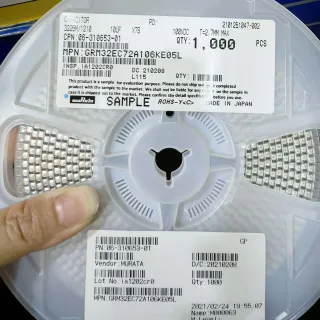
CMWX1ZZABZ-091 - LoRaWAN Module 868/915MHz | Murata
部品番号: CMWX1ZZABZ-091 ✓ 生産中| 数量 | 単価 | 小計 |
|---|---|---|
| 1 | $5.49 | $5.49 |
| 10 | $5.05 | $50.50 |
| 100 | $4.85 | $485.00 |
| 500 | $4.7 | $2,350.00 |
| 1,000 | $4.57 | $4,570.00 |
CMWX1ZZABZ-091 概要
A LoRaWAN module is a complete long-range, low-power wide-area network (LPWAN) radio subsystem that combines an RF transceiver, a host microcontroller, antenna matching, crystal references, and a shielded package into a single certified component. In the system hierarchy it sits above a bare transceiver IC: instead of designing RF matching networks and obtaining regional radio certifications yourself, a module such as the Type ABZ drops into a design with only power, ground, UART/SPI/I2C wiring, and an antenna connection required.
Key features include support for LoRaWAN Class A and Class C operation, radio-law certification already obtained for major regions (including CE and FCC for 868/915 MHz deployments), and open MCU design support that exposes all STM32L072 peripherals such as ADC, 16-bit timers, LP-UART, I2C, SPI, and USB 2.0 FS. The module can additionally support Sigfox by modifying the firmware, with Sigfox RC1, RC2, and RC4 certification available through the X-CUBE-SFOX package.
The Type ABZ architecture benefits from ST's I-CUBE-LRWAN stack and the B-L072Z-LRWAN1 Discovery kit, which embeds the same module, allowing code developed on the Discovery kit to transfer directly to production hardware. Standby-to-active wake-up occurs in approximately 60 microseconds via NRST, WKUP pins, RTC alarm, or RTC wakeup events, supporting strict battery-life budgets in asset-tracking and metering products.
Typical applications include smart utility metering, asset trackers, smart-city sensor nodes, agricultural monitoring, and industrial IoT endpoints that require multi-kilometer range and years of battery life.
A key design consideration is supply voltage: the module operates at 1.8 V to 3.6 V, so a primary lithium cell or low-dropout regulator should be chosen with adequate headroom for peak transmit current.
This page synthesizes distributor pricing, drop-in alternatives, and practical design notes not found in the manufacturer datasheet.
ドロップイン代替品: CMWX1ZZABZ-091 — 同一パッケージでピン互換。PCBの作り直しが必要な異なるパッケージの部品は除外されています。
このシリーズのバリエーション
同一シリーズでドロップイン互換のモデル: CMWX1ZZABZ-091 (同一形状・フットプリント).
クイック比較ツール — 並列比較する代替部品を選択:
CMWX1ZZABZ-078
✅ ドロップイン📋 参考代替品(カタログ未掲載)
CMWX1ZZABZ-091 仕様(メーカー公開)
| RF Frequency Range | 868 MHz / 915 MHz ISM band |
| Protocol | LoRaWAN (Sigfox supported via firmware modification) |
| Modulation | LoRa (spread spectrum) |
| Host MCU | STM32L072 (Arm Cortex-M0+) |
| RF Transceiver | SX1276 |
| 電源電圧 | 1.8 V to 3.6 V |
| Package Dimensions | 13.5 mm x 13.8 mm |
| Shielding | Shielded module |
| 実装タイプ | Surface Mount |
| Wake-up Time from Stop Mode | Approximately 60 us |
| Available MCU Interfaces | LP-UART, I2C, SPI, USB 2.0 FS, ADC, 16-bit timers |
| Radio Law Certification | Obtained for major regions (868/915 MHz) |
| LoRaWAN Classes | Class A, Class C |
| Sigfox Radio Configuration | RC1, RC2, RC4 certified (via X-CUBE-SFOX) |
| Pb Content of Termination | Termination material contains >0.1% Pb per JEDEC JESD97 classification (per TTI listing) |
CMWX1ZZABZ-091 インターフェースとコネクタ
CMWX1ZZABZ-091 は、メーカーが公開している以下のインターフェースとコネクタを備えています: 電力入力。拡張ヘッダーのピン配置、コネクタのピン番号、電気的制限はメーカーのドキュメントで定義されています。
| 電力入力 | 1.8 V to 3.6 V |
詳細は メーカー資料 をご参照ください(拡張ヘッダーのピン配置とコネクタのピン番号の詳細)。
電力・熱特性
| 電力入力 | 1.8 V to 3.6 V |
メーカーが公開している CMWX1ZZABZ-091 の電力入力および熱パラメータ。
主な用途
CMWX1ZZABZ-091 の用途: 6 件s: Smart Utility Metering, Asset Tracking, Smart City Sensor Nodes, Agricultural IoT Monitoring, Industrial IoT Endpoints, Prototype and Development with AT-Command Integration.
Smart Utility Metering
The CMWX1ZZABZ-091 fits utility metering (electricity, water, gas) because LoRaWAN's multi-kilometer link budget penetrates basements and metal enclosures that defeat cellular and short-range radios, while the STM32L072's low-power modes keep battery life within a 10-year service target. The module's approximately 60 us wake-up from Stop mode lets the firmware service precise Class A RX windows without burning standby current. In a typical water-meter endpoint, the MCU pulses a reed switch or Hall counter via EXTI, accumulates consumption, and transmits a compact payload once or a few times per day, staying in stop mode otherwise. Because regional radio certification is already obtained, meter vendors avoid a full RF re-qualification cycle when moving from prototype to production across the 868 MHz (EU) and 915 MHz (US/AU) markets.
おすすめ
Asset Tracking
For asset and livestock trackers, the CMWX1ZZABZ-091's open STM32L072 design lets the developer interface GPS or accelerometer peripherals directly over SPI/I2C/LP-UART without a second microcontroller, cutting BOM cost and board area. Community platforms such as the Cricket asset tracker and Grasshopper boards are built on this exact module, validating the approach with published schematics and Arduino support. A tracker typically wakes on a WKUP pin from an accelerometer motion interrupt, obtains a GPS fix, and uplinks position via LoRaWAN Class A; the 1.8 V to 3.6 V supply range runs directly from lithium primary cells. The shielded 13.5 x 13.8 mm package tolerates the mechanical and thermal environment of molded enclosures, and Sigfox firmware support (RC1/RC2/RC4) offers a protocol fallback where LoRaWAN public networks are unavailable.
おすすめ
Smart City Sensor Nodes
Smart-city deployments - parking occupancy, fill-level sensing, air quality - favor the CMWX1ZZABZ-091 because a single LoRaWAN gateway serves thousands of low-rate nodes, and the module's pre-obtained radio-law certification simplifies multi-region rollouts. The STM32L072's integrated ADC reads analog sensors (soil moisture, CO2 analog outputs) while I2C connects digital sensors such as the BME280; all firmware runs on the module itself thanks to the open MCU design and ST's I-CUBE-LRWAN stack. AT-command firmware (documented in ST AN4967) enables customers to integrate the module with an external host over LP-UART instead of writing bare-metal firmware, shortening development cycles for teams without STM32 experience. Class C operation supports actuators such as streetlight control where downlink latency matters.
おすすめ
Agricultural IoT Monitoring
In agriculture, sensor nodes must span kilometers of open field on small batteries; the CMWX1ZZABZ-091's SX1276 LoRa modulation achieves this link budget while the STM32L072 schedules multi-day sleep cycles. A typical node measures soil moisture and temperature several times daily, uplinks a few bytes per reading, and sleeps in Stop mode between transmissions - the 3.5 us EXTI wake-up handles sensor thresholds without keeping the CPU active. The 868/915 MHz dual-band support with existing certification lets the same PCB serve European, North American, and Australian farms with only a firmware region change. Because the module is fully open, integrators can run proprietary MAC layers alongside or instead of standard LoRaWAN, useful on private farm gateways where public network roaming fees would dominate the total cost of ownership.
おすすめ
Industrial IoT Endpoints
Industrial facilities use the CMWX1ZZABZ-091 for condition-monitoring endpoints - vibration, temperature, current signatures on motors - where cabling costs exceed radio cost. The STM32L072's 16-bit timers and ADC support basic vibration envelope sampling, while the LP-UART bridges to more capable sensor DSPs when needed. The shielded package provides EMI robustness near variable-frequency drives and switchgear that unshielded modules often fail. LoRaWAN Class A uplinks every few minutes report health indices to a plant gateway, and the module's open design allows integration of Modbus-over-UART gate logic for retrofit installations. With a 1.8 V to 3.6 V input, nodes run from industrial 3.3 V rails via a simple LDO, and the module's wake-up behavior (60 us from Stop) suits event-driven alarms such as threshold breach uplinks without scheduled polling overhead.
おすすめ
Prototype and Development with AT-Command Integration
The CMWX1ZZABZ-091 serves as a radio co-processor driven by AT commands: flashing ST's I-CUBE-LRWAN AT firmware (per application note AN4967, the same firmware demonstrated on the B-L072Z-LRWAN1 Discovery kit) turns the module into an LP-UART-controlled LoRaWAN modem for any host MCU, including legacy 8-bit controllers. This integration mode is popular because the host needs only a UART and simple command parsing, dramatically shortening development schedules. The Sigfox bi-mode capability (RC1/RC2/RC4 certified via X-CUBE-SFOX) lets one hardware platform serve two LPWAN ecosystems during network evaluation. The Arduino community core (used by SensorTile and Cricket boards) provides a third rapid-prototyping path. For teams evaluating LPWAN technology choices, one module and three software stacks cover LoRaWAN, Sigfox, and custom protocols.
おすすめ
おすすめ製品の概要
エンジニアリング参考データ: CMWX1ZZABZ-091 — 比較、設計ガイダンス、コンプライアンス情報。
選定ガイド
代替品との比較
| パラメータ | この製品 | CMWX1ZZABZ-078 |
|---|---|---|
| Package | 13.5 x 13.8 mm shielded LGA (Type ABZ) | 13.5 x 13.8 mm shielded LGA (Type ABZ) - same |
| Brand | Murata Manufacturing | Murata Manufacturing |
| RF Bands | 868 MHz / 915 MHz | 868 MHz / 915 MHz |
| Host MCU | STM32L072 (Cortex-M0+) | STM32L082 (Cortex-M0+, USB crystal-less) |
| RF Transceiver | SX1276 | SX1276 |
| Supply Voltage | 1.8 V to 3.6 V | 1.8 V to 3.6 V |
| USB FS Support | Via STM32L072 USB (crystal required) | Crystal-less USB FS via STM32L082 |
| Sigfox Support | Yes (via firmware, RC1/RC2/RC4) | Yes (via firmware, RC1/RC2/RC4) |
主な差別化要因
- Open MCU architecture exposes the full STM32L072 (vs closed-architecture LoRaWAN modules (host-MCU-required designs))
- Dual-protocol capability (vs CMWX1ZZABZ-078)
- Regional certifications already in hand (vs discrete SX1276 + STM32L0 board design)
設計ノート
Supply the module from a clean 1.8 V to 3.6 V rail. LoRa transmit draws pulsed current peaks, so place at least a 10 uF ceramic bulk capacitor plus a 100 nF decoupling capacitor directly at the module VDD pads. If powering from a 24 V industrial rail, use an LDO such as a TLV703 (3.3 V output) with adequate input capacitor sizing; verify the regulator's transient response can support TX bursts without drooping below the 1.8 V minimum, which would cause brown-out resets during transmission.
The Type ABZ is a land-grid module soldered to the top layer; do not route traces under the module body except a solid ground plane, which the datasheet requires as RF reference. Provide the antenna feed as a controlled-impedance (approximately 50 ohm) microstrip to a U.FL connector or SMD antenna pad, keeping it short and away from digital switching traces. Follow the land pattern in the Murata datasheet (spec BP-ABZ-C) exactly, including keep-out and stencil recommendations, to guarantee solder joint reliability on the shielded underside pads.
Distinguish -078 from -091 firmware: the two modules share the footprint but carry different MCUs (STM32L082 vs STM32L072), and pad functions differ subtly - per ST Community documentation, a PA12-related function present on -078 is absent on -091. Do not flash -078 builds on -091 hardware without checking peripheral mappings. Also remember the -091's STM32L072 requires an external crystal for USB FS, unlike the crystal-less USB of the -078; budget this in the BOM if your node connects to USB.
For battery-powered designs, connect an accelerometer or push-button to one of the three WKUP pins so the STM32L072 can wake from Stop mode on a hardware edge, per the datasheet's 60 us wake-up specification. Reserve NRST access on a test point for field firmware updates via SWD. Route the LP-UART used for AT-command mode away from the antenna feed to prevent conducted RF from corrupting serial data during transmit bursts.
コンプライアンス情報
TTI listing notes the termination material contains >0.1% Pb by weight as referenced in JEDEC JESD97, paragraph 3.5 (EU Commission Decision 2002/525/EC, Annex II, from ELV Directive 2000/53/EC) - an exemption-referenced classification that must be confirmed with Murata for RoHS scope. No explicit RoHS/REACH statement appears in the provided data.