The Toshiba 2SK170-GR is an N-channel silicon junction field-effect transistor (JFET) built specifically for low-noise audio amplifier applications, supplied in a 3-pin TO-92 through-hole package. Its defining verified specification is the GR grade Idss bin of 2.6 mA to 6.5 mA — the lowest-current grade in the 2SK170 family — with depletion-mode operation, gigaohm-level gate input impedance, and the very low input-referred noise that made it the legendary input device for phono preamplifiers, microphone preamps, and discrete hi-fi front ends. Toshiba has discontinued the entire 2SK170 family, but the part is currently sourced from remaining stock: XAIPART lists 68,000 units priced from $0.50 per unit at 1,000-piece volume (as of 2026-10-06), with a minimum order quantity of 1. The Linear Systems LSK170 series — documented by its manufacturer as a pin-for-pin replacement — is the qualified long-term substitute for new designs. This guide covers verified specifications, pinout, biasing practice, drop-in alternatives, and sourcing risk so you can decide quickly whether to buy remaining stock or qualify the LSK170.
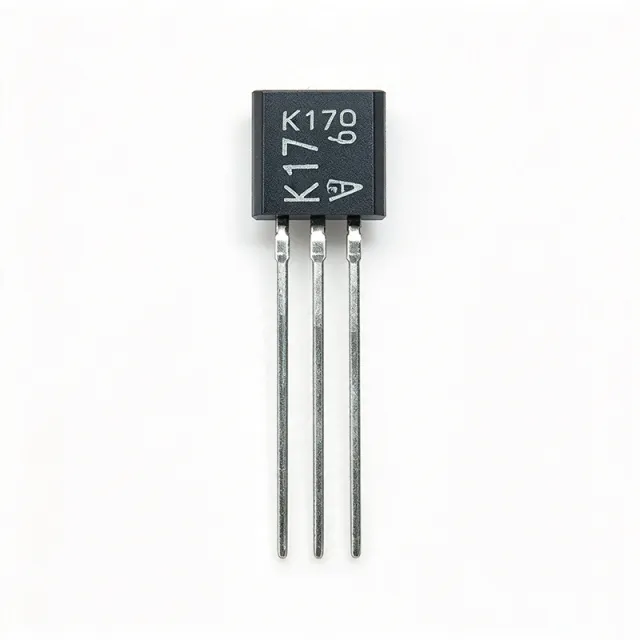
What Are the Quick Answers on the 2SK170-GR That Engineers Ask First?
Before the deep dive, here are the answers that resolve most sourcing and design questions immediately, each anchored to verified data.
What is it? A Toshiba N-channel depletion-mode JFET in TO-92, marketed for low-noise audio amplifiers. Silicon N-channel junction technology, 3 pins, through-hole mounting.
What does the GR suffix mean? It is the Idss grade bin: 2.6 mA to 6.5 mA zero-gate-voltage drain current, the lowest-current grade in the family. The BL grade of the same die covers 6 mA to 12 mA. Same die, package, pinout, and low-noise behavior; only the bin differs.
What is the pinout? With the flat face facing you, leads down, numbered left to right: pin 1 = Gate, pin 2 = Drain, pin 3 = Source. This TO-92 pinout varies across manufacturers, so confirm against the Toshiba datasheet before PCB assembly.
Is it discontinued? Yes — the 2SK170 family is end-of-life at Toshiba. Remaining distributor and broker stock is the only source. XAIPART shows 68,000 units available with MOQ 1 (as of 2026-10-06).
What does it cost? Verified tiered pricing as of 2026-10-06: $0.72 at qty 1, $0.65 at qty 10, $0.58 at qty 100, $0.53 at qty 500, and $0.50 at qty 1000.
What replaces it? The Linear Systems LSK170 series is the documented pin-for-pin replacement (TO-92, plus SOT-23 and SOT-89). Within Toshiba, the 2SK117-GR shares the same GR Idss range (2.6–6.5 mA) and the same pinout, but it is also a discontinued Toshiba part.
Action point: For a restoration project, order matched GR stock now; for a new production program, qualify LSK170 immediately — do not build a BOM on an EOL device.
How Do You Select, Bias, and Design In the 2SK170-GR Correctly?
Understand the device class before you select it
A JFET is a voltage-controlled semiconductor in which a reverse-biased gate junction controls conduction between source and drain. Unlike MOSFETs, JFETs have no insulating gate oxide. Conduction occurs in the bulk silicon channel, which avoids the 1/f surface noise typical of MOSFETs and yields very low input-referred voltage noise at audio frequencies — exactly why the 2SK170 was Toshiba's flagship for audio inputs. The wide channel geometry also gives the gigaohm-range gate input impedance that lets the device connect directly to high-impedance sources without loading them.
Why the GR grade, and not BL?
Toshiba bins the 2SK170 die by Idss. The GR grade covers 2.6 mA to 6.5 mA; the BL grade covers 6 mA to 12 mA. Choose GR when your bias target is lower standing current — battery-powered preamps, phantom- or battery-powered microphones, or input pairs where you want a defined low-current operating point. Choose BL when you need higher transconductance and more headroom and can afford roughly double the standing current. Within the GR bin itself, Idss varies unit-to-unit by a factor of 2.5, which drives the matching discipline below.
Pinout and physical design-in
The TO-92 pinout is verified as: pin 1 = Gate (high-impedance control terminal), pin 2 = Drain (connects to the positive supply side), pin 3 = Source (connects to ground or the bias resistor). Because the package is through-hole, it is easy to hand-match, socket, and solder in point-to-point audio builds — a practical advantage for prototype and small-batch work. Always confirm the pin diagram against the Toshiba datasheet: TO-92 pin assignments vary across JFET families and manufacturers.
Biasing: depletion mode means self-bias with one resistor
The 2SK170-GR conducts at Vgs = 0 and is biased with a negative gate-source voltage. The standard circuit is a source resistor to ground with the gate referenced to 0 V through a high-value gate resistor: the source resistor drop creates the negative Vgs automatically, requiring no negative gate supply. Target roughly half of Idss for the best linearity and noise trade-off. For the GR grade that means a bias current of about 1.3 mA to 3.3 mA.
Because GR units range from 2.6 mA to 6.5 mA in Idss, never assume a nominal value. Measure each device's actual Idss (gate shorted to source, specified drain voltage) and compute the source resistor from your measured figure. In differential input pairs, match devices to within a few percent of Idss to cancel offset and even-order distortion. In parallel configurations for lower noise, matched units are mandatory; parallel device count reduces noise roughly by the square root of the count.
Design cautions
Three verified habits protect your design. First, in precision high-impedance applications (pH probes, photodiodes, piezo sensors), guard or shield the gate node to prevent PCB surface leakage from dominating the JFET's picoampere-region gate leakage. Second, in cascode configurations, the 2SK170-GR as the lower device stabilizes drain voltage and reduces Miller capacitance — useful in measurement front ends and LF/HF receiver circuits. Third, the verified database does not carry the drain-source voltage, gate-drain voltage, gate reverse current, transfer Yfs, input capacitance, power dissipation, or operating temperature range values for this part; before applying any supply voltage, verify these ratings directly against the Toshiba datasheet noise and absolute maximum curves. This is especially important in RF/oscillator gain-block use, where designers must confirm the drain-source and gate voltage ratings against the datasheet before applying supply voltages.
Verification on receipt
Because the part is EOL and the surplus channel carries known counterfeit re-marked devices, verify Idss on receipt and buy only from reputable distributors. A quick Idss test at your bench catches re-marked BL or off-family parts in minutes.
Action point: Measure Idss on every unit, set bias near half of Idss, and match input pairs to a few percent — this converts the GR bin's wide 2.6–6.5 mA spread from a liability into a controlled design parameter.
What Are the Verified Alternatives and How Do They Compare?
Three alternatives appear in the verified database. All comparisons below use only provided data.
| Parameter | 2SK170-GR | 2SK117-GR (Toshiba) | LSK170B (Linear Systems) | LSK170C (Linear Systems) |
|---|---|---|---|---|
| Idss range | 2.6 mA – 6.5 mA (GR bin) | 2.6 mA – 6.5 mA (GR bin) | 6 mA – 12 mA | Roughly 12 mA – 20 mA |
| Interchangeability | Reference part (EOL) | Same pinout; direct replacement; slightly different channel geometry/noise curve | Pin-for-pin 2SK170 replacement (about +100% bias current vs GR) | Pin-for-pin 2SK170 replacement; requires bias circuit adjustment |
| Package | TO-92, 3-pin | TO-92 (same pinout) | TO-92; also SOT-23 and SOT-89 | TO-92; also SOT-23 and SOT-89 |
| Lifecycle | EOL (Toshiba discontinued family) | Discontinued Toshiba part | Active production | Active production |
| Best use | Restoring original designs; matched GR stock | Same-brand substitution while stock lasts | New builds; BL-grade-equivalent headroom with equal or better noise | New builds needing the highest Idss grade |
How to choose: For a closest GR-grade match, Linear Systems offers the lower-current LSK170A grade in the same TO-92 package as well as SOT-23 and SOT-89 — contact Linear Systems for factory noise and Idss sorting options. The 2SK117-GR is the same-manufacturer option and the DIY audio community actively recommends it, but it is also discontinued, so both Toshiba options face the same long-term supply reality. The LSK170B runs about double the GR bias current (6–12 mA vs 2.6–6.5 mA); if you substitute it into a GR-biased circuit, recalculate the source resistor and confirm dissipation. The LSK170C's roughly 12–20 mA Idss demands a bias circuit adjustment — do not drop it in unmodified.
Action point: Buy 2SK170-GR or 2SK117-GR stock for repairs and restorations; standardize new designs on LSK170A (GR-like current) or LSK170B (more headroom) with recalculated bias.
What Is the Market and Supply Position of the 2SK170-GR?
The lifecycle status is EOL: Toshiba has discontinued the entire 2SK170 family. Availability now depends entirely on remaining distributor and broker stock. XAIPART currently lists 68,000 units at the verified tiered pricing noted above (as of 2026-10-06) with MOQ 1, so the immediate supply picture is healthy — but lead time is not guaranteed or manufacturer-quoted, and brokered quantities may take days to weeks with quality risk. Counterfeit re-marked devices are a documented risk in the surplus channel.
Long-term demand continues from two communities: audio restoration and DIY builders who want the original GR bin, and production engineers maintaining legacy analog boards. Linear Systems' decision to produce the LSK170 series explicitly as a 2SK170 replacement — including factory Idss and noise sorting — confirms that sustained demand for this device class outlives the original manufacturer. RoHS status for the original 2SK170-GR is not confirmed; TO-92 through-hole parts of that era may have tinned (lead-containing) leads, so request a certificate of conformity from the specific seller. The LSK170 series is documented as available in RoHS-compliant packaging, which matters for new compliant products.
Action point: Treat the 68,000-unit stock position as finite. For any production program, qualify LSK170 now rather than reacting when broker stock dries up.
What Should Buyers Watch Next for Low-Noise JFETs Like the 2SK170-GR?
Anchor your buying decisions to three verified facts. First, price and stock: at $0.50 per unit at 1,000 pieces and 68,000 units listed (as of 2026-10-06), remaining GR stock is still affordable — matched lots for phono and instrumentation projects are worth buying while verified stock exists, always verifying Idss on receipt. Second, the replacement roadmap is mature: the LSK170 series is in active production, pin-for-pin compatible, offered in TO-92/SOT-23/SOT-89, with RoHS-compliant packaging and factory sorting — meaning the migration cost for new designs is a bias recalculation, not a redesign. Third, RoHS pressure: if your product must be compliant, the original part's unconfirmed compliance status makes the LSK170 the only clean path forward. Watch your own BOM exposure: any design still specifying 2SK170-GR carries an unquantifiable EOL supply risk that a one-time LSK170 qualification removes permanently.
Action point: Split your sourcing now — matched GR stock for restorations, LSK170 for everything forward-looking — and re-check stock on the 2SK170-GR product page or browse the XAIPART component catalog for JFET alternatives.
댓글
첫 번째 댓글을 남겨 보십시오.
🔐 먼저 로그인 댓글을 게시하려면
계정이 없으십니까? 회원가입