EPC4QI100N
EPC4QI100N - 4Mb In-System Programmable FPGA Config PROM | Altera (Intel)
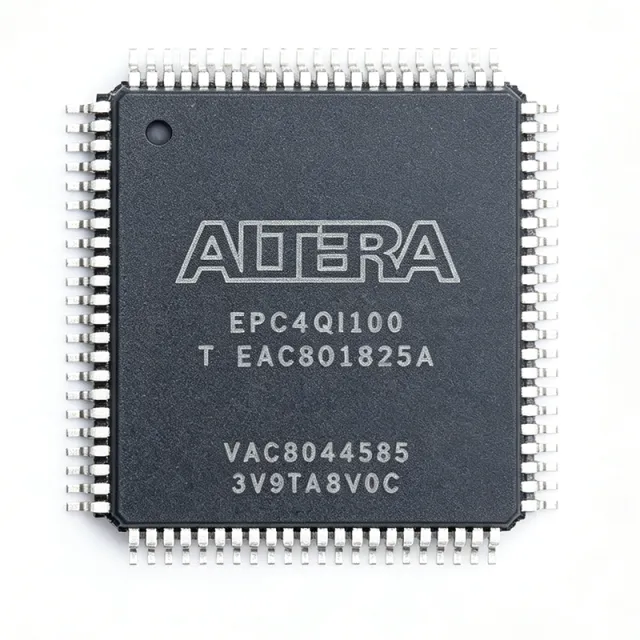
The Altera (Intel Programmable Solutions Group) EPC4QI100N is a 4-Mbit in-system programmable configuration PROM designed for configuring Altera FPGAs, packaged in a 100-pin PowerPQFP (PQFP-100, 20x14 mm) and operating from a single 3.3 V supply. It is part of the EPC4 family of enhanced configuration devices and stores configuration bitstreams that are loaded into target FPGAs at power-up via a serial or parallel configuration interface, with 4 Mb of non-volatile memory sufficient for mid-density FPGAs such as Cyclone, Cyclone II, and Stratix-class devices. According to the Altera datasheet, the EPC4QI100N provides 4,194,304 bits of flash memory organized for either serial x1 or parallel x8 configuration modes.
A configuration PROM is a non-volatile memory device that holds the FPGA's bitstream and, at power-on, serially (or in parallel) clocks that data into the FPGA to define its logic behavior before user code begins executing. Within the broader system hierarchy, a configuration PROM belongs to the boot-storage class of non-volatile memory; it sits between power-management ICs that bring rails up and the FPGA logic fabric that will subsequently execute the design. Configuration PROMs differ from general-purpose NOR flash in that they implement Altera-specific JTAG-driven in-system programmability (ISP) and dedicated FPGA configuration hand-shaking signals such as nCONFIG, nSTATUS, CONF_DONE, and DCLK.
Key features of the EPC4QI100N include 3.3 V single-supply operation (3.0 V to 3.6 V), in-system programmability via IEEE 1149.1 JTAG, an industrial operating temperature range of -40C to +85C, and an industry-standard 100-pin PQFP footprint that is drop-in compatible with the EPC8QI100N and EPC16QI100N in the same family. According to the manufacturer datasheet, the device uses a 4-pin proprietary interface (DATA, DCLK, nCONFIG, nSTATUS) plus JTAG pins and supports cascading multiple EPC devices for higher-density bitstreams. Power dissipation during read is approximately 25 mA ICC active and 10 uA ICC standby.
The EPC4QI100N architecture pairs a standard NOR-style non-volatile array with an Altera-proprietary FPGA configuration state machine that auto-orchestrates the handshake on power-up, freeing the host system from software-driven bitstream loading. Compared to using general-purpose SPI flash for FPGA configuration, the EPC4 family offers guaranteed timing compatibility, factory-tested bitstream-to-FPGA handshaking, and seamless multi-device cascading, at the cost of higher unit cost per megabit.
Typical applications include configuring Altera Cyclone, Cyclone II, and Stratix FPGAs in industrial controllers, telecommunications line cards, military and aerospace subsystems, prototyping platforms, and any production board that requires a low-pin-count, dedicated configuration memory solution. Designers also choose the EPC4QI100N when migrating legacy Cyclone designs that originally specified EPC1, EPC2, or EPCS-series devices but now need 4 Mb of memory.
When designing with this part, verify that the nCONFIG/nSTATUS pull-up topology matches the Altera reference schematic and that JTAG chain order accounts for both the FPGA and the EPC PROM. Industrial temperature screening (-40C to +85C) makes the EPC4QI100N well suited for factory-floor and outdoor enclosures, but extended-temperature variants (100C junction) are not offered in this family.
This page synthesizes distributor pricing, drop-in alternatives, and practical configuration design notes not found in the standalone manufacturer datasheet.
USD $10.40
문의하기