제품 (39,000+)

OPA602BP - 6.5MHz 35V/us Precision Difet Op Amp | Texas Instruments
OPA602BP

OPA602BP - 6.5MHz 35V/us Precision Difet Op Amp | Texas Instruments

The Texas Instruments OPA602BP is a high-speed precision Difet (dielectrically isolated FET) operational amplifier delivering a 6.5 MHz gain-bandwidth, 35 V/us slew rate, and a maximum input offset voltage of +/-250 uV in an 8-pin PDIP package. Its maximum input bias current of +/-1 pA and fast settling to 0.01% make it a rare combination of FET-input precision and wideband speed. An operational amplifier is a high-gain voltage amplifier with differential inputs, forming the foundation of the analog signal chain hierarchy: op amp -> amplifier IC -> analog IC -> semiconductor. Precision op amps like the OPA602 family minimize DC errors (offset, drift, bias current) while preserving AC performance, and the Difet process separates transistors with dielectric isolation to achieve speeds impossible in junction-isolated FET processes. Key differentiating features include laser-trimmed input circuitry for bipolar-grade offset and drift performance, unity-gain stability, and the ability to drive capacitive loads up to 1500 pF. Per the TI datasheet, all specifications are rated with a 1 kOhm resistor in parallel with a 500 pF load, and wide bandwidth with low distortion minimizes dynamic errors in data-conversion signal paths. The supply range of +/-5 V to +/-18 V supports both standard +/-15 V analog systems and lower-voltage precision designs. The OPA602BP grade offers the tightest offset specification within the family (OPA602AP is the looser A grade), suiting high-accuracy instrumentation front ends. Typical applications include precision instrumentation amplifiers, optoelectronic receiver front ends (photodiode transimpedance stages benefit from 1 pA bias current), and sonar/ultrasound signal conditioning where slew rate and settling accuracy are critical. Design consideration: with FET inputs, bias current doubles roughly every 10 C, so keep thermal gradients away from the input pins and use guard rings to preserve the picoampere-level input performance. This page synthesizes distributor pricing, drop-in alternative analysis, and practical design notes not found in the manufacturer datasheet.

견적 요청 문의하기
OPA602SM - 6.5MHz Precision Difet Op Amp | TI Burr-Brown
OPA602SM

OPA602SM - 6.5MHz Precision Difet Op Amp | TI Burr-Brown

The Texas Instruments (Burr-Brown) OPA602SM is a high-speed precision Difet (dielectrically isolated FET) operational amplifier delivering 6.5 MHz bandwidth, 35 V/us slew rate, and a maximum offset voltage of plus/minus 250 uV, housed in a round 8-pin TO-99 metal can package with military temperature grading. An operational amplifier is a high-gain differential voltage amplifier that, with external feedback networks, forms the core building block of analog signal conditioning: amplification, filtering, integration, buffering, and current-to-voltage conversion. The op amp hierarchy runs from general-purpose amplifiers through precision amplifiers to specialized high-speed precision parts like the OPA602SM, where both DC accuracy and AC speed are demanded simultaneously. Key features include a high slew rate of 35 V/us, low input bias current of plus/minus 1 pA maximum thanks to Difet input circuitry, fast settling to 0.01%, and unity-gain stability. The part easily drives capacitive loads up to 1500 pF, and all specifications are rated with a 1k resistor in parallel with a 500 pF load. Laser-trimmed input circuitry provides offset and drift performance normally associated with precision bipolar op amps, while the FET inputs eliminate bias-current errors in high-impedance circuits. The monolithic Difet construction (dielectrically isolated FET) provides an unusual combination of high speed and accuracy: dielectric isolation removes the junction capacitances that limit conventional JFET processes, allowing wide bandwidth and low distortion while preserving picoampere input currents. Wide bandwidth and low distortion minimize AC errors in precision signal chains. Typical applications include precision instrumentation, optoelectronics, and sonar/ultrasound systems, where the low bias current suits photodiode and high-impedance transducer interfaces, and the 6.5 MHz bandwidth supports fast pulse and carrier-based measurement. Design consideration: the TO-99 metal can requires careful ground-plane transitions when substituting surface-mount layouts, and offset trim pins should be used for sub-100 uV accuracy. This page synthesizes datasheet specifications, drop-in family alternatives, comparison tables, and practical design notes not found on distributor product pages.

견적 요청 문의하기
OPA604AP - FET Audio Op Amp | Texas Instruments
OPA604AP

OPA604AP - FET Audio Op Amp | Texas Instruments

Texas Instruments OPA604AP is a single-circuit, FET-input operational amplifier optimized for low-distortion audio performance. Its headline specifications include a 20 MHz unity-gain bandwidth, 25 V/us slew rate, 10 nV/sqrt(Hz) input noise, and operation from a single +5 V supply to a total supply voltage of 48 V, corresponding to ±24 V. The device is packaged in an 8-pin plastic mini-DIP for through-hole PCB assembly. An operational amplifier is a voltage-gain, active-feedback component that compares an input signal with a feedback network and drives its output to reduce the difference between them. Operational amplifiers belong to the broader amplifier IC and analog signal-conditioning hierarchy. FET-input amplifiers use field-effect transistors at the input, supporting low input bias current and effective operation with high-impedance sources. The OPA604AP is intended for applications where low distortion, low noise, wide bandwidth, and high dynamic range are more important than minimum power consumption. Key benefits include low-distortion operation at 1 kHz, 10 nV/sqrt(Hz) noise density, 20 MHz gain-bandwidth product, and unity-gain stability. These characteristics support precise signal amplification, active filtering, and current-to-voltage conversion without adding substantial distortion. Its wide supply range accommodates conventional bipolar audio rails, higher-voltage analog systems, and lower-voltage designs. The low-noise FET input maintains wide dynamic range even when driven from a high source impedance. Laser-trimmed offset voltage is also used to reduce the need for interstage coupling capacitors, making the amplifier easier to deploy in straightforward audio signal paths. Typical uses include professional audio equipment, PCM digital-to-analog converter current-to-voltage conversion, spectral-analysis instrumentation, active crossover networks, line-level preamplifiers, and precision test equipment. The combination of low noise and low distortion is particularly useful where small signal details must remain intelligible at the output. Designers should preserve adequate output headroom, verify the common-mode range across the complete signal excursion, and place input and feedback components close to the device to minimize parasitic feedback. The through-hole package also requires adequate spacing for a stable breadboard or through-hole layout rather than a compact surface-mount assembly. This product page combines manufacturer specifications, application guidance, pin information, and replacement considerations into an engineering-focused reference. It is designed to support circuit planning, source selection, and PCB design for low-noise audio and precision analog systems.

견적 요청 문의하기
OPA604AU - 20MHz 25V/us FET-Input Audio Op Amp | TI
OPA604AU

OPA604AU - 20MHz 25V/us FET-Input Audio Op Amp | TI

Texas Instruments OPA604AU is a single-circuit FET-input audio operational amplifier with a 20 MHz gain-bandwidth product, 25 V/us slew rate, and operation from ±4.5 V to ±24 V in an 8-pin SOIC package. Its low-noise FET input stage supports wide dynamic range even with relatively high source impedances, while laser-trimmed offset voltage reduces the need for interstage coupling capacitors. An operational amplifier, commonly called an op amp, is a high-gain differential amplifier used to amplify small signals. The OPA604 belongs to the FET-input operational-amplifier family and combines low input current, low distortion, wide bandwidth, and high slew rate. In the broader semiconductor hierarchy, it is an analog amplifier IC within the integrated-circuit and signal-conditioning categories. The OPA604AU combines a 20 MHz gain-bandwidth product with a 25 V/us slew rate, allowing it to process audio-bandwidth signals with low crossover distortion. Its FET input stage is suitable for high-impedance sources because it avoids the higher input bias currents commonly associated with bipolar transistor input stages. The wide ±24 V supply limit provides additional headroom for high-output-signal applications. The internal design emphasizes low distortion and wide dynamic range. Laser trimming of input offset voltage improves channel consistency and reduces circuit complexity in precision signal paths. The device is specified over a -40°C to +85°C temperature range and is available in the surface-mount SOIC-8 format designated by TI as package code D. Typical uses include high-fidelity audio preamplifiers, active crossover networks, line-level stages, instrumentation amplifiers, low-distortion filters, and analog signal-conditioning circuits. It is especially relevant where the source impedance is high enough to make input bias current important or where large slew rate is needed to preserve low distortion at audio signal levels. Circuit design must preserve adequate output-voltage swing and common-mode headroom within the selected supply rails. Decoupling capacitors should be placed close to the power pins, and the feedback network should use suitable resistor values to maintain stability with the load capacitance and source impedance present on the board. This product page combines the manufacturer specifications with practical pin-assignment guidance, drop-in replacement analysis, application examples, and design notes for evaluating the OPA604AU in precision analog and audio signal chains. It is intended to help engineers confirm electrical fit, package compatibility, thermal constraints, and application suitability before incorporating the amplifier into a production design.

견적 요청 문의하기
OPA627 - Precision High-Speed JFET Op Amp | Texas Instruments
OPA627

OPA627 - Precision High-Speed JFET Op Amp | Texas Instruments

The OPA627 is a precision, high-speed JFET operational amplifier from Texas Instruments, offering a unique combination of low noise, low offset voltage, and high speed. It operates from a supply voltage of 9V to 36V (±4.5V to ±18V) and is available in 8-pin DIP, SOIC, and other packages. Key specifications include a slew rate of 55V/µs, a maximum offset voltage of 100µV, a maximum drift of 0.8µV/°C, and a low input bias current of 5pA. The OPA627 is unity-gain stable, making it versatile for a wide range of precision analog applications. An operational amplifier (op amp) is a high-gain voltage amplifier with differential inputs and a single-ended output. It is a fundamental building block in analog electronics, used in signal conditioning, filtering, and instrumentation. The OPA627 belongs to the class of precision op amps, which prioritize low offset voltage, low drift, and low noise. Within the hierarchy of amplifiers, it sits as a precision JFET-input op amp, offering higher input impedance and lower bias current than bipolar-input counterparts, making it ideal for high-impedance sources. The OPA627 features very low noise of 4.5nV/√Hz at 10kHz, fast settling time to 0.01%, and low input bias current of 5pA. Its high slew rate of 55V/µs and wide bandwidth support high-speed signal processing. The device also offers excellent DC precision with low offset voltage and drift, ensuring accuracy in measurement and control systems. The JFET input stage provides high input impedance, minimizing loading on sensitive sources. Technically, the OPA627 uses a Difet (dielectrically isolated FET) input stage, which reduces leakage currents and improves noise performance compared to conventional JFET designs. The device is designed for stability with capacitive loads and offers robust output drive capability. Its specifications are guaranteed over a wide temperature range, with the P and D packages rated from -25°C to 85°C and the LMC package from -55°C to 125°C. Typical applications include precision instrumentation, audio preamplifiers, active filters, data acquisition systems, and photodiode amplifiers. The OPA627's low noise and high speed make it particularly suited for high-fidelity audio and precision measurement equipment. Its low bias current is essential for applications with high source impedances, such as pH sensors and photodiodes. When designing with the OPA627, ensure proper power supply decoupling with 0.1µF capacitors close to the supply pins. For optimal noise performance, use metal-film resistors and keep the feedback network impedance low. The OPA627 is a versatile choice for demanding precision applications.

견적 요청 문의하기
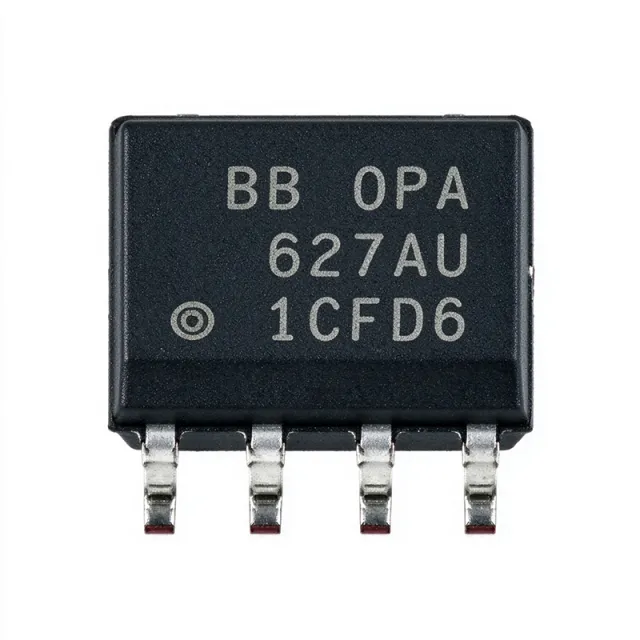
OPA627AU - 16MHz Precision DIFET Op Amp, 55V/us | TI
OPA627AU

OPA627AU - 16MHz Precision DIFET Op Amp, 55V/us | TI

The Texas Instruments OPA627AU is a precision high-speed DIFET (dielectrically isolated FET) operational amplifier delivering 16MHz unity-gain bandwidth, 55V/us slew rate, and a maximum offset voltage drift of 0.8uV/C, housed in an 8-pin SOIC (D) package rated from -25C to +85C. A precision operational amplifier is a type of high-accuracy voltage amplifier within the broader amplifier IC family of analog semiconductors. Precision op amps combine low input offset voltage, low drift, and low bias current so that signal-chain accuracy is preserved over time and temperature, and they sit upstream of ADCs, filters, and output drivers in instrumentation, audio, and measurement systems. The OPA627AU differentiates itself with very low input bias current of 5pA maximum, enabled by the DIFET junction-isolated FET input process, fast settling to 0.01% in 550ns, and a low maximum offset voltage of 100uV. Unity-gain stability distinguishes it from its sibling OPA637, which is stable only at gain of 5 or greater. Architecturally, the DIFET process uses dielectric isolation to shrink junction capacitances, allowing the unusual combination of FET-input precision (picoampere bias current) with high-speed dynamics normally associated with bipolar op amps. The result is a single-amplifier solution that historically replaced discrete FET-input hybrid designs in precision signal paths. Typical applications include professional and high-end audiophile audio preamplifiers and I/V converters for DACs, precision photodiode transimpedance amplifiers where 5pA bias current minimizes offset error, and test-and-measurement front ends requiring fast 55V/us slewing with microvolt-level accuracy. For design, note the offset trim pins on the SOIC-8 footprint and ensure supply decoupling close to pins 4 and 7; the -25C minimum operating temperature is narrower than many precision op amps, so verify ambient range compliance. This page synthesizes distributor pricing, drop-in alternatives, cross-references, and practical design notes not found in the manufacturer datasheet.

견적 요청 문의하기
OPA627AU/2K5 - 16MHz Precision JFET Op Amp 55V/us | TI
OPA627AU/2K5

OPA627AU/2K5 - 16MHz Precision JFET Op Amp 55V/us | TI

The Texas Instruments OPA627AU/2K5 is a precision, high-speed JFET-input operational amplifier delivering 16 MHz unity-gain bandwidth, 55 V/us slew rate, and a maximum offset voltage drift of 0.8 uV/C, housed in an 8-pin SOIC (D) package rated for -25C to +85C operation. A JFET-input operational amplifier is a voltage-feedback amplifier whose input stage uses junction field-effect transistors to achieve extremely low input bias current and high input impedance. Within the signal-chain hierarchy, it sits under the operational amplifier family, itself a core analog building block of amplifier ICs and precision analog front-end design. Key features include a very low offset voltage of 100 uV max, maximum drift of 0.8 uV/C, and input bias current as low as 5 pA max thanks to the DiFet (dielectrically isolated FET) input stage. The part is unity-gain stable, settling fast to 0.01% accuracy, and provides very low voltage noise at 10 kHz. Supply operation spans +-4.5 V to +-18 V, supporting both +-15 V industrial analog rails and +-5 V precision systems. Technically, the OPA6x7 family is fabricated on a high-speed dielectrically isolated (DiFet) process, which gives the OPA627 lower noise, lower offset, and higher speed than the earlier OPA111 while retaining picoampere input currents. The sibling OPA637 shares the die but is stable only at gains of 5 or greater, trading stability margins for wider bandwidth at high gain. Typical applications include precision data-acquisition front ends, photodiode transimpedance amplifiers, professional and audiophile audio preamplifiers, and test-and-measurement instrumentation where low offset drift and low bias current are decisive. A key design consideration: because the part is unity-gain stable at 16 MHz, layout with short feedback traces and solid ground planes is essential to avoid parasitic ringing; for gains of 5 or more, the faster OPA637 is often the better choice. This page synthesizes distributor pricing, drop-in alternatives, and practical design notes not found in the manufacturer datasheet.

USD $10.50 재고 있음
OPA627BP - 16MHz Precision Difet Op-Amp | Texas Instruments
OPA627BP

OPA627BP - 16MHz Precision Difet Op-Amp | Texas Instruments

The Texas Instruments OPA627BP is a precision high-speed Difet (dielectrically isolated FET) operational amplifier delivering 16 MHz unity-gain bandwidth, 55 V/us slew rate, and 0.8 uV/C maximum offset-voltage drift, housed in an 8-pin plastic DIP (PDIP-8) package. A precision operational amplifier is an op-amp engineered to minimize DC error terms - input offset voltage, bias current, and drift - while maintaining usable AC performance. Within the signal-chain hierarchy, it sits between general-purpose amplifiers and instrumentation amplifiers, and the OPA627 belongs to TI's (originally Burr-Brown) Difet family, where dielectric isolation of JFETs dramatically reduces input capacitance and leakage compared to conventional junction-isolated processes. Key differentiating features include the combination of high speed (16 MHz, 55 V/us) with true precision DC accuracy, JFET input for extremely low bias current, and industrial temperature grade options. The 'B' grade suffix denotes tighter offset and drift limits; the 'P' suffix denotes the plastic 8-pin DIP package. Architecturally, the Difet process places a dielectric layer around FET structures, yielding low input capacitance and low input bias current that remain stable over temperature. This is why the OPA627 achieves sub-microvolt-per-degree drift together with wideband dynamics - a combination rarely met by CMOS or bipolar alternatives of its era. Typical applications include high-fidelity audio preamplifiers and headphone amplifiers, precision integrators and photodiode transimpedance stages, active filters, and data-acquisition front ends where both DC accuracy and 16 MHz bandwidth are required. Design consideration: to preserve stability, follow the datasheet layout guidance - keep feedback resistance values moderate and decouple supplies close to pins 4 and 7; the decompensated sibling OPA637 (minimum stable gain of 5) is not a unity-gain-stable substitute. This page synthesizes distributor pricing, drop-in alternative analysis, and practical design notes not consolidated in the manufacturer datasheet, with prices as of 2026-09-13.

견적 요청 문의하기
OPA627SM - Precision JFET Op Amp 55V/us TO-99-8 | TI
OPA627SM

OPA627SM - Precision JFET Op Amp 55V/us TO-99-8 | TI

The Texas Instruments OPA627SM is a precision, high-speed JFET-input operational amplifier delivering 55 V/us slew rate, 0.8 uV/C maximum offset drift, and 16 MHz unity-gain bandwidth in an 8-pin TO-99 metal can package rated for ±18 V (36 V) supplies. A low-dropout linear regulator is a voltage regulator; an operational amplifier is an analog signal-chain building block that amplifies the voltage difference between two inputs, sitting within the broader hierarchy of amplifier ICs inside precision analog front ends. The OPA627 family is fabricated on a high-speed dielectrically isolated (DI) process, which separates the JFET input stage from the output stage and enables a rare combination of precision DC accuracy and 55 V/us speed: maximum offset voltage of 100 uV, input bias current of a few picoamperes, and low noise of 4.5 nV/sqrt(Hz) at 1 kHz. Compared with the older OPA111, the OPA6x7 family offers lower noise, lower offset, and significantly higher speed. Key differentiating specifications include the 0.8 uV/C max drift (which eliminates calibration in precision gain stages), 55 V/us slew rate for wide-dynamic-range AC signals, and 16 MHz gain-bandwidth product with unity-gain stability. The SM grade denotes TI's premium grade in the metal can package with tightened limits for offset and drift. Typical applications include precision photo-diode and integrator amplifiers, DAC output I/V conversion, professional and high-end audio preamplifiers, and test-and-measurement signal conditioning where a fast-settling, low-offset JFET amplifier is required. Design consideration: as a JFET op amp, bias current doubles roughly every 10 C, so thermal management of surrounding circuitry matters at high accuracy targets; TI recommends a compensating network and proper decoupling per the datasheet. This page synthesizes distributor pricing, drop-in same-package alternatives, pinout data, and practical design notes not found in the manufacturer datasheet.

견적 요청 문의하기
OPA631U - 80V 100V/us Single-Supply Op Amp | Texas Instruments
OPA631U

OPA631U - 80V 100V/us Single-Supply Op Amp | Texas Instruments

The Texas Instruments OPA631U is a low-power, single-supply operational amplifier featuring high bandwidth, a 100 V/us slew rate, 6 mA supply current, 6 nV/sqrt(Hz) input-voltage noise, operation to +10 V, and an 8-SOIC package. It is designed for instrumentation and signal-conditioning circuits that require fast response from a low-voltage supply. An operational amplifier is an analog integrated circuit that amplifies the voltage difference between two inputs while using negative feedback to set a stable closed-loop gain. The OPA631 belongs to the voltage-feedback operational-amplifier hierarchy, combining low input noise, wide bandwidth, single-supply operation, and rail-adjacent input capability. These characteristics place it between general-purpose amplifiers and higher-speed precision signal-conditioning devices. The verified manufacturer material highlights several performance features: high bandwidth, low 6 mA supply current, operation to +10 V, an input range that includes ground, approximately 4.8 V output swing from a +5 V supply, 100 V/us slew rate, and 6 nV/sqrt(Hz) low input-voltage noise. The zero-power disable function can reduce supply consumption when the amplifier is not needed, although the verified excerpts do not specify its exact shutdown-current value. OPA631U is a voltage-feedback amplifier with one amplifier circuit in an 8-SOIC package. Voltage-feedback topology responds directly to differential input voltage and is suitable for general-purpose gain, filtering, buffering, and instrumentation circuits. Its fast slew rate supports larger signal transitions, while low input voltage noise benefits applications in which source resistance and amplifier noise determine the usable signal floor. Typical uses include low-voltage sensor conditioning, audio and communication signal paths, analog measurement front ends, active filtering, and low-power instrumentation. When using it on a single supply, verify the selected gain, input range, output swing, load, and stability network against the complete manufacturer datasheet. Input and output behavior near the supply rails must be checked at the actual signal amplitude and frequency. For PCB implementation, place the feedback network, decoupling capacitors, and input components close to the amplifier pins. Use a ground plane and minimize parasitic capacitance on high-impedance nodes. This page combines the verified distributor identification, manufacturer-family excerpts, packaging information, and design guidance while identifying parameters that require confirmation from the complete datasheet. The practical design decision is whether the OPA631 speed and noise combination matches the required bandwidth without exceeding power or output-swing limits. Engineers should compare the complete electrical tables, pinout, and package details before production release, especially where input signals approach ground or the output approaches the supply rails.

견적 요청 문의하기
OPA632U - 68MHz, 6mA Op Amp Single-Supply SOIC-8 | Texas Instruments
OPA632U

OPA632U - 68MHz, 6mA Op Amp Single-Supply SOIC-8 | Texas Instruments

The Texas Instruments OPA632U is a SpeedPlus low-power, single-supply operational amplifier featuring 68 MHz bandwidth, 100 V/us slew rate, and 6 mA supply current in an 8-pin SOIC package. The device includes a zero-power disable mode and is designed for single-supply operation from +2.5 V to +10 V (or +/-5 V dual), with input common-mode range that includes ground and a 4.8 V output swing on a +5 V rail, making it suitable for ADC-driver and active-filter signal chains. An operational amplifier (op amp) is a high-gain DC-coupled electronic voltage amplifier with differential inputs and a single-ended output. Within the broader taxonomy, the OPA632 belongs to the voltage-feedback amplifier (VFA) family, which sits under the linear amplifier IC class, which in turn is a sub-category of analog signal-conditioning integrated circuits. The OPA632's distinguishing feature versus general-purpose op amps is its combination of wide bandwidth, high slew rate, and low input voltage noise (6 nV/sqrt(Hz)) in a power-efficient package. Key features of the OPA632U include 68 MHz unity-gain bandwidth, 100 V/us slew rate, 6 nV/sqrt(Hz) input-referenced voltage noise density, a low 6 mA quiescent current, and an integrated shutdown pin for power saving. The amplifier is unity-gain stable and provides a rail-to-rail output swing that approaches the positive rail and includes ground at the negative input range, easing single-supply signal chain design. Internally, the OPA632 uses a complementary bipolar architecture with a proprietary input stage that achieves low input bias current while preserving high bandwidth. The architecture delivers low distortion (typically 0.02 percent THD+N at 1 kHz into 600 ohm loads) and excellent DC precision, with a typical input offset voltage of +/-1 mV. The 8-pin SOIC (D) package is pin-compatible with industry-standard single op amp footprints, allowing drop-in replacement in existing designs. Typical applications of the OPA632U include high-fidelity audio ADC input buffers, active filter blocks, photodiode transimpedance front-ends, professional audio line drivers, and portable instrumentation. In each case, the combination of 68 MHz bandwidth, 6 mA supply current, and shutdown support makes the OPA632 a flexible analog building block for cost-sensitive but performance-critical designs. When designing with the OPA632U, observe the maximum supply rating of +12 V (or +/-6 V dual) and ensure output loading remains within the datasheet's safe operating area. Decouple the supply pin with a 0.1 uF ceramic capacitor placed within 5 mm of the IC, and use low-ESR bulk capacitance if the supply traces exceed 25 mm. The enable/disable pin should be tied to the positive supply through a 10 kohm resistor if the shutdown feature is not used, to prevent floating-input noise on that pin.

견적 요청 문의하기
OPA634U - Wideband Single-Supply Op Amp | Texas Instruments
OPA634U

OPA634U - Wideband Single-Supply Op Amp | Texas Instruments

The Texas Instruments OPA634U is a wideband, single-supply operational amplifier from TI's SpeedPlus family, housed in an 8-pin SOIC package. It is a voltage-feedback amplifier with approximately 200 MHz bandwidth, 250 V/us slew rate, and 5.6 nV/sqrt(Hz) input voltage noise, designed for high-speed signal-chain applications on low-voltage rails. The OPA634U operates from a single +5V supply, swings 4.8V on +5V, and supports a ground-referenced input range that includes 0V, simplifying single-supply ADC interface designs. A wideband, single-supply operational amplifier is a type of analog integrated circuit that combines high small-signal bandwidth with the ability to operate from a single low-voltage rail (typically 3V or 5V), eliminating the need for symmetrical plus/minus supplies. Wideband amplifiers sit in the signal-chain hierarchy between general-purpose op-amps and dedicated RF gain blocks: they are faster than audio op-amps but lower in distortion and noise than full RF amplifiers. This makes them ideal for intermediate-frequency (IF) stages, video drivers, and high-speed transducer signal conditioning where rail-to-rail input and wide output swing are required simultaneously. Key features include 200 MHz unity-gain bandwidth, 250 V/us slew rate, 5.6 nV/sqrt(Hz) input voltage noise density, 80 mA output current capability, and disable-free continuous operation. The architecture is a current-feedback topology optimized for low quiescent current while preserving large-signal behavior, allowing the OPA634U to drive 150 ohm loads to within 1V of either rail. The SOIC-8 package provides a familiar pinout and wide compatibility with hand-soldering and standard SMT assembly lines. The internal design uses TI's high-speed complementary bipolar process, with a proprietary input stage that accepts signals from below ground to within 1.5V of the positive rail. This makes the OPA634U particularly effective as a single-to-differential buffer for high-speed ADCs, an active filter for IF stages, and a low-distribution pre-amplifier for video and instrumentation front-ends. Its wide bandwidth and high output drive also suit line-driver applications in industrial and broadcast video distribution. Typical applications include high-speed single-to-differential ADC drivers, IF/RF signal-chain buffers, video line drivers, active filter implementations, transducer signal conditioning, and portable test equipment signal paths. The wide bandwidth and high slew rate make it especially well suited to applications up to 10 MHz where pulse fidelity and settling time are critical. When designing with the OPA634U, take care to provide low-impedance source termination for current-feedback stability - the datasheet's recommended feedback resistor of 750 ohms at G=+2 should be respected. Decouple the +5V supply with a 0.1 uF ceramic placed within 5 mm of the supply pin and a 4.7 uF tantalum or ceramic bulk cap on the board-level rail. Avoid running the output trace near sensitive analog inputs to minimize crosstalk, and keep the inverting input trace short to preserve the high-frequency feedback loop. This page synthesizes distributor pricing, drop-in alternatives, and practical design notes not found in the manufacturer datasheet.

견적 요청 문의하기
OPA635U - 100MHz High-Speed Amplifier | Texas Instruments
OPA635U

OPA635U - 100MHz High-Speed Amplifier | Texas Instruments

The Texas Instruments OPA635U is a single-circuit, voltage-feedback operational amplifier optimized for high-speed signal conditioning on supplies up to +10 V. Its three headline characteristics are 100 MHz gain-bandwidth product, 250 V/us slew rate, and 5.6 nV/sqrt(Hz) input-voltage noise, all supplied in an 8-pin SOIC package. The OPA635U also provides a shutdown function, an input range that includes ground, 4.8 V output swing from a +5 V supply, and output-current capability up to 80 mA. A high-speed operational amplifier is a voltage-feedback amplifier designed to amplify rapidly changing signals while maintaining useful gain, bandwidth, slew rate, and signal integrity. Within the broader hierarchy, an operational amplifier is an analog IC, and the OPA635U belongs to the high-speed voltage-feedback amplifier family. Its SpeedPlus architecture targets circuits requiring wide bandwidth and fast large-signal response without relying on a complex external compensation network. Key features include bandwidth extending to 100 MHz under the stated gain condition, 250 V/us slew rate, and 5.6 nV/sqrt(Hz) low input-voltage noise. The device supports operation to +10 V, can drive 80 mA, and can be placed in a shutdown state when the OPA635 version's power-disable function is used. Its input range extends to ground, making it relevant to single-supply systems that process signals near 0 V. The combination of high bandwidth and slew rate is useful in video and test equipment, high-speed filters, communications interfaces, active impedance conversion, and instrumentation buffers. Low input noise is especially relevant when amplifying small signals, while the 80 mA output-current capability provides drive for downstream stages and termination networks. Actual gain bandwidth, stability, and output swing depend on the selected gain, supply voltage, load, and feedback network. For +5 V operation, the verified data identifies a 4.8 V output swing, which leaves less headroom than the full supply rail and should be considered when designing receiver or driver interfaces. The 250 V/us slew rate supports fast transitions, but board parasitics, capacitive loading, and feedback-loop stability remain critical at high frequency. The SOIC package helps preserve the amplifier's high-frequency behavior compared with larger parasitic packages. A practical design should use short, controlled-impedance traces, a small, symmetric feedback network, and decoupling close to the supply pins. If the application does not need shutdown, the disable function should be tied to its inactive level according to the manufacturer datasheet. Confirm stability and output swing on the completed PCB because high-speed amplifier performance is sensitive to loading, grounding, and component placement. This page consolidates the verified OPA635U features, source links, package information, design cautions, and replacement-status assessment. It is intended to help engineers locate the datasheet, understand the core electrical limits, and plan a replacement without assuming that merely similar amplifier specifications guarantee drop-in compatibility.

견적 요청 문의하기
OPA637AM - Precision High-Speed DiFET Op Amp | Texas Instruments
OPA637AM

OPA637AM - Precision High-Speed DiFET Op Amp | Texas Instruments

The Texas Instruments OPA637AM is a precision high-speed DiFET (dielectrically isolated FET) operational amplifier supplied in a TO-99-8 metal can package, featuring a maximum input offset voltage of 100 uV, a maximum offset drift of 0.8 uV/C, and a maximum input bias current of 5 pA. Unlike its unity-gain-stable sibling OPA627, the OPA637 is de-compensated and stable only at closed-loop gains of 5 or greater, which enables significantly higher bandwidth in high-gain configurations. An operational amplifier is a high-gain DC-coupled voltage amplifier with differential inputs and a single-ended output, forming the foundational building block of the analog signal chain hierarchy: op amp -> amplifier IC -> analog IC -> semiconductor. Precision high-speed op amps such as the OPA637 combine the low input bias current of a JFET-input (DiFET) process with the speed required for fast-settling data acquisition systems. Key differentiating features include very low noise at 10 kHz, a fast settling time to 0.01% accuracy, low offset voltage (100 uV max), and extremely low bias current (5 pA max) enabled by the DiFET process. The metal TO-99-8 can provides superior EMI shielding and thermal performance compared to plastic packages. The DiFET architecture uses dielectrically isolated FET input transistors on a bipolar process, achieving both precision DC accuracy and wideband AC performance. The de-compensated internal design removes the internal compensation capacitor overhead, delivering higher slew rate and gain-bandwidth at gains above 5. Typical applications include high-speed data acquisition, precision pulse amplification, photodiode transimpedance amplification at high gain, and professional audio and instrumentation signal chains where low noise and fast settling are both required. Design consideration: because the OPA637 is only stable at gains of 5 or above, do not use it in unity-gain buffer configurations; choose the pin-compatible OPA627AM instead for gain-of-1 applications. This page synthesizes distributor pricing, drop-in alternatives, design notes, and application guidance not found in the manufacturer datasheet.

견적 요청 문의하기
OPA637AP - 80MHz Precision Difet Op Amp DIP-8 | Texas Instruments
OPA637AP

OPA637AP - 80MHz Precision Difet Op Amp DIP-8 | Texas Instruments

The Texas Instruments OPA637AP is a precision high-speed Difet (dielectrically isolated FET) operational amplifier delivering 80 MHz unity-gain bandwidth and 135 V/us slew rate, supplied in an 8-pin PDIP package and operating from dual supplies of +/-4.5V to +/-18V. A high-speed operational amplifier is a voltage-feedback amplifier designed to combine wide bandwidth with DC precision, sitting within the hierarchy: op-amp -> precision amplifier -> analog signal conditioning IC -> semiconductor. Where general-purpose amplifiers trade speed for accuracy, precision high-speed parts like the OPA637 preserve both, enabling high-dynamic-range analog signal chains. Key features of the OPA637AP include a very low maximum offset voltage of 100 uV, a maximum offset drift of 0.8 uV/C, and a maximum input bias current of only 5 pA thanks to the Difet (dielectrically isolated FET) input process. The amplifier settles fast to 0.01% accuracy and is unity-gain bandwidth specified at 80 MHz. Unlike its sibling OPA627, which is unity-gain stable, the OPA637 is stable only at closed-loop gains of 5 or greater - the compensation scheme de-compensates the amplifier to achieve its higher bandwidth, which is why the 80 MHz figure exceeds the OPA627's. The Difet process uses dielectric isolation rather than junction isolation, sharply reducing input capacitance and leakage. This yields the picoampere-class bias current and low noise typically associated with JFET-input precision amplifiers while preserving the high slew rate needed for fast pulse and wideband AC signals. Typical applications include wideband data-acquisition front ends, fast pulse amplification in test and measurement instruments, photodiode transimpedance stages with high closed-loop gain, and active filters in precision instrumentation. A key design consideration: because the OPA637 requires a minimum closed-loop gain of 5 for stability, do not substitute it for the unity-gain-stable OPA627 in follower configurations. Verify noise-gain margins and use good high-frequency PCB layout with short feedback paths. This page synthesizes distributor pricing, drop-in alternatives, pinout data, and practical design notes not found in the manufacturer datasheet.

견적 요청 문의하기
OPA637AU - Precision High-Speed Difet Op Amp | TI | Gain ≥5
OPA637AU

OPA637AU - Precision High-Speed Difet Op Amp | TI | Gain ≥5

The Texas Instruments OPA637AU is a precision high-speed Difet (dielectrically isolated FET) operational amplifier delivering 16 MHz bandwidth, 100 uV maximum input offset voltage, and 5 pA maximum input bias current in an 8-pin SOIC (D) package. Unlike its unity-gain-stable sibling OPA627, the OPA637 is decompensated and stable only at closed-loop gains of 5 or greater, which allows roughly twice the bandwidth and slew rate of the OPA627 in the same silicon. An operational amplifier is a high-gain differential voltage amplifier that forms the core building block of analog signal chains. Within the amplifier hierarchy, precision JFET-input and Difet op-amps occupy the segment between general-purpose bipolar amplifiers and ultra-fast current-feedback parts, combining very low input bias current with high speed and low noise. The Difet process uses dielectric isolation to reduce junction capacitances, enabling the OPA637's speed without sacrificing the picoampere-level bias current characteristic of JFET inputs. Key differentiating features include very low input voltage noise at 10 kHz, fast settling to 0.01% accuracy, maximum input offset voltage of 100 uV, and maximum offset drift of 0.8 uV/C. These parameters matter directly in precision measurement front ends, where offset error and drift accumulate as systematic error, and in wideband stages where noise sets the achievable dynamic range. Laser trimming of the input stage achieves the tight offset specification. Technically, the decompensated internal compensation capacitor is sized for a minimum noise gain of 5, trading phase margin at low gains for extended bandwidth and slew rate in high-gain configurations. This makes the part well suited to I/V conversion from photodiodes, gain-of-5 and higher instrumentation amplifier input stages, active filters, and DAC output buffering in high-resolution systems. Typical applications include precision data acquisition front ends, photodiode transimpedance amplifiers, professional audio equipment, and test and measurement instrumentation. The pA-level bias current preserves accuracy with high-impedance sources, while the 16 MHz-class bandwidth supports fast settling after transients. A critical design consideration: never use the OPA637 at closed-loop gains below 5, as it will oscillate; choose the pin-compatible OPA627 in the same SOIC-8 footprint for unity-gain applications. Proper supply decoupling with 0.1 uF ceramic capacitors at both rails is essential at these speeds. This page synthesizes distributor pricing, drop-in alternatives, and practical design notes not found in the manufacturer datasheet, with verified data as of 2026-09-13.

견적 요청 문의하기
OPA637AU/2K5 - 80MHz Precision Difet Op-Amp | TI
OPA637AU/2K5

OPA637AU/2K5 - 80MHz Precision Difet Op-Amp | TI

The Texas Instruments OPA637AU/2K5 is a precision high-speed Difet (dielectrically isolated JFET) operational amplifier delivering 80 MHz bandwidth and 135 V/µs slew rate in an 8-pin SOIC (D) package, supplied in tape-and-reel packaging with 2500 units per reel. A precision high-speed operational amplifier is a voltage-feedback amplifier that combines wide signal bandwidth with DC accuracy specifications normally reserved for precision instrumentation amplifiers. Within the amplifier hierarchy, the OPA637 sits in the precision JFET-input family: operational amplifier -> high-speed amplifier -> Difet precision op-amp -> signal conditioning IC. Its dielectrically isolated (Difet) JFET process achieves speed without sacrificing the low input bias current that JFET inputs provide. Key features include very low input noise at 10 kHz, fast settling to 0.01%, low offset voltage (100 µV max for the A grade), low drift (0.8 µV/°C max), and extremely low input bias current (5 pA max). The supply range spans ±4.5 V to ±18 V, allowing operation on standard ±15 V analog rails. Technically, the OPA637 is decompensated: unlike its unity-gain-stable sibling OPA627, the OPA637 is stable only in closed-loop gains of 5 or greater. This internal compensation trade-off is exactly what enables the 80 MHz bandwidth and 135 V/µs slew rate; at gain ≥5 it outpaces unity-gain-stable competitors while retaining Difet DC precision. Typical applications include photodiode transimpedance amplifiers with high closed-loop gain, fast precision data-acquisition front ends, video and broadband signal conditioning, and DAC output I/V conversion where both speed and sub-millivolt DC accuracy matter. Design consideration: verify every circuit using the OPA637 operates at closed-loop gain ≥5; substituting it directly for a unity-gain-stable op-amp (such as the OPA627 in the same package) will cause oscillation. This page synthesizes verified distributor pricing, drop-in alternatives within the OPA637 family, and design notes not found in the manufacturer datasheet.

견적 요청 문의하기
OPA637BP - 80MHz Precision Difet Op Amp DIP-8 | Texas Instruments
OPA637BP

OPA637BP - 80MHz Precision Difet Op Amp DIP-8 | Texas Instruments

The Texas Instruments OPA637BP is a precision high-speed Difet (dielectrically isolated FET) operational amplifier delivering an 80 MHz unity-gain crossover and a 135 V/us slew rate, powered from supplies of plus/minus 4.5 V to plus/minus 18 V in an 8-pin PDIP (DIP-8) package. An operational amplifier (op amp) is a high-gain voltage amplifier with differential inputs and a single-ended output that, with external feedback networks, forms the basis of amplifiers, filters, integrators, buffers, and precision signal-conditioning stages within the broader hierarchy of analog signal-chain ICs. JFET-input and Difet-process op amps combine the low input bias current of field-effect inputs with the speed of dielectrically isolated bipolar processes, occupying a niche between general-purpose CMOS and fully bipolar high-speed amplifiers. Key features of the OPA637BP include very low input offset voltage of 100 uV maximum, offset drift of 0.8 uV/C maximum, and input bias current of 5 pA maximum - values enabled by the JFET input stage. Compared to the popular OPA111, the OPA6x7 family offers lower noise, lower offset, and higher speed. The B-grade OPA637BP provides tighter precision than the A-grade OPA637AP. Technically, the OPA637 is fabricated on a high-speed dielectrically isolated complementary NPN/PNP (Difet) process. Critically, it is decompensated: unlike the unity-gain-stable OPA627, the OPA637 is stable only at closed-loop gains of 5 or greater, which permits its higher bandwidth and slew rate. Designs using the OPA637 in gain below 5 will oscillate. Typical applications include precision ADC/DAC buffering and I/V conversion, photodiode transimpedance amplifiers, high-speed data-acquisition front ends, and professional audio and test instrumentation stages where gain is configured at 5 or higher. Design consideration: verify the noise-gain of your topology is at least 5 V/V; for unity-gain buffering use the OPA627 instead. Also respect the 135 V/us slew rate when driving large signals to avoid distortion from slew limiting. This page adds distributor pricing tiers, pin-compatible alternatives, comparison tables, and practical design notes not found in the manufacturer datasheet.

견적 요청 문의하기
OPA637SM - Precision High-Speed DiFET Op Amp, TO-99 | Texas Instruments
OPA637SM

OPA637SM - Precision High-Speed DiFET Op Amp, TO-99 | Texas Instruments

The Texas Instruments OPA637SM is a single, precision high-speed DiFET (JFET-input) operational amplifier packaged in an 8-pin TO-99 metal can (LMC). Key headline figures are 100 uV maximum input offset voltage, 0.8 uV/C maximum offset voltage drift, 5 pA maximum input bias current, and very low noise at 10 kHz. Unlike unity-gain-stable general-purpose amplifiers, the OPA637 is stable in a minimum closed-loop gain of 5. An operational amplifier (op amp) is the core active building block of analog signal conditioning: it amplifies the difference between two inputs while presenting very high input impedance and very low output impedance. A precision high-speed FET-input op amp such as the OPA637 sits at the top of that hierarchy, combining the low offset and drift of instrumentation-grade parts with the bandwidth and slew rate needed to process signals above the audio band. In the taxonomy, it is a precision operational amplifier -> voltage amplifier -> amplifier IC -> integrated circuit -> semiconductor. Differentiating features include a very low noise voltage density at 10 kHz, fast settling time to 0.01%, low offset voltage (100 uV max), low temperature drift (0.8 uV/C max), and very low input bias current (5 pA max). The TO-99-8 hermetic-style metal can package supports through-hole mounting and keeps lead inductance low for high-speed feedback layouts, while the exposed metal shell provides an effective thermal path. Architecturally, the OPA637 uses a DiFET (dioded field-effect transistor) input stage rather than bipolar inputs. That input topology is what produces the 5 pA maximum bias current and the low voltage noise floor, at the cost of higher input bias voltage sensitivity than bipolar inputs. Because it is decompensated for a minimum gain of 5, closed-loop feedback resistors must be sized so that noise gain never falls below 5, or the amplifier will oscillate. Typical applications include photodiode and other high-impedance sensor front ends, precision ADC drivers, low-noise audio signal chains, active filter and Sallen-Key sections, and buffered references for instrumentation systems. Gain-of-5 minimum stability suits gain stages of 5, 10, and 20, which are common in multi-stage analog chains. The key design caution is noise gain: verify that the total noise gain at every frequency stays at or above 5, keep feedback loops short, and bypass the supply pins close to the can leads. Decoupling capacitors should be placed at the supply pins rather than at a distant bulk capacitor to avoid inductive feedback. This page organizes manufacturer documentation, package and pin information, drop-in alternatives, comparison parameters, and practical layout and stability guidance for engineers evaluating the OPA637SM in precision analog designs.

견적 요청 문의하기
OPA640P - 1.3 GHz Wideband Op Amp | Texas Instruments
OPA640P

OPA640P - 1.3 GHz Wideband Op Amp | Texas Instruments

The Texas Instruments OPA640P is a single-circuit, unity-gain-stable voltage-feedback operational amplifier with a 1.3 GHz unity-gain bandwidth, 2.9 nV/√Hz input noise, 350 V/µs slew rate, and 85 dB common-mode rejection ratio. The device is supplied in an 8-pin PDIP package, making it suitable for through-hole instrumentation, communications, video, and wideband signal-chain designs. An operational amplifier is a voltage-feedback amplifier that uses high open-loop gain to amplify the voltage difference between its inverting and non-inverting inputs. Within the broader semiconductor hierarchy, the OPA640P is an analog linear IC, an operational amplifier, and a wideband voltage-feedback amplifier. Its combination of bandwidth, slew rate, and low noise distinguishes it from general-purpose precision amplifiers intended mainly for slow signal conditioning. The OPA640P's 1.3 GHz unity-gain bandwidth supports wide closed-loop bandwidth when the surrounding feedback network permits it. Unity-gain stability means the amplifier can provide useful closed-loop operation without requiring a high noise-gain setting. Its 350 V/µs slew rate supports rapid signal transitions, while the specified 2.9 nV/√Hz noise density supports high-gain amplification of low-level analog signals. The verified source material also identifies 85 dB common-mode rejection and emphasizes low harmonic distortion at 10 MHz. These characteristics matter when the amplifier processes small signals superimposed on larger common-mode voltages or when broadband nonlinear distortion would limit measurement accuracy. The OPA640P is a voltage-feedback device rather than a current-feedback amplifier, so its feedback network and stability behavior should be evaluated using the manufacturer's guidance. Typical applications include broadband instrumentation, communications-interface signal conditioning, video amplification, active filtering, buffer stages, and gain blocks requiring more bandwidth than ordinary precision op amps provide. The wide operating capability can help designers preserve signal fidelity when analog stages must operate over a substantially higher frequency range than conventional audio-frequency amplifiers. Designers should confirm the complete electrical limits, recommended supply voltages, common-mode range, output swing, input bias current, offset voltage, and stability network requirements in the manufacturer datasheet before production use. Because the verified excerpts do not provide the complete pin mapping or application circuit values, those details must not be inferred from the package description alone. This page combines verified distributor information, distributor availability context, and manufacturer-style technical parameters for OPA640P selection. It also identifies where additional engineering data is required rather than presenting unverified specifications, ensuring that bandwidth, noise, slew-rate, packaging, and lifecycle decisions can be traced to available source material.

견적 요청 문의하기
OPA642P - 400MHz Wideband Op Amp | Texas Instruments
OPA642P

OPA642P - 400MHz Wideband Op Amp | Texas Instruments

The Texas Instruments OPA642P is a wideband, low-distortion, low-gain operational amplifier with a 400 MHz gain-bandwidth product, 2.7 nV/√Hz input-noise density, and operation from ±5.5 V, housed in an 8-pin PDIP package. It also provides 95 dB open-loop gain, 90 dB common-mode rejection, 0.01% 12-bit settling, and ±60 mA output-current capability. These characteristics position the OPA642P as a high-speed voltage-feedback amplifier for signal-chain, measurement, and communications equipment. An operational amplifier is a high-gain differential amplifier whose externally selected feedback network determines its closed-loop gain. The OPA642P belongs to the voltage-feedback operational-amplifier family within analog signal-chain ICs and power-management-adjacent semiconductor categories. Unlike a general-purpose precision amplifier optimized for low offset and low bias current, this device emphasizes bandwidth, slew capability, low distortion, and rapid settling. Key features include a 400 MHz gain-bandwidth product for high closed-loop bandwidth, 2.7 nV/√Hz input-noise density for low-noise signal conditioning, and a ±5.5 V supply capability. The listed 5 MHz low-distortion figure supports broadband applications requiring low signal corruption. Open-loop gain of 95 dB and common-mode rejection of 90 dB improve accuracy and rejection of common-mode disturbances. The device achieves 0.01% settling within the manufacturer-defined 12-bit settling test, making it relevant to instrumentation and signal-processing paths where usable resolution depends on rapid convergence after a step input. Its ±60 mA output-current capability gives it more drive than a basic low-power amplifier, although external load and stability requirements still determine the usable output amplitude. The architecture is explicitly suited to low-gain, high-speed voltage-feedback operation. Typical applications include video-signal conditioning, communications receivers, high-speed instrumentation, active filters, data-conversion interfaces, and clock or pulse-shaping circuits. The 400 MHz bandwidth is particularly useful when preserving nanosecond-scale signal content, while the low-noise and low-distortion characteristics help maintain fidelity in wideband analog paths. Designers should pay close attention to supply bypassing, output loading, feedback-component selection, and stability. Wideband amplifiers require short, low-inductance supply connections and carefully placed compensation or decoupling capacitors. The 8-pin PDIP package is also larger than modern surface-mount packages, so its mechanical footprint and lead spacing must be confirmed before using it in a new PCB design. This page consolidates the verified manufacturer and distributor information for the OPA642P, adds package-aware engineering guidance, and distinguishes same-family alternatives by function and gain configuration. It also records unresolved electrical details explicitly rather than substituting guessed values, enabling more reliable design and sourcing decisions.

견적 요청 문의하기
OPA643P - Wideband Low-Distortion Op Amp | Texas Instruments
OPA643P

OPA643P - Wideband Low-Distortion Op Amp | Texas Instruments

The Texas Instruments OPA643P is a wideband, low-distortion, high-gain monolithic operational amplifier from the Burr-Brown product line, configured as a single-channel voltage-feedback amplifier in an 8-pin PDIP through-hole package. The device delivers a gain-bandwidth product of 800 MHz, a 1000 V/µs slew rate, an ultra-low input voltage noise of 2.3 nV/√Hz, and low harmonic distortion of 5 MHz, making it well-suited for high-frequency signal conditioning where both speed and noise floor matter. A voltage-feedback operational amplifier is an analog active device that amplifies the difference between two input voltages while presenting a high input impedance and a low output impedance. The "voltage-feedback" architecture (as opposed to current-feedback) is characterized by a constant gain-bandwidth product, meaning that as closed-loop gain increases, usable bandwidth decreases proportionally. This topology sits within the broader hierarchy: operational amplifier -> analog amplifier -> amplifier IC -> integrated circuit -> semiconductor. The "P" suffix in the OPA643P designation specifically identifies the PDIP-8 plastic through-hole package, distinguishing it from surface-mount variants such as the OPA643N (SOIC-8) and OPA643U (SOT-23-5). Key features include low distortion specified at 5 MHz, 2.3 nV/√Hz input voltage noise density, 800 MHz gain-bandwidth product, 1000 V/µs slew rate, and stability for gains of 3 or higher. The wide supply range of ±5.5 V (11 V total) makes the device compatible with typical ±5 V analog rails. Its high open-loop gain and excellent DC precision support demanding instrumentation applications that require both wideband AC performance and accurate low-frequency operation. The OPA643P is built on a high-speed complementary bipolar process, which is the underlying technology enabling the combination of high slew rate, low noise, and low distortion. The internal topology is fully compensated for unity-gain stability, and external feedback components set the closed-loop response. Designers can exploit the high gain-bandwidth product for wideband transimpedance and ADC-driver applications, while the low-distortion characteristic suits communications IF stages, video buffers, and high-fidelity audio line drivers. Typical applications include wideband instrumentation amplifiers, low-distortion ADC input buffers, high-speed line drivers, video amplifier stages, communications IF amplifier blocks, and active filters. The device is also frequently deployed in test and measurement front-ends, medical imaging analog front-ends, and high-speed transimpedance amplifiers for photodiode interfaces. When designing with the OPA643P, attention to PCB layout is critical because the 800 MHz gain-bandwidth product makes the circuit susceptible to parasitic capacitance, ground bounce, and supply-rail ringing. Use a solid ground plane, short input traces, and well-bypassed supply pins (typically 0.1 µF ceramic in parallel with 6.8 µF tantalum) to preserve the datasheet's distortion and noise performance in practice. This page synthesizes distributor pricing, drop-in same-package alternatives, and practical design notes not found in the manufacturer datasheet alone.

견적 요청 문의하기
OPA643U - 800MHz High-Gain Op Amp | Texas Instruments
OPA643U

OPA643U - 800MHz High-Gain Op Amp | Texas Instruments

The Texas Instruments OPA643U is a wideband, low-distortion, high-gain operational amplifier featuring an 800 MHz gain-bandwidth product, 1000 V/µs high slew rate, 2.3 nV/√Hz low noise, and 5 MHz low-distortion operation in an 8-pin SOIC package. It is stable at gains of 3 or greater and is designed for high-speed signal conditioning, active filtering, video, communications, and test equipment. An operational amplifier is an analog integrated circuit that amplifies the voltage difference between its differential inputs. A voltage-feedback operational amplifier falls within the broader hierarchy of amplifier ICs, analog signal-chain ICs, and semiconductor devices. The OPA643U uses a de-compensated voltage-feedback architecture with two internal gain stages, allowing it to maintain high speed and dynamic range at relatively high closed-loop gains. Key features include an 800 MHz gain-bandwidth product for high closed-loop bandwidth, a 1000 V/µs slew rate for rapid large-signal transitions, and 2.3 nV/√Hz input noise for sensitivity in wideband circuits. The device is stable in gains of 3 and above, which supports gain settings that are higher than those normally used with unity-gain-stable amplifiers. It is available in an 8-pin SOIC package. The de-compensated architecture is important because it reserves performance for applications operating at higher closed-loop gains instead of simply providing maximum bandwidth near unity gain. However, feedback-network design remains critical: resistor and capacitor values, parasitic capacitance, and trace geometry can alter effective gain, peaking, and stability. Designers should follow the manufacturer datasheet for recommended gain and feedback arrangements rather than treating the amplifier as a unity-gain-stable part. Typical applications include broadband analog filtering, video signal conditioning, communications receivers, instrumentation, and high-speed test-equipment input stages. It is particularly useful where the required signal bandwidth is high and the circuit operates with a closed-loop gain of at least 3. For applications involving ADC drivers, cable termination, or impedance-sensitive analog nodes, the complete signal path must be evaluated for noise, output drive, and parasitic effects. A primary design consideration is stability at the intended gain and noise bandwidth. Keep feedback loops short, use the package ground and power pins as specified, and provide adequate high-frequency bypassing with low-inductance placement. The verified distributor excerpts identify the SOT23-5 package option for the device family, while OPA643U orderable-package information identifies an 8-pin SOIC package. This page consolidates verified manufacturer and distributor excerpts, exact available parameters, sourcing links, application guidance, and engineering constraints. It also distinguishes documented OPA643U attributes from data that still requires confirmation from the complete datasheet or an authorized distributor before production release.

견적 요청 문의하기
OPA644U - 500MHz Current-Feedback Op Amp | Texas Instruments
OPA644U

OPA644U - 500MHz Current-Feedback Op Amp | Texas Instruments

The Texas Instruments OPA644U is a low-distortion current-feedback operational amplifier with 500 MHz bandwidth, a 2500 V/µs slew rate, and very low differential gain and phase error in an 8-pin SOIC package. The device is intended for wideband signal chains that require high bandwidth, rapid slew response, low distortion, and accurate amplitude and phase behavior. A current-feedback operational amplifier is a voltage-input, voltage-output amplifier whose feedback impedance establishes the closed-loop gain. It belongs to the operational-amplifier hierarchy within analog and mixed-signal ICs. Unlike a voltage-feedback amplifier, the OPA644U is optimized for high-speed applications in which gain bandwidth, output-drive capability, slew rate, and feedback-component selection strongly influence signal fidelity. Principal features include 2500 V/µs slew rate, 0.008% differential gain error, 0.009° differential phase error, -85 dBc low distortion, 500 MHz bandwidth, and a 2.0 MΩ open-loop transimpedance. The amplifier is unity-gain stable and supports fast 12-bit settling to 0.01%. These characteristics make it suitable for wideband analog signal conditioning, data-conversion interfaces, video, communications, instrumentation, and test equipment. OPA644U uses a current-feedback topology whose closed-loop response depends on the external feedback resistor and termination network. High bandwidth and slew rate provide rapid signal transitions, while the specified low differential gain and phase error support accurate amplification of high-frequency waveforms. Designers should still validate stability, bandwidth, output swing, and distortion against their actual gain, load, supply, and feedback configuration. Typical applications include video distribution, high-speed instrumentation, communications receivers, analog-to-digital and digital-to-analog converter interfaces, active filters, and wideband test equipment. The 8-pin SOIC package makes the device suitable for conventional surface-mount assembly, although high-speed layouts require short traces, controlled impedance, and careful decoupling. The main design consideration is feedback-network compatibility. Current-feedback amplifiers require resistor values chosen for the target closed-loop gain, and improper feedback impedance can alter bandwidth or induce peaking. Input and output networks should be evaluated experimentally, with supply bypassing placed close to the device pins. This page consolidates verified distributor availability, exact manufacturer characteristics, same-family replacement analysis, and practical high-speed layout guidance to support faster component selection and safer PCB implementation.

견적 요청 문의하기