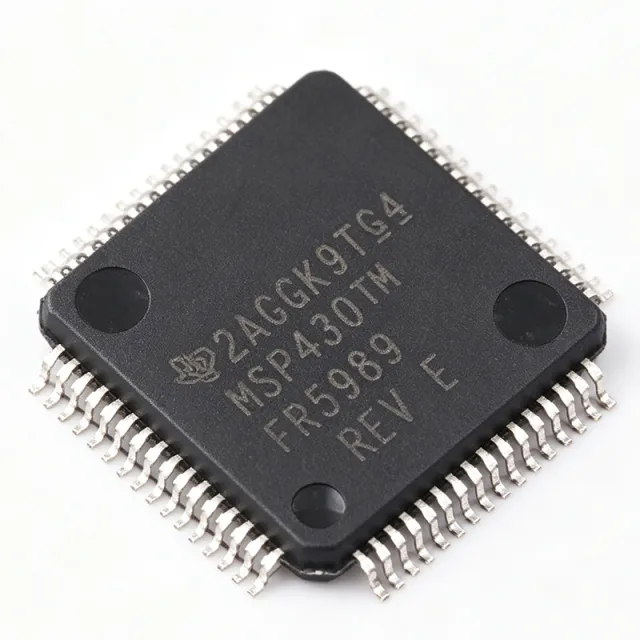
MSP430G2553CY
MSP430G2553CY - 16MHz 16KB Flash Mixed-Signal MCU | TI
Texas Instruments MSP430G2553CY is a 16-bit mixed-signal microcontroller operating at 16 MHz, with 16 KB of Flash memory and 512 bytes of SRAM. The device combines a comparator, timers, UART, SPI, and I2C interfaces in a 32-pin QFN package. The supplied ordering information identifies this orderable MPN as a die-sale device, so package-specific mechanical details and production procurement terms must be confirmed with TI before assembly.
A mixed-signal microcontroller is an embedded semiconductor that combines a programmable digital controller with analog or sensing functions. In the product hierarchy, this MSP430 belongs to the microcontroller, embedded processor, semiconductor, and mixed-signal controller classes. Its 16-bit MSP430 CPU architecture makes it suitable for compact control systems requiring low power, deterministic peripheral access, and several communication interfaces without a separate analog processor.
The verified device information identifies a 16 MHz operating speed, 16 KB Flash, 512 B SRAM, one comparator, UART/SPI/I2C connectivity, and timers. DigChip additionally lists 24 I/O ports, a 3.3 V to 3.6 V supply range, and a 0.1 µA off-mode current with RAM retention. These figures position MSP430G2553CY for low-power sensing, control, instrumentation, and communications designs where memory and integrated interfaces are more important than high-speed digital processing.
The MSP430G2xx family architecture is oriented toward low-power embedded control. Its integrated comparator supports threshold-based sensing, while UART, SPI, and I2C support connections to sensors, displays, transceivers, and external nonvolatile memory. The timer resources can provide event timing and periodic service functions, but individual timer channels, capture/compare resources, and interrupt assignments must be selected from the MSP430G2x53 datasheet for the exact die.
Typical applications include battery-powered sensor nodes, compact industrial monitors, digital thermometers, environmental measurement systems, motor or actuator controllers, and simple serial gateways. For a new PCB, the CY suffix and die-sale status require careful review: developers should not assume that the QFN-32 package information found in generic listings corresponds to the CY deliverable. Board assembly may instead require the documented die-sale process, bonding method, and package outline.
Before layout, confirm the exact pin assignment and exposed-pad requirements in the official MSP430G2x53 datasheet and with TI. Program development commonly uses an MSP430-compatible toolchain, but the verified data does not identify a specific IDE version, debugger, or programming adapter. Power, ground, decoupling, reset, boot-strapping, communication, and exposed-pad connections should therefore follow the authoritative device documentation rather than generic QFN assumptions.
This page consolidates verified manufacturer and distributor information, separates die-sale ordering facts from generic family specifications, and identifies unresolved package, pricing, pinout, lifecycle, and compliance details instead of guessing. It is intended as an engineering-data starting point for MSP430G2553CY sourcing and design review, not as a substitute for TI's final orderable datasheet and quality documentation.
견적 요청
문의하기