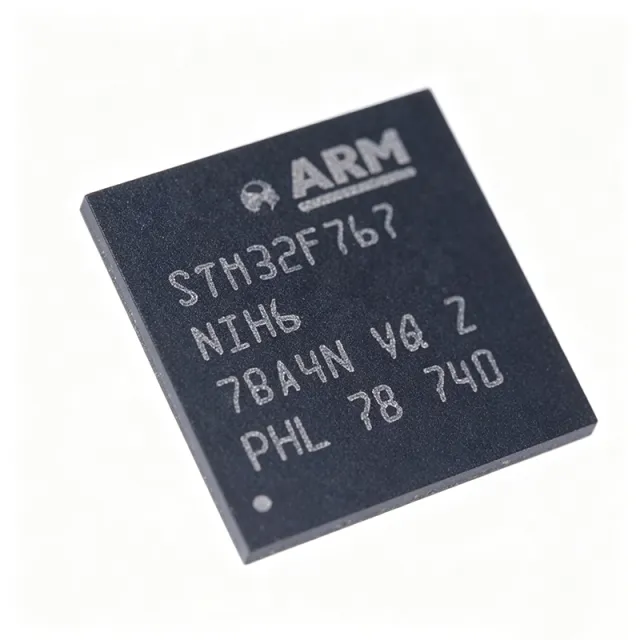
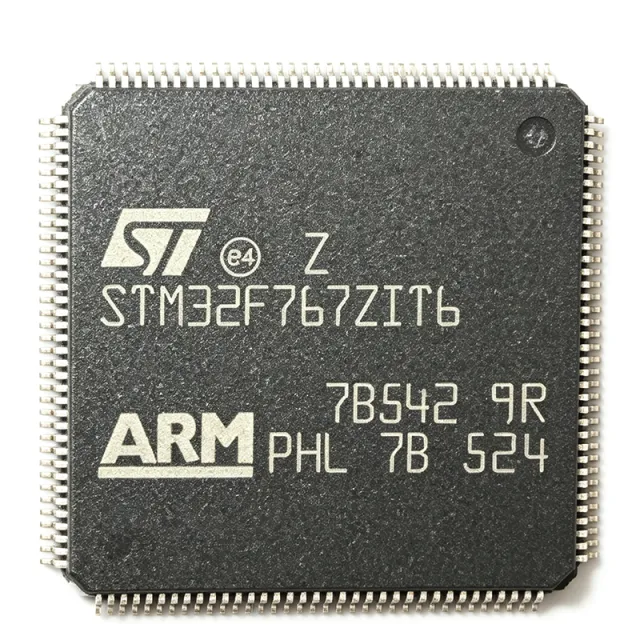
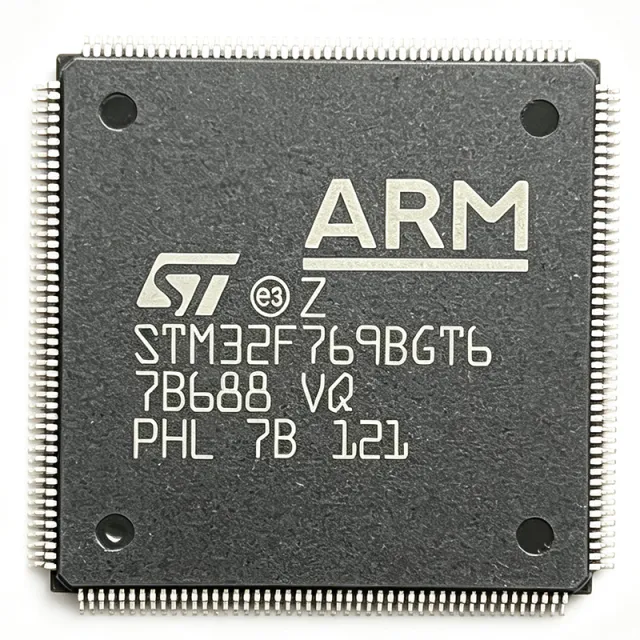
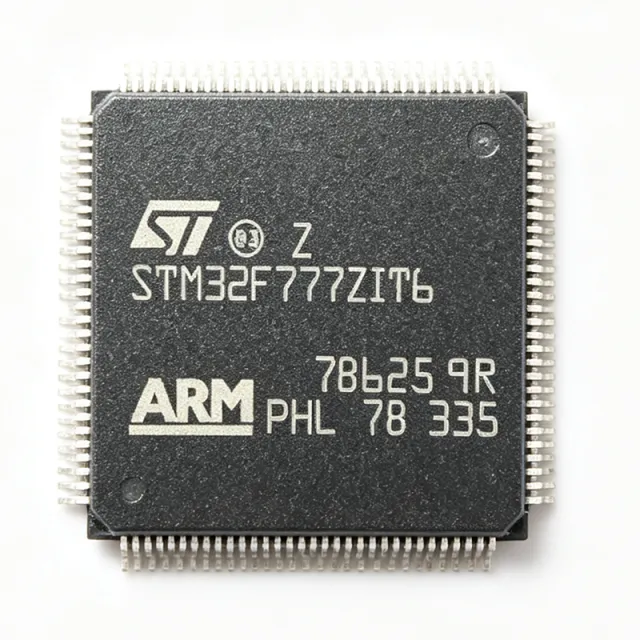
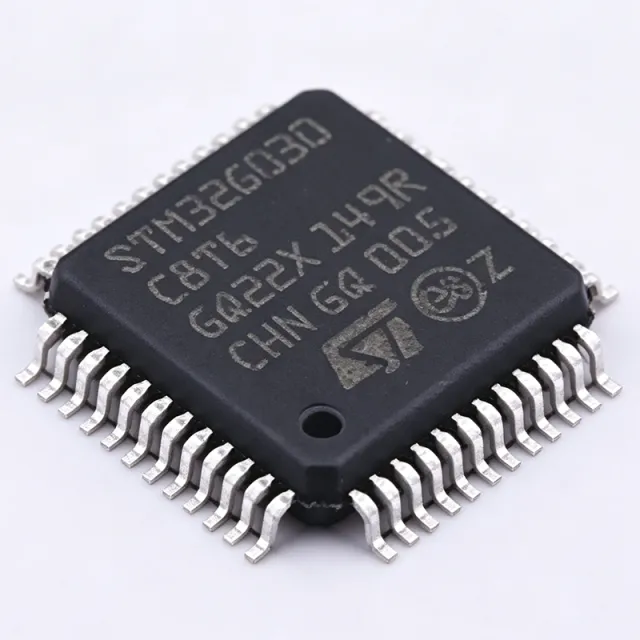
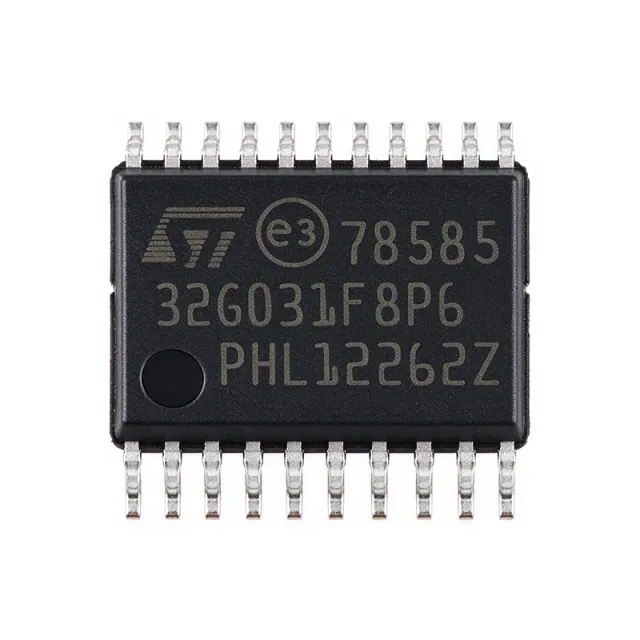
STM32F769NIH6
STM32F769NIH6 - 2MB Flash 216MHz ARM Cortex-M7 MCU | STMicroelectronics
The STMicroelectronics STM32F769NIH6 is a high-performance ARM Cortex-M7 microcontroller operating at up to 216 MHz, delivering 462 DMIPS/2.14 DMIPS/MHz, with 2 MB of dual-bank Flash and 512 KB of SRAM in a 216-pin TFBGA (13x13 mm) package. It supports 1.7V to 3.6V supply and -40C to +85C industrial temperature range, integrating a TFT LCD controller, hardware JPEG codec, and Chrom-ART Accelerator for graphics-rich applications.
What is a microcontroller? A microcontroller (MCU) is a compact integrated circuit that combines a processor core, Flash/SRAM memory, and programmable I/O peripherals on a single die, governing a defined operation in an embedded system. The STM32F769NIH6 belongs to the STM32F7 series within the broader STM32 family of 32-bit Flash microcontrollers. The hierarchy STM32F769 -> STM32F7 -> STM32 -> ARM Cortex-M7 places it in the high-performance tier with DSP extensions and a single-precision floating-point unit (FPU). Cortex-M7 MCUs are the preferred choice for real-time signal processing, motor control, advanced audio, and rich human-machine interface (HMI) systems that require both computational density and connectivity.
Key features include the Chrom-ART Accelerator for offloading 2D DMA2D operations (up to 10x faster than software rendering), a TFT LCD controller supporting up to XGA resolution, a hardware JPEG codec, and a cryptographic acceleration unit. The device exposes 168 GPIO across multiple ports, four I2C, six SPI, four USART/UART, three CAN, two SAI audio interfaces, one SDMMC, two USB 2.0 OTG (HS+FS), and two Ethernet MAC controllers. External memory bus (FMC) supports SDRAM, SRAM, NOR, and NAND for large frame buffers and code overlays. The 40nm process technology provides a balanced performance-per-watt profile for industrial embedded designs.
Technically, the STM32F769NIH6 includes the Cortex-M7 core with single-precision FPU, a memory protection unit (MPU), DSP instruction set, true random number generator (TRNG), real-time clock (RTC), and 12-bit ADCs/DACs. Two 12-bit DACs, three 12-bit ADCs, and seventeen timers (including 32-bit and 16-bit) enable precise motor control and audio synthesis. The external memory interface (FMC) supports PSRAM, NOR Flash, NAND Flash, and SDRAM, enabling up to 32-bit external buses with multiplexing.
Typical applications include high-end consumer electronics, industrial HMI panels, point-of-sale terminals, medical devices, audio processing subsystems, motor drives, and IoT gateways. The STM32F769NIH6 is particularly well-suited for smart home control panels and industrial displays where its graphics acceleration, JPEG codec, and Ethernet/USB connectivity deliver a complete platform.
When designing with this device, ensure proper decoupling with 100nF capacitors placed close to each VDD pin, and provide a 25 MHz HSE oscillator and a 32.768 kHz LSE crystal for RTC. For USB HS and Ethernet, route the differential pairs with 90-dpi impedance and use the internal PLL to derive 48 MHz. Hold NRST low during power-up and ensure VDD is applied before VDDA per datasheet sequencing guidelines.
This page synthesizes distributor pricing, drop-in alternatives from the same STM32F7 family, and practical design notes not aggregated on manufacturer product pages.
USD $15.85
재고 있음