STMicroelectronics

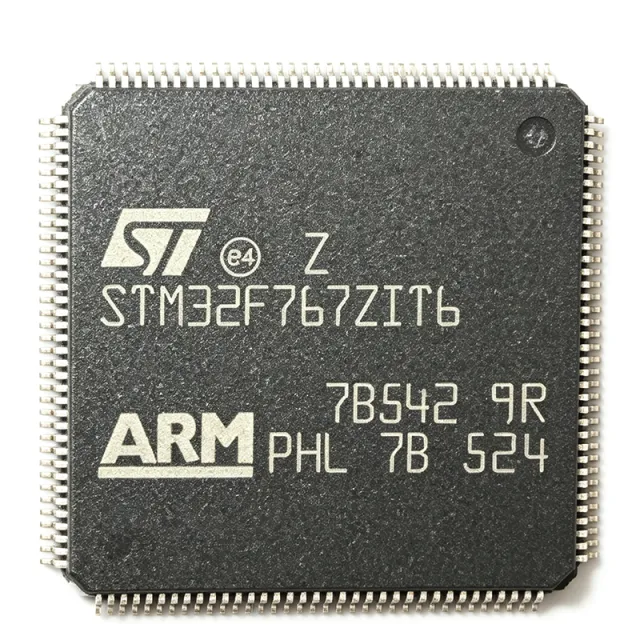
STM32F767ZIT6 - 216MHz Cortex-M7 2MB Flash MCU | ST

부품 번호: STM32F767ZIT6 ✓ 활성
재고 있음 영업일 기준 1~3일 내 발송
3.3 V Vdss 144-LQFP (20x20 mm, 0.5 mm pitch) Package 216 MHz Speed 2 MB Memory
시작가 $17.6 USD / 개
MOQ: 1 |
가격 업데이트: 2026-09-05
볼륨 가격
수량 단가 합계
1 $22.07 $22.07
10 $20.9 $209.00
100 $19.8 $1,980.00
500 $18.7 $9,350.00
1,000 $17.6 $17,600.00
ℹ️ 모든 가격은 USD 기준입니다

STM32F767ZIT6 개요

The STMicroelectronics STM32F767ZIT6 is a high-performance 32-bit ARM Cortex-M7 microcontroller running at up to 216 MHz (462 DMIPS / 1082 CoreMark) with 2 MB of Flash memory, 512 KB of SRAM, and a 144-pin LQFP (20x20 mm, 0.5 mm pitch) surface-mount package.

A microcontroller (MCU) is a compact integrated circuit that combines a processor core, memory, and programmable peripherals on a single die to govern a dedicated operation in an embedded system. The STM32F767ZIT6 belongs to the STM32F7 series within the broader STM32 family of Arm Cortex-M MCUs, positioning it in the high-performance tier of the embedded processing hierarchy, above mainstream Cortex-M4 devices such as the STM32F4 series.

Key features include a double-precision FPU and DSP instructions on the Cortex-M7 core, an ART Accelerator and 8 KB instruction/data caches for zero-wait-state execution from Flash, a Chrom-ART Accelerator for 2D graphics, and a TFT LCD controller. Rich connectivity covers USART/UART, SPI, I2C, CAN, USB OTG HS/FS, Ethernet MAC, and camera interfaces, alongside multiple 12-bit ADCs and 16-bit DACs.

Technically, the device integrates a hardware cryptographic accelerator (AES, DES/TDES, SHA-1, SHA-256) and a true random number generator (TRNG), with a flexible memory controller (FMC) supporting external SDRAM, NOR, and NAND. The 90 nm process balances high clock speed with low power, and dynamic clock gating supports low-power modes for battery-sensitive designs.

Typical applications include industrial control and motor drives, human-machine interfaces with TFT displays, IoT gateways, audio processing, and test instrumentation, where 216 MHz performance and Ethernet/USB connectivity justify a high-performance Cortex-M7 platform.

Design consideration: the MCU requires a 3.3V supply with 100 nF plus 4.7 uF decoupling capacitors at each VDD pair, and the two VCAP capacitors are mandatory for core regulation stability; it operates from -40C to +85C.

This page synthesizes distributor pricing, drop-in alternatives, and practical design notes not found in the ST datasheet, providing a complete selection and implementation resource.

드롭인 대체품: STM32F767ZIT6 — 동일 패키지, 핀 호환. PCB 재작업이 필요한 다른 패키지 부품은 제외됩니다.

이 시리즈의 변형

다음과 드롭인 호환되는 동일 시리즈 모델: STM32F767ZIT6 (동일 폼 팩터 및 풋프린트) — 차이점: Package, Operating Temperature, Communication Interfaces, SRAM, ADC.

Microchip Technology
Package: 100-LQFP (14x14 mm)
Operating Temperature: -40C to +105C (industrial)
Communication Interfaces: USB 2.0 High-Speed, 2x CAN-FD, Ethernet MAC, 3x SPI, 4x UART/USART, 2x I2C, HS SD card
비교 대상: STM32F767ZIT6 →
Microchip Technology
Package: 144-pin LQFP, 20x20 mm
Operating Temperature: -40 C to +105 C (industrial)
ADC: Yes (on-chip)
비교 대상: STM32F767ZIT6 →
STMicroelectronics
Package: LQFP144 (20x20 mm)
Communication Interfaces: Ethernet MAC, USB OTG HS/FS, CAN, SPI, I2C, UART, SDMMC
SRAM: 256 KB
비교 대상: STM32F767ZIT6 →
STMicroelectronics
Package: LQFP144 (20x20 mm)
Operating Temperature: -40°C to +85°C
Communication Interfaces: 4x USART, 4x UART, 6x SPI, 3x I2C, 2x CAN, 1x SDMMC, 1x Ethernet MAC, 1x USB OTG HS, 1x USB OTG FS
비교 대상: STM32F767ZIT6 →
STMicroelectronics
Package: LQFP-144 (ZIT6)
Operating Temperature: -40 C to +85 C (grade 6)
비교 대상: STM32F767ZIT6 →
STMicroelectronics
Package: LQFP-144 (20x20 mm)
Operating Temperature: -40°C to +85°C
Communication Interfaces: 4x I2C, 4x USART, 4x UART, 6x SPI, 3x CAN, 2x USB OTG, 2x SDMMC, 1x FMC, 2x SAI
비교 대상: STM32F767ZIT6 →
STMicroelectronics
Package: LQFP144 (20x20 mm)
Operating Temperature: -40°C to +85°C
Communication Interfaces: 4x USART, 4x SPI, 4x I2C, 2x CAN, USB OTG FS/HS, Ethernet MAC
비교 대상: STM32F767ZIT6 →
STMicroelectronics
Package: 144-pin LQFP (20x20 mm, 0.5 mm pitch)
Operating Temperature: -40 C to +85 C (industrial grade 6)
Communication Interfaces: Ethernet, USB 2.0 HS, CAN-FD, SDMMC, UART, SPI, I2C
비교 대상: STM32F767ZIT6 →

빠른 비교 도구 — 나란히 비교할 대체 부품을 선택하십시오:

STM32F769ZIT6

✅ 드롭인 ⚠️ 사양 미검증
📦 144-LQFP (20x20 mm)
same 144-LQFP footprint and 216 MHz Cortex-M7, 2 MB Flash; adds MIPI-DSI display interface on same pinout

📋 참조 대체품 (카탈로그에 없음)

STM32F777ZIT6

✅ 드롭인
STMicroelectronics
📦 144-LQFP (20x20 mm)
ARM Cortex-M7 · 216 MHz · 2 MB (dual-bank) · 512 KB · 1.7 V to 3.6 V · -40°C to +85°C · LQFP-144 (20x20 mm) · 114

✓ 재고 있음

$22.5909 / 개

데이터시트 보기 →

STM32F765ZIT6

✅ 드롭인 ⚠️ 사양 미검증
STMicroelectronics
📦 144-LQFP (20x20 mm)
Arm Cortex-M7 · 32-bit · 216 MHz · Double-precision · Yes · 462 DMIPS / 2.14 DMIPS/MHz · 2 MB · 512 KB

✓ 재고 있음

$10.95 / 개

데이터시트 보기 →

STM32F767ZGT6

✅ 드롭인
📦 144-LQFP (20x20 mm)
1 MB Flash vs 2 MB (-50% code density); otherwise identical 216 MHz Cortex-M7, same 144-pin LQFP pinout

📋 참조 대체품 (카탈로그에 없음)

STM32F756ZGT6

✅ 드롭인
STMicroelectronics
📦 144-LQFP (20x20 mm)
ARM Cortex-M7 · 216 MHz · 1 MB · 320 KB · LQFP144 (20x20 mm) · 1.7V to 3.6V · -40°C to +85°C · 114

✓ 재고 있음

$8.1 / 개

데이터시트 보기 →

STM32F767ZIT6 최대 정격 & 전기적 특성

Core ARM Cortex-M7 32-bit with FPU
최대 클록 주파수 216 MHz
Performance 462 DMIPS / 1082 CoreMark
Flash Memory 2 MB
SRAM 512 KB
공급 전압 3.3 V
동작 온도 -40C to +85C
패키지 144-LQFP (20x20 mm, 0.5 mm pitch)
실장 유형 Surface Mount
데이터 버스 폭 32 bit
FPU Yes (single and double precision)
DSP Instructions Yes
Graphics Chrom-ART Accelerator + TFT LCD controller
Connectivity USART/UART, SPI, I2C, CAN, USB OTG HS/FS, Ethernet MAC, camera interface
Analog Peripherals 12-bit ADCs, 16-bit DACs
Security AES/DES/TDES/SHA hardware crypto accelerator, TRNG
External Memory Interface FMC (SDRAM, NOR, NAND)
RoHS 상태 Compliant

STM32F767ZIT6 144-lqfp (20x20 mm, 0.5 mm pitch) 핀 구성 가이드

STM32F767ZIT6(144-lqfp (20x20 mm, 0.5 mm pitch) 패키지)의 핀 구성입니다. 이 디지털 IC에는 GPIO, 통신 인터페이스(UART, SPI, I2C), 전원 핀이 포함되어 있습니다. 대체 핀 기능과 구성 옵션은 제조사 데이터시트를 참조하십시오. 임베디드 시스템 설계와 PCB 레이아웃에 필수적입니다.

STM32F767ZIT6의 144-lqfp (20x20 mm, 0.5 mm pitch) 패키지 핀아웃 다이어그램

다음에 대한 상세 핀아웃 데이터 없음: STM32F767ZIT6.

다음을 참조하십시오: 데이터시트 전체 핀 구성은 다음을 참조하십시오.

일반적인 애플리케이션

STM32F767ZIT6 적합 용도: 6 애플리케이션s: Industrial Control and Automation, HMI with TFT LCD Displays, IoT Gateways, Audio Processing, Motor Drives and Power Conversion, Test and Measurement Instruments.

🏭

Industrial Control and Automation

The STM32F767ZIT6 fits industrial controllers that combine real-time control with communication: its 216 MHz Cortex-M7 with DSP instructions executes field-oriented motor control and PID loops while the dual CAN buses, Ethernet MAC, and multiple USARTs link to PLC networks and fieldbus gateways. The 2 MB Flash holds protocol stacks and application code without external memory, and 512 KB of SRAM buffers network traffic. Hardware determinism from the ART Accelerator delivers consistent interrupt latency for time-critical I/O, and the FMC adds SDRAM for data logging in demanding factory automation nodes.

💺

HMI with TFT LCD Displays

The Chrom-ART Accelerator and integrated TFT LCD controller make the STM32F767ZIT6 a natural HMI processor: the LCD controller drives panels up to XGA resolution while Chrom-ART performs 2D DMA blits, offloading frame composition from the CPU and raising achievable frame rates by an estimated 2x in ST's referenced benchmarks. With 2 MB internal Flash for UI assets and FMC-mapped SDRAM for frame buffers, designers can build multi-layer touch interfaces with Quad-SPI or parallel flash storage, and the camera interface adds barcode or face-capture capability to industrial and appliance touch panels.

🧩

IoT Gateways

As an IoT gateway controller, the STM32F767ZIT6 aggregates sensor data over SPI/I2C/CAN and uplinks via its 10/100 Ethernet MAC or USB OTG, supporting protocols such as MQTT and Modbus-TCP in 2 MB of internal Flash. The hardware crypto accelerator (AES, DES/TDES, SHA-1/SHA-256) and TRNG accelerate TLS handshakes, an essential capability for secure cloud connectivity. Low-power modes allow always-on monitoring nodes, and the 144-pin LQFP supplies enough GPIO to bridge multiple radio modules and sensor buses simultaneously in smart-building and industrial edge applications.

🎧

Audio Processing

The STM32F767ZIT6 suits professional and consumer audio products through its I2S peripherals, S/PDIF-capable interfaces, and a 216 MHz Cortex-M7 whose DSP instructions execute multichannel FIR/IIR filtering, echo cancellation, and audio codecs in software. The double-precision FPU permits high-quality float audio pipelines, while 512 KB SRAM buffers multiple audio streams concurrently. USB OTG FS enables USB Audio Class devices with no external USB controller, and the MCU can act as both audio effect processor and system controller in mixers, DSP effects units, and networked audio endpoints.

⚡

Motor Drives and Power Conversion

In motor drives, solar inverters, and UPS systems, the STM32F767ZIT6 provides advanced timers for complementary PWM generation with dead-time insertion, fast 12-bit ADCs for current sensing, and the 216 MHz DSP engine for field-oriented control executed every PWM cycle. The double-precision FPU allows control-loop tuning in float math without fixed-point scaling errors. 2 MB Flash stores parameter tables, waveform logs, and field-updatable firmware, while dual CAN interfaces connect to vehicle or industrial power-system networks, making it effective in servo drives and digitally controlled power stages.

🔧

Test and Measurement Instruments

Bench instruments, data loggers, and portable analyzers benefit from the STM32F767ZIT6's combination of fast analog acquisition, display driving, and connectivity. Multiple 12-bit ADCs sample control and telemetry channels while the FMC attaches external high-speed ADC front ends or SDRAM capture buffers; the TFT LCD controller renders measurement graphics and menus locally. USB OTG and Ethernet provide PC connectivity and remote control (SCPI over LAN), and 2 MB Flash supports upgradeable firmware and calibration tables, all in a single -40C to +85C qualified 144-LQFP device.

What is the STM32F767ZIT6 and what are its key specifications?
The STM32F767ZIT6 is a 32-bit ARM Cortex-M7 microcontroller from STMicroelectronics running at up to 216 MHz (462 DMIPS) with 2 MB of Flash, 512 KB of SRAM, a Chrom-ART graphics accelerator, TFT LCD controller, USB OTG HS/FS, Ethernet MAC, and hardware crypto (AES/SHA). According to the ST datasheet, it is housed in a 144-pin LQFP 20x20 mm package rated from -40C to +85C with a 3.3V supply.
What is the price of STM32F767ZIT6?
The STM32F767ZIT6 unit price is approximately $22.07 per piece at quantity 1, based on distributor listing data as of 2026-09-06. Volume pricing typically steps down at 10, 100, 500, and 1000 unit quantities; XAIPART lists tiered pricing on this page. Note that MCU market pricing fluctuates with allocation cycles, so requesting a current quotation is recommended before placing large orders.
Where can I buy STM32F767ZIT6 online?
The STM32F767ZIT6 can be purchased from XAIPART on this page, as well as from authorized distributors such as DigiKey and Mouser, which list it as an in-stock 144-LQFP STM32F7 Cortex-M7 MCU. Broker channels such as Heisener and Wolfchip also show stock (Wolfchip reported 5,250 pcs as of Aug 2026). Always verify stock and date codes when buying from non-franchised sources.
What is the difference between STM32F767ZIT6 and STM32F767ZGT6?
The STM32F767ZIT6 has 2 MB of Flash while the STM32F767ZGT6 has 1 MB; both are ARM Cortex-M7 MCUs in the same 144-pin LQFP package with identical peripherals and pinout. According to the JAK Electronics comparison, both operate at 216 MHz. The ZIT6 suits applications needing more than 1 MB of code or asset storage; the ZGT6 saves cost when 1 MB suffices. They are drop-in interchangeable on the same PCB.
STM32F767ZIT6 vs STM32F777ZIT6 - which is better for secure applications?
The STM32F777ZIT6 is better for security-focused designs: it adds cryptographic acceleration on top of the same 216 MHz Cortex-M7, 2 MB Flash, and 144-LQFP footprint as the STM32F767ZIT6. For general industrial control or HMI applications without cryptographic requirements, the STM32F767ZIT6 is the more economical choice since it shares the identical package and pinout, making the two parts mutually drop-in replaceable.
When should I choose STM32F767ZIT6 over STM32F429IIT6?
Choose the STM32F767ZIT6 when you need 216 MHz performance, double-precision FPU, 2 MB Flash, 512 KB SRAM, or the TFT LCD controller and Chrom-ART accelerator for graphical HMIs. Choose the STM32F429IIT6 when 180 MHz Cortex-M4 performance, single-precision FPU, and 2 MB Flash meet the requirement at lower cost. Note the two families differ in pinout and power architecture, so they are not drop-in interchangeable despite sharing LQFP packages.
Is STM32F767ZIT6 suitable for HMI and graphics applications?
Yes, the STM32F767ZIT6 is well suited to graphical HMI designs thanks to its integrated TFT LCD controller and Chrom-ART Accelerator, which offloads 2D DMA transfers to boost graphics frame rates. With 2 MB of internal Flash and FMC support for external SDRAM frame buffers, it can drive displays up to XGA resolution. According to ST product pages, this graphics subsystem is a defining feature of the STM32F7 high-performance series.
What is the best drop-in replacement for STM32F767ZIT6?
The best same-package drop-in replacements are the STM32F769ZIT6 (2 MB Flash, adds MIPI-DSI on the same 144-LQFP footprint), the STM32F777ZIT6 (adds crypto hardware), the STM32F765ZIT6 (2 MB Flash without LCD controller features per ordering-info differences), the STM32F756ZGT6 (1 MB Flash with crypto), and the STM32F767ZGT6 (1 MB Flash). All share the 144-LQFP (Z) pinout; only firmware and density code changes are typically needed.
Can STM32F767ZIT6 be replaced by an STM32H743ZIT6?
The STM32H743ZIT6 is also a Cortex-M7 MCU in a 144-LQFP package with higher 480 MHz performance, but it is NOT a guaranteed drop-in replacement for the STM32F767ZIT6. According to the ST Community thread on F769-to-H743 replacement, the H7 series changes the power architecture (integrated LDO/SMPS with software regulator control versus the F7 BYPASS_REG approach), so power supply circuitry changes are required even where pins align. Treat it as a redesign, not a swap.
What is the best Chinese domestic equivalent for STM32F767ZIT6?
There is no confirmed pin-to-pin Chinese domestic equivalent for the STM32F767ZIT6 in the 144-LQFP high-performance Cortex-M7 class. Domestic parts such as GigaDevice GD32F4 series (Cortex-M4) approximate STM32F4 but do not match the F7's 144-pin pinout at this performance tier. According to 2026 STM32 alternative guides, drop-in domestic substitutes are well established for STM32F1/F0 families, not for the Cortex-M7 STM32F7 series - designs should verify footprint and registers before attempting any swap.
Where can I download the STM32F767ZIT6 datasheet PDF?
The official STM32F767ZIT6 datasheet PDF is available free from STMicroelectronics at https://www.st.com/resource/en/datasheet/stm32f767zi.pdf. This document covers the STM32F765xx, STM32F767xx, STM32F768Ax, and STM32F769xx families, including pin configuration, electrical characteristics, and peripheral descriptions. ST also provides reference manuals, errata sheets, and application notes on the STM32F767ZI product page for full design support.
Is STM32F767ZIT6 the same as STM32F767ZI?
STM32F767ZIT6 is a specific ordering code within the STM32F767ZI product line. According to ST's part-numbering scheme, the trailing 'T6' indicates an LQFP package in tape-and-reel packing with a -40C to +85C industrial temperature range. Other STM32F767ZI order codes exist with different packages (for example BGA variants), so the base product name alone does not guarantee the 144-LQFP package - always confirm the full ordering code when purchasing.
What power supply and decoupling does the STM32F767ZIT6 require?
The STM32F767ZIT6 requires a 3.3V VDD supply with 100 nF ceramic decoupling capacitors placed at each VDD/VSS pair plus at least one 4.7 uF bulk capacitor, per ST's hardware getting-started guidance. The two VCAP pins require 2.2 uF capacitors each to stabilize the internal 1.2V core regulator. VDDA should be filtered separately from digital VDD with an LC filter for ADC accuracy, and NRST needs a 100 nF pull-down capacitor.
What development tools support the STM32F767ZIT6?
The STM32F767ZIT6 is supported by STM32CubeMX for graphical configuration and code generation, STM32CubeIDE (free Eclipse-based IDE), and the widely used NUCLEO-F767ZI discovery/evaluation boards that share the same MCU. The ZI variant is the one populated on the NUCLEO-F767ZI, which makes prototyping and firmware migration to the 144-LQFP part straightforward. Third-party toolchains including Keil MDK, IAR EWARM, and GCC also fully support the Cortex-M7 core.
Is the STM32F767ZIT6 RoHS compliant and what is its lifecycle status?
Yes, the STM32F767ZIT6 is RoHS compliant and lead-free, consistent with STMicroelectronics' standard environmental policy for current STM32 products. Its lifecycle status is active - the STM32F7 series is a mainstream ST product line, not listed for discontinuation as of 2026-09-06. REACH status, halogen-free details, and specific compliance certificates should be confirmed via ST's official product page or quality portal for formal regulatory documentation.

엔지니어링 참조 데이터: STM32F767ZIT6 — 비교, 설계 지침 및 규정 준수 정보.

선택 가이드

Choose the STM32F767ZIT6 when you need a 216 MHz Cortex-M7 with 2 MB Flash, full display subsystem (TFT LCD controller plus Chrom-ART), Ethernet, USB OTG, and AES/SHA crypto acceleration in a single 144-LQFP device - it is the balanced flagship of the F7 series. Choose STM32F767ZGT6 or STM32F756ZGT6 (same footprint, 1 MB Flash) when code fits in 1 MB and cost is decisive; the F756 adds crypto emphasis. Choose STM32F777ZIT6 when maximum security features are required, or STM32F769ZIT6 when MIPI-DSI display output is needed - all are drop-in on the same PCB. Do not treat STM32H743/H753 as drop-in upgrades: the power architecture differs and requires board redesign. For battery-powered nodes, step down to STM32L4 devices instead.

대체품과의 비교

파라미터 이 제품 STM32F769ZIT6 STM32F777ZIT6 STM32F765ZIT6 STM32F767ZGT6 STM32F756ZGT6
Package 144-LQFP (20x20 mm) 144-LQFP (20x20 mm) - same 144-LQFP (20x20 mm) - same 144-LQFP (20x20 mm) - same 144-LQFP (20x20 mm) - same 144-LQFP (20x20 mm) - same
Brand STMicroelectronics STMicroelectronics STMicroelectronics STMicroelectronics STMicroelectronics STMicroelectronics
Core / Max Frequency Cortex-M7, 216 MHz Cortex-M7, 216 MHz Cortex-M7, 216 MHz Cortex-M7, 216 MHz Cortex-M7, 216 MHz Cortex-M7, 216 MHz
Flash Memory 2 MB 2 MB 2 MB 2 MB 1 MB 1 MB
Operating Temperature -40C to +85C -40C to +85C -40C to +85C -40C to +85C -40C to +85C -40C to +85C

주요 차별점

  • Double Flash density for complex firmware (vs STM32F767ZGT6)
  • TFT LCD controller with Chrom-ART graphics acceleration (vs STM32F765ZIT6)
  • Honest trade-off: crypto variant offers more security features (vs STM32F777ZIT6)

설계 노트

Supply the 144-LQFP device from a clean 3.3V rail with 100 nF ceramic capacitors at every VDD/VSS pair plus at least one 4.7 uF bulk capacitor per ST hardware development guidance. The two VCAP pins each require 2.2 uF low-ESR capacitors for the internal 1.2V core regulator - never omit or substitute larger values without checking stability. Filter VDDA separately with an LC filter (ferrite bead plus 1 uF and 10 nF) to preserve ADC accuracy, and add a 100 nF capacitor on NRST.

For the 20x20 mm 144-LQFP, use at least a 4-layer board with a solid ground plane. Route the Ethernet RMII PHY clock (50 MHz) with controlled-length traces and keep it away from ADC analog routing. Place the FMC/SDRAM terminations with series resistors per ST AN notes on SDRAM interface design, and keep the 25 MHz HSE crystal loop compact with guard ground for stable 216 MHz PLL operation.

A frequent migration error is treating STM32F7 parts as drop-in to STM32H7: per the ST Community thread on F769-to-H743 pin-to-pin replacement, the H7 changes the power architecture (integrated LDO/SMPS and software regulator control versus the F7 core regulator with VCAP), so the power circuitry must change even when pin functions appear identical. Also verify the boot configuration (BOOT0/BOOT1 on PB2) and that the Flash density code in firmware matches the ordered variant (ZG 1 MB vs ZI 2 MB).

규정 준수 정보

RoHS
Compliant
REACH
Unknown
AEC-Q100
Not Applicable
무연
Yes
무할로겐
Unknown
분쟁 광물
Unknown

RoHS compliance and lead-free status consistent with ST standard product listing; REACH, halogen-free, and conflict-minerals declarations should be confirmed on the official ST product page quality documents.

데이터 검증일: 2026-09-06 — XAIPART 부품 엔지니어링 팀이 검증하고 관리한 데이터

관련 검색

STM32F767ZIT6 STM32F767ZIT6 datasheet STM32F767ZIT6 price buy STM32F767ZIT6 144-LQFP 216MHz Cortex-M7 STM32F767ZIT6 vs STM32F767ZGT6 STM32F767ZIT6 drop-in replacement STM32F767ZIT6 TFT LCD HMI application STMicroelectronics STM32F7 microcontroller 2MB flash what can replace STM32F767ZIT6 STM32F767ZIT6 pinout 144 LQFP STM32F767ZIT6 Ethernet IoT gateway MCU STM32F767ZIT6 vs STM32H743ZIT6 difference

관련 부품 & 용어

STMicroelectronics STM32F767ZIT6 STM32F767ZI STM32F767ZGT6 STM32F777ZIT6 STM32F769ZIT6 STM32H743ZIT6 ARM Cortex-M7 STM32F7 series microcontroller MCU Chrom-ART Accelerator TFT LCD controller 144-LQFP LQFP package family surface mount RoHS FMC USB OTG HS/FS Ethernet MAC TRNG AES hardware crypto 216 MHz 2 MB Flash IoT gateway
빠른 견적 RFQ
상세 정보를 모두 입력하십시오 — 영업팀이 24시간 이내에 답변드립니다
부품 번호 제조사 패키지 QTY 목표 가격 합계
합계: $0.00 USD
✓
견적이 제출되었습니다!

24시간 이내에 이메일로 답변드리겠습니다

1
RFQ 제출됨
2
견적 접수됨
3
주문 완료
4
결제
5
배송됨
6
배송 완료
RFQ 상세 보기