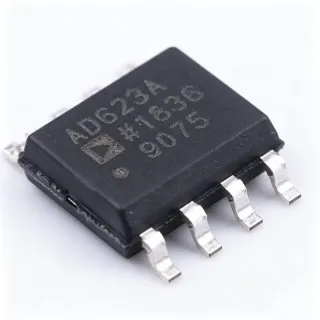
LM358QDRQ1 - Automotive Dual 1MHz Op-Amp SOIC-8 | Texas Instruments
부품 번호: LM358QDRQ1 ✓ 활성| 수량 | 단가 | 합계 |
|---|---|---|
| 1 | $0.45 | $0.45 |
| 10 | $0.38 | $3.80 |
| 100 | $0.28 | $28.00 |
| 500 | $0.22 | $110.00 |
| 1,000 | $0.18 | $180.00 |
LM358QDRQ1 개요
An operational amplifier (op-amp) is a high-gain voltage amplifier with differential inputs and a single-ended output; within the component hierarchy it belongs to the amplifier IC family, under integrated circuits, and is a core building block of analog signal chains. Dual op-amps such as the LM358-Q1 integrate two independent channels in one package, halving board area versus two single amplifiers while sharing supply rails.
Key features include two independent amplifier circuits, a 1 MHz class gain bandwidth, low input offset suitable for general-purpose sensing, operation from single or dual supplies, and AEC-Q100 automotive qualification with temperature grading that supports harsh under-hood environments. The wide supply range allows direct interfacing with battery-backed rails and regulated 5V logic domains.
Architecturally, the LM358-Q1 family traces to the classic LM358 bipolar design updated for automotive quality systems, with TI manufacturing controls per its automotive flow; the related LMV358-Q1 variant adds rail-to-rail output for low-voltage rails per the LMV321-Q1/LMV358-Q1/LMV324-Q1 datasheet.
Typical applications include automotive sensor signal conditioning, current-sense amplification front-ends, active filters, comparators and level shifters, and battery-management monitoring stages in vehicle ECUs and industrial controllers.
Design tip: with a 1 MHz GBW, keep closed-loop gains modest (10x or below) to preserve bandwidth and phase margin; check the output swing versus load, since the classic LM358 output does not reach the positive rail.
드롭인 대체품: LM358QDRQ1 — 동일 패키지, 핀 호환. PCB 재작업이 필요한 다른 패키지 부품은 제외됩니다.
이 시리즈의 변형
다음과 드롭인 호환되는 동일 시리즈 모델: LM358QDRQ1 (동일 폼 팩터 및 풋프린트) — 차이점: Amplifier Type, Gain Bandwidth Product, Slew Rate.
빠른 비교 도구 — 나란히 비교할 대체 부품을 선택하십시오:
LM358ADR
✅ 드롭인 ⚠️ 사양 미검증📋 참조 대체품 (카탈로그에 없음)
LM2904QDRQ1Q1
✅ 드롭인 ⚠️ 사양 미검증📋 참조 대체품 (카탈로그에 없음)
LMV358AQDRQ1
✅ 드롭인📋 참조 대체품 (카탈로그에 없음)
MC33202DR2
✅ 드롭인 ⚠️ 사양 미검증📋 참조 대체품 (카탈로그에 없음)
LM2904YDT
✅ 드롭인 ⚠️ 사양 미검증📋 참조 대체품 (카탈로그에 없음)
LM358QDRQ1 최대 정격 & 전기적 특성
| Amplifier Type | General Purpose |
| Number of Circuits | 2 |
| Gain Bandwidth Product | 1 MHz |
| Automotive Qualification | Qualified for automotive applications (AEC-Q100 family) |
| 패키지 / 케이스 | 8-SOIC (0.154 in, 3.90 mm width) |
| 실장 유형 | Surface Mount |
| Packaging | Tape & Reel (TR) |
| RoHS 상태 | Compliant |
| Related Family | LMV321-Q1 (single), LMV358-Q1 (dual), LMV324-Q1 (quad) rail-to-rail output op-amps |
LM358QDRQ1 핀 구성
| 핀 1 | OUT A — Output of amplifier A |
| 핀 2 | IN A- — Inverting input of amplifier A |
| 핀 3 | IN A+ — Non-inverting input of amplifier A |
| 핀 4 | V- / GND — Negative supply or ground (single supply) |
| 핀 5 | IN B+ — Non-inverting input of amplifier B |
| 핀 6 | IN B- — Inverting input of amplifier B |
| 핀 7 | OUT B — Output of amplifier B |
| 핀 8 | V+ — Positive supply |
일반적인 애플리케이션
LM358QDRQ1 적합 용도: 6 애플리케이션s: Automotive Sensor Signal Conditioning, Current Sense Amplification Front-End, Active Filter Stages, Comparator and Level-Shifter Functions, Battery Management Monitoring, Industrial Control and Automation Analog Front-Ends.
Automotive Sensor Signal Conditioning
The LM358QDRQ1's Q1 automotive qualification and 1 MHz gain bandwidth make it well suited to conditioning low-frequency sensor signals such as pressure, position, and temperature in ECU front-ends. Used as a non-inverting amplifier or buffer between a resistive sensor bridge and an ADC, it adds gain with the offset floor appropriate for 12V single-supply rails. Its two channels allow amplification plus an active filter stage in one SOIC-8 footprint, reducing board area and BOM count in high-volume automotive builds.
추천
Current Sense Amplification Front-End
Paired with a shunt resistor, the LM358QDRQ1 amplifies small differential voltages for battery-management and load-monitoring circuits in vehicles and industrial equipment. Its general-purpose input stage and wide single-supply operation let one channel amplify the shunt signal while the second channel sets a reference or drives a fault comparator. For dedicated high-accuracy current sensing, TI INA-series amplifiers integrate the precision stage; the LM358-Q1 remains the economical choice where moderate accuracy and 1 MHz bandwidth are sufficient.
추천
Active Filter Stages
With a 1 MHz gain bandwidth product, the LM358QDRQ1 implements Sallen-Key and multiple-feedback active filters with corner frequencies up to tens of kilohertz while preserving adequate loop gain for accurate Q and cutoff settings. This fits anti-aliasing filters ahead of ADCs in automotive sensor modules and industrial controllers. Keeping closed-loop gains at or below 10x preserves bandwidth and phase margin; designers should account for the classic LM358 output stage swing limits when setting filter output headroom on single supplies.
추천
Comparator and Level-Shifter Functions
One LM358QDRQ1 channel can operate as a low-speed comparator for over-voltage, under-voltage, or window detection in 12V and 24V automotive rails, while the second channel buffers a threshold derived from a voltage reference. At 1 MHz-class speed it suits DC and slow transient supervision rather than fast edge detection. This dual-role usage - supervision plus reference buffering in one SOIC-8 package - is a common pattern in ECU power-monitoring and industrial power-supply health circuits where cost and board space dominate.
추천
Battery Management Monitoring
In battery-management systems, the LM358QDRQ1 buffers cell-voltage dividers and temperature-monitoring outputs before they reach a battery-monitor IC or microcontroller ADC. The Q1 automotive grade supports under-hood and traction-adjacent environments, and the dual channels let one package handle both a voltage buffer and a temperature-signal gain stage. Designers should bias inputs to keep the amplifier in its linear region across the full cell-voltage span, given the standard (non-rail-to-rail) output swing of the classic LM358 architecture.
추천
Industrial Control and Automation Analog Front-Ends
Beyond vehicles, the LM358QDRQ1 serves PLC I/O cards, motor-control supervisory circuits, and instrumentation front-ends that condition 0-10V or 4-20mA-derived signals. Its general-purpose bipolar design tolerates the noisy electrical environment of factory floors, and the SOIC-8 surface-mount footprint integrates into standard SMT assembly. The 1 MHz bandwidth covers control-loop feedback signals comfortably; for precision instrumentation where sub-millivolt offsets matter, TI's OPA series is the upgrade path at higher cost.
추천
추천 제품 요약
엔지니어링 참조 데이터: LM358QDRQ1 — 비교, 설계 지침 및 규정 준수 정보.
선택 가이드
대체품과의 비교
| 파라미터 | 이 제품 | LM358ADR | LM2904QDRQ1Q1 | LMV358AQDRQ1 | MC33202DR2 | LM2904YDT |
|---|---|---|---|---|---|---|
| Package | SOIC-8 (D) | SOIC-8 (D) - same | SOIC-8 (D) - same | SOIC-8 (D) - same | SOIC-8 - same | SOIC-8 - same |
| Brand | Texas Instruments | Texas Instruments | Texas Instruments | Texas Instruments | onsemi | STMicroelectronics |
| Number of Circuits | 2 | 2 | 2 | 2 | 2 | 2 |
| Gain Bandwidth Product | 1 MHz | 1 MHz | 1 MHz | 1 MHz | 2.2 MHz | 1 MHz |
| Automotive Qualification | Q1 automotive flow | No (industrial) | Yes (Q1) | Yes (Q1) | No (industrial) | Automotive grade |
주요 차별점
- Automotive Q1 qualification at commodity price (vs LM358ADR)
- Wide-supply classic architecture vs low-voltage variant (vs LMV358AQDRQ1)
- Cost and second-source coverage vs precision amplifiers (vs MC33202DR2)
설계 노트
The classic LM358 architecture does not swing rail-to-rail on the output: the output approaches the negative rail closely but stops roughly 1.5V below the positive supply under load. Do not design output ranges that require the positive rail; budget headroom or choose the rail-to-rail LMV358-Q1 variant instead. Also note the input common-mode range includes the negative rail but not the positive rail.
Place a 100 nF ceramic decoupling capacitor directly at pin 8 (V+) to pin 4 (V-/GND), plus a 1 uF bulk capacitor per supply rail. In automotive environments with load-dump transients, protect the supply pin with a series resistor or TVS clamp if the rail can exceed the device maximum rating.
With 1 MHz gain bandwidth, closed-loop gains above 10x erode bandwidth and phase margin; a gain-of-10 amplifier has only about 100 kHz of usable bandwidth. For filters, verify that the corner frequency is at least a decade below GBW divided by the noise gain to keep Q accurate. Keep feedback resistors in the 1k-100k range to balance bias-current error and stability.
규정 준수 정보
Q1 suffix denotes TI automotive flow with AEC-Q100-family qualification. RoHS/lead-free per standard TI automotive flow; verify REACH and halogen-free status on TI product page.