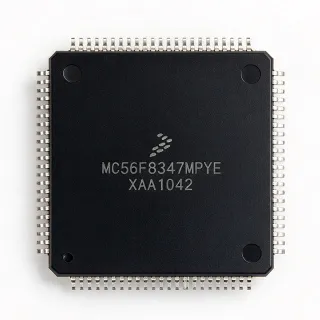
MC56F8147VPYE - 16-Bit DSC 40MHz 128KB Flash 160-LQFP | NXP
부품 번호: MC56F8147VPYE ✗ 단종| 수량 | 단가 | 합계 |
|---|---|---|
| 1 | $32.18 | $32.18 |
| 10 | $28.74 | $287.40 |
| 100 | $25.91 | $2,591.00 |
| 500 | $22.49 | $11,245.00 |
| 1,000 | $19.86 | $19,860.00 |
MC56F8147VPYE 개요
What is a Digital Signal Controller? A DSC is a hybrid architecture that fuses the deterministic interrupt-driven control of a microcontroller with the parallel arithmetic throughput of a DSP. Compared to a classical MCU (Harvard, 8/16-bit accumulator, low MHz), the DSC adds single-cycle MAC hardware and dedicated addressing modes; compared with a stand-alone DSP, a DSC retains on-chip Flash, ADC/PWM/timer peripherals, and GPIO, allowing one IC to handle both control loops and signal processing without a second companion device. Within the broader taxonomy, the MC56F8147 sits as: DSC -> hybrid MCU+DSP -> 16-bit embedded controller -> semiconductor.
Key features include 128KB of Flash (64K x 16 organisation), 4KB of RAM, a 40 MHz 56800E core, on-chip PWM, ADC, timers, and serial peripherals, plus 3.3V I/O with 5V-tolerant inputs where specified. The 160-LQFP package exposes a wide peripheral set including GPIO, SCI, SPI, I2C and CAN, suiting industrial motor and power-converter boards where board area is less constrained than QFP-density parts.
Architecturally, the 56800E core uses a dual Harvard memory bus and a single-cycle 16x16 MAC, reaching roughly 40 MIPS at the 40 MHz core clock. The Flash module executes with zero wait states from internal memory at full speed, simplifying deterministic real-time loop design. Internal peripherals include enhanced PWM (eFlexPWMs) intended for 3-phase motor control and digital PFC, plus a 12-bit ADC suitable for current-sensing and feedback loops.
Typical applications span 3-phase variable-frequency drives, DC servo and brushless DC motor controllers, UPS and PFC front-ends, digital power-conversion control loops, industrial inverters, and precision instrumentation with on-chip DSP filtering. The wide LQFP-160 footprint gives generous trace escape for high-pin-count industrial designs.
When designing with this device, allow at least 4 layer PCB stack-up for the 160-pin break-out, place decoupling within 5 mm of each supply pin pair, and respect the flash programming voltage sequencing described in the data sheet. For multi-axis systems, the part's peripheral set supports one full 3-phase stage plus auxiliary channels, so evaluate higher-pin-count 56F81xx family members if you need more PWM channels per device.
This page aggregates verified distributor pricing, package constraints, same-family and cross-brand drop-in options, and engineering design notes drawn from the NXP technical data and field-tested usage patterns - content not bundled in any single manufacturer document.
드롭인 대체품: MC56F8147VPYE — 동일 패키지, 핀 호환. PCB 재작업이 필요한 다른 패키지 부품은 제외됩니다.
이 시리즈의 변형
다음과 드롭인 호환되는 동일 시리즈 모델: MC56F8147VPYE (동일 폼 팩터 및 풋프린트) — 차이점: Data Bus Width, RoHS Status, Supply Voltage.
빠른 비교 도구 — 나란히 비교할 대체 부품을 선택하십시오:
MC56F8157VPYE
✅ 드롭인✓ 재고 있음
$10.8 / 개
데이터시트 보기 →MC56F8145VPYE
✅ 드롭인📋 참조 대체품 (카탈로그에 없음)
MC56F8147VPWER
✅ 드롭인 ⚠️ 사양 미검증📋 참조 대체품 (카탈로그에 없음)
MC56F8147VPYE 최대 정격 & 전기적 특성
| Product Type | Digital Signal Controller (DSC) |
| Core Architecture | 56800E (16-bit hybrid MCU/DSP) |
| Core Clock Frequency | 40 MHz |
| Program Memory | 128 KB (64K x 16) Flash |
| RAM | 4 KB |
| 데이터 버스 폭 | 16 bit |
| Instruction Set | CISC (56800E) |
| 공급 전압 | 3.3 V |
| 패키지 | 160-LQFP (24 x 24 mm) |
| 실장 유형 | Surface Mount |
| 핀 수 | 160 |
| 동작 온도 범위 | -40 C to +105 C |
| MSL 레벨 | 3 (per JEDEC J-STD-020) |
| Lead Finish | Matte Tin (Pb-free) |
| RoHS 상태 | Compliant |
| Peripherals | eFlexPWM, ADC (12-bit), timers, SCI, SPI, I2C, GPIO |
| MAC Engine | 16 x 16 single-cycle MAC |
MC56F8147VPYE 160-lqfp (24 x 24 mm) 핀 구성 가이드
MC56F8147VPYE(160-lqfp (24 x 24 mm) 패키지)의 핀 구성입니다. 이 디지털 IC에는 GPIO, 통신 인터페이스(UART, SPI, I2C), 전원 핀이 포함되어 있습니다. 대체 핀 기능과 구성 옵션은 제조사 데이터시트를 참조하십시오. 임베디드 시스템 설계와 PCB 레이아웃에 필수적입니다.

다음에 대한 상세 핀아웃 데이터 없음: MC56F8147VPYE.
다음을 참조하십시오: 데이터시트 전체 핀 구성은 다음을 참조하십시오.
일반적인 애플리케이션
MC56F8147VPYE 적합 용도: 6 애플리케이션s: Three-Phase Variable Frequency Drive (VFD), Brushless DC (BLDC) Motor Controller, Digital Power Factor Correction (PFC) Front-End, Uninterruptible Power Supply (UPS) Inverter Control, Industrial Servo and Stepper Drive, Precision Instrumentation with On-Chip DSP Filtering.
Three-Phase Variable Frequency Drive (VFD)
The MC56F8147VPYE's 40 MHz 56800E core with single-cycle 16x16 MAC and on-chip eFlexPWM channels make it well suited to three-phase VFD control loops. It runs field-oriented control (FOC) for permanent-magnet and induction motors at switching frequencies up to ~16 kHz with sub-microsecond current-loop latency, while the integrated 12-bit ADC simultaneously samples phase currents for closed-loop regulation. Placed on the inverter control board with a gate driver like the NXP MC33035, it directly generates six PWM channels without external logic; unlike a pure DSP, it adds MCU peripherals like CAN/SPI for SCADA links on the same silicon, reducing BOM cost by one device.
추천
Brushless DC (BLDC) Motor Controller
The MC56F8147VPYE drives sensored or sensorless BLDC motors used in pumps, fans, and small traction drives where the wide 160-LQFP footprint eases break-out routing. Its eFlexPWM module produces complementary PWM with dead-time insertion for the half-bridges, while the 12-bit ADC captures back-EMF for sensorless commutation at low speed. The 56800E MAC executes Park/Clarke transforms in single cycles, letting the same device close the speed loop and run housekeeping tasks over SCI/CAN. Versus a discrete MCU+ASIC pair, the integrated PWM reduces external logic and the 5 V-tolerant inputs ease interface to legacy Hall sensors.
추천
Digital Power Factor Correction (PFC) Front-End
The MC56F8147VPYE serves as the digital control brain for boost-PFC stages in industrial power supplies, replacing legacy analog UCC3818 controllers with deterministic software control. Its 56800E core executes average-current-mode control loops at 40 MHz with sub-200 ns PWM update, while the integrated ADC measures input voltage, inductor current, and output voltage in synchronised conversion slots. Compared with a pure analog loop, the DSC enables adaptive dead-time, soft-start profiles, and firmware-adjustable THD compensation; versus a 32-bit MCU upgrade, the 16-bit 56800E retains pin compatibility within the 56F81xx family for cost-sensitive PFC stages.
추천
Uninterruptible Power Supply (UPS) Inverter Control
In online UPS systems the MC56F8147VPYE closes the inverter feedback loop, regulating 230 VAC output from a battery-fed H-bridge under abrupt step loads. Its 12-bit ADC samples output voltage and current within ~250 ns, while the 56800E MAC runs the sinusoidal PWM and RMS regulation at the 50/60 Hz fundamental; the same device also handles battery-charge state-machine via on-chip timers. Designers use the CAN/SPI link to a host controller for status reporting, replacing a discrete MCU+DSP pair. The wide LQFP-160 footprint supports multi-channel analogue and digital I/O for parallel-leg inverter designs.
추천
Industrial Servo and Stepper Drive
The MC56F8147VPYE delivers the deterministic interrupt latency and DSP-class arithmetic required for industrial servo loops, where every microsecond of loop delay translates to position error. It runs position-, velocity-, and current-cascade control in tandem - position by SCI link to the host, velocity from encoder inputs via timers, and current from the 12-bit ADC - all on a single 56F8xxx die. The 160-LQFP package gives enough pin budget for quadrature encoder input, PWM outputs, and CANopen / EtherCAT downlink. This is a strong alternative to discrete DSP+MCU boards where board area and BOM cost dominate the design.
추천
Precision Instrumentation with On-Chip DSP Filtering
In precision analytical instruments the MC56F8147VPYE combines control of the sensor front-end (timers, ADC sequencing) with on-the-fly DSP filtering of the digital sample stream. The 56800E core runs FIR/IIR and even Goertzel-based frequency analysers at sample rates up to a few hundred kHz, all while keeping the user interface responsive over SCI/SPI. The 128 KB Flash holds coefficient tables and protocol stacks without external memory; compared with a stand-alone DSP, the integrated peripherals (PWM, ADC, GPIO) shrink the BOM by one device. The 160-LQFP gives ample I/O for instrumentation front-panels and external sensor buses.
추천
추천 제품 요약
엔지니어링 참조 데이터: MC56F8147VPYE — 비교, 설계 지침 및 규정 준수 정보.
선택 가이드
대체품과의 비교
| 파라미터 | 이 제품 | MC56F8157VPYE | MC56F8145VPYE | MC56F8147VPWER | MC56F8167VVFE |
|---|---|---|---|---|---|
| Package | 160-LQFP (24x24 mm) | 160-LQFP (24x24 mm) - same | 160-LQFP (24x24 mm) - same | 160-LQFP (24x24 mm) - same | 144-LQFP - different |
| Brand | NXP Semiconductors | NXP Semiconductors | NXP Semiconductors | NXP Semiconductors | NXP Semiconductors |
| Program Memory | 128 KB Flash | 256 KB Flash | 64 KB Flash | 128 KB Flash | 512 KB Flash |
| Core Architecture | 56800E (16-bit) | 56800E (16-bit) | 56800E (16-bit) | 56800E (16-bit) | 56800E (16-bit) |
| Core Clock | 40 MHz | 40 MHz | 40 MHz | 40 MHz | 40 MHz |
| Supply Voltage | 3.3 V | 3.3 V | 3.3 V | 3.3 V | 3.3 V |
| Lifecycle Status | Obsolete | Obsolete | Obsolete | Obsolete | Obsolete |
주요 차별점
- True 16-bit DSC with on-chip DSP-grade MAC (vs MC56F8167VVFE)
- Wider pin-count LQFP footprint for industrial designs (vs MC56F8322VFAE)
- Industry-proven 56800E toolchain (CodeWarrior + Processor Expert) (vs dsPIC33F (Microchip))
설계 노트
Place 100 nF X7R bypass capacitors within 5 mm of every VDD/VSS pair on the MC56F8147VPYE 160-LQFP, and add a single 10 uF bulk tantalum or ceramic on each regulated rail. Power sequencing follows the procedure documented in section 1.4 of the NXP MC56F8347/56F8147 Technical Data: drive VDD first, wait 100 us, then assert reset. Loading the on-chip voltage regulator with a load exceeding its 100 mA limit will cause brown-out; for motor-control designs, drive the analog VDD separately and add a ferrite bead to keep switching noise out of the ADC reference.
The 160-LQFP uses 0.5 mm pitch, which is at the practical fine-pitch limit for hand-prototype soldering. Use a 4-layer or 6-layer stack-up with a continuous ground plane under the device for thermal dissipation and EMI. Route eFlexPWM outputs in matched-length groups to keep switching skew below 5 ns - critical for centre-aligned PWM and clean 3-phase waveforms. Keep analog ADC traces short and away from PWM edges, and assign each analog ground pin a low-impedance tie back to a star ground near the controller's AVSS pin.
Do not assume MC56F81xx family members are pin-compatible across all 160-LQFP variants - the MC56F8167 ships in a 144-LQFP, requiring PCB rework. Confirm Flash size before firmware bring-up: the 56F8147 has 128 KB and the 56F8157 has 256 KB, but the same binary compiled for 256 KB will fail to load on 128 KB parts. When migrating from 56F81xx to 56F82xx, double-check that the PWM fault-input pin mapping has not changed; several PCN documents flagged peripheral-base-address renumbering between sub-families.
Estimated: at 40 MHz core clock and 3.3 V supply, the MC56F8147VPYE draws approximately 100 mA - that is roughly 0.33 W internal dissipation. The 160-LQFP has a typical theta-JA of ~50 C/W on a 4-layer 2 oz copper board, giving ~17 C rise. High-current GPIO switching at 25 mA per pin can push local dissipation higher; keep total GPIO current under 200 mA aggregate to stay within the 1 W power ceiling for the LQFP-160 body.
규정 준수 정보
RoHS compliant per NXP product materials declaration and confirmed by LCSC listing. Not AEC-Q100 qualified; for automotive motor-control designs select S12ZVM or S32K family instead.