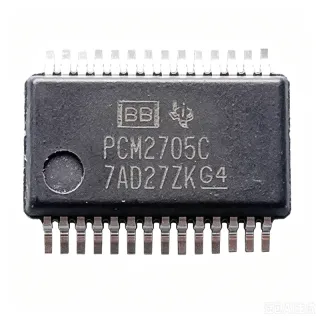
PCM3794RHB - Low-Power Stereo Audio Codec w/ HP Amp | Texas Instruments
부품 번호: PCM3794RHB ✓ 활성PCM3794RHB 개요
An audio codec is a mixed-signal integrated circuit that converts analog audio signals into a digital bitstream for transmission or storage and converts digital audio data back into analog voltage for playback. The codec hierarchy runs from audio codec, to sound converter, to interface IC, to integrated circuit, and finally to semiconductor. Placing the converter, digital filters, and headphone output stage in a single package shortens the analog path, reduces board area, and lowers system cost in handsets, portable audio, and networked voice terminals.
The PCM3794 differentiates itself mainly through its analog output stage. Instead of driving headphones through an external discrete amplifier, the device provides an on-chip headphone amplifier, which removes the need for a separate output buffer and the associated EMI filtering. The integrated notch filters remove DC and low-frequency hum before the signal reaches the headphone driver, while the ALC function automatically adjusts gain during level changes so recordings stay consistent without manual gain rides. The 3D effect stage adds a simple spatial widening to the stereo image for playback enhancement.
The PCM3794 communicates with a host processor over a serial audio bus, and distributor records describe the part as a 16-bit serial stereo audio interface. Because the conversion, filtering and headphone functions sit behind one serial interface, the host only needs an audio port, a few control registers, and a compact passives network around the analog pins. The 32-pin VQFN footprint keeps the layout small enough for handset and dongle form factors where board area is tightly constrained.
Typical deployments include voice-over-IP terminals, USB and Bluetooth audio dongles, portable media players, smart speaker front ends, VoIP handsets and industrial call-box modules. In each case the codec reduces the number of external active components and keeps the analog output path short, which helps limit board noise coupling into the microphone and headphone loops.
When laying out a design around the PCM3794RHB, keep the analog supply decoupling close to the device, place input and output capacitors on the shortest possible traces, and route the digital interface signals away from the microphone and headphone nets. Confirm the exposed-pad connection and thermal requirements against the manufacturer datasheet before committing to a high-temperature operation in a sealed enclosure.
드롭인 대체품: PCM3794RHB — 동일 패키지, 핀 호환. PCB 재작업이 필요한 다른 패키지 부품은 제외됩니다.
PCM3793RHB
✅ 드롭인 ⚠️ 사양 미검증📋 참조 대체품 (카탈로그에 없음)
PCM3792RHB
✅ 드롭인 ⚠️ 사양 미검증📋 참조 대체품 (카탈로그에 없음)
PCM1794RHB
✅ 드롭인 ⚠️ 사양 미검증📋 참조 대체품 (카탈로그에 없음)
PCM1795RHB
✅ 드롭인 ⚠️ 사양 미검증📋 참조 대체품 (카탈로그에 없음)
PCM1792RHB
✅ 드롭인 ⚠️ 사양 미검증📋 참조 대체품 (카탈로그에 없음)
PCM3794RHB 사양
| Manufacturer | Texas Instruments |
| Device Type | Stereo Audio Codec with Headphone Amplifier |
| 카테고리 | Integrated Circuits > Interface ICs > Audio Codecs |
| 패키지 | 32-pin VQFN (RHB), 5 x 5 mm |
| 핀 수 | 32 pins |
| 실장 유형 | Surface Mount |
| Serial Interface | 16-bit serial audio interface |
| Integrated Features | Headphone amplifier, notch filters, ALC, 3D effects |
| Number of Functions | 1 function, stereo |
| RoHS 상태 | Not applicable (per distributor product record) |
| Manufacturer Product Page | https://www.ti.com/product/PCM3794 |
PCM3794RHB 32-pin vqfn (rhb), 5 x 5 mm 핀 구성 가이드
PCM3794RHB(32-pin vqfn (rhb), 5 x 5 mm 패키지)의 핀 구성입니다. 핀 번호, 기능, 연결 다이어그램은 제조사 데이터시트에 정의되어 있습니다. 정확한 풋프린트와 솔더링 지침은 해당 문서를 참조하십시오.

다음에 대한 상세 핀아웃 데이터 없음: PCM3794RHB.
다음을 참조하십시오: 데이터시트 전체 핀 구성은 다음을 참조하십시오.
일반적인 애플리케이션
PCM3794RHB 적합 용도: 6 애플리케이션s: Voice-over-IP Terminal and Handset, USB and Bluetooth Audio Dongle, Portable Media Player and Headphone Amplifier, Smart Speaker and Voice Assistant Front End, Industrial Call Box and Intercom Station, Audio Interface and Sound Card Add-On.
Voice-over-IP Terminal and Handset
The PCM3794RHB suits VoIP terminals because it consolidates the microphone capture path, the digital serial audio link to the network processor, and the headphone output stage into a single 32-pin VQFN (RHB) device. Its ALC function keeps the transmit level stable while the user speaks at varying distances from the microphone, which removes the need for a discrete level control circuit. The 3D effect stage adds spatial width on the receive side without external DSP. Keeping the analog path inside one package also shortens the trace run to the handset connector, which limits EMI pickup on the microphone bias and headset lines in a densely packed handset PCB.
추천
USB and Bluetooth Audio Dongle
For a compact dongle, board area and quiescent power dominate the design, and the PCM3794RHB delivers capture and playback in one 32-pin VQFN (RHB) footprint rather than a codec plus an output buffer. The integrated headphone amplifier drives the output stage directly, so the dongle needs only a handful of passive components around the analog pins and no separate output filter network. Texas Instruments markets the part as a very low-power CODEC, which helps keep battery drain acceptable when the dongle is idle between playback bursts, and the notch filters suppress DC offset that would otherwise waste headphone output headroom.
추천
Portable Media Player and Headphone Amplifier
The PCM3794RHB works well in portable players where the headphone stage is the last active block before the connector and every milliamp matters. Because the headphone amplifier is on-chip, the signal path from the digital input to the headphone output avoids an external op-amp stage, which reduces both quiescent current and the chance of distortion at low listening levels. The 3D effect block provides a simple spatial enhancement for the headphone playback path, while the notch filters keep low-frequency rumble and DC out of the earphone driver, protecting it from excessive excursion.
추천
Smart Speaker and Voice Assistant Front End
In a smart speaker front end, the codec must handle a far-field microphone array and drive a speaker or line output, and the PCM3794RHB provides a compact stereo capture and playback solution in a single 32-pin VQFN (RHB) package. The ALC keeps the wake-word and command capture levels consistent regardless of how close the user stands to the device, which is important for reliable automatic speech recognition downstream. The on-chip notch filtering removes offset and hum before conversion, and the small package leaves board area around the microphone array and the speaker amplifier for a more complete acoustic design.
추천
Industrial Call Box and Intercom Station
Industrial call boxes and intercom stations operate from a single low-voltage rail with a 24 V or 48 V line interface, and the PCM3794RHB provides the audio half of that interface in a compact package. The device handles the microphone preamp path, digital transport of the voice channel, and headphone or line monitoring output, so the board needs only one audio IC plus the line interface components. The ALC feature is particularly valuable in hands-free installations where the user distance varies widely, and the 32-pin VQFN (RHB) outline allows a small, sealed control panel with a short microphone trace to limit hum pickup in a metal enclosure.
추천
Audio Interface and Sound Card Add-On
A sound card or audio interface add-on built around the PCM3794RHB benefits from the single-package codec-plus-headphone-amplifier arrangement, since the board outline of the design is set by the connectors rather than by a chain of separate converter chips. The device captures a line or microphone input, transports it digitally to the host over the serial audio interface, and simultaneously drives the monitoring output, so the design can present a headphone monitor jack alongside the line input. The 3D effect stage gives a headphone monitoring option that many sound cards otherwise implement with additional DSP, and the small QFN footprint keeps the analog routing short and predictable.
추천
추천 제품 요약
엔지니어링 참조 데이터: PCM3794RHB — 비교, 설계 지침 및 규정 준수 정보.
선택 가이드
대체품과의 비교
| 파라미터 | 이 제품 | PCM3793RHB | PCM3792RHB | PCM1794RHB | PCM1795RHB | PCM1792RHB |
|---|---|---|---|---|---|---|
| Package | VQFN-32 (RHB), 5 x 5 mm | VQFN-32 (RHB) - same | VQFN-32 (RHB) - same | VQFN-32 (RHB) - same | VQFN-32 (RHB) - same | VQFN-32 (RHB) - same |
| Brand | Texas Instruments | Texas Instruments | Texas Instruments | Texas Instruments | Texas Instruments | Texas Instruments |
| Device Type | Stereo audio codec with headphone amplifier | Stereo audio codec with headphone amplifier | Stereo audio codec with headphone amplifier | Stereo DAC only, no ADC | Stereo DAC only, no ADC | Stereo DAC only, no ADC |
| Analog Capture (ADC) | Yes, single-ended stereo input path | Yes | Yes | No | No | No |
| Integrated Headphone Amplifier | Yes | Yes | Yes | No, external amplifier required | No, external amplifier required | No, external amplifier required |
| ALC (Automatic Level Control) | Yes | Yes | Reduced feature set | No | No | No |
| Notch Filters and 3D Effects | Yes, both included | Yes, both included | Reduced feature set | No | No | No |
| Serial Audio Interface | 16-bit serial audio interface | 16-bit serial audio interface | 16-bit serial audio interface | 16-bit serial audio interface | 16-bit serial audio interface | 16-bit serial audio interface |
| Power Class | Very low-power stereo codec | Very low-power stereo codec | Very low-power stereo codec | Low-power stereo DAC | Low-power stereo DAC | Low-power stereo DAC |
| Board Change Required | Reference design | None, pin-to-pin in same footprint | None, pin-to-pin in same footprint | None in footprint, but ADC and headphone path unused | None in footprint, but ADC and headphone path unused | None in footprint, but ADC and headphone path unused |
주요 차별점
- Integrated headphone amplifier removes an external output stage (vs PCM1794RHB)
- Full capture path with automatic level control in a single package (vs PCM1795RHB)
- Closest same-footprint functional sibling for firmware-compatible reuse (vs PCM3792RHB)
- Single IC replaces codec plus external headphone buffer (vs Discrete codec plus discrete output amplifier)
설계 노트
Place the analog supply decoupling capacitors directly adjacent to the device supply pins, and route the analog ground return to the same ground reference used by the headphone output stage. On a QFN layout, the exposed pad must be connected to the ground plane with a full array of vias rather than a single thermal spoke, because the pad carries both the return path and the heat. Keep the microphone input traces short and away from the digital serial interface and from the switching node of any nearby converter.
Do not assume a DAC-only pin-compatible part can substitute for this codec: the PCM179x family devices have no ADC and no integrated headphone amplifier, so a microphone input in the original design disappears after the swap and an external output amplifier must be added. Conversely, when the PCM3793RHB or PCM3792RHB is used instead, re-check the register map, the external component values around the analog pins and the effect block configuration, because the feature set and recommended values differ from the PCM3794.
The serial audio interface between the codec and the host is a clocked digital link, so route it as a short, continuous, impedance-controlled trace with a continuous reference plane underneath, and avoid routing it parallel to the headphone output traces. Keep the analog input nets on the opposite side of the board from the interface pins where the layout allows, and provide local return paths so the headphone current loop does not share copper with the microphone bias path. A solid ground pour under the analog section helps reject the switching noise that a nearby converter injects into the board.
Estimated: with an analog supply of 5 V and a 3.3 V digital rail, and an average headphone load that draws roughly 10 mA per channel, the analog path dissipation is on the order of 50 mW plus the device bias current, which the QFN package can shed without external heat sinking in normal ambient conditions. Verify against the datasheet current figures and the maximum headphone output power your design requires, since raising the output power into lower-impedance headphones increases dissipation and reduces the available headroom for the ALC and 3D processing stages.
규정 준수 정보
A distributor product record lists RoHS status as not applicable for this telecom interface IC; RoHS, REACH, lead-free, halogen-free and conflict-minerals declarations for the exact PCM3794RHB suffix were not located in the product information, so they are recorded as unknown rather than assumed.