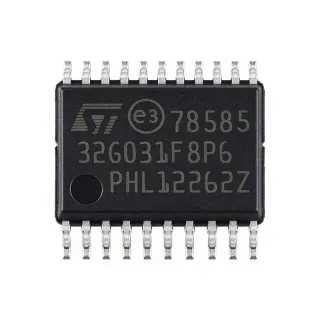
STM8L151F3P3 - 16MHz 8KB Flash MCU | STMicroelectronics
부품 번호: STM8L151F3P3 ✓ 활성| 수량 | 단가 | 합계 |
|---|---|---|
| 1 | $18.0667 | $18.07 |
| 10 | $17.5 | $175.00 |
| 100 | $15.8 | $1,580.00 |
| 500 | $13.9 | $6,950.00 |
| 1,000 | $12.5 | $12,500.00 |
STM8L151F3P3 개요
What is an ultra-low-power microcontroller? An MCU integrates a processor, programmable memory, peripherals, and I/O on one semiconductor device. The STM8L family is designed for energy-efficient embedded control, where the system may spend substantial time in low-power states between sensor readings, user actions, or communications. In the hierarchy of electronic components, an MCU is a semiconductor, a microcontroller, and an embedded processing device used for control and automation.
The verified device information identifies an enhanced STM8 CPU core capable of up to 16 MIPS at 16 MHz, 8 KB Flash organized as 8K x 8, and 1 KB of RAM as indicated by the comparison data. The 20-pin TSSOP package supports surface-mount assembly and is specified for an operating supply of 1.8 V to 3.6 V. The MCU is positioned for low-power embedded control rather than high-performance computing, providing a balanced combination of processing speed, memory, and compact packaging.
The STM8L151F3P3 can be used in sensor nodes, battery-powered instruments, simple industrial controls, consumer accessories, and low-power monitoring systems. Its 8-bit architecture is appropriate for sequential control, parameter reading, state management, and communication tasks where application complexity does not require a larger processor. Its TSSOP-20 package is also useful when a design needs a modest pin count and a conventional leaded surface-mount footprint.
When designing a board around the STM8L151F3P3, verify the exact pin assignments and peripheral multiplexing in the manufacturer datasheet before finalizing the PCB. Provide stable decoupling near the power pins, confirm the clock and reset requirements, and account for the 1.8 V to 3.6 V supply range. Firmware should also be tested across the intended temperature, voltage, and low-power operating conditions.
This product page combines the verified manufacturer and distributor information with practical sourcing, comparison, and design guidance. Pricing and availability should be checked with authorized distributors, while the manufacturer datasheet remains the controlling reference for electrical limits, pinout, memory behavior, and peripheral operation.
드롭인 대체품: STM8L151F3P3 — 동일 패키지, 핀 호환. PCB 재작업이 필요한 다른 패키지 부품은 제외됩니다.
이 시리즈의 변형
다음과 드롭인 호환되는 동일 시리즈 모델: STM8L151F3P3 (동일 폼 팩터 및 풋프린트) — 차이점: RoHS Status, Communication Interfaces, Core, Data EEPROM, Package.
빠른 비교 도구 — 나란히 비교할 대체 부품을 선택하십시오:
STM8L101F3P3
✅ 드롭인📋 참조 대체품 (카탈로그에 없음)
STM8L151F3P6
✅ 드롭인✓ 재고 있음
가격 문의
데이터시트 보기 →STM8S003F3P6
✅ 드롭인✓ 재고 있음
$0.36 / 개
데이터시트 보기 →STM8S103F3P6
✅ 드롭인✓ 재고 있음
$0.92 / 개
데이터시트 보기 →STM8L001J3M3
✅ 드롭인✓ 재고 있음
$0.49 / 개
데이터시트 보기 →STM8L151F3P3 최대 정격 & 전기적 특성
| Product Type | 8-bit ultra-low-power microcontroller |
| Series | STM8L EnergyLite |
| CPU Core | Enhanced STM8 core |
| Maximum Clock Speed | 16 MHz |
| Maximum Processing Performance | Up to 16 MIPS at 16 MHz |
| Flash Memory | 8 KB (8K x 8) |
| RAM Memory | 1 KB |
| Supply Voltage Range | 1.8 V to 3.6 V |
| 패키지 | 20-pin TSSOP |
| 실장 유형 | Surface Mount |
| I/O Ports | 41 |
| Program Memory Type | Flash |
| Data Memory | 1 KB RAM |
| Nominal Supply | 2.5 V or 3.3 V application supply |
| Lifecycle Stage | Active |
| RoHS 상태 | Unknown |
| REACH Status | Unknown |
| AEC-Q100 Qualification | Not applicable |
STM8L151F3P3 20-pin tssop 핀 구성 가이드
STM8L151F3P3(20-pin tssop 패키지)의 핀 구성입니다. 이 디지털 IC에는 GPIO, 통신 인터페이스(UART, SPI, I2C), 전원 핀이 포함되어 있습니다. 대체 핀 기능과 구성 옵션은 제조사 데이터시트를 참조하십시오. 임베디드 시스템 설계와 PCB 레이아웃에 필수적입니다.

다음에 대한 상세 핀아웃 데이터 없음: STM8L151F3P3.
다음을 참조하십시오: 데이터시트 전체 핀 구성은 다음을 참조하십시오.
일반적인 애플리케이션
STM8L151F3P3 적합 용도: 6 애플리케이션s: Battery-Powered Sensor Node, Low-Power Environmental Monitor, Battery-Powered Smart Lock, Compact Industrial Control Module, Low-Power Consumer Accessory, Low-Power Data Acquisition Front End.
Battery-Powered Sensor Node
The STM8L151F3P3 fits battery-powered sensor nodes because it combines a 16 MHz enhanced STM8 core with a 1.8 V to 3.6 V supply range and STM8L EnergyLite positioning. It can sample a sensor, apply threshold logic, and manage a low-power duty cycle without requiring a larger processor. The 8 KB Flash capacity is sufficient for compact firmware, while 1 KB RAM supports small working buffers. Designers should pair the MCU with a low-quiescent-current regulator and use the device’s low-power modes to reduce energy use between measurements.
추천
Low-Power Environmental Monitor
For environmental monitoring, the STM8L151F3P3 can supervise periodic readings from temperature, humidity, or gas sensors and decide when to activate a communications interval. Its 8-bit architecture is appropriate for sequential acquisition and control tasks, while the 20-pin TSSOP package helps keep compact boards manageable. A key design consideration is keeping the MCU and sensor rails within the 1.8 V to 3.6 V range. Use low-leakage input protection and verify peripheral timing before entering long idle periods.
추천
Battery-Powered Smart Lock
The STM8L151F3P3 is suitable for battery-powered access-control products such as electronic locks, keypad controllers, and compact door interfaces. The MCU can scan inputs, evaluate credentials locally, drive a display or indicator, and remain inactive between user events. The 16 MHz clock provides sufficient control headroom for debouncing and state-machine logic, while the STM8L low-power positioning can help reduce standby consumption. Validate actuator drive levels separately because the MCU should not directly supply high-current loads.
추천
Compact Industrial Control Module
The STM8L151F3P3 can serve as the local controller in a small industrial module with pushbuttons, indicator LEDs, status inputs, and a low-speed serial interface. Its 8 KB Flash and 1 KB RAM are suitable for a focused control application rather than a large user interface or data-processing workload. The 20-pin TSSOP package is practical for compact assemblies and can coexist with external drivers when the MCU is not expected to power loads directly. Use galvanic isolation, surge protection, and proper grounding where the module connects to external wiring.
추천
Low-Power Consumer Accessory
STM8L151F3P3 is appropriate for compact consumer accessories that need local button handling, LED indication, simple timing, and battery-conscious behavior. The MCU can implement product state machines without the overhead of a high-power processor, and its 20-pin TSSOP package supports a compact assembly. Firmware can use timers and low-power states to reduce energy consumption, but the final battery-life result depends on display load, switch bounce, wireless activity, and regulator standby current. Validate the complete accessory rather than relying on MCU specifications alone.
추천
Low-Power Data Acquisition Front End
The STM8L151F3P3 can manage a small, low-rate data-acquisition front end when the application requires sequencing, filtering, thresholding, and compact storage rather than high-throughput conversion. Its 8-bit STM8 core handles control flow efficiently, and the 1.8 V to 3.6 V supply range supports low-voltage sensor systems. The 8 KB Flash limit should be checked against the acquisition firmware, while external storage can be added if required. Keep analog front-end layout separate from switching and high-current paths to reduce measurement disturbance.
추천
추천 제품 요약
엔지니어링 참조 데이터: STM8L151F3P3 — 비교, 설계 지침 및 규정 준수 정보.
선택 가이드
대체품과의 비교
| 파라미터 | 이 제품 | STM8L101F3P3 | STM8L151F3P6 | STM8S003F3P6 | STM8S103F3P6 | STM8L001J3M3 |
|---|---|---|---|---|---|---|
| Brand | STMicroelectronics | STMicroelectronics | STMicroelectronics | STMicroelectronics | STMicroelectronics | STMicroelectronics |
| CPU Architecture | 8-bit STM8 enhanced core | 8-bit STM8 core | 8-bit STM8 core | 8-bit STM8 core | 8-bit STM8 core | 8-bit STM8 core |
| Low-Power Positioning | STM8L EnergyLite ultra-low-power MCU | STM8L low-power family | STM8L151F3 family | STM8S series | STM8S series | STM8L low-power family |
주요 차별점
- Specified STM8L EnergyLite positioning (vs STM8S003F3P6)
- 16 MHz enhanced STM8 core (vs STM8L101F3P3)
- Verified 8 KB Flash and 1 KB RAM configuration (vs STM8L001J3M3)
- 20-pin TSSOP package alignment (vs STM8S103F3P6)
설계 노트
Design the power tree around the verified 1.8 V to 3.6 V STM8L151F3P3 supply range. Place the required bypass capacitors close to the device power pins and confirm that the regulator has adequate transient response for peripherals. If the design uses a low-power battery source, estimate standby current from the MCU mode selection, pull states, external leakage, and regulator quiescent current; the MCU datasheet alone does not determine total system sleep current.
Use the exact 20-pin TSSOP footprint and verify pin 1 orientation against the manufacturer package drawing before routing. Keep clock, reset, and decoupling connections short, and avoid placing noisy switching paths beside sensitive input pins. Because the supplied results identify a TSSOP-20 package but do not provide the complete pin table in the prompt, do not infer alternate-function assignments from generic STM8 documentation; cross-check them against the exact STM8L151F3 datasheet.
Do not treat STM8L101F3P3, STM8S003F3P6, or other TSSOP-20 MCUs as drop-in replacements based on package similarity alone. A valid substitution must match pin mapping, power pins, reset and clock behavior, I/O levels, memory needs, peripheral assignments, and firmware assumptions. The verified cross-reference results identify comparison candidates but do not establish complete pin-to-pin equivalence, so perform a board-level validation before committing to a replacement.
For battery-operated products, calculate the energy budget from the average current and duty cycle rather than from the 16 MHz clock rating. Estimated: if the active state consumes one current level and the sleep state consumes another, use the weighted average Iavg = active_current × active_duty_cycle + sleep_current × sleep_duty_cycle. Then multiply Iavg by the average supply voltage and runtime to estimate battery consumption. Actual numbers must be measured because the supplied data does not include active or sleep current.
규정 준수 정보
The supplied verified product and distributor snippets do not state RoHS, REACH, lead-free, halogen-free, conflict-minerals, or automotive qualification status. Obtain current STMicroelectronics material-compliance documentation before regulatory release.