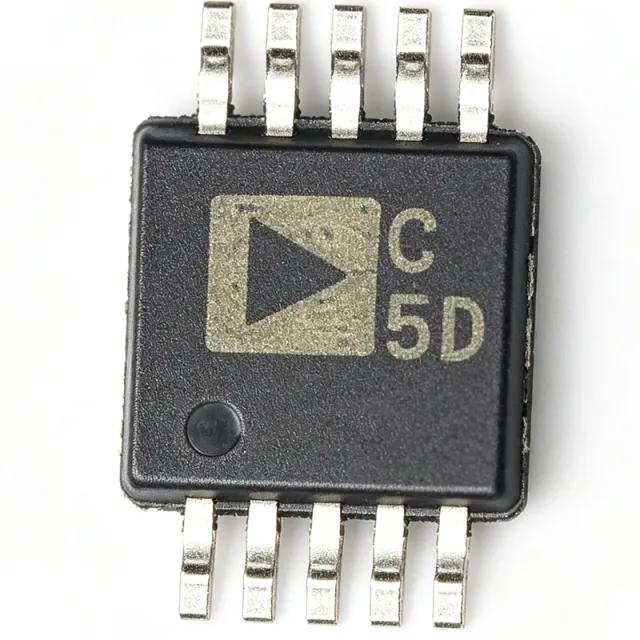
AD7980BRMZ - 16-Bit 1 MSPS PulSAR ADC | Analog Devices
MPN: AD7980BRMZ ✓ Active| Qty | Unit Price | Extended |
|---|---|---|
| 1 | $28.9091 | $28.91 |
| 10 | $20.8788 | $208.79 |
| 100 | $18.4697 | $1,846.97 |
| 500 | $17.6667 | $8,833.35 |
| 1,000 | $16.8636 | $16,863.60 |
AD7980BRMZ Overview
A SAR ADC is an analog-to-digital converter that determines the output code using a binary-search algorithm, comparing the held input against a DAC output one bit at a time. SAR ADCs balance resolution, speed, power, and small size, making them a common choice in precision data acquisition systems. Within the converter hierarchy, the AD7980 is a PulSAR ADC, a proprietary Analog Devices architecture optimized for low power and high accuracy. It sits in the broader signal-chain hierarchy of sensor → signal conditioning → ADC → digital host.
Key features include 16-bit resolution with no missing codes, maximum INL of ±1.25 LSB, and a throughput of 1 MSPS. The device supports a pseudo-differential input for common-mode noise rejection, an external reference for flexible full-scale range selection, and a 3-wire SPI interface with daisy-chain capability and an optional BUSY indicator. The digital interface is compatible with 1.8 V to 5 V logic families, easing connection to a wide range of microcontrollers and FPGAs.
Architecturally, the AD7980 uses an internal capacitor DAC and low-power comparator to achieve fast conversion while maintaining excellent linearity. Power dissipation scales linearly with throughput, which is advantageous in battery-powered and duty-cycled systems. The small 10-MSOP package and exposed pad provide space savings and flexible layout options for dense printed-circuit boards.
Typical applications include industrial control, medical instrumentation, automated test equipment, precision sensor signal chains, and PLC analog input modules. The combination of 16-bit resolution, 1 MSPS speed, low power, and an SPI interface makes it suitable for multichannel systems where small board area is required. Designers should provide a low-impedance reference source, a driver amplifier with adequate settling time, and careful decoupling on VDD and VIO for best performance.
Drop-in alternatives for AD7980BRMZ — same package, pin-to-pin compatible. Different-package parts requiring PCB rework are excluded.
Variants in this series
Same-series models that are drop-in compatible with AD7980BRMZ (same form factor and footprint) — differing in Architecture, Package, Resolution, Sampling Rate, Interface.
Quick Comparison Tool — Select alternative parts for side-by-side comparison:
AD7980BCPZ-RL7
✓ In Stock
$18 / Unit
View Datasheet →AD7980ACPZ-RL7
✓ In Stock
$8.1 / Unit
View Datasheet →AD7980BRMZRL7
✓ In Stock
$10.75 / Unit
View Datasheet →AD7690BRMZ-RL7
✓ In Stock
$17.6 / Unit
View Datasheet →AD7982BRMZ
📋 Reference alternative (not in catalog)
AD7691BRMZ
📋 Reference alternative (not in catalog)
AD7980BRMZ Maximum Ratings & Electrical Characteristics
| Resolution | 16 bits |
| Throughput | 1 MSPS |
| Architecture | SAR (PulSAR) |
| Number of Inputs | 1 |
| Input Type | Pseudo-differential |
| Analog Input Range | 0 V to VREF |
| Reference Voltage | External, independent of VDD |
| INL (Typical) | ±0.6 LSB |
| INL (Maximum) | ±1.25 LSB |
| Digital Interface | SPI-compatible, 3-wire, daisy-chain capable |
| Logic Compatibility | 1.8 V to 5 V |
| Package | 10-lead MSOP |
| RoHS Status | Compliant (ROHS3) |
| MSL Level | 1 (Unlimited) |
AD7980BRMZ Pin Configuration
| Pin 1 | IN+ — Positive analog input |
| Pin 2 | IN- — Negative analog input (pseudo-differential) |
| Pin 3 | GND — Ground |
| Pin 4 | VIO — Digital interface supply |
| Pin 5 | SDI — Serial data input (for daisy-chain) |
| Pin 6 | SCK — Serial clock input |
| Pin 7 | SDO — Serial data output |
| Pin 8 | CNV — Convert input (start conversion) |
| Pin 9 | VDD — Power supply |
| Pin 10 | REF — Reference voltage input |
Typical Applications
AD7980BRMZ is suitable for 6 applications: Industrial Control, Medical Instrumentation, Automated Test Equipment, Precision Sensor Signal Chains, PLC Analog Input Modules, Data Acquisition Systems.
Industrial Control
The AD7980BRMZ is ideal for industrial control systems requiring high-speed, high-resolution analog-to-digital conversion. Its 16-bit resolution and 1 MSPS throughput enable precise monitoring of process variables such as voltage, current, and temperature. The pseudo-differential input rejects common-mode noise, ensuring accurate readings in electrically noisy factory environments. The SPI interface simplifies connection to industrial microcontrollers and PLCs, while the small MSOP package saves board space in dense control panels. Power scaling with throughput allows energy-efficient operation in always-on monitoring systems.
Recommended
Medical Instrumentation
In medical instrumentation, the AD7980BRMZ provides the precision and speed needed for diagnostic equipment such as patient monitors, imaging systems, and laboratory analyzers. Its 16-bit resolution ensures accurate representation of biological signals, while the 1 MSPS throughput captures fast transients. The low power dissipation is critical for portable and battery-operated medical devices. The external reference allows calibration to specific measurement ranges, and the SPI interface integrates seamlessly with medical-grade microcontrollers. The compact MSOP package is suitable for miniaturized medical probes and wearable sensors.
Recommended
Automated Test Equipment
The AD7980BRMZ is well-suited for automated test equipment (ATE) that requires fast, accurate measurements across multiple channels. Its 1 MSPS throughput enables high-speed data acquisition, reducing test time and increasing throughput. The 16-bit resolution provides the accuracy needed for validating electronic components and systems. The daisy-chain capability allows multiple ADCs to share a single SPI bus, simplifying wiring in multi-channel test systems. The external reference supports precise full-scale calibration, and the small package enables dense channel density on test boards.
Recommended
Precision Sensor Signal Chains
The AD7980BRMZ excels in precision sensor signal chains, converting analog sensor outputs into digital data with high accuracy. Its 16-bit resolution and low INL (±1.25 LSB max) preserve sensor linearity, while the pseudo-differential input rejects common-mode interference from long sensor leads. The external reference allows the full-scale range to match the sensor output, maximizing dynamic range. The SPI interface connects directly to microcontrollers or FPGAs, and the low power consumption is ideal for battery-powered sensors. The compact MSOP package fits into space-constrained sensor modules.
Recommended
PLC Analog Input Modules
The AD7980BRMZ is a key component in PLC analog input modules, converting analog field signals (e.g., 4-20 mA, 0-10 V) into digital values for processing. Its 16-bit resolution provides high measurement accuracy, and the 1 MSPS throughput supports fast update rates for real-time control. The pseudo-differential input rejects common-mode noise from industrial environments, ensuring reliable readings. The SPI interface allows easy integration with PLC backplanes, and the small MSOP package enables high channel density. Power scaling with throughput helps manage thermal dissipation in multi-channel modules.
Recommended
Data Acquisition Systems
The AD7980BRMZ is a versatile building block for general-purpose data acquisition systems, offering a balance of speed, resolution, and power. Its 1 MSPS throughput captures dynamic signals, while 16-bit resolution ensures high fidelity. The external reference allows customization of the input range, and the SPI interface supports daisy-chaining for multi-channel systems. The low power dissipation is beneficial for portable DAQ devices. The compact MSOP package is easy to integrate into custom PCBs, and the device's robustness makes it suitable for both laboratory and field applications.
Recommended
Recommended Products Summary
Engineering reference data for AD7980BRMZ — comparison, design guidance, and compliance information.
Selection Guide
Comparison with Alternatives
| Parameter | This Product | AD7980BCPZ-RL7 | AD7980ACPZ-RL7 | AD7980BRMZRL7 | AD7982BRMZ | AD7690BRMZ-RL7 | AD7691BRMZ |
|---|---|---|---|---|---|---|---|
| Package | 10-lead MSOP | 10-lead LFCSP | 10-lead LFCSP | 10-lead MSOP | 10-lead MSOP | 10-lead MSOP | 10-lead MSOP |
| Brand | Analog Devices | Analog Devices | Analog Devices | Analog Devices | Analog Devices | Analog Devices | Analog Devices |
| Resolution | 16 bits | 16 bits | 16 bits | 16 bits | 18 bits | 16 bits | 18 bits |
| Throughput | 1 MSPS | 1 MSPS | 1 MSPS | 1 MSPS | 1 MSPS | 400 kSPS | 250 kSPS |
| INL (Max) | ±1.25 LSB | ±1.25 LSB | ±1.25 LSB | ±1.25 LSB | ±2 LSB | ±1.5 LSB | ±2 LSB |
| Input Type | Pseudo-differential | Pseudo-differential | Pseudo-differential | Pseudo-differential | Pseudo-differential | Pseudo-differential | Pseudo-differential |
| Reference | External | External | External | External | External | External | External |
| Interface | SPI (3-wire) | SPI (3-wire) | SPI (3-wire) | SPI (3-wire) | SPI (3-wire) | SPI (3-wire) | SPI (3-wire) |
Key Differentiators
- Pin-for-pin compatible with 18-bit AD7982 (vs AD7982BRMZ)
- Higher throughput than AD7690 (vs AD7690BRMZ-RL7)
- Lower INL than AD7982 (vs AD7982BRMZ)
Design Notes
The AD7980BRMZ operates from a single VDD supply, but the reference voltage (REF) is applied externally and can be set independent of VDD. Ensure that the reference source has low output impedance and is properly decoupled with a 10 µF capacitor to maintain accuracy. The digital interface supply (VIO) should be decoupled with a 0.1 µF capacitor close to the pin.
For optimal performance, place the AD7980BRMZ close to the signal source and keep analog and digital grounds separate. Use a solid ground plane and avoid routing digital signals under the analog input pins. Decouple VDD and VIO with 0.1 µF capacitors placed as close as possible to the pins. The reference input should have a low-impedance path to the reference source.
A common pitfall is driving the analog input with a source that has insufficient settling time. The input must settle to 16-bit accuracy within the acquisition time. Use a driver amplifier with adequate bandwidth and low output impedance. Also, ensure the reference voltage is stable and noise-free, as it directly affects the full-scale accuracy.
Compliance Information
ROHS3 compliant, REACH unaffected, MSL 1 (Unlimited) per PartGenie data.