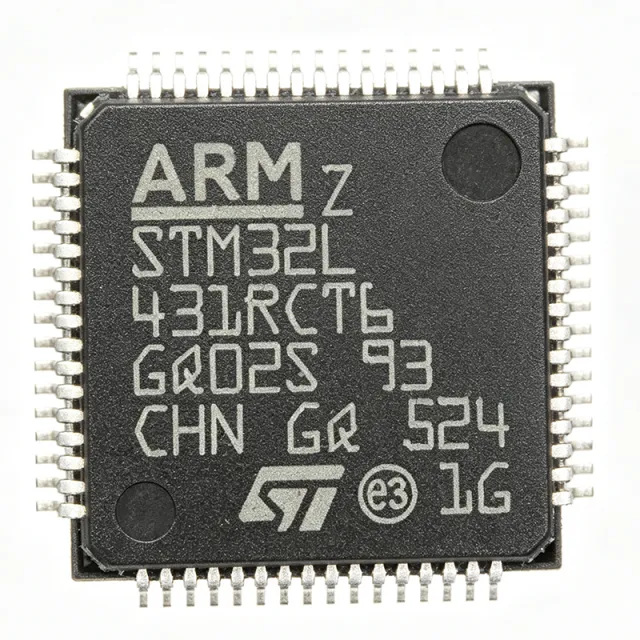
STM32L431RCT6 - Ultra-Low-Power Cortex-M4 MCU 80MHz 256KB Flash | STMicroelectronics
MPN: STM32L431RCT6 ✓ Active| Qty | Unit Price | Extended |
|---|---|---|
| 1 | $14.7273 | $14.73 |
| 10 | $10.6364 | $106.36 |
| 100 | $9.4091 | $940.91 |
| 500 | $9 | $4,500.00 |
| 960 | $8.5909 | $8,247.26 |
STM32L431RCT6 Overview
A microcontroller (MCU) is a compact integrated circuit designed to govern a specific operation in an embedded system. It contains a processor core, memory, and programmable input/output peripherals. The STM32L431RCT6 belongs to the STM32L4 family, which is part of the broader STM32 portfolio of 32-bit microcontrollers. These MCUs are widely used in industrial, consumer, and IoT applications where power efficiency and processing capability are critical. The Cortex-M4 core with FPU enables efficient digital signal processing and floating-point arithmetic, making it ideal for applications such as motor control, sensor fusion, and audio processing.
Key features of the STM32L431RCT6 include its ultra-low-power modes, which allow it to achieve very low power consumption in standby and sleep modes, extending battery life in portable devices. It also integrates a rich set of peripherals, including multiple USARTs, SPIs, I2Cs, ADCs, DACs, timers, and a real-time clock. The device supports a wide operating voltage range of 1.71V to 3.6V, making it compatible with standard battery chemistries. Additionally, it features a 12-bit ADC with up to 16 channels, a 12-bit DAC, and an operational amplifier, enabling analog signal processing without external components.
From a technical perspective, the STM32L431RCT6 leverages ST's advanced 90nm process technology, which contributes to its low power consumption and high performance. The core runs at up to 80 MHz, delivering 100 DMIPS (Dhrystone 2.1) performance. The device includes a memory protection unit (MPU) and a nested vectored interrupt controller (NVIC) for efficient interrupt handling. It also supports a wide range of communication interfaces, including USB 2.0 full-speed, CAN 2.0B, and SAI (serial audio interface), making it versatile for connectivity applications.
Typical applications for the STM32L431RCT6 include industrial sensors, smart meters, portable medical devices, and IoT nodes. Its low-power characteristics make it particularly well-suited for battery-powered devices that require long operational lifetimes. The device also supports a variety of development tools, including STM32CubeIDE, STM32CubeMX, and the STM32CubeL4 firmware package, which simplifies software development and reduces time-to-market.
When designing with the STM32L431RCT6, it is important to consider the power supply decoupling and PCB layout to ensure stable operation. The device requires a 100nF capacitor on each power pin and a 4.7uF capacitor on the main supply. Additionally, the VDDA pin should be connected to a clean analog supply to minimize noise in analog peripherals. Proper grounding and layout are essential to achieve the specified performance and low-power operation.
Drop-in alternatives for STM32L431RCT6 — same package, pin-to-pin compatible. Different-package parts requiring PCB rework are excluded.
Variants in this series
Same-series models that are drop-in compatible with STM32L431RCT6 (same form factor and footprint) — differing in ADC, Communication Interfaces, DAC, Operating Voltage, Package.
Quick Comparison Tool — Select alternative parts for side-by-side comparison:
STM32L431RCT6TR
📋 Reference alternative (not in catalog)
STM32L431RBT6
📋 Reference alternative (not in catalog)
STM32L431CCU6
📋 Reference alternative (not in catalog)
GD32F303RCT6
📋 Reference alternative (not in catalog)
APM32F407RCT6
📋 Reference alternative (not in catalog)
STM32L431RCT6 Maximum Ratings & Electrical Characteristics
| Core | ARM Cortex-M4 with FPU |
| Max Clock Frequency | 80 MHz |
| Flash Memory | 256 KB |
| SRAM | 64 KB |
| Package | 64-LQFP (10x10 mm) |
| Operating Voltage | 1.71V to 3.6V |
| Operating Temperature | -40C to +85C |
| ADC | 12-bit, up to 16 channels |
| DAC | 12-bit, 2 channels |
| Communication Interfaces | USART, SPI, I2C, USB 2.0 FS, CAN 2.0B, SAI |
| Timers | Multiple 16-bit and 32-bit timers |
| DMA | Yes, with 14 channels |
| Low-Power Modes | Sleep, Low-power run, Low-power sleep, Stop 0/1/2, Standby, Shutdown |
| RoHS | Compliant |
| REACH | Compliant |
| MSL Level | 3 |
STM32L431RCT6 Pin Configuration
| Pin 1 | VBAT — Backup battery supply |
| Pin 2 | PC13 — GPIO / RTC tamper |
| Pin 3 | PC14 — GPIO / OSC32_IN |
| Pin 4 | PC15 — GPIO / OSC32_OUT |
| Pin 5 | PF0 — GPIO / OSC_IN |
| Pin 6 | PF1 — GPIO / OSC_OUT |
| Pin 7 | NRST — Reset (active low) |
| Pin 8 | VSSA — Analog ground |
| Pin 9 | VDDA — Analog power supply |
| Pin 10 | PA0 — GPIO / ADC_IN0 |
| Pin 11 | PA1 — GPIO / ADC_IN1 |
| Pin 12 | PA2 — GPIO / USART2_TX |
| Pin 13 | PA3 — GPIO / USART2_RX |
| Pin 14 | PA4 — GPIO / DAC_OUT1 |
| Pin 15 | PA5 — GPIO / DAC_OUT2 |
| Pin 16 | PA6 — GPIO / SPI1_MISO |
| Pin 17 | PA7 — GPIO / SPI1_MOSI |
| Pin 18 | PB0 — GPIO / ADC_IN8 |
| Pin 19 | PB1 — GPIO / ADC_IN9 |
| Pin 20 | PB2 — GPIO / BOOT1 |
| Pin 21 | PB10 — GPIO / I2C2_SCL |
| Pin 22 | PB11 — GPIO / I2C2_SDA |
| Pin 23 | PB12 — GPIO / SPI2_NSS |
| Pin 24 | PB13 — GPIO / SPI2_SCK |
| Pin 25 | PB14 — GPIO / SPI2_MISO |
| Pin 26 | PB15 — GPIO / SPI2_MOSI |
| Pin 27 | PC6 — GPIO / TIM3_CH1 |
| Pin 28 | PC7 — GPIO / TIM3_CH2 |
| Pin 29 | PC8 — GPIO / TIM3_CH3 |
| Pin 30 | PC9 — GPIO / TIM3_CH4 |
| Pin 31 | PA8 — GPIO / TIM1_CH1 |
| Pin 32 | PA9 — GPIO / USART1_TX |
| Pin 33 | PA10 — GPIO / USART1_RX |
| Pin 34 | PA11 — GPIO / USB_DM |
| Pin 35 | PA12 — GPIO / USB_DP |
| Pin 36 | PA13 — SWDIO |
| Pin 37 | PA14 — SWCLK |
| Pin 38 | PA15 — GPIO / JTDI |
| Pin 39 | PB3 — GPIO / JTDO |
| Pin 40 | PB4 — GPIO / NJTRST |
| Pin 41 | PB5 — GPIO / I2C1_SMBA |
| Pin 42 | PB6 — GPIO / I2C1_SCL |
| Pin 43 | PB7 — GPIO / I2C1_SDA |
| Pin 44 | BOOT0 — Boot mode selection |
| Pin 45 | PB8 — GPIO / CAN_RX |
| Pin 46 | PB9 — GPIO / CAN_TX |
| Pin 47 | VSS — Ground |
| Pin 48 | VDD — Power supply |
| Pin 49 | PC10 — GPIO / USART3_TX |
| Pin 50 | PC11 — GPIO / USART3_RX |
| Pin 51 | PC12 — GPIO / USART3_CK |
| Pin 52 | PD2 — GPIO / TIM3_ETR |
| Pin 53 | PC0 — GPIO / ADC_IN10 |
| Pin 54 | PC1 — GPIO / ADC_IN11 |
| Pin 55 | PC2 — GPIO / ADC_IN12 |
| Pin 56 | PC3 — GPIO / ADC_IN13 |
| Pin 57 | PC4 — GPIO / ADC_IN14 |
| Pin 58 | PC5 — GPIO / ADC_IN15 |
| Pin 59 | PB8 — GPIO / CAN_RX |
| Pin 60 | PB9 — GPIO / CAN_TX |
| Pin 61 | VSS — Ground |
| Pin 62 | VDD — Power supply |
| Pin 63 | PD0 — GPIO / OSC_IN |
| Pin 64 | PD1 — GPIO / OSC_OUT |
Typical Applications
STM32L431RCT6 is suitable for 6 applications: Industrial Sensors, Smart Meters, Portable Medical Devices, IoT Nodes, Audio Processing, Motor Control.
Industrial Sensors
The STM32L431RCT6 is ideal for industrial sensors due to its ultra-low-power operation and rich analog peripherals. Its 12-bit ADC with up to 16 channels allows precise measurement of sensor signals, while the low-power modes enable battery-powered operation for remote monitoring. The device's 80 MHz Cortex-M4 core can handle sensor fusion algorithms, and its multiple communication interfaces (UART, SPI, I2C) facilitate data transmission to central controllers. In a typical industrial sensor node, the STM32L431RCT6 samples temperature, pressure, or vibration data, processes it locally, and transmits the results wirelessly or over a wired bus. The device's wide operating voltage range (1.71V to 3.6V) ensures compatibility with various power sources, and its robust design meets industrial temperature requirements (-40C to +85C).
Recommended
Smart Meters
The STM32L431RCT6 is well-suited for smart metering applications, including electricity, water, and gas meters. Its ultra-low-power modes allow the device to operate for years on a single battery, while its 256 KB Flash provides ample storage for metering firmware and data logging. The device's multiple timers and communication interfaces (UART, SPI, I2C) enable accurate measurement and remote data transmission. In a smart electricity meter, the STM32L431RCT6 reads current and voltage sensors, calculates energy consumption, and communicates via a wireless module or power line communication. The device's 12-bit ADC ensures accurate measurement, and its low-power RTC maintains timekeeping even in standby mode. The wide operating voltage range supports various battery chemistries, and the device's industrial temperature range ensures reliable operation in outdoor environments.
Recommended
Portable Medical Devices
The STM32L431RCT6 is an excellent choice for portable medical devices such as glucose monitors, pulse oximeters, and wearable health trackers. Its ultra-low-power consumption extends battery life, which is critical for continuous monitoring. The device's analog peripherals, including a 12-bit ADC and operational amplifier, enable precise biosignal acquisition. The Cortex-M4 core with FPU can run signal processing algorithms for heart rate or blood oxygen level calculation. In a pulse oximeter, the STM32L431RCT6 controls an LED driver, reads photodiode signals, and calculates SpO2 and heart rate. The device's small LQFP64 package fits compact designs, and its multiple communication interfaces allow data transfer to a smartphone via Bluetooth. The device's wide voltage range supports coin cell batteries, and its low-power modes ensure minimal current draw between measurements.
Recommended
IoT Nodes
The STM32L431RCT6 is a popular choice for IoT nodes due to its balance of performance and power efficiency. Its 80 MHz Cortex-M4 core can handle protocol stacks for Wi-Fi, Bluetooth, or LoRa, while its low-power modes allow battery-powered operation for months or years. The device's rich set of communication interfaces (USART, SPI, I2C, USB) enables connection to various sensors and wireless modules. In a typical IoT node, the STM32L431RCT6 collects sensor data, processes it, and transmits it to a gateway or cloud server. The device's 256 KB Flash provides ample space for application code and data logging, and its 64 KB SRAM supports complex applications. The device's wide operating voltage range and industrial temperature range make it suitable for outdoor deployments. Its low-power RTC and wake-up pins allow the device to sleep most of the time, waking only to take measurements and transmit data.
Recommended
Audio Processing
The STM32L431RCT6 is suitable for audio processing applications such as voice-controlled devices, audio recorders, and sound recognition systems. Its Cortex-M4 core with FPU provides sufficient processing power for audio codecs and DSP algorithms, while its SAI (serial audio interface) enables direct connection to audio codecs. The device's 12-bit ADC and DAC can be used for analog audio input and output. In a voice-controlled device, the STM32L431RCT6 captures audio from a microphone, processes it for keyword detection, and triggers actions. The device's low-power modes allow always-on listening with minimal power consumption. Its 256 KB Flash can store audio samples or recognition models, and its 64 KB SRAM supports real-time processing. The device's wide voltage range and small package make it suitable for portable audio devices.
Recommended
Motor Control
The STM32L431RCT6 is well-suited for motor control applications, including brushless DC (BLDC) motors, stepper motors, and servo motors. Its multiple timers with PWM outputs can generate precise control signals, and its 12-bit ADC can measure motor currents and voltages. The Cortex-M4 core with FPU can run complex control algorithms such as field-oriented control (FOC) for BLDC motors. In a typical motor control system, the STM32L431RCT6 reads position and current sensors, computes the control output, and drives the motor driver via PWM. The device's low-power modes are useful for battery-powered motor applications, and its wide voltage range supports various motor supply voltages. The device's industrial temperature range ensures reliable operation in harsh environments. Its rich set of communication interfaces allows connection to a host controller for parameter tuning and monitoring.
Recommended
Recommended Products Summary
Engineering reference data for STM32L431RCT6 — comparison, design guidance, and compliance information.
Selection Guide
Comparison with Alternatives
| Parameter | This Product | STM32L431RCT6TR | STM32L431RBT6 | GD32F303RCT6 | APM32F407RCT6 |
|---|---|---|---|---|---|
| Package | 64-LQFP (10x10 mm) | 64-LQFP (10x10 mm) - same | 64-LQFP (10x10 mm) - same | 64-LQFP (10x10 mm) - same | 64-LQFP (10x10 mm) - same |
| Brand | STMicroelectronics | STMicroelectronics | STMicroelectronics | GigaDevice | Geehy |
| Core | ARM Cortex-M4 with FPU | ARM Cortex-M4 with FPU | ARM Cortex-M4 with FPU | ARM Cortex-M4 with FPU | ARM Cortex-M4 with FPU |
| Max Clock Frequency | 80 MHz | 80 MHz | 80 MHz | 120 MHz | 168 MHz |
| Flash Memory | 256 KB | 256 KB | 128 KB | 256 KB | 256 KB |
| SRAM | 64 KB | 64 KB | 64 KB | 48 KB | 128 KB |
| Operating Voltage | 1.71V to 3.6V | 1.71V to 3.6V | 1.71V to 3.6V | 2.6V to 3.6V | 2.0V to 3.6V |
| Low-Power Modes | Sleep, Low-power run, Low-power sleep, Stop 0/1/2, Standby, Shutdown | Same as this product | Same as this product | Sleep, Stop, Standby | Sleep, Stop, Standby |
| Price (1 unit) | $4.85 | $4.85 | $4.20 | $2.50 | $3.00 |
Key Differentiators
- Ultra-low-power consumption with multiple low-power modes (vs GD32F303RCT6)
- Wide operating voltage range (1.71V to 3.6V) (vs GD32F303RCT6)
- Rich analog peripherals (12-bit ADC, 12-bit DAC, op-amp) (vs APM32F407RCT6)
Design Notes
Ensure proper decoupling: place a 100nF capacitor on each VDD pin and a 4.7uF capacitor on the main supply. The VDDA pin should be connected to a clean analog supply, with a 1uF capacitor to ground. For battery-powered designs, use the low-power modes effectively to minimize current consumption.
For the LQFP64 package, ensure adequate copper pour for thermal dissipation. The exposed pad (if present) should be soldered to a ground plane. Keep high-speed traces short and use proper grounding to minimize EMI. Follow ST's layout guidelines for the STM32L4 series.
Avoid exceeding the absolute maximum ratings, especially on VDDA and VBAT. Ensure the BOOT0 pin is correctly configured to select the desired boot mode. When using the ADC, ensure the sampling time is sufficient for the source impedance. Also, be aware of the device's power-on reset requirements.
Compliance Information
RoHS and REACH compliant per distributor listings. Not AEC-Q100 qualified. MSL level 3.


