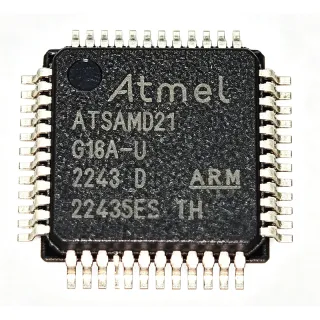
ATMXT540SXES-CCUR - maXTouch 540-Ch Touch Controller | Microchip
MPN: ATMXT540SXES-CCUR ✓ Active| Qty | Unit Price | Extended |
|---|---|---|
| 1 | $2.08 | $2.08 |
| 10 | $1.98 | $19.80 |
| 100 | $1.85 | $185.00 |
| 500 | $1.72 | $860.00 |
| 1,000 | $1.58 | $1,580.00 |
ATMXT540SXES-CCUR Overview
A capacitive touchscreen controller is a type of sensor interface IC that scans a grid of transparent electrodes (ITO pattern) on a touch sensor, measures mutual capacitance changes caused by finger proximity, and reports processed touch coordinates to a host processor. Within the system hierarchy, the touchscreen controller sits between the touch sensor panel and the application host, forming part of the human-machine interface (HMI) subsystem alongside displays, buttons, and gesture engines.
The ATMXT540SXES-CCUR is part of the maXTouch 540 series, engineered for multi-touch screens supporting standard touch and stylus use cases. Key family features typically include mutual-capacitance sensing, multi-touch reporting, noise-robust acquisition algorithms for charger and display noise immunity, and host communication over a serial interface (I2C/SPI per the maXTouch family convention). The '-CCUR' suffix denotes a specific pinout and packaging configuration in the XS pin-combination matrix of the maXTouch naming scheme.
Architecturally, maXTouch devices integrate an acquisition engine with programmable scan frequencies and filtering that suppresses interference from LCD displays and switching chargers, allowing reliable touch operation in electrically noisy environments. The integrated touch processing offloads touch detection and tracking from the host CPU, reducing host software complexity and latency.
Typical applications include smartphones, tablets, industrial HMI panels, automotive center-stack touchscreens, and smart appliance control surfaces where multi-touch capacitive sensing is required.
Design consideration: touchscreen controller selection must match both the sensor electrode pattern (TX/RX channel count) and the mechanical stack-up; verify the exact channel matrix and interface before footprint commitment. Refer to the official Microchip maXTouch configuration tools for sensor tuning.
This page synthesizes distributor availability, drop-in variant cross-references, and practical design guidance beyond the manufacturer datasheet.
Drop-in alternatives for ATMXT540SXES-CCUR — same package, pin-to-pin compatible. Different-package parts requiring PCB rework are excluded.
Quick Comparison Tool — Select alternative parts for side-by-side comparison:
ATMXT540SXES-CCU
✅ Drop-In📋 Reference alternative (not in catalog)
ATMXT540E-T
✅ Drop-In📋 Reference alternative (not in catalog)
ATMXT641T-ATR
✅ Drop-In📋 Reference alternative (not in catalog)
ATMXT616-Z2UR
✅ Drop-In📋 Reference alternative (not in catalog)
ATMXT540SXES-CCUR Maximum Ratings & Electrical Characteristics
| Manufacturer | Atmel (Microchip Technology) |
| Product Series | maXTouch 540 (mXT540S X-series) |
| Function | Capacitive touchscreen controller |
| Sensing Technology | Projected capacitive (mutual capacitance) |
| Touch Channels | 540 |
| Multi-Touch Support | Yes |
| Category | Integrated Circuits (ICs) - Sensor, Capacitive Touch |
| Packaging | Bulk |
| Mounting Type | Surface Mount |
ATMXT540SXES-CCUR standard Pin Configuration Guide
Pin configuration for ATMXT540SXES-CCUR (standard package). Pin numbering, functions, and connection diagrams are defined in the manufacturer datasheet. Refer to it for the exact footprint and soldering guidelines.

No detailed pinout data available for ATMXT540SXES-CCUR.
Refer to the datasheet for full pin configuration.
Typical Applications
ATMXT540SXES-CCUR is suitable for 6 applications: Smartphone and Tablet Touchscreens, Industrial HMI Touch Panels, Automotive Center-Stack Displays, Smart Appliance Control Surfaces, Point-of-Sale and Retail Terminals, Medical Device Interfaces.
Smartphone and Tablet Touchscreens
The ATMXT540SXES-CCUR provides 540-channel mutual-capacitance scanning suited to smartphone and tablet touch panels where multi-touch and fast report rates are mandatory. The maXTouch acquisition engine tracks multiple simultaneous fingers and reports processed coordinates over a serial host link, offloading the application processor. Its charger-noise rejection algorithms maintain accuracy while the device charges, a common failure point for lower-cost controllers. Placement of the controller close to the sensor flex tail minimizes sense-line capacitance; keep the scanning frequency configured away from display refresh harmonics to suppress coupling. The result is a responsive, drift-stable touch experience with low host CPU overhead.
Recommended
Industrial HMI Touch Panels
Industrial operator interfaces benefit from the maXTouch controller's noise-robust acquisition, which suppresses interference from switching power supplies, VFDs, and servo drives common on factory floors. With 540 sensing channels, the ATMXT540SXES-CCUR supports medium-to-large sensor matrices with multi-touch gestures such as pinch-zoom for SCADA screens. The object-based configuration memory lets designers retune sensitivity for gloved-hand operation or thick cover glass without hardware changes. Place the controller PCB away from high-current switching nodes and route sensor lines with ground guard traces; configure burst frequency to avoid industrial EMI bands. This yields reliable touch registration even in electromagnetically harsh cabinets.
Recommended
Automotive Center-Stack Displays
In-vehicle touchscreens demand immunity to alternator ripple, high-frequency switching chargers, and display drive noise - conditions the maXTouch X-series acquisition architecture was engineered to handle. The ATMXT540SXES-CCUR's programmable scan frequencies and filtering allow the sensor to coexist with an LCD panel in the same stack while preserving multi-touch responsiveness. Automotive designs should validate the specific temperature grade and qualification level of the chosen suffix against the vehicle program's requirements, since family members differ in grade. Mount the controller on the display board or sensor flex with short sense routing and configure frequency hopping to avoid AM radio and infotainment bands.
Recommended
Smart Appliance Control Surfaces
Refrigerators, ovens, washing machines, and HVAC controllers increasingly use capacitive touch panels behind glass or plastic covers. The ATMXT540SXES-CCUR supports thick-overlay sensing through its sensitivity configuration, enabling sleek sealed front panels that are easy to clean. Multi-touch support allows gesture shortcuts while water-tolerance tuning distinguishes a finger from droplets or a wet cloth. Designers should calibrate for the overlay dielectric constant and thickness, and enable the controller's water-rejection modes in humid environments. Placing the touch IC on a small PCB behind the overlay with guarded sense routing keeps parasitic capacitance low and thresholds stable across temperature swings.
Recommended
Point-of-Sale and Retail Terminals
POS terminals, kiosks, and receipt printers need durable glass-front touch interfaces that survive millions of actuations. The ATMXT540SXES-CCUR's mutual-capacitance design eliminates mechanical wear points, while its multi-touch engine supports signature capture and pinch gestures on modern payment screens. Charger-noise immunity is important because terminals frequently operate while plugged into assorted USB power adapters - a scenario where inferior controllers exhibit jitter. Configure the burst and hopping profile to avoid switching-frequency interference from the printer and wireless modules co-located in the terminal, and shield the sensor tail where it crosses the thermal-printer driver section for stable, glitch-free touch performance.
Recommended
Medical Device Interfaces
Medical monitors, infusion pumps, and diagnostic equipment use sealed capacitive touchscreens for infection control and reliable operation around disinfectants. The ATMXT540SXES-CCUR enables gloved-touch tuning via configuration objects, essential in clinical settings where operators wear nitrile gloves. Its deterministic touch processing reduces host-side latency so alarms and controls respond promptly. Medical designs must verify the suffix's qualification and temperature range against the device's regulatory requirements, and EMI emissions of the scan bursts must be characterized to meet medical EMC limits. Routing sense lines on inner layers with ground planes and using the controller's frequency-hopping modes helps satisfy both touch accuracy and EMC compliance.
Recommended
Recommended Products Summary
Engineering reference data for ATMXT540SXES-CCUR — comparison, design guidance, and compliance information.
Selection Guide
Comparison with Alternatives
| Parameter | This Product | ATMXT540SXES-CCU | ATMXT540E-T | ATMXT641T-ATR | ATMXT616-Z2UR |
|---|---|---|---|---|---|
| Brand | Microchip Technology (Atmel) | Microchip Technology (Atmel) | Microchip Technology (Atmel) | Microchip Technology (Atmel) | Microchip Technology (Atmel) |
| Series Generation | maXTouch X-series (mXT540S) | maXTouch X-series (mXT540S) | maXTouch E-series | maXTouch 641 series | maXTouch 616 series |
| Multi-Touch | Yes | Yes | Yes | Yes | Yes |
| Sensing Technology | Projected capacitive (mutual) | Projected capacitive (mutual) | Projected capacitive (mutual) | Projected capacitive (mutual) | Projected capacitive (mutual) |
| Drop-in Compatibility | Reference part | Pin-to-pin identical | Requires pinout verification | Requires pinout verification | Requires pinout verification |
Key Differentiators
- Newest X-series generation with modern noise algorithms (vs ATMXT540E-T)
- Exact die-level replacement availability (vs ATMXT540SXES-CCU)
- Larger channel matrix than smaller family parts (vs ATMXT616-Z2UR)
Design Notes
Place the touchscreen controller as close to the sensor flex-tail connector as possible. Sense (Y) lines carry high-impedance charge signals, so keep their routing short, on inner layers referenced to a solid ground plane, and away from display driver traces, backlight boost converters, and USB charger rails. Guard sense routing with ground traces and match the ground return of the controller's analog supply to the sensor shield electrode. Excessive sense-line capacitance reduces SNR and forces longer burst times, lowering the achievable report rate.
Configure the maXTouch burst/acquisition frequency to avoid harmonics of the LCD refresh rate and the charger's switching frequency. maXTouch X-series devices provide frequency-hopping and jitter algorithms in firmware configuration - enable them in environments with USB chargers or industrial inverters. Validate the configuration on the final mechanical stack-up (cover glass thickness and adhesive change the signal amplitude), not on the bare development sensor, because sensitivity thresholds tuned on a prototype often drift on the production stack.
Do not assume pin compatibility across maXTouch family suffixes: the -CCU/-CCUR pin combination is specific to the XS variant matrix, and E-series or 6xx-series parts use different ball maps and firmware objects. Always verify the exact pin-combination definition in the official Microchip maXTouch datasheet before committing a footprint. Additionally, when substituting ATMXT540SXES-CCU for the -CCUR reel version, confirm your pick-and-place supports the delivery format or request cut-tape service.
Compliance Information
Compliance status not stated in the retrieved web data; confirm via the official Microchip product page and material declarations.