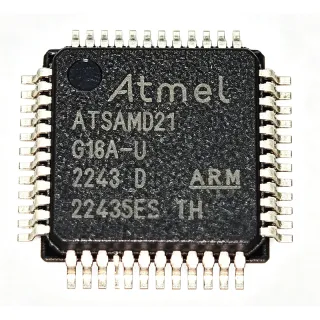
ATMXT1188S-CU - maXTouch 1188-Node Touch Controller | Microchip
MPN: ATMXT1188S-CU ✓ Active| Qty | Unit Price | Extended |
|---|---|---|
| 1 | $0 | $0.00 |
| 10 | $0 | $0.00 |
| 100 | $0 | $0.00 |
| 500 | $0 | $0.00 |
| 1,000 | $0 | $0.00 |
ATMXT1188S-CU Overview
A capacitive touch controller is a type of human-machine interface (HMI) IC that measures tiny capacitance changes across a grid of touch sensor electrodes. Within the system hierarchy, it sits between the touch sensor glass (the electrode pattern laminated on the display) and the application host processor, converting raw analog capacitance data into filtered, gesture-ready touch coordinates over a digital interface. Touchscreen controllers are a subset of the broader sensor interface IC category within semiconductor-based HMI solutions.
Key features of the ATMXT1188S-CU include its 1188-node sensing matrix, which supports large-format touch panels with many X-Y electrode crossings, and the high noise immunity that Microchip's maXTouch architecture is known for - essential when the touch sensor shares a flex or PCB with display drivers, Wi-Fi antennas, and switching power converters in tablet environments. The maXTouch signal-processing firmware handles finger tracking, palm rejection, and wet-finger operation, offloading these tasks from the host CPU.
The single-chip architecture integrates the analog front end, charge drivers, and digital signal processing on one die, reducing bill-of-materials count compared to discrete solutions. Microchip's maXTouch devices are typically configured through an object-based register map over an I2C-compatible interface, allowing tuning of touch sensitivity, report rates, and acquisition parameters in system firmware.
Typical applications include 7-inch to 10-inch tablet touchscreen systems running Windows 8 or Android, industrial HMI panels with capacitive glass, and portable devices requiring robust multi-touch performance in electrically noisy environments.
When designing with this device, verify the sensor electrode pattern node count against the 1188-node limit and follow Microchip's maXTouch hardware design guidelines for sensor layout, ground stitching, and shielding to preserve the device's high noise immunity advantage.
This page synthesizes distributor availability, cross-reference guidance, and practical selection notes not found in the manufacturer product page, including the manufacturer-recommended alternative controller ATMXT1066T2 for designs with different node-count requirements.
Drop-in alternatives for ATMXT1188S-CU — same package, pin-to-pin compatible. Different-package parts requiring PCB rework are excluded.
Quick Comparison Tool — Select alternative parts for side-by-side comparison:
No drop-in alternatives available for this product.
Request AlternativesATMXT1188S-CU Maximum Ratings & Electrical Characteristics
| Product Type | Projected Capacitive Touchscreen Controller |
| Family | maXTouch (mXT1188S) |
| Sensing Nodes | 1188 |
| Touch Technology | Mutual capacitance, projected capacitive |
| Target Panel Size | 7 in to 10 in |
| Host OS Support | Windows 8, Android |
| Architecture | Single-chip, integrated analog front end and DSP |
| Noise Immunity | High (maXTouch architecture) |
| Package | VFBGA12 |
| Mounting Type | Surface Mount |
ATMXT1188S-CU vfbga12 Pin Configuration Guide
Pin configuration for ATMXT1188S-CU (vfbga12 package). Pin numbering, functions, and connection diagrams are defined in the manufacturer datasheet. Refer to it for the exact footprint and soldering guidelines.

No detailed pinout data available for ATMXT1188S-CU.
Refer to the datasheet for full pin configuration.
Typical Applications
ATMXT1188S-CU is suitable for 6 applications: 7-10 Inch Tablet Touchscreens, Windows 8 / Android Host Devices, Industrial HMI Touch Panels, Medical Device Touch Interfaces, Portable Multimedia Devices, Smart Appliance and IoT Control Panels.
7-10 Inch Tablet Touchscreens
The ATMXT1188S-CU is purpose-built for 7-inch to 10-inch tablet touch panels, where Microchip optimized its 1188-node sensing matrix for the electrode densities typical of this screen class. The maXTouch signal processing delivers finger tracking, palm rejection, and wet-finger robustness while offloading acquisition workload from the host CPU. In Windows 8 and Android tablet designs, the controller reports filtered touch coordinates over its digital host interface, letting the OS handle gesture interpretation directly. Its high noise immunity is decisive in tablets, where the touch sensor sits beside display drivers, Wi-Fi antennas, and switching converters; the controller's front-end filtering suppresses this interference without additional shielding layers. Designers should size the sensor X-by-Y electrode grid to remain within the 1188-node budget.
Recommended
Windows 8 / Android Host Devices
The ATMXT1188S-CU targets systems running Windows 8 and Android, where Microchip provides maXTouch host driver support and configuration tooling. In these host environments, the controller's object-based register map allows firmware-level tuning of report rates, sensitivity thresholds, and acquisition channels, enabling the same sensor glass to be tuned across product variants. The device converts raw mutual-capacitance measurements into de-noised touch reports, reducing host-side processing and battery drain in portable Windows and Android devices. Integration typically follows Microchip's maXTouch porting guides, which cover HID enumeration on Windows and input driver integration on Android. Verifying driver availability for your specific host OS version is recommended early in the design cycle to avoid late-stage software surprises.
Recommended
Industrial HMI Touch Panels
Industrial human-machine interface panels benefit from the ATMXT1188S-CU's high noise immunity and single-chip integration. Factory environments expose touch sensors to electrical noise from motor drives, switching supplies, and solenoids; the maXTouch front-end filtering and firmware-configurable noise thresholds maintain touch accuracy under these conditions. The 1188-node capacity supports mid-size capacitive glass panels used on machine control terminals and operator consoles. Compared with resistive touch solutions, projected capacitive sensing offers better optical clarity, multi-touch gestures, and longer mechanical life - important for high-cycle industrial use. Designers should confirm the operating temperature range against the datasheet for the specific deployment environment and follow Microchip's sensor layout guidelines for grounding and shield rings on the flex tail.
Recommended
Medical Device Touch Interfaces
Medical monitoring and diagnostic equipment increasingly uses capacitive touch for user interfaces, and the ATMXT1188S-CU's wet-finger tolerance and palm rejection improve usability when clinicians wear gloves or work in demanding conditions. The single-chip architecture minimizes component count on sterilizable, sealed front panels where mechanical buttons would compromise ingress protection. The maXTouch firmware supports configurable sensitivity, allowing tuning for gloved-touch scenarios by adjusting the acquisition thresholds through the object-based register map. Its high noise immunity is valuable near medical imaging equipment and switching-mode power supplies. Because medical designs have long qualification cycles, verify lifecycle status and consider the ATMXT1066T2 as a documented second source per Microchip's own alternative recommendation to mitigate single-sourcing risk.
Recommended
Portable Multimedia Devices
Beyond tablets, portable multimedia players, navigation units, and handheld terminals with 7-inch to 10-inch-class displays can adopt the ATMXT1188S-CU wherever the electrode grid fits the 1188-node budget. The controller's multi-finger tracking and fast report rates support gestures such as pinch-zoom and swipe on map and media applications under Android or Windows hosts. Its integrated analog front end and digital signal processing eliminate the need for a separate touch MCU, shrinking board area - a key constraint in handheld enclosures. High noise immunity keeps touch accuracy stable when cellular, Wi-Fi, and Bluetooth radios transmit close to the sensor. Battery-powered designs additionally benefit from firmware-configurable idle modes that trade report latency for average supply current in always-on devices.
Recommended
Smart Appliance and IoT Control Panels
Connected appliances and IoT control hubs with capacitive glass front panels can use the ATMXT1188S-CU for its robust sensing in kitchen and household environments, where condensation and wet fingers commonly defeat inferior capacitive solutions. The maXTouch wet-finger operation and configurable thresholds maintain reliable activation on glass panels subject to moisture. The 1188-node capacity covers panel sizes from small control strips up to large full-glass surfaces. Under an embedded Linux or Android host, the device integrates through standard input frameworks using Microchip's driver support. High noise immunity addresses the electrically noisy environment near inverter-driven compressors and induction heating elements. Designers should budget the electrode grid within the node limit and follow the sensor ground-stitching guidance to preserve signal quality.
Recommended
Recommended Products Summary
Engineering reference data for ATMXT1188S-CU — comparison, design guidance, and compliance information.
Selection Guide
Comparison with Alternatives
| Parameter | This Product | ATMXT1066T2 |
|---|---|---|
| Brand | Microchip Technology | Microchip Technology |
| Noise Immunity | High (maXTouch) | High (maXTouch) |
| Architecture | Single-chip | Single-chip |
| Manufacturer Status | Listed on Microchip product page | Recommended alternative per Microchip product page |
Key Differentiators
- 1188-node sensing matrix (vs ATMXT1066T2)
- Tablet-optimized platform support (vs ATMXT1066T2)
- Single-chip high noise immunity integration (vs ATMXT1066T2)
Design Notes
For the VFBGA12 package, fan out sensor and host balls on a dedicated touch flex or a quiet PCB region, and follow Microchip's maXTouch hardware design guidelines for sensor electrode layout, ground stitching, and shield ring placement. Keep the controller's analog sense traces away from display flex and switching regulator loops; the maXTouch front end provides high noise immunity, but layout discipline preserves that margin. Refer to the official datasheet ball map before routing.
Match the sensor electrode grid to the controller's 1188-node limit with margin: node count equals X electrodes times Y electrodes, and exceeding the budget forces a sensor respin. Do not assume the manufacturer-recommended ATMXT1066T2 is pin-to-pin compatible - it is a different maXTouch variant with a different node count and likely package, so verify both ball maps and firmware configuration objects before qualifying a swap.
In tablet and portable designs, sequence power so the touch controller stabilizes before host interface enumeration, and configure maXTouch noise-suppression objects (thresholds, acquisition filters) via the register map after characterizing the panel next to the actual display and radios. Tuning performed on a bench sensor without the real display stack typically underestimates display-coupled noise and leads to field touch artifacts.
Compliance Information
Compliance data was not present in the verified web data. Request a material declaration from Microchip or your distributor before RoHS-regulated production.