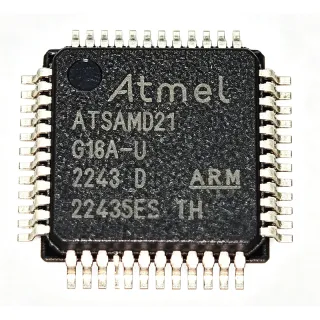
ATMXT1188S-CUR - maXTouch 1188-Node Touch Controller | Microchip
MPN: ATMXT1188S-CUR ✓ Active| Qty | Unit Price | Extended |
|---|---|---|
| 1 | $6.2 | $6.20 |
| 10 | $5.7 | $57.00 |
| 100 | $5.1 | $510.00 |
| 500 | $4.65 | $2,325.00 |
| 1,000 | $4.2 | $4,200.00 |
ATMXT1188S-CUR Overview
A projected-capacitive touchscreen controller is a mixed-signal interface IC that measures mutual-capacitance changes across an electrode grid and converts finger or stylus positions into touch coordinates for a host processor. Within the signal-chain hierarchy, it sits above the sensor glass itself and below the application processor, functioning as both a high-voltage charge-transfer analog front end and a digital touch-processing engine.
Key features of the maXTouch mXT1188S family include 1188 nodes of mutual-capacitive sensing, high noise immunity for demanding tablet environments, and optimized performance specifically validated for 7-inch to 10-inch form factors. According to the family datasheet summary, the mXT1188S supports two touchscreens with true 12-bit multiple-touch reporting, up to 16 concurrent touches per screen, screen sizes from 8 to 12.1 inches with a 5 mm electrode pitch, and flexible grid configurations. These capabilities make it suitable for multi-user touch scenarios and glove or passive-stylus operation where lower-node controllers struggle.
The architecture integrates the charge-transfer analog front end, a dedicated touch-processing engine, and configuration memory in a single chip, reducing bill-of-materials complexity compared with discrete sensor-plus-processor solutions. Microchip's maXTouch acquisition algorithms deliver noise immunity against display and charger noise common in consumer tablets.
Typical applications include 7-inch to 10-inch Android and Windows 8 tablets, industrial touch panels, and human-machine interface displays requiring multi-touch, high-node-count sensing. Microchip explicitly recommends the ATMXT1066T2 as the alternative touch controller for designs needing a different node count.
When designing with the ATMXT1188S-CUR, match the electrode grid configuration and electrode pitch (5 mm typical) to the controller's supported grid table, and verify the object-code configuration file generated by Microchip's touch tuning tools before production.
This page synthesizes distributor inventory, Microchip's recommended alternative controllers, and drop-in variant guidance not consolidated in the manufacturer datasheet.
Drop-in alternatives for ATMXT1188S-CUR — same package, pin-to-pin compatible. Different-package parts requiring PCB rework are excluded.
Quick Comparison Tool — Select alternative parts for side-by-side comparison:
ATMXT1066T2
✅ Drop-In📋 Reference alternative (not in catalog)
ATMXT1188S-AT
✅ Drop-In📋 Reference alternative (not in catalog)
ATMXT1189TD-A
✅ Drop-In📋 Reference alternative (not in catalog)
ATMXT1188S-CUR Maximum Ratings & Electrical Characteristics
| Type | Capacitive Touch Screen Sensor IC (maXTouch) |
| Sensing Nodes | 1188 |
| Touch Technology | Projected capacitive (mutual capacitance) |
| Touch Reporting | True 12-bit multiple touch |
| Concurrent Touches | Up to 16 per screen (2 screens) |
| Supported Screen Sizes | 7 inch to 10 inch (family: 8 to 12.1 inch, 5 mm electrode pitch) |
| Target OS Platforms | Windows 8, Android |
| Noise Immunity | High (single-chip maXTouch acquisition) |
| Number of Screens | Supports two touchscreens |
| Electrode Pitch | 5 mm |
| Mounting Type | Surface Mount |
| Packaging | Tape & Reel |
ATMXT1188S-CUR standard Pin Configuration Guide
Pin configuration for ATMXT1188S-CUR (standard package). Pin numbering, functions, and connection diagrams are defined in the manufacturer datasheet. Refer to it for the exact footprint and soldering guidelines.

No detailed pinout data available for ATMXT1188S-CUR.
Refer to the datasheet for full pin configuration.
Typical Applications
ATMXT1188S-CUR is suitable for 6 applications: 7-10 inch Android/Windows Tablets, Dual-Screen Touch Devices, Industrial HMI Touch Panels, Interactive Kiosks and Point-of-Information Displays, Automotive Center-Stack and Co-Pilot Displays, Medical Bedside and Diagnostic Touch Displays.
7-10 inch Android/Windows Tablets
The ATMXT1188S-CUR is purpose-optimized by Microchip for 7-inch to 10-inch tablet touchscreens running Windows 8 and Android, which is the exact validated design window stated on the product page. Its 1188-node mutual-capacitance array supports the dense electrode grids of 9-10 inch panels at a 5 mm pitch, while up to 16 concurrent touches per screen with true 12-bit resolution enables smooth multi-finger gesture tracking. The single-chip maXTouch architecture integrates the analog front end and touch-processing engine, giving high noise immunity against display and charger noise that typically degrades tablet touch accuracy. Configure the grid via Microchip tuning tools and verify touch latency on the final display stack.
Recommended
Dual-Screen Touch Devices
Per the family datasheet, the mXT1188S supports two touchscreens simultaneously, making it suitable for dual-display products such as foldable or clamshell concept tablets, dual-panel industrial terminals, and interactive kiosk heads. Each screen can report up to 16 concurrent touches with true 12-bit coordinate resolution, so both panels retain full multi-touch functionality from a single controller, reducing cost and I2C/USB host channel count versus dual-chip solutions. The flexible grid configuration allows each screen to use a different electrode matrix size. Design consideration: total node budget of 1188 must be partitioned across both screens, which limits very large combined panel sizes.
Recommended
Industrial HMI Touch Panels
The high noise immunity of the maXTouch acquisition engine makes the ATMXT1188S-CUR a strong fit for industrial human-machine interface panels where switching power supplies, motor drives, and backlight inverters generate conducted and radiated interference. The 1188-node grid supports 8-12.1 inch cover glass at 5 mm electrode pitch per the datasheet, and the 16-touch capability supports gloved or multi-operator interaction in factory settings. For harsh environments, the ATMXT1188S-AT variant provides -40C to +125C automotive-grade operation on the same die. Validate susceptibility against the specific EMI environment and enable Microchip's noise-filtering configuration options during tuning.
Recommended
Interactive Kiosks and Point-of-Information Displays
Self-service kiosks in the 7-10 inch secondary-display class benefit from the ATMXT1188S-CUR's combination of node density and multi-touch support: up to 16 concurrent touches with 12-bit precision accommodates simultaneous two-handed operation by adjacent users, and the single-chip design simplifies the display electronics bill of materials. Windows 8 and Android platform optimization means standard HID-class touch drivers are available, shortening software integration. The 5 mm electrode pitch specification allows low-cost ITO sensor glass. Key trade-off: kiosk duty cycles run 24/7, so validate thermals and enable the controller's low-power scan modes between interactions to reduce average power dissipation.
Recommended
Automotive Center-Stack and Co-Pilot Displays
For automotive touch applications, the same mXT1188S die is offered as the ATMXT1188S-AT in an LQFP144 package rated from -40C to +125C, as listed on Mouser as a maXTouch automotive touch screen controller. The 1188-node array and 16-touch reporting suit 8-10 inch center-stack navigation and climate-control panels, and maXTouch noise immunity addresses the severe conducted-noise environment of vehicle power networks and display backlight inverters. Engineers targeting automotive designs should base new layouts on the -AT variant and follow AEC-qualification requirements of the end system, then validate water rejection and gloved-touch performance on production sensor glass.
Recommended
Medical Bedside and Diagnostic Touch Displays
Mid-size medical monitoring and diagnostic touch panels in the 8-12.1 inch class match the mXT1188S datasheet screen range and benefit from its high-fidelity 12-bit touch reporting for precise on-screen control of clinical user interfaces. Single-chip integration reduces the component count inside enclosures that must be sealed for disinfection, and the noise-immune acquisition engine tolerates the electrically noisy environment of medical power supplies and switching displays. Up to 16 concurrent touches supports gloved multi-operator input. Regulatory note: the standard CUR part is a commercial-grade component, so verify the end-equipment qualification strategy; the -AT temperature variant may be preferable for validated medical platforms.
Recommended
Recommended Products Summary
Engineering reference data for ATMXT1188S-CUR — comparison, design guidance, and compliance information.
Selection Guide
Comparison with Alternatives
| Parameter | This Product | ATMXT1066T2 | ATMXT1188S-AT | ATMXT1189TD-A |
|---|---|---|---|---|
| Brand | Microchip Technology | Microchip Technology | Microchip Technology | Microchip Technology |
| Sensing Nodes | 1188 | 1066-class (lower node count) | 1188 | mXT1189 class (higher) |
| Target Grade | Consumer/tablet | Consumer/tablet | Automotive (MAXTOUCH AUTO) | Automotive (-A suffix) |
Key Differentiators
- Highest node density in its tablet class (vs ATMXT1066T2)
- Dual-screen capability (vs ATMXT1188S-AT)
- Trade-off: no automotive qualification (vs ATMXT1188S-AT)
Design Notes
Confirm the exact package option tied to the CUR ordering suffix from the Microchip ordering-code table before finalizing the PCB footprint; suffixes within the mXT1188S family map to different packages (for example, the -AT variant is LQFP144). Place the controller close to the sensor flex-tail connector to keep the high-voltage drive lines short, and route sensitive sense lines away from display LVDS/eDP pairs to preserve the maXTouch noise-immunity margin.
Touch noise immunity depends heavily on sensor-glass grounding and display-stack shielding. Follow Microchip's maXTouch design-in guidance for ITO shield layers and chassis grounding, and enable the noise-filtering configuration options during tuning on the final display assembly - noise measured on a bench fixture does not represent the integrated stack with an active backlight and charger connected.
The grid configuration file (object table) is specific to each sensor glass geometry; never reuse a configuration from a different panel. With 1188 nodes at 5 mm pitch, the grid table must exactly match the sensor matrix or touch coordinates will be offset. If migrating to the ATMXT1066T2 recommended alternative, node count differs, so the grid partition and configuration must be regenerated and re-tuned - it is not a firmware-only swap.
Compliance Information
Compliance status not stated in verified distributor data; verify on Microchip product page or distributor compliance tabs. The -AT automotive variant serves AEC-qualified platforms.