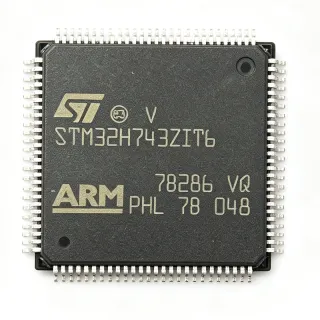
ATSAM3X4EA-AU - 84MHz Cortex-M3 MCU 256KB Flash | Microchip
MPN: ATSAM3X4EA-AU ✓ Active| Qty | Unit Price | Extended |
|---|---|---|
| 1 | $15.05 | $15.05 |
| 10 | $13.85 | $138.50 |
| 100 | $12.45 | $1,245.00 |
| 500 | $11.2 | $5,600.00 |
| 1,000 | $10.4 | $10,400.00 |
ATSAM3X4EA-AU Overview
A 32-bit microcontroller (MCU) is an integrated circuit that combines a processor core, memory, and programmable peripherals on a single chip, forming the highest-volume class of embedded processors. Within the hierarchy of ARM-based flash MCUs, the SAM3X sits in Microchip (formerly Atmel) AT91SAM mid-range tier: ARM Cortex-M3 core -> AT91SAM ARM-based Flash MCU -> 32-bit embedded microcontroller -> semiconductor.
Key features include the ARM Cortex-M3 revision 2.0 core with Memory Protection Unit (MPU), Thumb-2 instruction set, 24-bit SysTick counter, and Nested Vector Interrupt Controller (NVIC). Connectivity spans CAN, EBI/EMI external bus, Ethernet MAC, I2C, IrDA, LIN, and MMC/SD, plus USB high-speed for fast data up/downloading with robust EMI tolerance. Industrial temperature support (GREEN IND TEMP grade per Mouser) makes it suitable for extended environments.
Technical depth: the Cortex-M3 core at 84 MHz delivers approximately 1.25 DMIPS/MHz deterministic interrupt handling, while the multi-layer bus matrix allows parallel access to Flash, SRAM, and peripherals. Two 2x128 KB flash banks per the digichips listing reflect dual-bank architecture enabling simultaneous code execution and programming.
Typical applications include 3D printers, industrial automation, networked CAN/Ethernet gateways, and USB-connected embedded systems where high-speed USB plus CAN coexistence is required.
Design consideration: the LQFP-144 20x20 mm footprint requires careful decoupling on multiple VDDIO/VDDCORE pins; use 100 nF ceramic capacitors at each supply pin pair.
This page synthesizes verified distributor data, drop-in alternatives, and practical design notes not found in the manufacturer datasheet.
Drop-in alternatives for ATSAM3X4EA-AU — same package, pin-to-pin compatible. Different-package parts requiring PCB rework are excluded.
Variants in this series
Same-series models that are drop-in compatible with ATSAM3X4EA-AU (same form factor and footprint) — differing in Connectivity, Core Processor, Flash Memory, Package, Series.
Quick Comparison Tool — Select alternative parts for side-by-side comparison:
ATSAM3X8EA-AU
✅ Drop-In✓ In Stock
$4.25 / Unit
View Datasheet →ATSAM3X4EA-AU Maximum Ratings & Electrical Characteristics
| Core Processor | ARM Cortex-M3 (revision 2.0) |
| Core Size | 32-Bit |
| Maximum Clock Speed | 84 MHz |
| Flash Memory | 256 KB (256K x 8) |
| Series | SAM3X |
| Package | 144-LQFP (20x20 mm) |
| Mounting Type | Surface Mount |
| Connectivity | CAN, EBI/EMI, Ethernet, I2C, IrDA, LIN, MMC, USB |
| Peripherals | MPU, 24-bit SysTick, NVIC, DMA |
| Instruction Set | Thumb-2 |
| USB | High-speed USB with integrated transceiver |
| Temperature Grade | Industrial (GREEN IND TEMP) |
| RoHS Status | Compliant (GREEN package, MRL A) |
| Packaging | Tray |
ATSAM3X4EA-AU 144-lqfp (20x20 mm) Pin Configuration Guide
Pin configuration for ATSAM3X4EA-AU (144-lqfp (20x20 mm) package). This digital IC includes GPIO, communication interfaces (UART, SPI, I2C), and power pins. Refer to the manufacturer datasheet for alternate pin functions and configuration options. Essential for embedded system design and PCB layout.

No detailed pinout data available for ATSAM3X4EA-AU.
Refer to the datasheet for full pin configuration.
Typical Applications
ATSAM3X4EA-AU is suitable for 6 applications: 3D Printer Control Boards, Industrial Automation and PLC Nodes, CAN-to-Ethernet Gateways, USB Data Acquisition and Instrumentation, Building Automation and HVAC Controllers, Embedded Networking Equipment and IoT Hubs.
3D Printer Control Boards
The ATSAM3X4EA-AU fits 3D printer mainboard designs because its 84 MHz Cortex-M3 core provides the deterministic timing needed for multi-axis stepper pulse generation while simultaneously running USB and network communication stacks. Its high-speed USB with integrated transceiver transfers G-code and firmware at 480 Mbps without an external PHY, and the EBI/EMI bus can address external SRAM for large line buffers. The SAM3X family is the same silicon class used in the Arduino Due (ATSAM3X8E), so the RepRap/Arduino Due firmware ecosystem, ASF3 drivers, and toolchains port directly. Designers should allocate 256 KB Flash carefully between bootloader and application; if headroom runs out, the pin-compatible ATSAM3X8EA-AU with 512 KB Flash is a zero-PCB-change upgrade path.
Recommended
Industrial Automation and PLC Nodes
In industrial automation nodes, the ATSAM3X4EA-AU combines dual CAN controllers, an Ethernet MAC, and IrDA/LIN connectivity that factory floor protocols such as CANopen and DeviceNet demand. The 84 MHz Cortex-M3 with MPU enables RTOS partitioning for safety-adjacent logic, and the 24-bit SysTick plus NVIC deliver the sub-microsecond deterministic interrupts required for I/O scanning and communication timing. Industrial temperature grade (GREEN IND TEMP per Mouser) supports control-cabinet environments. The EBI/EMI interface attaches external parallel ADCs, displays, or memory-mapped expansion modules. Because CAN and Ethernet coexist on-chip, one ATSAM3X4EA-AU can serve as a CAN-to-Ethernet gateway, eliminating a second processor and reducing BOM cost in machine control retrofit designs.
Recommended
CAN-to-Ethernet Gateways
The ATSAM3X4EA-AU is purpose-built for protocol gateway applications because it integrates both dual CAN controllers and a 10/100 Ethernet MAC on a single 84 MHz Cortex-M3 die. A gateway bridges CAN frames into EtherNet/IP, Modbus TCP, or raw UDP packets; the multi-layer bus matrix lets the CPU service CAN message objects and Ethernet DMA descriptors concurrently without bottlenecking. High-speed USB doubles as a local configuration and diagnostics port with plug-and-play connectivity and robust EMI tolerance per the SAM3X datasheet. The 256 KB Flash accommodates a combined CANopen/LwIP stack with margin for TLS pre-shared-key variants. Hardware hash filtering on the Ethernet MAC reduces CPU load, preserving headroom for application-level protocol translation at full line rate.
Recommended
USB Data Acquisition and Instrumentation
For USB-connected data acquisition modules, the ATSAM3X4EA-AU's integrated high-speed USB transceiver streams ADC sample data to a host PC at up to 480 Mbps without external PHY components, cutting BOM cost and layout complexity. The EBI/EMI external bus interfaces parallel 16-bit ADCs at memory-mapped speeds, while on-chip DMA moves samples from the bus to USB endpoint RAM with minimal CPU intervention. The 84 MHz Cortex-M3 applies decimation, calibration, and protocol framing between transfers. The MPU enables privilege separation between the DAQ firmware and USB stack, improving robustness in laboratory instruments. Chipdig highlights the family's 'fast up/downloading of data and robust EMI tolerance,' which is critical for noise-sensitive measurement front ends in benchtop equipment.
Recommended
Building Automation and HVAC Controllers
Building automation controllers benefit from the ATSAM3X4EA-AU's blend of LIN, I2C, CAN, and Ethernet in a single industrial-temperature MCU. A rooftop HVAC controller can use LIN for zone sensor buses, I2C for humidity and temperature sensors, CAN for chiller plant networks, and Ethernet for BMS backbone integration, all without external communication controllers. The 84 MHz core executes PID loops for multiple control channels at millisecond rates with margin for a TCP/IP stack. The 256 KB Flash holds a combined BACnet MS/TP or lightweight BACnet/IP application. GREEN package compliance and MRL A rating satisfy commercial building material specifications, and the MCU's dual-bank flash architecture supports field firmware updates over the network without bricking the controller.
Recommended
Embedded Networking Equipment and IoT Hubs
Embedded IoT hubs use the ATSAM3X4EA-AU as a deterministic control plane: the Ethernet MAC with DMA offloads packet framing, the MMC controller reads SD-card storage for logging and provisioning, and I2C/SPI buses manage radios and sensors. At 84 MHz the Cortex-M3 sustains tens of Mbps of through-data while servicing real-time control tasks, a balance pure application processors cannot match at this power and cost point. High-speed USB provides local service and firmware flashing at production test. The MPU allows sandboxing of the network stack from safety-relevant control code. Designers must budget the 256 KB Flash across bootloader, LwIP, and application; the pin-compatible ATSAM3X8EA-AU (512 KB) provides a same-footprint escalation when feature sets grow.
Recommended
Recommended Products Summary
Engineering reference data for ATSAM3X4EA-AU — comparison, design guidance, and compliance information.
Selection Guide
Comparison with Alternatives
| Parameter | This Product | ATSAM3X8EA-AU |
|---|---|---|
| Package | 144-LQFP (20x20 mm) | 144-LQFP (20x20 mm) - same |
| Brand | Microchip Technology (Atmel) | Microchip Technology (Atmel) |
| Core / Speed | ARM Cortex-M3, 84 MHz | ARM Cortex-M3, 84 MHz |
| Flash Memory | 256 KB | 512 KB |
| Connectivity | CAN, Ethernet, EBI/EMI, I2C, IrDA, LIN, MMC, USB HS | CAN, Ethernet, EBI/EMI, I2C, IrDA, LIN, MMC, USB HS |
| Core Revision / Features | Cortex-M3 rev 2.0, MPU, Thumb-2, NVIC, SysTick | Cortex-M3 rev 2.0, MPU, Thumb-2, NVIC, SysTick |
| Temperature Grade | Industrial (GREEN IND TEMP) | Industrial |
Key Differentiators
- Cost-optimized 256 KB Flash entry point (vs ATSAM3X8EA-AU)
- Integrated high-speed USB transceiver (vs ATSAM3X8EA-AU)
- Flash headroom trade-off is real (vs ATSAM3X8EA-AU)
Design Notes
The SAM3X in 144-LQFP uses multiple VDDIO, VDDCORE, and VDDUTMI (USB) supply domains. Place a 100 nF ceramic capacitor within 2 mm of every supply pin pair and one 4.7-10 uF bulk capacitor per domain. The VDDCORE rail must ramp before or together with VDDIO per the datasheet power sequencing guidance; a series ferrite plus local bulk cap on VDDCORE helps suppress core noise. The VDDUTMI transceiver supply should be filtered separately since USB PHY switching currents inject noise into shared planes.
The 20x20 mm 144-LQFP exposes a 0.5 mm pin pitch - use a 4-mil trace/space rule for fanout and route the EBI/EMI address and data buses as length-matched groups if attaching external parallel memory or ADCs. Keep the Ethernet RMII/MII and USB DM/DP traces as controlled-impedance pairs (90 ohm differential for USB). Reserve the pin-compatible footprint so ATSAM3X8EA-AU can be substituted without a board spin; both parts share the identical 144-LQFP land pattern.
Two frequent errors on SAM3X designs: (1) under-budgeting Flash - 256 KB fills quickly with USB, TCP/IP, and CAN stacks plus a bootloader; plan a migration path to the 512 KB ATSAM3X8EA-AU from day one. (2) Neglecting flash wait states - at 84 MHz the embedded flash requires the correct wait-state configuration and cache enable in the EEFC/CMCC settings; wrong settings cause silent execution slowdowns. Also verify ERASE pin handling at reset to avoid accidental mass erase during power glitches.
Compliance Information
Mouser lists 'QFP144, GREEN IND TEMP, MRL A' - GREEN indicates halogen-free/RoHS-compliant package, MRL A is the highest material restriction compliance tier. REACH and conflict minerals status should be confirmed via official Microchip certificate of conformance.