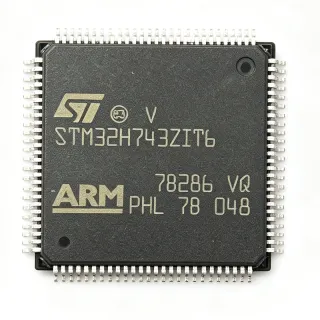
ATSAM4E8EB-ANR - 120MHz Cortex-M4 MCU 512KB Flash | Microchip
MPN: ATSAM4E8EB-ANR ✓ Active| Qty | Unit Price | Extended |
|---|---|---|
| 1 | $9.85 | $9.85 |
| 10 | $8.9 | $89.00 |
| 100 | $7.95 | $795.00 |
| 500 | $7.1 | $3,550.00 |
| 1,000 | $6.45 | $6,450.00 |
ATSAM4E8EB-ANR Overview
A microcontroller (MCU) is a single integrated circuit that combines a processor core, memory, and peripherals into one chip, forming the basis of embedded systems. The SAM4E family sits within Microchip's SMART ARM-based MCU portfolio: Cortex-M4 core -> 32-bit microcontroller -> embedded processing. The -B suffix denotes Revision B silicon, which Microchip recommends for both prototypes and new production designs.
Key features of the ATSAM4E8EB-ANR include the ARM Cortex-M4 core with an integrated floating point unit (FPU), which accelerates DSP and math-intensive firmware; a high data bandwidth bus architecture; 512 KB (512K x 8) of flash for program storage; and 128 KB of SRAM for data buffers and stack. The extended industrial temperature grade (-40C to +105C) supports harsh environments.
Architecturally, the SAM4E8E targets applications needing both processing throughput and rich connectivity, with a multi-layer bus matrix that lets DMA, Ethernet-class peripherals, and the core operate concurrently with minimal contention. The 120 MHz clock enables single-cycle flash access with prefetch buffering to keep pipeline stalls low.
Typical applications include industrial automation controllers, networking and communication equipment, and embedded systems requiring deterministic floating point processing such as motor control and sensing nodes.
When designing with this device, verify that your supply chain references the Revision B silicon (-B suffix), since Microchip recommends Revision B for new designs and production, while earlier steppings may differ errata-wise.
This page synthesizes distributor pricing, drop-in same-family alternatives, and practical design notes not found in the manufacturer datasheet, adding sourcing and selection value beyond raw specification tables.
Drop-in alternatives for ATSAM4E8EB-ANR — same package, pin-to-pin compatible. Different-package parts requiring PCB rework are excluded.
Variants in this series
Same-series models that are drop-in compatible with ATSAM4E8EB-ANR (same form factor and footprint) — differing in Core Processor, Flash Memory, Package, Packaging, SRAM.
Quick Comparison Tool — Select alternative parts for side-by-side comparison:
ATSAM4E8EA-ANR
✅ Drop-In📋 Reference alternative (not in catalog)
ATSAM4E16EB-ANR
✅ Drop-In ⚠️ 参数待验证✓ In Stock
$12.24 / Unit
View Datasheet →ATSAM4E16EA-ANR
✅ Drop-In ⚠️ 参数待验证📋 Reference alternative (not in catalog)
ATSAM4E8EB-CN
✅ Drop-In✓ In Stock
$8.51 / Unit
View Datasheet →ATSAM4E8EB-ANR Maximum Ratings & Electrical Characteristics
| Core Processor | ARM Cortex-M4 |
| Core Size | 32-Bit |
| Max Clock Frequency | 120 MHz |
| Flash Memory | 512 KB (512K x 8) |
| SRAM | 128 KB (128K x 8) |
| FPU | Yes (Cortex-M4 integrated) |
| Operating Temperature | -40C to +105C (TA) |
| Package | 144-LQFP (20x20 mm) |
| Mounting Type | Surface Mount |
| Packaging | Tape & Reel (TR), Cut Tape (CT) |
| Silicon Revision | Revision B (recommended for new designs) |
| RoHS Status | Compliant (GREEN per Mouser listing) |
ATSAM4E8EB-ANR 144-lqfp (20x20 mm) Pin Configuration Guide
Pin configuration for ATSAM4E8EB-ANR (144-lqfp (20x20 mm) package). This digital IC includes GPIO, communication interfaces (UART, SPI, I2C), and power pins. Refer to the manufacturer datasheet for alternate pin functions and configuration options. Essential for embedded system design and PCB layout.

No detailed pinout data available for ATSAM4E8EB-ANR.
Refer to the datasheet for full pin configuration.
Typical Applications
ATSAM4E8EB-ANR is suitable for 6 applications: Industrial Automation Controllers, Networking and Communication Equipment, Motor Control and Drives, Embedded Sensing and Data Acquisition, Test and Measurement Instruments, Building and Energy Management Systems.
Industrial Automation Controllers
The ATSAM4E8EB-ANR fits industrial automation nodes because its 120 MHz ARM Cortex-M4 core with hardware FPU executes control-loop math and protocol stacks concurrently, while 512 KB of flash and 128 KB of SRAM hold substantial firmware, communication buffers, and logging data. The high data bandwidth bus architecture lets DMA move sensor data while the core processes it, minimizing latency jitter in real-time control. Its -40C to +105C temperature grade covers control-cabinet ambient conditions without derating. In a typical deployment, the MCU runs fieldbus or industrial Ethernet-class communication firmware while scanning I/O; the FPU accelerates PID and filtering routines in single-precision arithmetic. Designers should reserve flash headroom (512 KB minus application size) for field firmware updates over the communication link.
Recommended
Networking and Communication Equipment
The SAM4E8E family targets networking applications, and the ATSAM4E8EB-ANR's high data bandwidth architecture is the key parameter: it sustains concurrent peripheral traffic from communication peripherals and DMA without stalling the 120 MHz Cortex-M4 core. The 128 KB SRAM provides room for packet buffers, and 512 KB flash stores protocol stacks with room to spare. Because the -B part is Revision B silicon, designs inherit Microchip's latest errata fixes, important in always-on communication hardware. In a typical design the MCU manages link monitoring, protocol processing, and system supervision while dedicated PHY hardware handles the physical layer; the FPU offloads any throughput or encryption-adjacent arithmetic. Evaluate SRAM partitioning carefully, since packet buffering contends with stack and heap in the single 128 KB SRAM.
Recommended
Motor Control and Drives
Field-oriented control (FOC) motor drives benefit directly from the ATSAM4E8EB-ANR's Cortex-M4 FPU, which executes the single-precision Clarke/Park transforms and PI loops typical of FOC without software floating point overhead at 120 MHz. The high bandwidth architecture supports tight synchronization between ADC current sampling and PWM updates, which is the timing backbone of stable current loops. The extended -40C to +105C operating range suits drive electronics mounted near motors or in enclosed cabinets. The 512 KB flash leaves room for multiple motor profiles and field-updatable tuning tables. Firmware developers should budget the 128 KB SRAM between control-loop state, diagnostic buffers, and commutation lookup tables; the FPU removes most cycle-budget pressure but ISR latency discipline remains essential for predictable current-loop bandwidth.
Recommended
Embedded Sensing and Data Acquisition
The ATSAM4E8EB-ANR suits data-acquisition front ends where sampled signals must be filtered, scaled, and stored: the Cortex-M4 DSP-friendly instruction set and FPU process single-precision filter kernels efficiently at 120 MHz, and the 128 KB SRAM buffers acquired data before upload. With 512 KB of flash, the MCU can hold calibration tables, self-test firmware, and logging structures locally. The industrial temperature grade supports sensors installed outdoors or in factory environments. In a typical acquisition chain, DMA streams conversion results to SRAM while the core applies digital filtering and packs results for a communication link, an arrangement the SAM4E bus matrix supports with minimal contention. Designers should characterize analog reference quality and layout around the MCU's analog pins early, since acquisition accuracy is bounded by reference noise rather than core throughput.
Recommended
Test and Measurement Instruments
Benchtop and portable instrumentation uses the ATSAM4E8EB-ANR as a main controller: 120 MHz Cortex-M4 execution handles user interface, measurement sequencing, and math-heavy post-processing (RMS, FFT windowing) with FPU acceleration, while 512 KB flash supports feature-rich menus and self-calibration routines. The 144-pin LQFP exposes ample GPIO for keypad scanning, display interfacing, and peripheral control, and 128 KB SRAM accommodates waveform capture buffers. The Revision B silicon recommended by Microchip for production reduces errata risk in long-lifecycle instruments. In a typical architecture the MCU supervises the analog front end and communicates results over USB or serial links; deterministic interrupt latency from the Cortex-M4 NVIC keeps timebase control stable. Reserve flash margin for firmware feature updates across the instrument's service life.
Recommended
Building and Energy Management Systems
Building controllers, metering heads, and energy management gateways use the ATSAM4E8EB-ANR to run communication stacks and metering algorithms simultaneously: the 120 MHz core with FPU computes power/energy integration in single-precision floating point, and the bus bandwidth sustains continuous UART/fieldbus traffic with DMA. The 512 KB flash holds multiple protocol variants and an over-the-air update bootloader, and the -40C to +105C grade covers rooftop and electrical-room ambient swings. The Revision B (-B) ordering code ensures designs receive Microchip's current silicon stepping, easing long-term procurement. In a typical node, the MCU cycles through channel scanning, energy accumulation, and report transmission; the 128 KB SRAM must be partitioned between metering state and communication buffers. Designers should implement watchdog supervision to guarantee recovery from fieldbus lockups in unattended installations.
Recommended
Recommended Products Summary
Engineering reference data for ATSAM4E8EB-ANR — comparison, design guidance, and compliance information.
Selection Guide
Comparison with Alternatives
| Parameter | This Product | ATSAM4E8EA-ANR | ATSAM4E16EB-ANR | ATSAM4E16EA-ANR |
|---|---|---|---|---|
| Package | 144-LQFP (20x20 mm) | 144-LQFP (20x20 mm) - same | 144-LQFP (20x20 mm) - same | 144-LQFP (20x20 mm) - same |
| Brand | Microchip Technology | Microchip Technology | Microchip Technology | Microchip Technology |
| Core | ARM Cortex-M4 with FPU, 32-bit | ARM Cortex-M4 with FPU, 32-bit | ARM Cortex-M4 with FPU, 32-bit | ARM Cortex-M4 with FPU, 32-bit |
| Max Clock Frequency | 120 MHz | 120 MHz | 120 MHz | 120 MHz |
| Flash Memory | 512 KB | 512 KB | 1 MB | 1 MB |
| SRAM | 128 KB | 128 KB | 128 KB | 128 KB |
| Silicon Revision | Revision B | Revision A | Revision B | Revision A |
| Operating Temperature | -40C to +105C | -40C to +105C | -40C to +105C | -40C to +105C |
Key Differentiators
- Revision B silicon recommended for production (vs ATSAM4E8EA-ANR)
- 512 KB flash / 128 KB SRAM balance (vs ATSAM4E16EB-ANR)
- Hardware FPU at 120 MHz (vs ATSAM4E8EA-ANR)
Design Notes
Ordering-code hygiene matters on the SAM4E8E: the -B in ATSAM4E8EB-ANR denotes Revision B silicon, which Microchip explicitly recommends for prototypes and production on the official SAM4E8E product page. Older Revision A stock (ATSAM4E8EA-ANR) is footprint-identical and functionally interchangeable, but may carry earlier-stepping errata. When sourcing from secondary distributors, verify date codes and stepping in incoming inspection, and treat mixed A/B stock on one production line as a firmware-validation risk.
Verify the exact supply voltage domain configuration against the SAM4E family datasheet before finalizing the power tree - the verified data on this page does not include the VDDCORE/VDDIO regulator arrangement, and SAM4E-class MCUs typically require specific core/IO sequencing and decoupling per power domain. Place 100 nF ceramic decoupling capacitors at each supply pin pair plus bulk capacitance near the 20x20 LQFP, and follow the Microchip SAM4E hardware design application note for the core regulator external component requirements.
The 144-pin LQFP (0.5 mm pitch) requires careful fanout: use 4-mil trace/space for the inner rows and place vias close to pads to escape to inner layers. Allocate a solid ground plane under the device and keep crystal and analog reference traces short and guarded. On a 20x20 mm body with 144 pins, thermal relief is rarely a constraint for MCU-level dissipation, but provide at least standard thermal vias per IPC-recommended practice if high peripheral activity is continuous.
At 120 MHz with a high-bandwidth bus matrix, keep high-speed peripheral routing (parallel buses, high-rate serial links) length-matched where timing matters, and series-terminate long clock traces to control ringing. The 20x20 mm LQFP package inductance is modest but nonzero; for fast edges, add 22-33 ohm series resistors on lines longer than about 10 cm to damp reflections and reduce EMI.
Compliance Information
Mouser listing describes the package as LQFP, GREEN, EXT TEMP - the GREEN designation indicates RoHS-compliant, halogen-reduced packaging. Full REACH, lead-free, and conflict-minerals declarations should be confirmed via Microchip's official product compliance documentation.