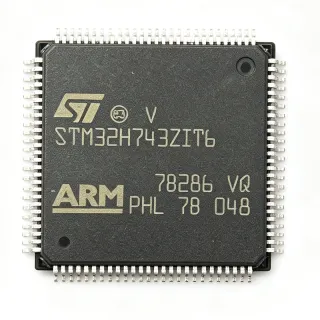
ATSAM4E16EB-ANR - Cortex-M4 120MHz 1MB MCU | Microchip
MPN: ATSAM4E16EB-ANR ✓ Active| Qty | Unit Price | Extended |
|---|---|---|
| 1 | $16.32 | $16.32 |
| 10 | $15.34 | $153.40 |
| 100 | $14.05 | $1,405.00 |
| 500 | $13.12 | $6,560.00 |
| 1,000 | $12.24 | $12,240.00 |
ATSAM4E16EB-ANR Overview
A microcontroller is a single-chip computer that integrates a processor core, memory, and peripherals such as UARTs, SPI, I2C, ADCs, and timers on one die. Within the embedded-systems hierarchy, a 32-bit MCU such as the SAM4E family sits above 8-bit MCUs (like Microchip PIC16 devices) and below application processors, serving real-time industrial and connectivity tasks.
Key features include the ARM Cortex-M4 core with a floating point unit (FPU), which accelerates DSP and control-loop math; a high data bandwidth bus architecture for fast peripheral throughput; and 1 MB of Flash for substantial application code. The SAM4E series integrates an Ethernet MAC and USB device port for networked nodes, per the SAM4E16E product family description from Microchip.
The revision B silicon (the B suffix in ATSAM4E16EB) is the version Microchip recommends for new prototypes and production, offering corrected errata over revision A. Supply voltage is 3.3 V with 1.2 V internal core operation, per distributor parametric listings (1.2V/3.3V). The extended temperature suffix supports demanding industrial environments, and the GREEN, MRL-B designation indicates RoHS-compliant matte-tin lead finish.
Typical applications include industrial automation nodes with Ethernet connectivity, motor control systems leveraging the FPU for field-oriented control, embedded gateways, and test and measurement equipment requiring 120 MHz compute headroom.
Design consideration: allocate PCB decoupling per the SAM4E16E datasheet power supply recommendations and verify errata for revision B silicon before final tape-out. As an LQFP-144 device, plan for 0.5 mm fine-pitch soldering and adequate ground-plane thermal relief.
This page synthesizes distributor pricing, drop-in same-package alternatives, and practical design notes not found in the manufacturer datasheet, per verified web data as of 2026-09-20.
Drop-in alternatives for ATSAM4E16EB-ANR — same package, pin-to-pin compatible. Different-package parts requiring PCB rework are excluded.
Variants in this series
Same-series models that are drop-in compatible with ATSAM4E16EB-ANR (same form factor and footprint) — differing in FPU, Flash Memory, Package, Operating Temperature, Packaging.
Quick Comparison Tool — Select alternative parts for side-by-side comparison:
ATSAM4E16EA-ANR
✅ Drop-In📋 Reference alternative (not in catalog)
ATSAM4E16EA-AN
✅ Drop-In📋 Reference alternative (not in catalog)
ATSAM4E16EB-AN
✅ Drop-In✓ In Stock
$8.2 / Unit
View Datasheet →ATSAM4E16EB-ANR Maximum Ratings & Electrical Characteristics
| Core Processor | ARM Cortex-M4 |
| Core Size | 32-bit |
| Maximum Clock Frequency | 120 MHz |
| Flash Memory | 1 MB (1M x 8) |
| FPU | Yes (Cortex-M4 FPU) |
| Supply Voltage | 1.2 V / 3.3 V |
| Package | 144-LQFP (20x20 mm) |
| Mounting Style | SMD |
| Packaging | Tape & Reel (T&R) |
| Operating Temperature | Extended temperature range (per Microchip EXT TEMP marking) |
| Product Series | SAM4E (ATSAM4E16E) |
| Silicon Revision | Revision B (recommended for new designs) |
| RoHS | Y (GREEN lead finish) |
| Product Category | ARM Microcontrollers - MCU |
ATSAM4E16EB-ANR 144-lqfp (20x20 mm) Pin Configuration Guide
Pin configuration for ATSAM4E16EB-ANR (144-lqfp (20x20 mm) package). This digital IC includes GPIO, communication interfaces (UART, SPI, I2C), and power pins. Refer to the manufacturer datasheet for alternate pin functions and configuration options. Essential for embedded system design and PCB layout.

No detailed pinout data available for ATSAM4E16EB-ANR.
Refer to the datasheet for full pin configuration.
Typical Applications
ATSAM4E16EB-ANR is suitable for 6 applications: Industrial Automation Nodes, Ethernet-Connected Embedded Gateways, Motor Control and Drives, Test and Measurement Equipment, Building Automation and HVAC Controllers, Point-of-Sale and Industrial HMI Terminals.
Industrial Automation Nodes
The ATSAM4E16EB-ANR fits industrial automation endpoints because its 120 MHz Cortex-M4 core with FPU executes control loops and communication stacks concurrently, while 1 MB of Flash holds application firmware plus protocol libraries. In a factory node, the MCU polls sensors over SPI and I2C, processes the data, and reports upstream via its high-bandwidth bus architecture. Placed on a 3.3 V industrial rail with the extended-temperature LQFP-144 package, it tolerates panel environments where consumer-grade parts fail. The 120 MHz headroom provides roughly 2x margin over a 60 MHz-class Cortex-M3 for PID and filter computation, reducing real-time overrun risk in deterministic control tasks.
Recommended
Ethernet-Connected Embedded Gateways
For protocol-conversion gateways, the ATSAM4E16EB-ANR's SAM4E architecture, described by Microchip as having a floating point unit and high data bandwidth, targets exactly this class of networked design. The 1 MB Flash accommodates a full TCP/IP stack plus dual protocol implementations (for example Modbus-to-OPC UA translation), and the 144-pin LQFP exposes enough GPIO and serial peripherals for multi-port designs. Operating from 3.3 V with 1.2 V internal core, it integrates cleanly with standard PHY circuitry. The revision B silicon, which Microchip recommends for production, reduces field-failure risk from revision A errata in always-on gateway deployments.
Recommended
Motor Control and Drives
The Cortex-M4 FPU in the ATSAM4E16EB-ANR accelerates field-oriented control (FOC) mathematics - Park/Clarke transforms and PI loops - which are float-intensive and otherwise require fixed-point libraries on integer cores. At 120 MHz, single-cycle FPU operations leave ample cycle budget for PWM generation, current sampling, and protection routines. The 1 MB Flash stores multiple drive profiles and parameter tables, and the 144-pin package provides the PWM, ADC-trigger, and encoder-interface pins that motor designs demand. Estimated benefit: FOC loops executing on hardware floating point run several times faster than software-emulated float on Cortex-M3 parts of equal clock rate.
Recommended
Test and Measurement Equipment
Bench and portable instruments benefit from the ATSAM4E16EB-ANR's combination of 120 MHz compute, FPU, and abundant 144-pin I/O for front-panel encoders, displays, and acquisition circuitry. The 1 MB Flash supports complex state machines, calibration tables, and USB communication firmware within a single device, simplifying BOM. In a data-logger design, the MCU buffers ADC samples through its high-bandwidth bus into SRAM and formats results over USB or UART; the FPU accelerates the FFT and statistical processing used in measurement math. Revision B silicon is preferred here because instrument calibration routines must run on errata-free, production-recommended silicon.
Recommended
Building Automation and HVAC Controllers
HVAC and building-automation controllers need long-lifecycle, extended-temperature MCUs with generous Flash for protocol stacks such as BACnet or Modbus - the ATSAM4E16EB-ANR's 1 MB Flash and 120 MHz Cortex-M4 meet this directly. The extended-temperature, RoHS GREEN LQFP-144 package suits control boards inside air-handling units and panel-mounted controllers exposed to elevated ambient temperatures. The FPU handles sensor-fusion and energy-optimization algorithms, while the wide peripheral set of the 144-pin footprint interfaces dampers, valves, and RS-485 transceivers. Using revision B silicon per Microchip's recommendation minimizes recall risk in multi-year field deployments.
Recommended
Point-of-Sale and Industrial HMI Terminals
HMI terminals require responsive graphics processing and rich peripheral connectivity; the ATSAM4E16EB-ANR's 120 MHz core with FPU drives UI logic and touch-processing algorithms with low latency, and 1 MB Flash stores fonts, language packs, and application logic. The 144-pin LQFP provides parallel/serial display interfaces plus USB and Ethernet for backend connectivity in POS or operator terminals. Running from 3.3 V keeps the power budget within sealed-terminal thermal limits, and the industrial temperature option covers unconditioned retail and factory-floor environments. Estimated UI benefit: hardware float accelerates touch-gesture filtering versus integer-only Cortex-M3 alternatives at the same clock rate.
Recommended
Recommended Products Summary
Engineering reference data for ATSAM4E16EB-ANR — comparison, design guidance, and compliance information.
Selection Guide
Comparison with Alternatives
| Parameter | This Product | ATSAM4E16EA-ANR | ATSAM4E16EA-AN | ATSAM4E16EB-AN |
|---|---|---|---|---|
| Package | 144-LQFP (20x20 mm) | 144-LQFP (20x20 mm) - same | 144-LQFP (20x20 mm) - same | 144-LQFP (20x20 mm) - same |
| Brand | Microchip Technology | Microchip Technology | Microchip Technology | Microchip Technology |
| Core | ARM Cortex-M4 with FPU | ARM Cortex-M4 with FPU | ARM Cortex-M4 with FPU | ARM Cortex-M4 with FPU |
| Max Clock Frequency | 120 MHz | 120 MHz | 120 MHz | 120 MHz |
| Flash Memory | 1 MB (1M x 8) | 1 MB (1024KB) | 1 MB (1024KB) | 1 MB (1M x 8) |
| Silicon Revision | Revision B (recommended for new designs) | Revision A | Revision A | Revision B |
| Packing | Tape & Reel | Tape & Reel | Tray | Tray |
| Supply Voltage | 1.2 V / 3.3 V | 1.2 V / 3.3 V | 1.2 V / 3.3 V | 1.2 V / 3.3 V |
| RoHS | Compliant (GREEN) | Compliant | Compliant | Compliant |
Key Differentiators
- Production-recommended revision B silicon (vs ATSAM4E16EA-ANR)
- Tape & Reel delivery for automated assembly (vs ATSAM4E16EB-AN)
- Cortex-M4 FPU at 120 MHz with 1 MB Flash (vs ATSAM3S8BA-MUR (Cortex-M3 family))
Design Notes
The SAM4E16E uses a 1.2 V core with 3.3 V I/O supply, per JAK Electronics parametric data (1.2V/3.3V). Design the power tree with a dedicated LDO or buck converter for the 1.2 V core rail and sequence it per the SAM4E16E datasheet power supply section. Decouple every VDD/VDDIO pin pair with 100 nF ceramics placed within 2 mm of the pins, plus bulk 10 uF capacitance near the regulator. Verify the exact VDDCORE/VDDIO pin grouping in the official datasheet before layout; do not rely on generic ARM reference designs for this pinout.
The 144-LQFP (20x20 mm) package has a 0.5 mm lead pitch, requiring careful land-pattern design and reflow profile tuning. Use solder mask-defined pads with non-solder-mask-defined geometry per the Microchip LQFP landing-pattern recommendation in the datasheet. Route high-frequency traces (Ethernet RMII, USB, 12 MHz crystal) short and keep crystal load capacitors adjacent to the pins. Provide a continuous ground plane beneath the device; avoid splitting it under the crystal or analog supply pins. Estimated: a 4-layer stack with internal ground gives the best signal-integrity margin for the 120 MHz core clock harmonics.
Use revision B silicon (the -EB suffix) for all new designs: Microchip's official ATSAM4E16E page explicitly recommends Revision B for prototypes and production, so referencing revision A errata workarounds (-EA parts) is unnecessary when starting fresh. When substituting an -EA for an -EB in an existing design, audit the revision A errata list against your used peripherals before releasing the swap. Also confirm the programming/debug interface (SWD) pin assignment matches your connector, and never mix tray (-AN) and Tape & Reel (-ANR) reorder codes when your pick-and-place requires T&R feeders.
Compliance Information
RoHS: Y and GREEN (MRL-B matte-tin lead finish) per Mouser and omo-ic.com listings. Extended temperature grade per Mouser 'EXT TEMP' marking. REACH, halogen-free, and conflict-minerals declarations not stated in verified data.