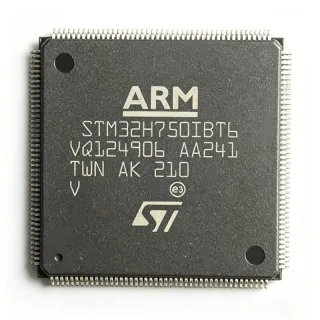
ATSAM4CP16C-AHU-Y - Dual-Core 120MHz MCU 1MB Flash | Microchip
MPN: ATSAM4CP16C-AHU-Y ✓ Active| Qty | Unit Price | Extended |
|---|---|---|
| 1 | $18.54 | $18.54 |
| 10 | $17.61 | $176.10 |
| 100 | $16.69 | $1,669.00 |
| 500 | $15.85 | $7,925.00 |
| 1,000 | $15.06 | $15,060.00 |
ATSAM4CP16C-AHU-Y Overview
A microcontroller (MCU) is a single integrated circuit that combines a processor core, memory, and peripherals to execute embedded control tasks. Within the system hierarchy, the ATSAM4CP16C sits in the smart-energy MCU class: microcontroller -> 32-bit ARM MCU -> ARM Cortex-M4 family -> Atmel SMART energy portfolio. Dual-core MCUs partition safety-critical or real-time workloads (such as PLC modem handling) from application logic, improving determinism and security in one package.
Key features include two Cortex-M4/M4F cores each running at 120 MHz with FPU, on-chip cache for each core, an advanced cryptographic engine for secure communication, and a G3-PLC modem supporting CENELEC, ARIB, and FCC profiles as defined by the G3-PLC specification. The supply range spans 1.08V to 3.6V, and the industrial temperature grade covers -40C to +85C (IND TEMP A).
Technically, the stacked-die construction integrates the SAM4C MCU die with the PLC modem circuitry, delivering a complete G3-PLC node on a single footprint. The cryptographic engine accelerates AES-based authentication and encryption required by modern smart-grid protocols, offloading both cores.
Typical applications include smart electricity meters, streetlighting controllers, solar inverter monitoring, and home-area-network gateways where power-line communication replaces dedicated wiring.
When designing, budget the dual-core flash allocation carefully - both cores share the 1 MB Flash, and modem firmware residency affects application space.
This page synthesizes distributor pricing, drop-in alternatives, and practical design notes not found in the manufacturer datasheet.
Drop-in alternatives for ATSAM4CP16C-AHU-Y — same package, pin-to-pin compatible. Different-package parts requiring PCB rework are excluded.
Quick Comparison Tool — Select alternative parts for side-by-side comparison:
ATSAM4CP16C-AU
✅ Drop-In ⚠️ 参数待验证📋 Reference alternative (not in catalog)
ATSAM4C16C-AU
✅ Drop-In ⚠️ 参数待验证📋 Reference alternative (not in catalog)
ATSAM4CP16B-AU
✅ Drop-In ⚠️ 参数待验证📋 Reference alternative (not in catalog)
ATSAM4CP16C-AHU-Y Maximum Ratings & Electrical Characteristics
| Core Processor | ARM Cortex-M4/M4F |
| Number of Cores | Dual-Core |
| Core Size | 32-Bit |
| Maximum Clock Frequency | 120 MHz |
| Flash Memory | 1 MB (1M x 8) |
| SRAM | 128 KB |
| Cache | On-chip cache for each core |
| Supply Voltage Range | 1.08 V to 3.6 V |
| ADC Resolution | 10 bit |
| Special Features | Cryptographic engine, G3-PLC modem (CENELEC, ARIB, FCC profiles) |
| Operating Temperature | -40C to +85C (TA), Industrial |
| Package | 176-LQFP (24x24 mm) |
| Mounting Type | Surface Mount |
| Packaging | Tray |
| Connectivity | G3-PLC power line communication modem |
| Construction | Stacked dies |
| Green Status | Green, MRL |
ATSAM4CP16C-AHU-Y 176-lqfp (24x24 mm) Pin Configuration Guide
Pin configuration for ATSAM4CP16C-AHU-Y (176-lqfp (24x24 mm) package). This digital IC includes GPIO, communication interfaces (UART, SPI, I2C), and power pins. Refer to the manufacturer datasheet for alternate pin functions and configuration options. Essential for embedded system design and PCB layout.

No detailed pinout data available for ATSAM4CP16C-AHU-Y.
Refer to the datasheet for full pin configuration.
Typical Applications
ATSAM4CP16C-AHU-Y is suitable for 6 applications: Smart Electricity Metering, Streetlighting Control Nodes, Solar Inverter Monitoring and Gateways, Home Area Network (HAN) Gateways, Industrial PLC-Based SCADA Nodes, Gas and Water Smart Metering.
Smart Electricity Metering
The ATSAM4CP16C-AHU-Y fits smart electricity meters because it combines dual-core 120 MHz Cortex-M4 processing, 1 MB Flash, and an integrated G3-PLC modem with CENELEC, ARIB, and FCC profile support, eliminating a discrete modem chip and shrinking the meter mainboard. One core executes metrology and DLMS/COSEM application firmware while the second core services the PLC protocol stack, so communication interrupts never jitter energy-accumulation timing. The on-chip cryptographic engine accelerates AES authentication and encryption demanded by modern grid security standards. Powered from 1.08V to 3.6V and rated -40C to +85C, it tolerates meter supply droop and outdoor enclosure temperatures. Place it behind the meter front-end with the PLC coupling circuit on the same PCB; the integrated approach reduces BOM cost but concentrates firmware complexity in the shared 1 MB Flash, so budget flash partitions carefully.
Recommended
Streetlighting Control Nodes
Smart streetlight controllers use power-line communication because dedicated control wiring is uneconomical over kilometer-scale networks. The ATSAM4CP16C-AHU-Y integrates the G3-PLC modem directly with its dual-core Cortex-M4 processor, so a single 176-LQFP device handles both luminance scheduling and CENELEC-band communication over the 230V mains. The 120 MHz cores run dimming profiles and mesh-routing firmware concurrently, while the cryptographic engine secures command authentication against tampering. The -40C to +85C industrial range survives pole-mounted enclosure environments, and the 1.08V to 3.6V supply interfaces with the low-voltage standby rail. Compared with discrete modem-plus-MCU designs, the stacked-die integration cuts board area and component count; the trade-off is less flexibility to change modem silicon independently of the application processor during field upgrades.
Recommended
Solar Inverter Monitoring and Gateways
Distributed solar installations need inverter-level monitoring gateways that report generation data over existing power lines rather than installing RF or Ethernet backhaul. The ATSAM4CP16C-AHU-Y provides the complete G3-PLC node in one package: dual 120 MHz Cortex-M4 cores execute inverter telemetry sampling and PLC stack duties in parallel, 128 KB SRAM buffers communication frames, and the crypto engine signs reports for grid-operator acceptance. The 10-bit ADC captures auxiliary analog telemetry such as enclosure temperature or DC-bus scaled signals. Its 1.08V to 3.6V operation matches gateway auxiliary supplies, and the 176-LQFP 24x24 mm footprint integrates cleanly into inverter communication daughterboards. Designers should provide clean 3.3V decoupling and a compliant coupling network, since PLC signal quality on noisy inverter switching environments determines link budget.
Recommended
Home Area Network (HAN) Gateways
In-Home Display and HAN gateway designs bridge utility meter data to consumer devices, and G3-PLC over the premises wiring is a preferred physical layer because it reaches outlets without new cabling. The ATSAM4CP16C-AHU-Y runs the G3-PLC modem on one Cortex-M4 core while the second core handles user-interface logic and local protocol translation, all within the 1 MB Flash. The integrated cryptographic engine enforces meter-to-gateway authentication, and the on-chip caches sustain the processing headroom needed for concurrent PLC mesh routing. FCC-profile support makes it suitable for North American deployments, while CENELEC and ARIB profiles cover European and Japanese bands on the same silicon. The 176-LQFP surface-mount package and 1.08V to 3.6V supply range suit compact consumer-grade mains-powered hardware with industrial-grade robustness.
Recommended
Industrial PLC-Based SCADA Nodes
Industrial facilities increasingly use medium- and low-voltage power lines for SCADA telemetry where installing RS-485 or fiber runs is impractical. The ATSAM4CP16C-AHU-Y serves as a PLC data node: its dual-core 120 MHz architecture isolates the G3-PLC stack from sensor-acquisition firmware, the 1 MB Flash stores protocol and logging code, and 128 KB SRAM buffers time-series data between communication windows. The 10-bit ADC digitizes local analog sensors, and the cryptographic engine protects command integrity on shared plant infrastructure. Industrial -40C to +85C rating and 1.08V to 3.6V tolerance fit control-cabinet power conditions. Unlike RF solutions, power-line media penetrates metal enclosures and cable trays where wireless fades; the trade-off is dependence on line impedance, so design the coupling network per the CENELEC or FCC band in use.
Recommended
Gas and Water Smart Metering
Gas and water utilities share grid communication infrastructure with electricity meters, and G3-PLC nodes mounted on these meters reuse the same network stack and provisioning tools. The ATSAM4CP16C-AHU-Y brings the integrated PLC modem and crypto engine to battery-adjacent designs: its dual cores let one core sleep between metering reads while the other wakes periodically for communication, conserving energy in battery-backed enclosures. The 1 MB Flash supports extensive logging and DLMS/COSEM object models, and -40C to +85C operation covers buried and pit installations. Because the modem is integral, engineers avoid the integration risk of pairing third-party modems with generic MCUs. The main design consideration is peak transmit current on the PLC coupler, which must be budgeted against battery capacity and local decoupling capacitance sized accordingly.
Recommended
Recommended Products Summary
Engineering reference data for ATSAM4CP16C-AHU-Y — comparison, design guidance, and compliance information.
Selection Guide
Comparison with Alternatives
| Parameter | This Product | ATSAM4CP16C-AU | ATSAM4C16C-AU | ATSAM4CP16B-AU |
|---|---|---|---|---|
| Package | 176-LQFP (24x24 mm) | 176-LQFP (24x24 mm) - same | 176-LQFP (24x24 mm) - same | 176-LQFP (24x24 mm) - same |
| Brand | Microchip Technology | Microchip Technology | Microchip Technology | Microchip Technology |
| Core / Speed | Dual-Core Cortex-M4, 120 MHz | Dual-Core Cortex-M4, 120 MHz | Cortex-M4 family per datasheet | Dual-Core Cortex-M4, 120 MHz |
| Integrated G3-PLC Modem | Yes (stacked die, CENELEC/ARIB/FCC) | Yes (CENELEC/ARIB/FCC) | No | Yes (CENELEC/ARIB/FCC) |
| Marking / Ordering Variant | Green, MRL (-Y) | Standard (non-MRL variant) | Standard | Standard |
Key Differentiators
- Integrated stacked-die G3-PLC modem (vs ATSAM4C16C-AU)
- Identical die in non-MRL variant (vs ATSAM4CP16C-AU)
- Maximum flash density in SAM4CP PLC family (vs ATSAM4CP16B-AU)
Design Notes
Supply the SAM4CP16C from a clean 3.3V rail within the 1.08V to 3.6V specified range, with 100 nF ceramic decoupling on every VDD/VDDIO pin pair placed within 2 mm of the pins, plus bulk 10 uF near the device. If the design uses an internal core regulator per the SAM4C family power architecture, follow the datasheet-required external capacitor on VDDCORE. Peak current spikes occur during G3-PLC transmit bursts, so oversize the bulk capacitance on the analog/PLC supply domain to prevent rail droop from resetting the modem.
The 176-LQFP 24x24 mm footprint needs a well-defined ground return for the PLC analog front end. Partition the PCB into digital (MCU, memories) and analog (PLC coupler, line-driver) zones, with a single-point connection at the ADC/plc-modem reference. Route crystal and cache-critical high-speed traces short and guard them with ground. Because the PLC modem is a stacked die, thermal relief is modest, but give the underside a continuous ground pour with stitched vias to reduce radiated emissions on the power-line coupler.
Both Cortex-M4 cores share the 1 MB Flash; developers frequently over-allocate modem firmware and exhaust application space late in the project. Define flash partitioning and the inter-core mailbox protocol at project start, per the Microchip dual-core programming model in the device document 00002301B. Also confirm the ordering-code variant (-Y MRL vs standard) matches your assembly partner's marking and traceability requirements before release, and validate that second-source stock carries the same industrial temperature grade.
Compliance Information
Mouser listing designates the part Green with MRL (Microchip Reliability Lab) status; industrial temperature grade IND TEMP A. REACH SVHC and conflict-minerals declarations not stated in provided data - obtain material declaration from Microchip.