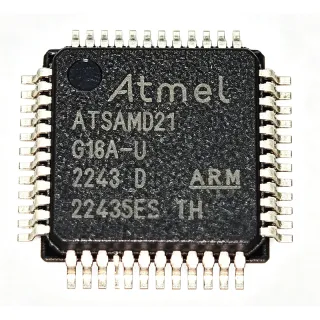
ATSAMC20E15A-AUT - 48MHz Cortex-M0+ 32KB Flash MCU | Microchip
MPN: ATSAMC20E15A-AUT ✓ Active| Qty | Unit Price | Extended |
|---|---|---|
| 1 | $2.85 | $2.85 |
| 10 | $2.61 | $26.10 |
| 100 | $2.32 | $232.00 |
| 500 | $2.05 | $1,025.00 |
| 1,000 | $1.78 | $1,780.00 |
ATSAMC20E15A-AUT Overview
A microcontroller (MCU) is a single-chip computer containing a CPU core, program and data memory, and integrated peripherals. The Cortex-M0+ is the smallest, most energy-efficient member of the ARM Cortex-M family, optimized for deterministic interrupt response and low active power in cost-sensitive embedded applications. The ATSAMC20E15A-AUT sits in the SAM C20 family of 5V Cortex-M0+ MCUs, engineered for industrial and commercial environments with electrically noisy power rails.
Key features include 6 SERCOM (each configurable as USART, I2C, or SPI), CAN-FD, a 12-bit ADC up to 1 Msps, a 10-bit DAC, a 16-bit timer/counter, RTC, brown-out detection and power-on reset. The on-chip PTC supports capacitive-touch sensing without external components. The 48 MHz core executes 78 DMIPS while drawing roughly 3 mA active and dropping below 5 uA in deep-sleep backup mode.
Architecturally, the part uses a 2-layer AHB-Lite bus with a separate APB bridge for low-speed peripherals. The integrated voltage regulator supports both linear (LDO) and DC-DC buck modes, and the device offers six DMA channels for low-CPU-overhead data movement. The "A" silicon revision reflects a planned errata-fixed die that supersedes earlier SAM C20 revs.
Typical applications include industrial sensor nodes, HVAC controllers, building automation, home appliances, automotive body and chassis subsystems (non-safety-critical), USB-to-CAN bridges, and low-cost HMI panels using the on-chip PTC. The wide 5V tolerance and CAN-FD support make it especially well suited to factory-floor devices.
When designing with this part, budget attention for the integrated DC-DC mode: it requires an external inductor and Schottky, and the LDO-mode default simplifies PCB layout. The CAN-FD peripheral is ISO 11898-1:2015 compliant and supports bit rates up to 1 Mbit/s.
This page synthesizes verified distributor pricing, drop-in alternatives, and practical design notes not found in the manufacturer datasheet alone.
Drop-in alternatives for ATSAMC20E15A-AUT — same package, pin-to-pin compatible. Different-package parts requiring PCB rework are excluded.
Variants in this series
Same-series models that are drop-in compatible with ATSAMC20E15A-AUT (same form factor and footprint) — differing in MSL Level, Operating Temperature, Package, RoHS Status, SRAM.
Quick Comparison Tool — Select alternative parts for side-by-side comparison:
ATSAMC20E16A-AUT
✅ Drop-In✓ In Stock
$1.96 / Unit
View Datasheet →ATSAMC20E15A-AAB
✅ Drop-In📋 Reference alternative (not in catalog)
ATSAMC20E14A-AUT
✅ Drop-In📋 Reference alternative (not in catalog)
ATSAMC21E15A-AUT
✅ Drop-In📋 Reference alternative (not in catalog)
ATSAMC20G15A-AUT
✅ Drop-In📋 Reference alternative (not in catalog)
MKL02Z32VFG4
✅ Drop-In📋 Reference alternative (not in catalog)
ATSAMC20E15A-AUT Maximum Ratings & Electrical Characteristics
| Core Architecture | ARM Cortex-M0+ (32-bit) |
| Maximum CPU Clock | 48 MHz |
| Flash Memory | 32 KB (32K x 8) |
| SRAM | 4 KB |
| Supply Voltage (VDD) | 2.7 V to 5.5 V |
| Operating Temperature | -40 C to +85 C |
| Package | 48-pin TQFP (7x7 mm) |
| Mounting Type | Surface Mount |
| SERCOM Modules | 6 (each USART/I2C/SPI configurable) |
| CAN-FD Controller | 1 (ISO 11898-1:2015, up to 1 Mbit/s) |
| ADC | 12-bit, up to 1 Msps |
| DAC | 10-bit, 1 channel |
| Peripheral Touch Controller (PTC) | Yes |
| Hardware Multiplier | Single-cycle |
| DMA Channels | 6 |
| Micro Trace Buffer | Yes |
| Memory Protection Unit (MPU) | Yes |
| RoHS Status | Compliant (Green) |
| MSL Level | 3 (per JEDEC J-STD-020) |
ATSAMC20E15A-AUT Pin Configuration
| Pin 1 | VDD — Digital supply voltage |
| Pin 2 | PA00 — GPIO / XIN32 (external 32.768 kHz crystal) |
| Pin 3 | PA01 — GPIO / XOUT32 |
| Pin 4 | PA02 — GPIO / AIN0 (ADC input) |
| Pin 5 | PA03 — GPIO / AIN1 / VREFA |
| Pin 6 | GND — Ground |
| Pin 7 | PA04 — GPIO / AIN2 / VREFB |
| Pin 8 | PA05 — GPIO / AIN3 |
| Pin 9 | PA06 — GPIO / AIN4 |
| Pin 10 | PA07 — GPIO / AIN5 |
| Pin 11 | PA08 — GPIO / AIN6 / PTC Y0 |
| Pin 12 | PA09 — GPIO / AIN7 / PTC Y1 |
| Pin 13 | PA10 — GPIO / AIN8 / PTC Y2 |
| Pin 14 | PA11 — GPIO / AIN9 / PTC Y3 |
| Pin 15 | VDD — Digital supply voltage |
| Pin 16 | GND — Ground |
| Pin 17 | PA12 — GPIO / CAN0 RX / PTC Y4 |
| Pin 18 | PA13 — GPIO / CAN0 TX / PTC Y5 |
| Pin 19 | PA14 — GPIO / SERCOM2 pad0 / PTC Y6 |
| Pin 20 | PA15 — GPIO / SERCOM2 pad1 / PTC Y7 |
| Pin 21 | PA16 — GPIO / SERCOM1 pad0 / PTC X0 |
| Pin 22 | PA17 — GPIO / SERCOM1 pad1 / PTC X1 |
| Pin 23 | PA18 — GPIO / SERCOM1 pad2 / PTC X2 |
| Pin 24 | PA19 — GPIO / SERCOM1 pad3 / PTC X3 |
| Pin 25 | PA20 — GPIO / SERCOM5 pad0 / PTC X4 |
| Pin 26 | PA21 — GPIO / SERCOM5 pad1 / PTC X5 |
| Pin 27 | PA22 — GPIO / SERCOM3 pad0 / PTC X6 |
| Pin 28 | PA23 — GPIO / SERCOM3 pad1 / PTC X7 |
| Pin 29 | PA24 — GPIO / SERCOM3 pad2 / PTC X8 |
| Pin 30 | PA25 — GPIO / SERCOM3 pad3 / PTC X9 |
| Pin 31 | GND — Ground |
| Pin 32 | VDD — Digital supply voltage |
| Pin 33 | PA26 — GPIO |
| Pin 34 | PA27 — GPIO |
| Pin 35 | PA28 — GPIO / RESET |
| Pin 36 | PA29 — GPIO / DEC |
| Pin 37 | PA30 — GPIO / SWCLK |
| Pin 38 | PA31 — GPIO / SWDIO |
| Pin 39 | PB00 — GPIO |
| Pin 40 | PB01 — GPIO |
| Pin 41 | PB02 — GPIO |
| Pin 42 | PB03 — GPIO |
| Pin 43 | PB04 — GPIO |
| Pin 44 | PB05 — GPIO |
| Pin 45 | PB06 — GPIO |
| Pin 46 | PB07 — GPIO |
| Pin 47 | PB08 — GPIO |
| Pin 48 | PB09 — GPIO |
Typical Applications
ATSAMC20E15A-AUT is suitable for 7 applications: Industrial CAN-FD Sensor Nodes, HVAC and Building Automation Controllers, Home Appliance Motor Control, Capacitive Touch HMI Panels, Automotive Body and Chassis Modules, Low-Cost USB-to-CAN Bridges, Smart Energy and Metering Endpoints.
Industrial CAN-FD Sensor Nodes
The ATSAMC20E15A-AUT is purpose-built for factory-floor sensor nodes thanks to its 2.7V to 5.5V supply that tolerates 24V bus-derived rails without external level shifters, and its integrated CAN-FD controller supporting ISO 11898-1:2015 at 1 Mbit/s data phase. The 32 KB Flash holds a CANopen or J1939 stack plus application code, while 4 KB SRAM buffers CAN messages. At 78 DMIPS / 48 MHz the Cortex-M0+ executes control loops well within millisecond budgets. Pair the part with an MCP2562FD CAN transceiver for a complete 2-node industrial bus.
Recommended
HVAC and Building Automation Controllers
The wide 5V-tolerant supply of the ATSAMC20E15A-AUT simplifies direct connection to 24VAC-derived rectified rails common in HVAC equipment. The Peripheral Touch Controller (PTC) enables capacitive-touch keypads without dedicated touch ICs, reducing BOM. Six SERCOM channels run multiple I2C temp sensors, SPI displays, and USART-modem links simultaneously. The 12-bit ADC at 1 Msps samples analog pressure and airflow signals with adequate resolution for closed-loop control. RTC with calendar supports time-stamped logging of HVAC events.
Recommended
Home Appliance Motor Control
Appliance designs using the ATSAMC20E15A-AUT benefit from the 16-bit timer/counter with PWM outputs that drive BLDC or brushed motors up to a few hundred watts. The 5V tolerance interfaces directly with 12V appliance rails through a simple LDO. CAN-FD or RS-485 connectivity (via SERCOM USART) supports modern appliance networking. The hardware multiplier executes single-cycle MAC operations needed for field-oriented control (FOC) math, while the MPU isolates the motor-control task from the user-interface task for safety and reliability.
Recommended
Capacitive Touch HMI Panels
The integrated Peripheral Touch Controller (PTC) of the ATSAMC20E15A-AUT supports self-capacitance and mutual-capacitance touch sensing across up to 32 channels without external components - ideal for sealed glass-front HMI panels in appliances, access control, and industrial equipment. The PTC handles water rejection, noise immunity, and gesture recognition in firmware. The 10-bit DAC drives analog contrast voltage for LCDs, while six SERCOMs link to UART-controlled display modules. The 48-pin TQFP has enough GPIO for both touch matrix and TFT control.
Recommended
Automotive Body and Chassis Modules
The ATSAMC20E15A-AUT is suitable for non-safety automotive body and chassis subsystems such as lighting controllers, mirror adjusters, seat controllers, and climate modules. The -40C to +85C industrial temperature range covers most cabin applications (for under-hood use, the SAM C20 -AUT suffix is industrial-grade; AEC-Q100 Grade 0 requires the SAM C20 -AUT automotive variant per Microchip ordering guide). CAN-FD at 1 Mbit/s supports modern vehicle bus architectures, and the 5V tolerance interfaces directly with 12V battery rails.
Recommended
Low-Cost USB-to-CAN Bridges
A USB-to-CAN bridge built around the ATSAMC20E15A-AUT uses one SERCOM for USB device (with an external USB PHY or via the on-chip USB on the larger SAM C20 G variant), another SERCOM as UART debug, and the CAN-FD peripheral for bus access. The 32 KB Flash accommodates USB CDC + CAN-FD driver stack, while 4 KB SRAM buffers USB and CAN packets. The wide 2.7V to 5.5V supply and industrial temperature range make the bridge suitable for both bench use and in-vehicle diagnostics.
Recommended
Smart Energy and Metering Endpoints
Smart-meter endpoints and sub-metering modules use the ATSAMC20E15A-AUT to sample current/voltage via the 12-bit ADC at 1 Msps, compute RMS and power quantities in firmware, and report over CAN, RS-485, or wireless M-Bus. The hardware multiplier accelerates DSP math for power calculations. The wide supply range accepts rectified mains-derived rails without extra regulation. The RTC with calendar provides time-stamped logging, and the integrated PTC enables tamper-detect capacitive buttons on meter enclosures.
Recommended
Recommended Products Summary
Engineering reference data for ATSAMC20E15A-AUT — comparison, design guidance, and compliance information.
Selection Guide
Comparison with Alternatives
| Parameter | This Product | ATSAMC20E16A-AUT | ATSAMC20E14A-AUT | ATSAMC21E15A-AUT | MKL02Z32VFG4 |
|---|---|---|---|---|---|
| Brand | Microchip Technology | Microchip Technology | Microchip Technology | Microchip Technology | NXP Semiconductors |
| Package | 48-pin TQFP | 48-pin TQFP - same | 48-pin TQFP - same | 48-pin TQFP - same | 48-pin QFN - different outline |
| Core | Cortex-M0+ | Cortex-M0+ | Cortex-M0+ | Cortex-M0+ | Cortex-M0+ |
| Max Clock | 48 MHz | 48 MHz | 48 MHz | 48 MHz | 48 MHz |
| Flash | 32 KB | 64 KB | 16 KB | 32 KB | 32 KB |
| SRAM | 4 KB | 4 KB | 2 KB | 4 KB | 4 KB |
| Supply Voltage | 2.7V to 5.5V | 2.7V to 5.5V | 2.7V to 5.5V | 2.7V to 5.5V | 1.71V to 3.6V |
| CAN-FD | Yes | Yes | Yes | Yes | No |
| SERCOM / UART | 6 SERCOM | 6 SERCOM | 6 SERCOM | 6 SERCOM | 2 UART |
Key Differentiators
- True 5V supply tolerance with integrated CAN-FD (vs MKL02Z32VFG4)
- Six flexible SERCOM channels (vs MKL02Z32VFG4)
- Integrated Peripheral Touch Controller (PTC) (vs ATSAMC20E14A-AUT)
Design Notes
ATSAMC20E15A-AUT requires a 100 nF decoupling capacitor on each VDD pin placed within 3 mm of the pin, plus a bulk 4.7 uF to 10 uF tantalum or ceramic cap on the main VDD rail. If the DC-DC buck mode is enabled, add an external 4.7 uH inductor and a Schottky diode (e.g., MBRS140) on the DEC pin - LDO mode (default after reset) eliminates these and simplifies layout for low-power designs.
The 48-pin TQFP package has a 0.5 mm pitch and benefits from a 4-layer PCB with a continuous ground plane under the IC. Route the SWD signals (PA30/PA31) as a 4-wire SWD header or Tag-Connect footprint for debug access. Keep the PTC lines short and guarded by a ground trace to maximize touch-sensing noise immunity in noisy industrial environments.
Do not leave unused SERCOM pins floating - configure them as outputs or enable internal pull resistors in firmware to avoid additional current draw through floating CMOS inputs. When migrating from ATSAMC20E15A-AAB (tray) to ATSAMC20E15A-AUT (tape-and-reel), verify your pick-and-place feeder supports 7-inch reels. If your design uses the CAN peripheral, do not forget the external MCP2562FD transceiver - the on-chip CAN-FD controller is logic-only.
Estimated: At 48 MHz active, typical core current is 3 mA at 3.3 V, giving ~10 mW dissipation - well within the TQFP-48 thermal resistance of approximately 60 C/W. Even at +85 C ambient, junction rise is only ~0.6 C, so no thermal management is needed for the MCU itself. However, design the PCB with adequate copper on the VDD and GND planes to keep the regulator section below 50 C for stable operation.
Compliance Information
Industrial temperature grade -40C to +85C. AEC-Q100 qualification requires the SAM C20 AEC-Q100 suffix variants - consult Microchip ordering guide for -AUT automotive grade nomenclature clarification.