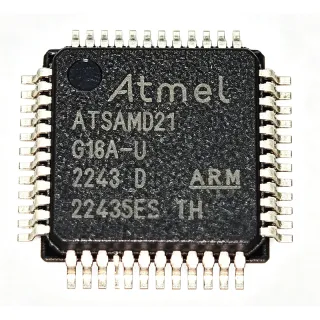
PIC16F19186-E/PT - 28KB Flash 32MHz 8-bit XLP MCU | Microchip
MPN: PIC16F19186-E/PT ✓ Active| Qty | Unit Price | Extended |
|---|---|---|
| 1 | $3.5 | $3.50 |
| 10 | $3.15 | $31.50 |
| 100 | $2.74 | $274.00 |
| 500 | $2.39 | $1,195.00 |
| 1,000 | $2.1 | $2,100.00 |
PIC16F19186-E/PT Overview
An 8-bit microcontroller (MCU) is a single-chip computer built around an 8-bit data bus and Harvard or modified-Harvard architecture; the PIC16F19186 is a member of Microchip's PIC16 enhanced mid-range family (PIC16 -> 8-bit MCU -> microcontroller -> embedded computing device). It executes most instructions in a single clock cycle and provides deterministic interrupt latency, which is why PIC MCUs are commonly chosen for real-time control, low-power sensing, and human-machine interface (HMI) panels.
Key features of this device include 28KB (16K x 14) Flash program memory, 2KB SRAM data memory, 256B EEPROM, integrated 12-bit ADC2 with computation, a 5-bit DAC, low-power comparators, CCP, PWM, CWG (Complementary Waveform Generator), SMT (Signal Measurement Timer), ZCD (Zero-Cross Detect), PPS (Peripheral Pin Select), RTCC, Hardware Limit Timer, WWDT, and Power Management Module (PMD). The -E industrial temperature grade spans -40C to +125C.
Architecture-wise, the device pairs the enhanced mid-range PIC core with on-chip LCD drive hardware, an internal charge pump to bias the LCD glass from a low-voltage supply, and a high-current I/O capability, reducing the external BOM for segment LCD designs. The XLP technology suite (idle/doze/sleep modes + nanoWatt XLP peripherals) enables microamp-level sleep currents.
Typical applications include battery-powered LCD consumer appliances, IoT sensor nodes with segment displays, e-meter / home-automation keypads, portable medical monitoring with LCD readouts, and ruggedized industrial HMI panels. The integrated LCD controller and charge pump allow direct drive of glass displays without a separate bias generator.
When designing with the PIC16F19186-E/PT, ensure the VDDCORE is properly decoupled (typically 0.1uF + bulk) and follow Microchip's LCD bias and charge-pump capacitor recommendations (typically 0.1uF to 1uF) for stable contrast. Use PPS to remap peripherals and avoid pin-conflict routing on the 48-pin TQFP. For lowest sleep current, gate unused peripherals via the PMD register.
This page synthesizes distributor pricing, drop-in same-package alternatives, and practical design notes that go beyond the manufacturer datasheet, helping engineers select, source, and design with the PIC16F19186-E/PT more efficiently.
Drop-in alternatives for PIC16F19186-E/PT — same package, pin-to-pin compatible. Different-package parts requiring PCB rework are excluded.
Variants in this series
Same-series models that are drop-in compatible with PIC16F19186-E/PT (same form factor and footprint) — differing in Package, ADC, Operating Temperature, DAC, Program Memory (Flash).
Quick Comparison Tool — Select alternative parts for side-by-side comparison:
PIC16F19176-I/PT
✅ Drop-In✓ In Stock
$1.85 / Unit
View Datasheet →PIC16F19175-E/PT
✅ Drop-In✓ In Stock
$1.72 / Unit
View Datasheet →PIC16F19186-E/MV
✅ Drop-In✓ In Stock
$2.65 / Unit
View Datasheet →PIC16F18877-I/PT
✅ Drop-In✓ In Stock
$2.18 / Unit
View Datasheet →PIC16F18876-E/P
✅ Drop-In✓ In Stock
$2.04 / Unit
View Datasheet →PIC16F19186-E/PT Maximum Ratings & Electrical Characteristics
| Core Architecture | PIC16 enhanced mid-range 8-bit RISC |
| Program Memory (Flash) | 28 KB (16K x 14 words) |
| Data SRAM | 2 KB |
| EEPROM | 256 bytes |
| Maximum CPU Speed | 32 MHz |
| Instruction Set Width | 14-bit |
| Operating Temperature | -40C to +125C (industrial, -E grade) |
| Package | 48-pin TQFP (7x7 mm) |
| DAC | 5-bit DAC |
| Comparators | Low-power comparators |
| LCD Driver | Integrated with charge pump |
| Timers | CCP, SMT (Signal Measurement Timer), Hardware Limit Timer, WWDT |
| PWM / CWG | PWM + Complementary Waveform Generator |
| ZCD / PPS | Zero-Cross Detect + Peripheral Pin Select |
| RTCC | Real-Time Clock Calendar |
| PMD | Peripheral Module Disable (power management) |
| Mounting Type | Surface Mount (TQFP) |
| RoHS Status | Compliant |
PIC16F19186-E/PT Pin Configuration
| Pin 1 | VDD — Positive supply voltage |
| Pin 2 | RA5 — Port A bit 5 / I/O |
| Pin 3 | RA4 — Port A bit 4 / I/O |
| Pin 4 | RA3 — Port A bit 3 / I/O |
| Pin 5 | RC5 — Port C bit 5 / I/O |
| Pin 6 | RC4 — Port C bit 4 / I/O |
| Pin 7 | RC3 — Port C bit 3 / I/O |
| Pin 8 | RC6 — Port C bit 6 / I/O |
| Pin 9 | RC7 — Port C bit 7 / I/O |
| Pin 10 | RB7 — Port B bit 7 / I/O |
| Pin 11 | RB6 — Port B bit 6 / I/O |
| Pin 12 | RB5 — Port B bit 5 / I/O |
| Pin 13 | RB4 — Port B bit 4 / I/O |
| Pin 14 | RC2 — Port C bit 2 / I/O |
| Pin 15 | RC1 — Port C bit 1 / I/O |
| Pin 16 | RC0 — Port C bit 0 / I/O |
| Pin 17 | OSC1 — Crystal oscillator input |
| Pin 18 | OSC2 — Crystal oscillator output |
| Pin 19 | VSS — Ground reference |
| Pin 20 | VDD — Positive supply voltage |
| Pin 21 | RB0 — Port B bit 0 / I/O |
| Pin 22 | RB1 — Port B bit 1 / I/O |
| Pin 23 | RB2 — Port B bit 2 / I/O |
| Pin 24 | RB3 — Port B bit 3 / I/O |
| Pin 25 | RA2 — Port A bit 2 / I/O |
| Pin 26 | RA1 — Port A bit 1 / I/O / ICSPCLK |
| Pin 27 | RA0 — Port A bit 0 / I/O / ICSPDAT |
| Pin 28 | VSS — Ground reference |
| Pin 29 | RA7 — Port A bit 7 / I/O |
| Pin 30 | RA6 — Port A bit 6 / I/O |
| Pin 31 | RC0 — Port C bit 0 / SEG0 (LCD segment) |
| Pin 32 | RC1 — Port C bit 1 / SEG1 (LCD segment) |
| Pin 33 | RC2 — Port C bit 2 / SEG2 (LCD segment) |
| Pin 34 | RC3 — Port C bit 3 / SEG3 (LCD segment) |
| Pin 35 | RD0 — Port D bit 0 / I/O |
| Pin 36 | RD1 — Port D bit 1 / I/O |
| Pin 37 | RD2 — Port D bit 2 / I/O |
| Pin 38 | RD3 — Port D bit 3 / I/O |
| Pin 39 | RD4 — Port D bit 4 / I/O |
| Pin 40 | RD5 — Port D bit 5 / I/O |
| Pin 41 | RD6 — Port D bit 6 / I/O |
| Pin 42 | RD7 — Port D bit 7 / I/O |
| Pin 43 | RE0 — Port E bit 0 / I/O |
| Pin 44 | RE1 — Port E bit 1 / I/O |
| Pin 45 | RE2 — Port E bit 2 / I/O |
| Pin 46 | VDDCORE — Core voltage decoupling pin |
| Pin 47 | VSS — Ground reference |
| Pin 48 | VDD — Positive supply voltage |
Typical Applications
PIC16F19186-E/PT is suitable for 7 applications: Battery-Powered LCD Consumer Appliances, IoT Sensor Nodes with Segment LCD, Smart Home HMI Keypads and Thermostats, Industrial HMI and Panel Meters, Portable Medical Monitoring Devices, Automotive Cabin HMI and Dashboard Sub-Displays, E-Meter and Utility Meter Displays.
Battery-Powered LCD Consumer Appliances
The PIC16F19186-E/PT is purpose-built for battery-powered LCD consumer appliances such as portable kitchen scales, blood-pressure monitors, and remote-control panels with segment displays. Its integrated charge pump drives the LCD glass directly from a 3V coin cell without an external bias generator, while XLP technology drops sleep current into the nanoamp range - critical for applications where two AA cells must last 2+ years. The 12-bit ADC2 with computation handles sensor readings on-chip, reducing MCU wake time. Compared with discrete MCU + LCD driver solutions, the integrated architecture saves PCB area and BOM cost while the 32 MHz CPU keeps button-debounce and UI logic responsive.
Recommended
IoT Sensor Nodes with Segment LCD
The PIC16F19186-E/PT fits IoT sensor nodes that need a local segment-LCD readout (temperature, humidity, air-quality displays) because the on-chip LCD controller eliminates an external driver and the Peripheral Pin Select (PPS) allows flexible I/O mapping for sensors and radios. The 32 MHz CPU runs Microchip's Modbus or proprietary RF stacks, while the SMT (Signal Measurement Timer) captures sensor pulse streams without CPU intervention. Battery life is dominated by sleep current, which XLP technology targets at sub-1uA - enabling years of operation from a primary cell. The 256B EEPROM stores calibration constants that survive battery swap events.
Recommended
Smart Home HMI Keypads and Thermostats
Wall-mounted smart-home keypads and thermostats benefit from the PIC16F19186-E/PT because the integrated LCD driver directly addresses segment displays (time, temperature, setpoint) without extra ICs, while the capacitive touch-ready I/O and PWM channels handle backlight dimming and haptic feedback. The -E temperature grade (-40C to +125C) handles indoor environments near heating ducts or exterior walls. RTCC provides accurate timekeeping across power cycles with on-chip 32 kHz crystal support, and ZCD (Zero-Cross Detect) enables silent triac control of AC loads for line-voltage thermostats. Engineers gain BOM reduction versus MCU+LCD-driver+ RTC three-chip solutions.
Recommended
Industrial HMI and Panel Meters
The PIC16F19186-E/PT powers industrial HMI panels and panel meters where a segment LCD shows process variables (pressure, flow, voltage) in 4-20 mA loop-powered environments. The 12-bit ADC2 with computation oversamples and averages noisy industrial signals on-chip, freeing the CPU to manage Modbus RTU over UART. The Hardware Limit Timer (HLT) and Windowed Watchdog (WWDT) meet functional-safety expectations for fault detection, while the -E temperature grade survives +85C cabinet interiors. The integrated CWG generates complementary PWM for synchronous buck pre-regulators feeding the analog supply rails.
Recommended
Portable Medical Monitoring Devices
Portable medical devices (pulse oximeters, glucose meters, digital thermometers) use the PIC16F19186-E/PT because XLP technology supports the IEC 60601-01 low-current sleep profile that AAA or coin cells demand, while the integrated LCD driver shows readings on the device's segment display without a second chip. The 12-bit ADC2 captures pulse or temperature waveforms with hardware averaging, and the CCP/SMT timers measure pulse intervals precisely for SpO2 calculations. Microchip's medical-grade quality and documentation support IEC 60601-1 design review. PPS allows routing sensitive analog inputs away from digital switching noise.
Recommended
Automotive Cabin HMI and Dashboard Sub-Displays
Within automotive cabin HMI and sub-displays (climate-control readouts, mirror displays, seat-controller panels), the PIC16F19186-E/PT serves as a segment-LCD sub-display driver because its -40C to +125C industrial grade handles cabin thermal swings, while the integrated charge pump and LCD controller replace a separate LCD-driver ASIC. The PWM + CWG pair handles LED backlight dimming, and LIN bus-ready UART connects to the body-control module. Engineers pair the PIC with a CAN/LIN transceiver and use the CCP modules to interpret HVAC rotary encoders. Note: a fully AEC-Q100 qualified variant would be required for under-hood applications.
Recommended
E-Meter and Utility Meter Displays
Single-phase e-meters and utility sub-meters with segment LCD readouts use the PIC16F19186-E/PT to drive consumption displays while an external metrology IC handles energy measurement. The RTCC tracks time-of-use tariffs, and the 256B EEPROM stores calibration and billing snapshots that survive brownouts. The integrated 12-bit ADC2 monitors the meter's own supply and battery backup, while ZCD detects mains zero-crossings for accurate reactive-power timestamping. The CWG can drive an audible alarm transducer for tamper alerts. XLP sleep modes keep the meter's parasitic draw within utility regulatory limits.
Recommended
Recommended Products Summary
Engineering reference data for PIC16F19186-E/PT — comparison, design guidance, and compliance information.
Selection Guide
Comparison with Alternatives
| Parameter | This Product | PIC16F19176-I/PT | PIC16F19175-E/PT | PIC16F19186-E/MV | PIC16F18877-I/PT | PIC16F18876-E/P |
|---|---|---|---|---|---|---|
| Brand | Microchip Technology | Microchip Technology | Microchip Technology | Microchip Technology | Microchip Technology | Microchip Technology |
| Package | 48-pin TQFP (7x7 mm, PT) | 48-pin TQFP (PT) - same | 48-pin TQFP (PT) - same | 48-pin TQFP-equivalent die in UQFN MV | 48-pin TQFP (PT) - same | TQFP/DIP variant |
| Flash Memory | 28 KB | 28 KB | 14 KB | 28 KB | 28 KB | 28 KB |
| SRAM | 2 KB | 2 KB | 1 KB | 2 KB | 2 KB | 2 KB |
| EEPROM | 256 bytes | 256 bytes | 256 bytes | 256 bytes | 256 bytes | 256 bytes |
| Maximum CPU Speed | 32 MHz | 32 MHz | 32 MHz | 32 MHz | 32 MHz | 32 MHz |
| Temperature Grade | -E: -40C to +125C | -I: -40C to +85C | -E: -40C to +125C | -E: -40C to +125C | -I: -40C to +85C | -E: -40C to +125C |
| LCD Driver | Integrated with charge pump | Integrated with charge pump | Integrated with charge pump | Integrated with charge pump | Integrated | Integrated |
| ADC | 12-bit ADC2 with computation | 12-bit ADC2 with computation | 12-bit ADC2 with computation | 12-bit ADC2 with computation | 12-bit ADC2 with computation | 12-bit ADC2 with computation |
Key Differentiators
- Integrated LCD charge pump eliminates external bias generator (vs PIC16F18877-I/PT)
- Highest memory tier in the PIC16F191x6 family in TQFP-48 (vs PIC16F19175-E/PT)
- Extended -E industrial temperature grade vs -I (vs PIC16F19176-I/PT)
- Core Independent Peripherals (CIP) for low-power determinism (vs PIC16F19186-E/MV (UQFN variant))
Design Notes
Decouple VDD and VDDCORE with a 0.1uF ceramic capacitor placed within 3 mm of each pin pair, plus a bulk 1-10uF tantalum or ceramic capacitor. The PIC16F19186-E/PT VDDCORE pin must be tied only to its decoupling cap - do not load it externally, as it is the internal regulator output. For battery applications, gate unused peripherals using the PMD register to drop sleep current below 1 uA.
Do not skip the LCD bias capacitor network recommended in the PIC16(L)F19186 datasheet; absent capacitors cause low contrast and ghost segments. When using the integrated charge pump, populate both the charge-pump capacitor (typically 0.1uF) and the VLCD bypass (typically 0.1uF to 1uF). Also remember to enable the LCD charge pump in the LCDCON register before segment activation.
Route the ICSP/ICD pins (RA0/ICSPDAT, RA1/ICSPCLK) so they can be accessed by the programmer header without crossing analog traces. Place the 32 kHz crystal within 5 mm of OSC1/OSC2 with a guard ground ring for RTCC accuracy. Keep LCD segment traces short and matched in length within a group to minimize ghost-segment artifacts.
When using PPS to remap peripherals, always clear and reconfigure PPS registers around writes to avoid transient glitches on remapped functions. The ZCD (Zero-Cross Detect) input should be AC-coupled through a current-limiting resistor when monitoring mains - never connect mains directly to the ZCD pin. For noisy industrial environments, use the 12-bit ADC2 hardware averaging and oversampling features to suppress 50/60 Hz interference.
Compliance Information
RoHS and lead-free per Microchip product page. PIC16F19186-E/PT is industrial-grade (-E), not AEC-Q100 automotive-qualified; for under-hood automotive applications, look for a specific AEC-Q100 qualified PIC16F variant. Halogen-free status not explicitly stated in retrieved data.