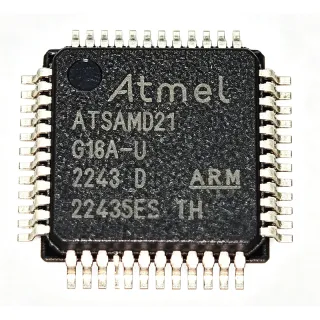
ATSAMC20E16A-AUT - 48MHz ARM Cortex-M0+ MCU, 64KB Flash, 5V CAN-FD | Microchip
MPN: ATSAMC20E16A-AUT ✓ Active| Qty | Unit Price | Extended |
|---|---|---|
| 1 | $3.42 | $3.42 |
| 10 | $3.08 | $30.80 |
| 100 | $2.74 | $274.00 |
| 500 | $2.45 | $1,225.00 |
| 1,000 | $2.19 | $2,190.00 |
| 2,500 | $1.96 | $4,900.00 |
ATSAMC20E16A-AUT Overview
What is a 5V Cortex-M0+ microcontroller? An ARM Cortex-M0+ microcontroller is a 32-bit RISC processor core implementing the Thumb/Thumb-2 instruction set, designed for the lowest gate count and energy efficiency in the Cortex-M family. Devices in the 5V-tolerant class integrate linear regulators and ESD-protected I/O that survive the voltage transients and EMI typical of industrial buses, making them part of the broader category of embedded microcontrollers within the semiconductor and MCU hierarchy. They sit above 8/16-bit MCUs in performance and below Cortex-M3/M4 parts in cost and DSP capability.
Key features of the ATSAMC20E16A-AUT include a single-cycle hardware multiplier, a Micro Trace Buffer for lightweight instruction trace, a Memory Protection Unit for safe partitioning of code, a dedicated 2 KB Flash block that emulates EEPROM endurance without wearing the main array, and a Peripheral Touch Controller (PTC) supporting capacitive touch sensing. The device adds a CAN-FD controller alongside the SERCOM-configurable serial channels (each can become I2C, SPI, or UART), giving designers a mix of industrial-fieldbus and user-interface peripherals on one die.
The architecture pairs the Cortex-M0+ core with a 6-channel Direct Memory Access controller, a 12-bit 1 MSPS analog-to-digital converter, two analog comparators, a 16-bit timer/counter array, and a real-time clock. Brown-out detection, watchdog timer, and power-on reset are integrated, while the on-chip voltage regulator accepts a single 2.7 V to 5.5 V rail and produces the internal 1.2 V core supply, simplifying 5V system designs that previously required external regulators for 3.3 V MCUs.
Typical applications include industrial sensor transmitters, HVAC controllers, building-automation nodes, automotive body and accessory modules (with CAN-FD), capacitive-touch human-machine interfaces, and low-cost motor-control sub-assist functions where the 5V tolerance eliminates level-shifters to 5V sensors. The wide supply range also suits battery-backed smart meters and remote I/O modules.
Designers should budget for the 48-pin TQFP's exposed-pad thermal dissipation path and observe Microchip's decoupling guidance (one 100 nF per supply pin plus a bulk 4.7 uF) to keep the internal LDO in regulation during high-current SERCOM and CAN-FD transients.
This page synthesizes distributor pricing, drop-in same-family alternatives, and practical design notes not found in the manufacturer datasheet alone.
Drop-in alternatives for ATSAMC20E16A-AUT — same package, pin-to-pin compatible. Different-package parts requiring PCB rework are excluded.
Variants in this series
Same-series models that are drop-in compatible with ATSAMC20E16A-AUT (same form factor and footprint) — differing in ADC, Operating Temperature, DAC, Timers, Package.
Quick Comparison Tool — Select alternative parts for side-by-side comparison:
ATSAMC20E17A-AUT
✅ Drop-In📋 Reference alternative (not in catalog)
ATSAMC20G16A-AUT
✅ Drop-In ⚠️ 参数待验证✓ In Stock
$2.65 / Unit
View Datasheet →ATSAMC20E16A-AUT Maximum Ratings & Electrical Characteristics
| Core Processor | ARM Cortex-M0+ |
| Core Size | 32-Bit Single-Core |
| Maximum CPU Clock | 48 MHz |
| Program Memory Size | 64 KB (64K x 8) Flash |
| EEPROM Emulation | 2 KB independent self-programmable Flash |
| SRAM | 8 KB |
| Supply Voltage (VDDIN) | 2.7 V to 5.5 V |
| I/O Pins | 26 |
| Connectivity | I2C, LINbus, SPI, UART/USART, CAN-FD |
| Peripherals | Brown-out Detect/Reset, DMA, POR, WDT, PTC, ADC, AC, RTC |
| ADC | 12-bit, up to 1 MSPS |
| Package | 48-TQFP (7x7 mm) |
| Operating Temperature | -40C to +85C |
| Mounting Type | Surface Mount |
| MSL Level | 3 |
| RoHS Status | Compliant |
ATSAMC20E16A-AUT Pin Configuration
| Pin 1 | PA00 — GPIO / XIN (external clock input) |
| Pin 2 | PA01 — GPIO / XOUT (external clock output) |
| Pin 3 | VDDIN — Digital supply input (2.7-5.5 V) |
| Pin 4 | VDDIO — I/O supply reference |
| Pin 5 | GND — Ground |
| Pin 6 | PA02 — GPIO / AIN0 (ADC input) |
| Pin 7 | PA03 — GPIO / AIN1 / VREFA |
| Pin 8 | PA04 — GPIO / AIN2 / VREFB |
| Pin 9 | PA05 — GPIO / AIN3 |
| Pin 10 | PA06 — GPIO / AIN4 |
| Pin 11 | PA07 — GPIO / AIN5 |
| Pin 12 | PA08 — GPIO / AIN6 / PTC X0 |
| Pin 13 | PA09 — GPIO / AIN7 / PTC Y0 |
| Pin 14 | PA10 — GPIO / AIN8 / PTC X1 |
| Pin 15 | PA11 — GPIO / AIN9 / PTC Y1 |
| Pin 16 | PA12 — GPIO / AIN10 / PTC X2 |
| Pin 17 | PA13 — GPIO / AIN11 / PTC Y2 |
| Pin 18 | PA14 — GPIO / AIN12 / PTC X3 |
| Pin 19 | PA15 — GPIO / AIN13 / PTC Y3 |
| Pin 20 | PA16 — GPIO / SERCOM1 PAD0 (I2C/SPI/UART) |
| Pin 21 | PA17 — GPIO / SERCOM1 PAD1 |
| Pin 22 | PA18 — GPIO / SERCOM1 PAD2 |
| Pin 23 | PA19 — GPIO / SERCOM1 PAD3 |
| Pin 24 | PA20 — GPIO / SERCOM3 PAD0 |
| Pin 25 | PA21 — GPIO / SERCOM3 PAD1 |
| Pin 26 | PA22 — GPIO / SERCOM3 PAD2 |
| Pin 27 | PA23 — GPIO / SERCOM3 PAD3 |
| Pin 28 | PA24 — GPIO / SERCOM5 PAD0 / CAN0 TX |
| Pin 29 | PA25 — GPIO / SERCOM5 PAD1 / CAN0 RX |
| Pin 30 | PA26 — GPIO / SERCOM5 PAD2 |
| Pin 31 | PA27 — GPIO / SERCOM5 PAD3 |
| Pin 32 | PA28 — GPIO |
| Pin 33 | PA29 — GPIO |
| Pin 34 | PA30 — GPIO / SWCLK (programming/debug) |
| Pin 35 | PA31 — GPIO / SWDIO (programming/debug) |
| Pin 36 | PB00 — GPIO |
| Pin 37 | PB01 — GPIO |
| Pin 38 | PB02 — GPIO |
| Pin 39 | PB03 — GPIO |
| Pin 40 | PB04 — GPIO |
| Pin 41 | PB05 — GPIO |
| Pin 42 | PB06 — GPIO |
| Pin 43 | PB07 — GPIO |
| Pin 44 | PB08 — GPIO |
| Pin 45 | PB09 — GPIO |
| Pin 46 | RESET — Reset input, active low |
| Pin 47 | VDDCORE — Internal core voltage decoupling (cap to GND) |
| Pin 48 | GND — Ground |
Typical Applications
ATSAMC20E16A-AUT is suitable for 6 applications: Industrial Sensor Transmitters, Building Automation and HVAC Nodes, Automotive Body and Accessory Modules, Capacitive-Touch HMI Panels, Low-Cost Motor-Control Sub-Assist, Smart Energy and Metering Nodes.
Industrial Sensor Transmitters
The ATSAMC20E16A-AUT's 2.7 V to 5.5 V supply tolerance, 12-bit 1 MSPS ADC, and SERCOM-configurable I2C/SPI/UART channels make it well-suited for 4-20 mA and IO-Link sensor transmitters. According to the SAM C20 datasheet, the integrated CAN-FD and 5V-tolerant GPIO remove the need for external level shifters, reducing BOM cost for pressure, flow, and temperature transmitters mounted on 24V industrial loops.
Recommended
Building Automation and HVAC Nodes
The ATSAMC20E16A-AUT delivers 48 MHz Cortex-M0+ performance with 64 KB Flash, ample for BACnet/Modbus stacks, and integrates the Peripheral Touch Controller (PTC) for capacitive buttons on thermostats and access panels. According to Microchip application notes, the part's 5V tolerance interfaces directly with triac-driven HVAC loads and 24V actuator drivers, simplifying the power tree of building-automation nodes.
Recommended
Automotive Body and Accessory Modules
The ATSAMC20E16A-AUT is well-matched to non-safety body controllers, lighting nodes, and accessory modules where CAN-FD connectivity and 5V rail tolerance are required. According to the SAM C20 datasheet, the -AUT variant's -40C to +85C rating covers cabin environments, and its 26 GPIO can drive LED matrices and switch-scan matrices without external expanders, reducing module cost in seat controllers and mirror-adjust units.
Recommended
Capacitive-Touch HMI Panels
The ATSAMC20E16A-AUT integrates Microchip's Peripheral Touch Controller (PTC), supporting capacitive buttons, sliders, and wheels without an external touch IC. According to the SAM C20 datasheet, the PTC works with the on-chip DMA to offload touch scanning from the CPU, freeing Cortex-M0+ cycles for HMI logic, display driving, and BLE/Wi-Fi backhaul via SERCOM-attached modules.
Recommended
Low-Cost Motor-Control Sub-Assist
The ATSAMC20E16A-AUT's 16-bit timer/counter array with PWM and its 12-bit ADC with 1 MSPS sampling rate allow simple BLDC and stepper sub-assist loops such as small fans, pumps, and dampers. According to Microchip's motor-control collateral, the part's CAN-FD connectivity simplifies integration into coordinated multi-motor systems like HVAC air-handling units, where it serves as a peripheral node to a higher-end controller.
Recommended
Smart Energy and Metering Nodes
The ATSAMC20E16A-AUT's 5V tolerance interfaces directly with shunt resistors and Rogowski coils used in single-phase energy meters, while its low-power Run, Wait, and Sleep modes with RTC retention suit battery-backed metering. According to the SAM C20 datasheet, the 2 KB EEPROM-emulation Flash block stores tariff tables and consumption logs without wearing the main array, extending product lifetime in deployed meters.
Recommended
Recommended Products Summary
Engineering reference data for ATSAMC20E16A-AUT — comparison, design guidance, and compliance information.
Selection Guide
Comparison with Alternatives
| Parameter | This Product | ATSAMC20E17A-AUT | ATSAMC20G16A-AUT |
|---|---|---|---|
| Brand | Microchip Technology | Microchip Technology | Microchip Technology |
| Package | 48-TQFP (7x7 mm) | 48-TQFP (7x7 mm) - same | 48-TQFP (7x7 mm) - same |
| Core | ARM Cortex-M0+ | ARM Cortex-M0+ | ARM Cortex-M0+ with op-amps |
| Max Clock | 48 MHz | 48 MHz | 48 MHz |
| Flash | 64 KB | 128 KB | 64 KB |
| SRAM | 8 KB | 8 KB | 8 KB |
| Supply Voltage | 2.7 V to 5.5 V | 2.7 V to 5.5 V | 2.7 V to 5.5 V |
| CAN-FD | Yes | Yes | Yes |
| Integrated Op-Amps | No | No | Yes (SAM C20G) |
| Operating Temperature | -40C to +85C | -40C to +85C | -40C to +85C |
Key Differentiators
- 5V-tolerant supply and GPIO without external level shifters (vs ATSAMC20E15A-MUT (32-QFN))
- Integrated CAN-FD controller without external MCP2518FD (vs ATSAMC20E15A-MUT (32-QFN, no CAN-FD))
- Same-family upgrade path to 128 KB Flash without PCB rework (vs ATSAMC20E17A-AUT (128 KB Flash))
Design Notes
Place a 100 nF decoupling capacitor on each VDDIN/VDDIO pin and a single bulk 4.7 uF ceramic on the main VDDIN rail, positioned within 3 mm of the package. Estimated: a 48-pin TQFP can demand up to 15 mA transient current when the CAN-FD and SERCOM blocks switch simultaneously; without adequate bulk capacitance the internal 1.2 V regulator droops and triggers the brown-out detector.
Route the SWDIO and SWCLK signals (PA30, PA31) with a 50-ohm-controlled impedance to the programming header, keeping them under 50 mm to avoid signal-integrity issues with the on-chip debug logic. According to Microchip's SAM C20 hardware design notes, add 4.7 kohm pull-ups on SWDIO/SWCLK if the header is removable, otherwise the debugger may fail to handshake.
Do not leave unused PTC pins floating - the Peripheral Touch Controller injects a small bias current that disturbs the touch baseline if left open. According to the SAM C20 datasheet, unused PTC channels must be tied to GND through a 100 kohm resistor or reconfigured as standard GPIO with the touch channels disabled in the PTC control register.
Estimated: at 48 MHz CPU clock and full peripheral activity, the 48-TQFP package dissipates approximately 30-40 mW, well within the junction temperature budget without a heatsink. For designs that disable unused peripherals and run the CPU at lower clocks via the DFLL48M, total active current drops below 5 mA, enabling 5V designs without thermal relief copper pours.
Compliance Information
RoHS and REACH compliant per Microchip product page. Not AEC-Q100 qualified; for automotive safety applications consider SAM C21 or SAM V71 families that include automotive-grade parts. Lead-free and halogen-free per Microchip material declaration.