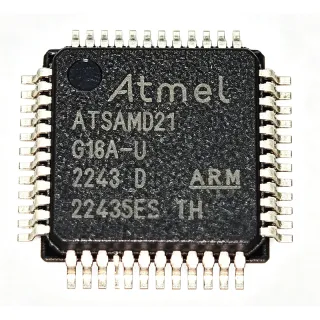
ATSAMC21G18A-AUT - 256KB Flash 48MHz Cortex-M0+ MCU | Microchip
MPN: ATSAMC21G18A-AUT ✓ Active| Qty | Unit Price | Extended |
|---|---|---|
| 1 | $4.62 | $4.62 |
| 10 | $4.15 | $41.50 |
| 100 | $3.74 | $374.00 |
| 500 | $3.39 | $1,695.00 |
| 1,000 | $3.06 | $3,060.00 |
| 2,500 | $2.78 | $6,950.00 |
ATSAMC21G18A-AUT Overview
What is a Cortex-M0+ microcontroller? An ARM Cortex-M0+ is the smallest and most energy-efficient core in the Cortex-M family, designed for deeply embedded, deterministic 32-bit applications. It belongs to the broader microcontroller (MCU) hierarchy (microcontroller -> embedded processor -> semiconductor IC) and supersedes legacy 8/16-bit architectures by adding a 32-bit datapath, NVIC, and modern toolchain support while retaining ultra-low active and sleep currents. The SAM C21 series targets industrial and commercial designs in electrically noisy environments.
Key features of the ATSAMC21G18A-AUT include: SERCOM (Serial Communication Interface) modules that can be independently configured as UART, SPI, or I2C; a CAN-FD controller for high-bandwidth automotive networking; a 12-bit ADC, 10-bit DAC, and analog comparators; PWM timers with complementary outputs and dead-time insertion for motor control; and 5V-tolerant I/O allowing direct interface to legacy 5V peripherals without level shifters.
On the architecture side, the device uses the Cortex-M0+ v6M instruction set with a 2-stage pipeline, single-cycle I/O port access, and tightly-coupled SRAM for deterministic interrupt response. The CAN-FD peripheral supports ISO 11898-1:2015 frames with up to 64-byte payloads, and the SERCOM engine allows flexible pin mapping via the I/O multiplexing matrix.
Typical applications include industrial automation (sensor hubs, PLC I/O modules), automotive body and chassis electronics (using CAN-FD), building automation (HVAC, lighting controllers), home appliances, and low-cost motor control such as small BLDC or stepper drivers. AEC-Q100 grade 1 qualification also enables under-hood and dashboard deployment.
When designing with this MCU, plan the I/O multiplexing early because SERCOM and timer functions share mapping; Microchip's MPLAB Harmony Configurator (MCC) pin manager simplifies assignment. The 5V-tolerant pins tolerate but do not drive 5V outputs, so external level shifting is required when communicating with true 5V peripherals.
Drop-in alternatives for ATSAMC21G18A-AUT — same package, pin-to-pin compatible. Different-package parts requiring PCB rework are excluded.
Variants in this series
Same-series models that are drop-in compatible with ATSAMC21G18A-AUT (same form factor and footprint) — differing in ADC, Operating Temperature, Package, Core, Flash Memory.
Quick Comparison Tool — Select alternative parts for side-by-side comparison:
ATSAMC21G17A-AUT
✅ Drop-In ⚠️ 参数待验证✓ In Stock
$2.78 / Unit
View Datasheet →ATSAMC21G18A-MUT
✅ Drop-In ⚠️ 参数待验证📋 Reference alternative (not in catalog)
ATSAMC21G18A-ANT
✅ Drop-In✓ In Stock
$4.62 / Unit
View Datasheet →ATSAMC21G15A-AUT
✅ Drop-In ⚠️ 参数待验证✓ In Stock
$2.15 / Unit
View Datasheet →ATSAMC20G18A-ANT
✅ Drop-In ⚠️ 参数待验证✓ In Stock
$2.34 / Unit
View Datasheet →ATSAMC21G18A-AUT Maximum Ratings & Electrical Characteristics
| Core | ARM Cortex-M0+ (32-bit) |
| Max CPU Clock | 48 MHz |
| Program Flash | 256 KB (256K x 8) |
| SRAM | 32 KB |
| EEPROM Emulation Flash | 8 KB (independent, self-programmable) |
| Supply Voltage (VDDIN) | 2.7 V to 5.5 V |
| I/O Voltage Tolerance | 5 V tolerant |
| Operating Temperature | -40 C to +125 C (automotive grade) |
| Package | 48-TQFP (7x7 mm) |
| Mounting Type | Surface Mount |
| CAN-FD Controller | Yes (ISO 11898-1:2015) |
| SERCOM Modules | Configurable as UART/SPI/I2C |
| ADC | 12-bit, up to 1 Msps |
| DAC | 10-bit |
| Memory Protection Unit (MPU) | Yes |
| Micro Trace Buffer | Yes |
| RoHS Status | Compliant |
| AEC-Q100 | Qualified (grade 1) |
ATSAMC21G18A-AUT Pin Configuration
| Pin 1 | PA00 — General purpose I/O / XIN32 |
| Pin 2 | PA01 — General purpose I/O / XOUT32 |
| Pin 3 | VDDIO — Digital I/O supply voltage |
| Pin 4 | GND — Ground |
| Pin 5 | PA02 — General purpose I/O / ADC AIN0 |
| Pin 6 | PA03 — General purpose I/O / ADC AIN1 |
| Pin 7 | PA04 — General purpose I/O / VREFA |
| Pin 8 | PA05 — General purpose I/O |
| Pin 9 | PA06 — General purpose I/O |
| Pin 10 | PA07 — General purpose I/O |
| Pin 11 | VDDIN — Main voltage regulator input |
| Pin 12 | GND — Ground |
| Pin 13 | PA08 — General purpose I/O |
| Pin 14 | PA09 — General purpose I/O |
| Pin 15 | PA10 — General purpose I/O |
| Pin 16 | PA11 — General purpose I/O |
| Pin 17 | PA12 — General purpose I/O |
| Pin 18 | PA13 — General purpose I/O |
| Pin 19 | PA14 — General purpose I/O |
| Pin 20 | PA15 — General purpose I/O |
| Pin 21 | PA16 — General purpose I/O |
| Pin 22 | PA17 — General purpose I/O |
| Pin 23 | PA18 — General purpose I/O |
| Pin 24 | PA19 — General purpose I/O |
| Pin 25 | VDDIO — Digital I/O supply voltage |
| Pin 26 | GND — Ground |
| Pin 27 | PA20 — General purpose I/O |
| Pin 28 | PA21 — General purpose I/O |
| Pin 29 | PA22 — General purpose I/O |
| Pin 30 | PA23 — General purpose I/O |
| Pin 31 | PA24 — General purpose I/O |
| Pin 32 | PA25 — General purpose I/O |
| Pin 33 | PB00 — General purpose I/O |
| Pin 34 | PB01 — General purpose I/O |
| Pin 35 | PB02 — General purpose I/O / ADC AIN14 |
| Pin 36 | PB03 — General purpose I/O |
| Pin 37 | PB04 — General purpose I/O |
| Pin 38 | PB05 — General purpose I/O |
| Pin 39 | PB06 — General purpose I/O |
| Pin 40 | PB07 — General purpose I/O |
| Pin 41 | PB08 — General purpose I/O |
| Pin 42 | PB09 — General purpose I/O |
| Pin 43 | VDDIO — Digital I/O supply voltage |
| Pin 44 | GND — Ground |
| Pin 45 | PB10 — General purpose I/O |
| Pin 46 | PB11 — General purpose I/O |
| Pin 47 | PB12 — General purpose I/O |
| Pin 48 | PB13 — General purpose I/O / SWDIO |
Typical Applications
ATSAMC21G18A-AUT is suitable for 6 applications: Industrial Automation - PLC I/O Modules, Automotive Body Electronics - CAN-FD Nodes, Home Appliance Motor Control - BLDC / Stepper, Building Automation - HVAC and Lighting, Sensor Hub and Data Logger, Smart Home Gateway and Edge Node.
Industrial Automation - PLC I/O Modules
The ATSAMC21G18A-AUT fits industrial PLC I/O modules because its 5V-tolerant I/O (2.7-5.5V VDDIN) drives 24V-sensed industrial inputs through external optocouplers directly, while the six SERCOM modules map flexibly to UART, SPI, or I2C field-bus transceivers. With 256KB Flash and 32KB SRAM it runs Modbus, IO-Link, or proprietary protocols plus application logic concurrently. AEC-Q100 grade 1 qualification also tolerates the wide industrial temperature range and the electrical noise of motor cabinets.
Recommended
Automotive Body Electronics - CAN-FD Nodes
The ATSAMC21G18A-AUT serves automotive body and chassis CAN-FD nodes because its hardware CAN-FD controller (ISO 11898-1:2015) supports up to 5 Mbps in the data phase and 64-byte payloads, ideal for next-generation body domain networks. The AEC-Q100 grade 1 qualification (operating -40C to +125C) survives under-hood thermal stress, while the 12-bit ADC and 10-bit DAC interface directly with automotive sensors and actuator drivers. The 256KB Flash accommodates AUTOSAR MCAL or vendor-specific stacks plus bootloader.
Recommended
Home Appliance Motor Control - BLDC / Stepper
The ATSAMC21G18A-AUT drives small BLDC or stepper motors in washing machines, refrigerators, and ceiling fans because its PWM timers offer complementary outputs with dead-time insertion, eliminating shoot-through in half-bridge drivers. Combined with the 12-bit 1Msps ADC for back-EMF sensing and the Cortex-M0+ deterministic interrupt latency for field-oriented control loops, the part delivers competent motor control at sub-3 BOM cost. The 5V I/O simplifies interface to legacy Hall-effect sensors and gate drivers.
Recommended
Building Automation - HVAC and Lighting
The ATSAMC21G18A-AUT powers HVAC controllers and DALI/0-10V lighting controllers because its 256KB Flash runs full Modbus, BACnet, or KNX stacks while 32KB SRAM buffers frame queues without dropping packets. The 5V-tolerant I/O drives triac optocouplers directly, eliminating level shifters in legacy building wiring, and the SERCOM modules map to multiple isolated RS-485 ports for floor-level networking. AEC-Q100 qualification ensures long-term reliability in unattended equipment rooms.
Recommended
Sensor Hub and Data Logger
The ATSAMC21G18A-AUT acts as a sensor hub in industrial data loggers because its 12-bit 1Msps ADC captures analog sensors and the six SERCOM modules interface simultaneously to SPI sensors, I2C devices, and UART GPS modules. The 256KB Flash stores configuration and look-up tables, while 32KB SRAM buffers logged frames before batch transmission. The 8KB EEPROM-emulation Flash safely wear-levels calibration constants and time-stamps across millions of write cycles.
Recommended
Smart Home Gateway and Edge Node
The ATSAMC21G18A-AUT forms the edge node in smart-home gateways because its Cortex-M0+ core at 48MHz is fast enough to run Zigbee or Thread NCP firmware while its CAN-FD peripheral interfaces with home energy meters and EV chargers. With 5V-tolerant I/O it ties directly into legacy doorbell, alarm, and HVAC wiring, and the 256KB Flash supports Matter, Thread, or proprietary stacks concurrently. AEC-Q100 grade 1 ensures long-term reliability in continuously-powered devices.
Recommended
Recommended Products Summary
Engineering reference data for ATSAMC21G18A-AUT — comparison, design guidance, and compliance information.
Selection Guide
Comparison with Alternatives
| Parameter | This Product | ATSAMC21G17A-AUT | ATSAMC21G18A-MUT | ATSAMC21G18A-ANT | ATSAMC21G15A-AUT | ATSAMC20G18A-ANT |
|---|---|---|---|---|---|---|
| Brand | Microchip Technology | Microchip Technology | Microchip Technology | Microchip Technology | Microchip Technology | Microchip Technology |
| Package | 48-TQFP (7x7) | 48-TQFP (7x7) - same | 48-TQFP (7x7) - same | 64-TFBGA - different footprint | 48-TQFP (7x7) - same | 48-TQFP (7x7) - same |
| Core | Cortex-M0+ 48 MHz | Cortex-M0+ 48 MHz | Cortex-M0+ 48 MHz | Cortex-M0+ 48 MHz | Cortex-M0+ 48 MHz | Cortex-M0+ 48 MHz |
| Flash | 256 KB | 128 KB | 256 KB | 256 KB | 32 KB | 256 KB |
| SRAM | 32 KB | 32 KB | 32 KB | 32 KB | 8 KB | 32 KB |
| CAN-FD | Yes | Yes | Yes | Yes | Yes | No (SAM C20 lacks CAN-FD) |
| Operating Temperature | -40C to +125C | -40C to +125C | -40C to +85C | -40C to +125C | -40C to +125C | -40C to +125C |
| AEC-Q100 | Yes (Grade 1) | Yes (Grade 1) | No (industrial grade) | Yes (Grade 1) | Yes (Grade 1) | Yes (Grade 1) |
Key Differentiators
- Highest Flash density in 48-TQFP automotive-grade SAM C21 family (vs ATSAMC21G17A-AUT)
- Automotive temperature grade with industrial-grade second source (vs ATSAMC21G18A-MUT)
- CAN-FD versus CAN 2.0B only (vs ATSAMC20G18A-ANT)
Design Notes
Estimated: at maximum CPU activity (48 MHz, all peripherals enabled) the ATSAMC21G18A-AUT draws approximately 10 mA from VDDIN at 3.3V. Add a 100 nF ceramic decoupling capacitor as close as possible to each VDDIO pin and a single 4.7 uF bulk capacitor on VDDIN. Place the bulk capacitor within 5 mm of the VDDIN pin to suppress switching transients from the internal DC-DC converter.
Route the SWD signals (SWDIO, SWCLK, RESET) as short, impedance-controlled traces and avoid routing them near switching power or CAN traces. Place a 4.7 kohm pull-up on RESET and a 100 kohm pull-down on SWDIO. Reserve the I/O multiplexing matrix in MPLAB Harmony Configurator early because SERCOM and timer functions share physical pins and conflict-resolution is easier before PCB layout.
When using the CAN-FD peripheral at data rates above 2 Mbps, terminate the bus with 120 ohm resistors at each end and keep stub lengths under 1/10 of the signal rise time. Use a twisted-pair or differential routing with characteristic impedance of 120 ohms and place a TVS diode such as SMAJ24CA near the bus connector to suppress automotive transient pulses per ISO 7637-2.
The 5V-tolerant I/O pins can READ 5V signals but OUTPUT at the VDDIO rail level (typically 3.3V). For designs that must drive 5V logic, use an external level shifter such as the TXS0108E. Do not exceed the 5.5V absolute maximum on any I/O pin, even when the pin is configured as input - voltage transients from inductive loads can destroy the ESD clamp diodes if external protection is absent.
Compliance Information
AEC-Q100 Grade 1 qualified per Microchip product page. RoHS and REACH compliant. Halogen-free per JESD709.